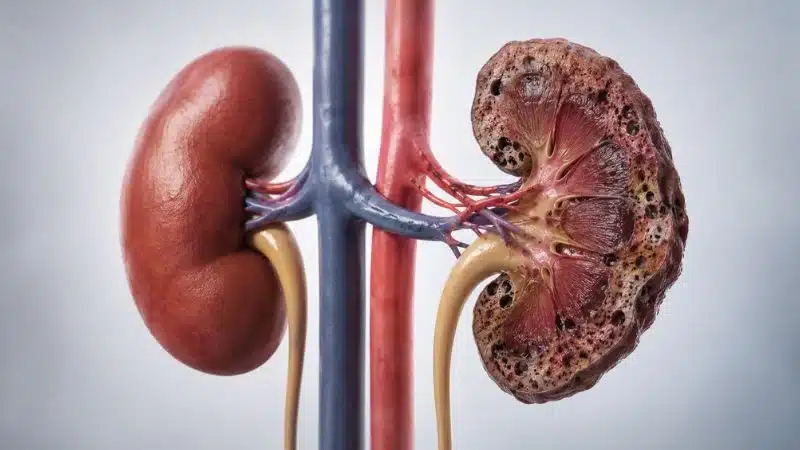
Every minute, your kidneys filter about 1.3 liters of blood.
They work without rest, balancing fluids, clearing waste, regulating electrolytes, controlling blood pressure, and keeping every organ in your body functioning within safe limits.
Now imagine that system crashing, not over years, but within hours.
That is exactly what happens in acute kidney injury (AKI). It is sudden. It is serious. And without the right response, it can be fatal.
AKI is not a rare or distant diagnosis. It affects 1 in 5 hospitalized patients worldwide. In ICU settings, that number climbs to nearly 1 in 2. In India, it is one of the leading causes of preventable in-hospital deaths, yet it remains poorly understood outside medical circles.
The critical reality is this: AKI is often reversible when caught and treated early. The kidneys have a remarkable capacity to heal. But every hour of delay narrows that window.
Acute Kidney Injury (AKI) is a sudden, rapid deterioration of kidney function that develops over hours to days, causing a dangerous accumulation of waste products, fluid imbalance, and electrolyte disturbances in the body.
It was previously called acute renal failure (ARF), a term still used in clinical settings.
The kidneys lose their ability to:
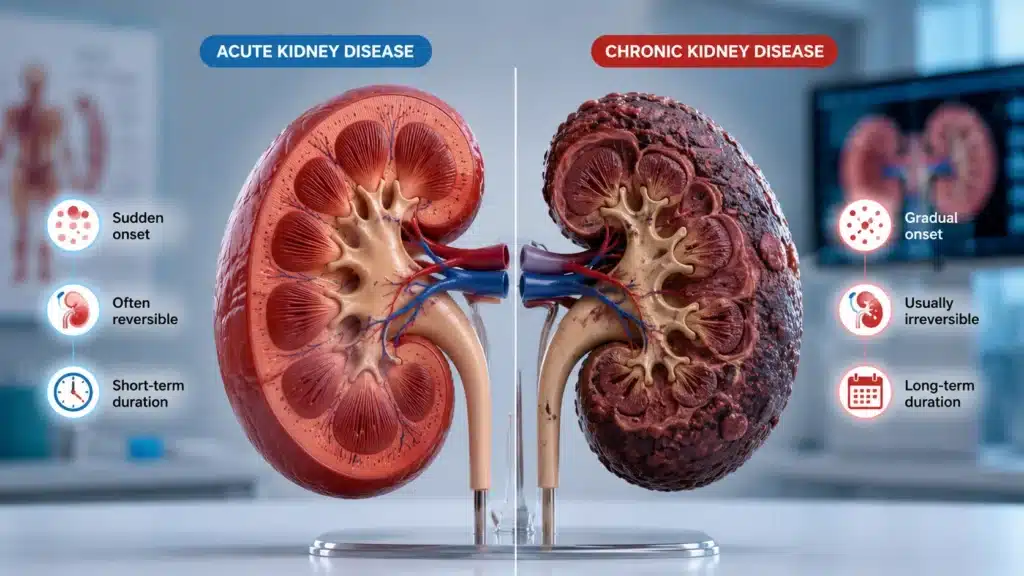
The difference between acute kidney disease and chronic kidney disease (CKD) is speed. CKD develops silently over months and years. AKI strikes fast and demands an equally fast response.
AKI is classified based on where the problem originates, before the kidney, within the kidney, or after the kidney.
The kidney itself is structurally intact. The problem is insufficient blood flow reaching the kidneys.
When blood pressure drops or blood volume falls, the kidneys receive less blood to filter and respond by reducing urine output to conserve fluid. This is initially a protective mechanism, but if the low blood flow persists, the kidney tissue itself begins to die.
Common causes:
Prerenal AKI is the most common type and the most reversible when treated promptly.
Here the kidney tissue itself is directly damaged, at the level of the tubules, glomeruli, interstitium, or blood vessels.
Common causes:
The kidney produces urine normally, but urine cannot flow out due to an obstruction. Backed-up pressure eventually damages the kidney. Post-renal AKI is often the most rapidly reversible; once the obstruction is relieved, kidney function can recover quickly.
Common causes:
|
AKI Type |
Origin of Problem |
Common Causes |
Reversibility |
| Pre-Renal | Reduced blood flow to kidneys | Dehydration, shock, heart failure, blood loss | Highly reversible with early fluid resuscitation |
| Intrinsic Renal | Direct kidney tissue damage | ATN, glomerulonephritis, nephrotoxins, vasculitis | Variable, depends on cause and severity |
| Post-Renal | Obstruction of urine outflow | Kidney stones, BPH, tumours, strictures | Rapidly reversible once obstruction is relieved |
AKI does not discriminate, but certain people face a significantly higher risk.
The most dangerous thing about early AKI is that it can feel like nothing at all.
Rule of thumb for families: If someone who was recently ill, had surgery, or lost significant fluids is suddenly making very little urine and seems confused, treat it as an emergency. Do not wait.
|
AKI Stage |
Serum Creatinine |
Urine Output |
Severity |
| Stage 1 | Rises 1.5–1.9x baseline in 7 days OR ≥0.3 mg/dL rise in 48 hrs | <0.5 mL/kg/hr for 6–12 hrs | Mild |
| Stage 2 | Rises 2.0–2.9x baseline | <0.5 mL/kg/hr for ≥12 hrs | Moderate |
| Stage 3 | Rises ≥3x baseline OR ≥4.0 mg/dL OR requires dialysis | <0.3 mL/kg/hr for ≥24 hrs OR anuria for 12 hrs | Severe |
Source: https://kdigo.org/wp-content/uploads/2016/10/KDIGO-2012-AKI-Guideline-English.pdf
|
Test |
What it checks |
Why it matters in AKI |
| Serum Creatinine | Waste product in blood | The primary marker rises rapidly in AKI |
| Blood Urea Nitrogen | Another waste product | Confirms kidney filtration failure |
| eGFR | Estimated kidney filtration rate | Quantifies how much function remains |
| Serum Electrolytes | Sodium, Potassium, Bicarbonate | High potassium (hyperkalemia) is life-threatening |
| Complete Blood Count (CBC) | Infection, anaemia | Identifies sepsis or blood loss as a cause |
| Urine Routine & Microscopy | Protein, blood, casts in urine | Distinguishes pre-renal from intra-renal AKI |
| Urine Sodium & Creatinine | Kidney’s response to stress | Key to identifying pre-renal vs intrinsic AKI |
| Renal Ultrasound | Kidney size, blockage, stones | Rules out post-renal (obstructive) cause |
| Chest X-Ray | Fluid in lungs | Detects pulmonary edema, fluid overload |
| ECG | Heart rhythm | Critical, high potassium can cause cardiac arrest |
| Serum Albumin | Protein levels | Low albumin affects fluid balance and prognosis |
| Kidney Biopsy | Tissue-level examination | Used in complex or unclear cases |
| Blood Cultures | Identifies bacteria in blood | Confirms sepsis as the trigger |
|
Finding in urine |
What it suggests |
| Dark yellow, concentrated urine | Pre-renal AKI, dehydration |
| Protein in urine | Intra-renal damage, glomerulonephritis |
| Blood (red cells) in urine | Kidney inflammation or stone |
| Muddy brown granular casts | Acute tubular necrosis, direct kidney damage |
| White cell casts | Infection: pyelonephritis |
| Very dilute urine despite injury | Tubular damage: kidneys cannot concentrate |
| Almost no urine output | Severe AKI, Stage 3 emergency |
AKI treatment depends entirely on the stage, type, and underlying cause. The faster treatment begins, the greater the chance of full recovery.
This is the most important step. Every AKI has a trigger, and removing that trigger is the foundation of treatment.
Hyperkalemia (high potassium): Most dangerous complication
|
Potassium Level |
Treatment |
| Mildly elevated | Dietary restriction, potassium binders (Patiromer, Sodium Zirconium) |
| Moderately elevated | Calcium Gluconate (protects heart) + Insulin + Dextrose |
| Severely elevated | Emergency dialysis |
Metabolic acidosis (blood becomes too acidic)
Fluid overload / pulmonary edema (fluid in lungs)
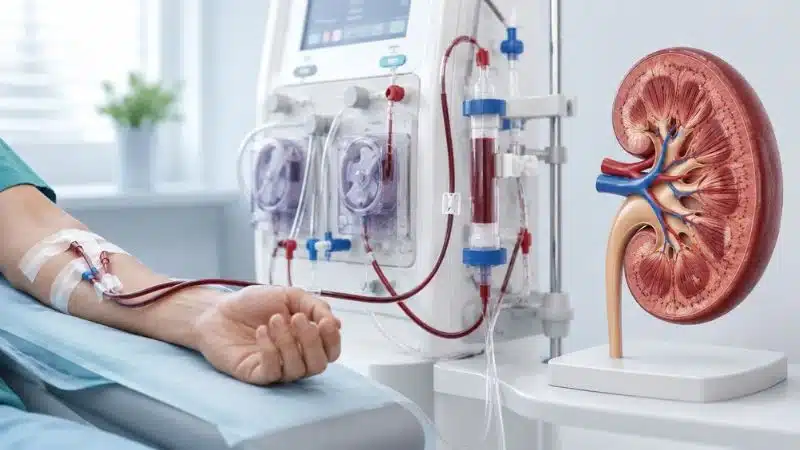
When kidneys cannot sustain life, dialysis becomes necessary. In AKI, dialysis is often temporary; kidneys may recover.
Indications for Emergency Dialysis (AEIOU):
|
Dialysis type |
How it works |
Best for |
| Intermittent Hemodialysis (IHD) | Blood filtered through machine 3–4 hrs/session | Stable AKI patients |
| Continuous Renal Replacement Therapy (CRRT) | Slow, continuous blood filtration 24 hrs/day | Critically ill, ICU patients with unstable BP |
| Peritoneal Dialysis (PD) | Fluid in abdomen filters waste | Children, limited vascular access, resource-limited settings |
Good news for families: In AKI, dialysis is frequently temporary. As the underlying cause is treated and kidneys heal, many patients successfully come off dialysis.
When AKI fails to recover, either partially or completely, and progresses to end-stage renal disease (ESRD), kidney transplantation becomes the definitive long-term treatment.
Kidney transplant offers the following:
Patients are evaluated carefully, medically, surgically, and psychosocially before being listed for transplant.
|
Parameter |
Acute Kidney Injury (AKI) |
Chronic Kidney Disease (CKD) |
| Onset | Hours to days | Months to years |
| Duration | Days to weeks | Permanent, lifelong |
| Reversibility | Often fully reversible | Generally irreversible |
| Kidney size on ultrasound | Normal or enlarged | Small, shrunken kidneys |
| Creatinine trend | Rapid rise | Slow, gradual rise |
| Anaemia | Mild, acute | Severe, chronic (low EPO) |
| Bone disease | Absent | Common (renal osteodystrophy) |
| Relationship | Acute kidney injury can trigger or accelerate CKD | CKD increases risk of AKI |
|
Complication |
How AKI causes it |
Severity |
| Cardiac arrest | Hyperkalaemia disrupts heart rhythm | Life-threatening |
| Pulmonary oedema | Fluid overload floods the lungs | Life-threatening |
| Metabolic acidosis | Acid accumulation, respiratory failure | Critical |
| Uraemic encephalopathy | Brain toxicity from urea, confusion, coma | Severe |
| Uraemic pericarditis | Urea inflames the sac around the heart | Serious |
| Haemorrhage | Platelet dysfunction from uraemia | Significant |
| Sepsis | Immune system collapse in AKI | Life-threatening |
| Permanent CKD | Unresolved AKI scars kidney tissue | Long-term disability |
| End-Stage Renal Disease (ESRD) | Kidney function never returns | Permanent dialysis or transplant needed |
| Multi-organ failure | AKI triggers cascading organ dysfunction | Very high mortality |
Yes, in many cases, particularly Stage 1 and Stage 2 acute kidney injury.
If the underlying cause is identified and treated quickly, kidneys often recover without needing dialysis:
Dialysis becomes necessary only when:
Recovery from AKI is possible, and often complete, especially when treated early.
|
Acute kidney injury stage |
Typical recovery time |
Expected Outcome |
| Stage 1 (Mild) | Days to 1–2 weeks | Full recovery in most cases |
| Stage 2 (Moderate) | 2–4 weeks | Good recovery; monitor kidney function |
| Stage 3 (Severe) | Weeks to months | Partial recovery; risk of residual CKD |
| Acute kidney injury on pre-existing CKD | Variable | Higher risk of permanent damage |
| Acute kidney injury requiring prolonged dialysis | 6–12 weeks | Some patients develop permanent CKD |
Starting AKI treatment within the first 24–48 hours changes everything:
Yes. When diagnosed early and the underlying cause is treated effectively, most patients recover complete or near-complete kidney function. The key is speed, early treatment dramatically improves outcomes.
Mild AKI may resolve in days to 2 weeks. Moderate to severe AKI can take 4–12 weeks or longer. Recovery depends on the stage, cause, age, and pre-existing kidney function. Some patients have partial residual impairment.
Not usually. Most patients who need dialysis during AKI can eventually come off dialysis once the kidneys recover. Dialysis in AKI is a bridge, buying time for the kidneys to heal. Only those whose kidneys fail to recover will need long-term dialysis.
They refer to the same condition. “Acute kidney failure” is the older term; “acute kidney injury” is the current preferred terminology, reflecting that even milder kidney impairment, not just complete failure, causes significant harm.
NSAIDs, aminoglycoside antibiotics, ACE inhibitors and ARBs in dehydrated or CKD patients, iodinated contrast agents, and certain chemotherapy drugs.
Yes. Severe dehydration, from prolonged vomiting, diarrhea, inadequate intake, or heat stroke, reduces kidney blood flow significantly and is one of the most common causes of pre-renal AKI, especially in elderly patients.
Not always. Many patients fully recover. However, severe AKI, recurrent AKI episodes, or AKI in patients with pre-existing CKD significantly increases the long-term risk of developing or worsening CKD. All acute kidney injury survivors need follow-up kidney function testing at 3 months after discharge.
Yes. Children can develop AKI from severe diarrheal illness, hemolytic uremic syndrome (HUS), urinary tract infections, congenital abnormalities, or post-cardiac surgery. Pediatric AKI is managed with the same principles but adapted dosing and dialysis modalities.
Restrict potassium-rich foods (bananas, oranges, potatoes, tomatoes), phosphate-rich foods (dairy, nuts, cola drinks), and sodium. Adequate protein is important but should be calibrated to kidney function and dialysis status. A renal dietitian should guide the specific plan.
All patients should have blood tests (creatinine, eGFR, electrolytes, urine protein) at 3 months post-discharge. Patients with residual impairment should be followed by a nephrologist at 6 and 12 months. Long-term BP control, diabetes management, and avoidance of nephrotoxins are essential.
Acute kidney injury is not just a complication. It is a warning signal, one that your body sends when something has gone seriously wrong.
The kidneys are resilient. Given the right treatment, in time, they can heal from even severe injury. But that window of recovery depends entirely on how quickly the right diagnosis is made and the right treatment is started.
Acute kidney injury is now understood to be a major driver of long-term kidney disease, cardiovascular risk, and premature death, not just an acute episode that ends at hospital discharge. This makes expert management not just about surviving the immediate crisis but about protecting kidney health for the decades ahead.
Modern nephrology offers powerful tools, from CRRT and plasmapheresis to targeted immunosuppression and advanced surgical interventions. But none of these tools work if the patient arrives too late.
Recognize the signs. Seek care early. Trust the process of recovery.
Your kidneys gave you everything silently, tirelessly, and invisibly. They deserve the same commitment in return.

Most people don’t wake up one morning and suddenly develop kidney disease. It usually happens slowly. Quietly.
Every summer, hospitals across India see a noticeable rise in kidney stone cases. While many people blame food habits alone, one of the biggest reasons is actually the weather itself.
Many people use the terms “kidney stone” and “ureter stone” interchangeably, but they are not exactly the same.
Kidney stones are becoming increasingly common, especially among young adults in India. While many people believe kidney stones happen only because of “not drinking enough water.”
Over the last decade, Noida has transformed from a fast-growing IT and residential city into one of India’s most promising healthcare destinations.
No rows found.