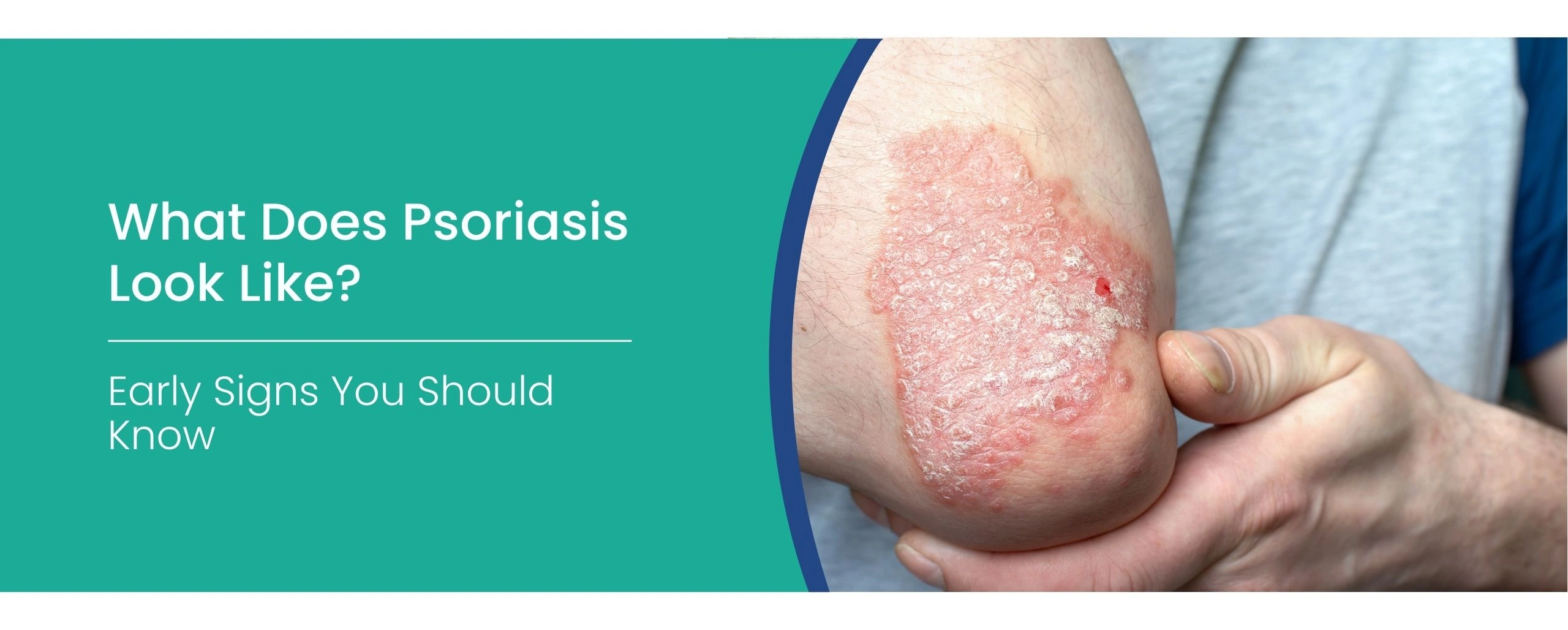
Not every itchy or dry patch of skin is psoriasis. But if you notice raised, scaly, itchy or discoloured patches that keep coming back, it may be worth getting your skin checked.
So, what does psoriasis look like?
Psoriasis can look different from person to person. The most common form, called plaque psoriasis, usually appears as raised patches of skin covered with dry, thick scales. Depending on your skin tone, these patches may look red or pink, or they may appear purple, brown or darker, with grayish or silvery scaling.
Psoriasis can affect the elbows, knees, scalp and lower back, but it can develop almost anywhere on the body. It may also affect the nails and, in some people, the joints.
Recognising the early signs of psoriasis can help you seek the right medical advice instead of repeatedly treating the rash as simple dryness, dandruff or an allergy.
What Does Psoriasis Look Like?
Psoriasis is a chronic inflammatory skin condition associated with an overactive immune response. This causes skin cells to develop and move to the surface much faster than usual, leading to a buildup of skin cells and the formation of visible patches or plaques.
The appearance of psoriasis can vary depending on its type and your skin tone.
Common psoriasis skin symptoms include:
- Raised or thickened patches of skin
- Dry, flaky or scaly skin
- Itching, burning or soreness
- Cracks that may sometimes bleed
- Discoloured patches
- Recurrent flare-ups
- Nail changes in some people
On lighter skin, psoriasis may appear pink or red with white or silvery scales. On darker skin, the patches may appear purple, brown, dark gray or violet, often with grayish scaling.
This difference matters because psoriasis can sometimes be harder to recognise when there is less visible redness.
What Are the Early Signs of Psoriasis?
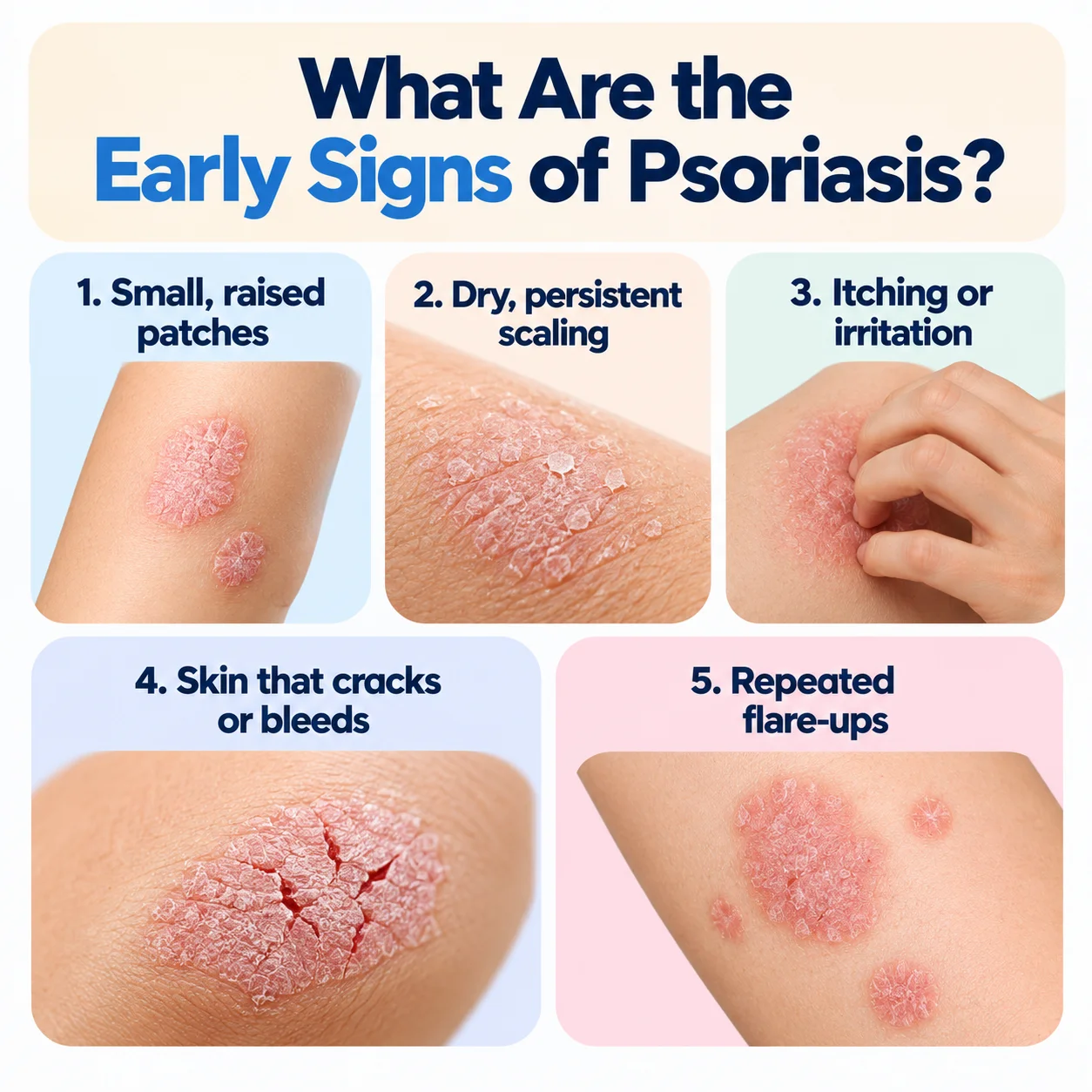
Psoriasis doesn’t always begin as a large, obvious patch.
In some people, the early signs may start as small bumps or spots that gradually become thicker and develop scaling. As the condition progresses, these areas can grow and join together to form larger plaques.
Watch for skin changes such as:
1. Small, raised patches
An early psoriasis rash may appear as small raised areas of skin. Over time, these areas may become thicker and more noticeable.
2. Dry, persistent scaling
Unlike ordinary dry skin that may improve with regular moisturising, psoriasis can produce persistent scaling that repeatedly returns.
3. Itching or irritation
Psoriasis patches may itch, burn, sting or feel sore. The intensity can vary from mild irritation to significant discomfort.
4. Skin that cracks or bleeds
Thicker or very dry plaques can develop cracks. Scratching may further damage the skin and sometimes cause bleeding.
5. Repeated flare-ups
Psoriasis often follows a cycle. Symptoms may become more noticeable for a period and then improve before returning later.
If a skin rash keeps coming back despite home care, it is worth discussing it with a dermatologist.
Where Does Psoriasis Usually Appear?
Psoriasis can develop almost anywhere, but certain areas are affected more commonly.
Elbows and knees
Plaque psoriasis commonly affects the outer surfaces of the elbows and knees. The patches may become thick, raised and scaly.
Scalp
Scalp psoriasis can look similar to severe dandruff. It may cause thick, scaly patches, itching and flaking. In some cases, the scaling can extend beyond the hairline or affect the area behind the ears.
Lower back and trunk
Psoriasis may also appear on the lower back, abdomen or other parts of the trunk.
Hands and feet
Some forms of psoriasis can affect the palms and soles, where the skin may become thick, cracked or painful.
Skin folds
Inverse psoriasis tends to affect areas such as the groin, buttocks and under the breasts. Instead of the typical thick scaling seen in plaque psoriasis, it can cause smoother, inflamed patches in skin folds.
Nails
Psoriasis isn’t limited to the skin. It can also affect fingernails and toenails.
Possible nail changes include:
- Small pits in the nails
- Discolouration
- Abnormal nail growth
- Nail thickening
- Separation of the nail from the nail bed
- Crumbling in more severe cases
If you notice unexplained nail changes along with persistent skin patches, mention both symptoms during your dermatology consultation.
What Are the Different Types of Psoriasis?
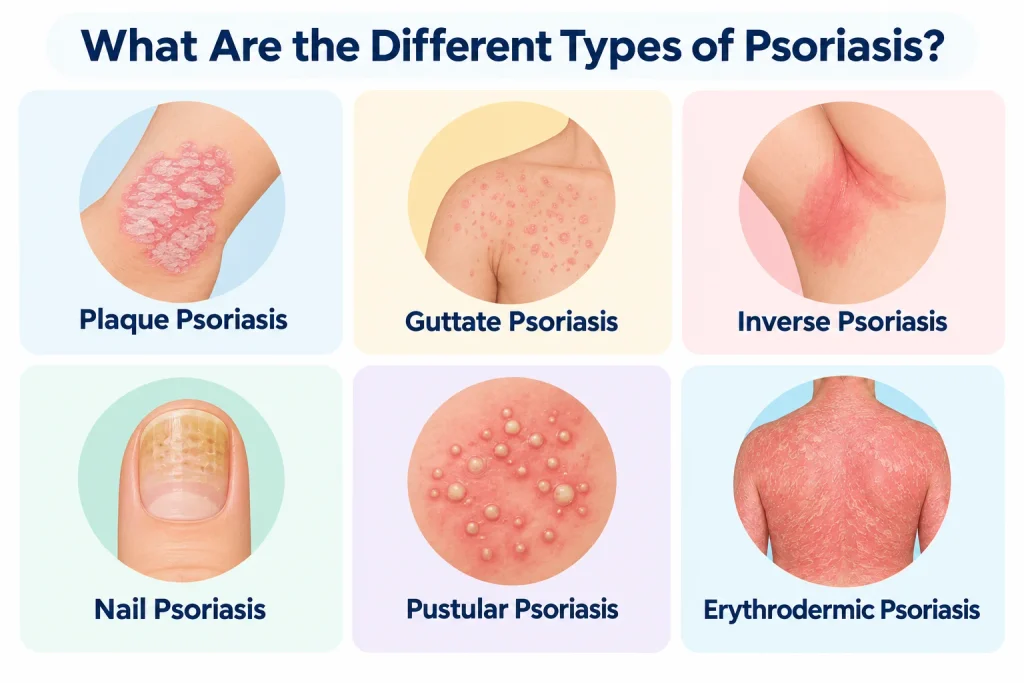
Not all psoriasis looks the same. There are several types, and recognising the pattern can help a dermatologist determine the most appropriate diagnosis and treatment.
Plaque Psoriasis
This is the most common type of psoriasis.
It usually causes raised, thick and scaly plaques on areas such as the elbows, knees, scalp and lower back.
Guttate Psoriasis
Guttate psoriasis appears as multiple small, drop-shaped spots. It is more commonly seen in children and young adults and may occur after certain infections, including streptococcal throat infection.
Inverse Psoriasis
This type affects skin folds and may cause smooth, inflamed patches rather than thick scales. Common locations include the groin, buttocks and under the breasts.
Nail Psoriasis
Nail psoriasis can cause pitting, discolouration, thickening or separation of the nail from the nail bed.
Pustular Psoriasis
This less common form can cause pus-filled blisters surrounded by inflamed skin. It may affect areas such as the palms and soles or occur over larger areas of the body.
Erythrodermic Psoriasis
This is an uncommon but potentially serious form that can cause widespread peeling, intense itching or burning and extensive skin involvement. It requires prompt medical attention.
Psoriasis vs Dry Skin: What’s the Difference?
Dry skin and psoriasis can look similar, especially in the beginning.
However, there are some clues that may help you recognise when a skin problem needs professional evaluation.
This comparison is only a general guide. Several skin conditions can resemble psoriasis, so appearance alone may not always be enough to make a diagnosis.
| Dry Skin | Psoriasis |
| Usually causes general dryness or fine scaling | Often causes defined, raised or thick patches |
| May improve with moisturising | Often persists or returns despite basic moisturising |
| Usually linked to weather, bathing habits or skin dryness | Associated with an inflammatory immune response |
| May affect many areas evenly | Often affects characteristic areas such as elbows, knees or scalp |
| Usually does not cause thick plaques | Can cause thick, scaly plaques |
Psoriasis vs Eczema: Can You Tell the Difference?
Psoriasis and eczema can both cause itching, irritation and changes in skin colour, which can make them difficult to distinguish without a professional examination.
Psoriasis often produces well-defined, raised, thicker plaques with visible scaling, while eczema commonly causes intensely itchy, inflamed and irritated skin. However, the appearance can vary considerably between people and skin tones.
If you have been treating a recurring rash as eczema or an allergy but it continues to return, consider seeing a dermatologist for an accurate diagnosis.
Is Psoriasis Contagious?
No. Psoriasis is not contagious.
You cannot catch psoriasis by touching someone who has it, sharing a swimming pool or being in close physical contact with someone with psoriasis. It is associated with an abnormal immune response rather than an infection that spreads from one person to another.
This is important because visible skin changes can sometimes lead to unnecessary stigma or avoidance.
What Can Trigger a Psoriasis Flare-Up?
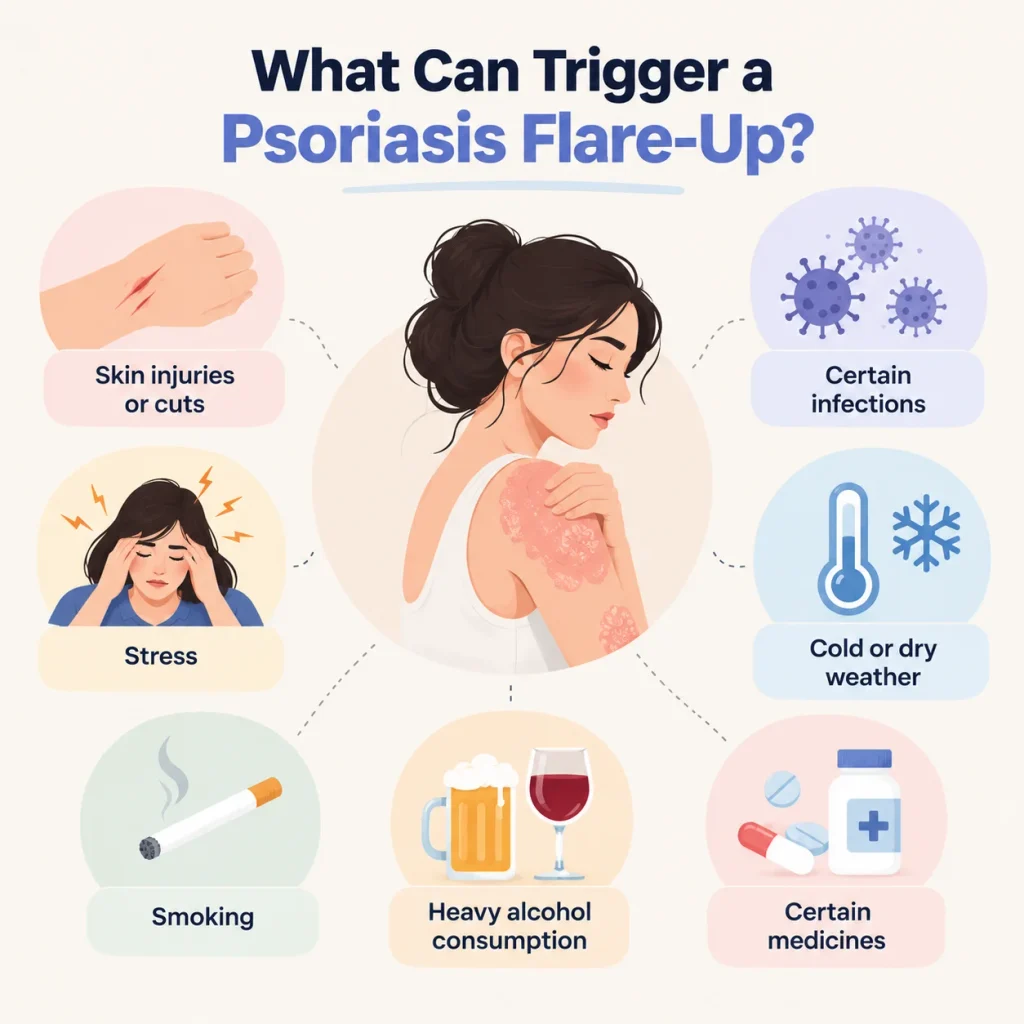
Psoriasis may remain quiet for periods and then become active again.
Potential triggers can include:
- Skin injuries or cuts
- Certain infections
- Stress
- Cold or dry weather
- Smoking
- Heavy alcohol consumption
- Certain medicines
Not every trigger affects every person, and sometimes a flare-up occurs without an obvious cause.
Keeping track of when your symptoms worsen may help you and your dermatologist identify possible patterns.
When Should You See a Dermatologist?
You don’t need to wait until a rash becomes severe before getting it checked.
Consider seeing a dermatologist if:
- A rash keeps returning
- You develop thick or scaly skin patches
- Itching is affecting your sleep or daily activities
- Your skin cracks or bleeds
- You develop unexplained nail changes
- Over-the-counter products are not improving the problem
- The rash is spreading or becoming more uncomfortable
- You develop joint pain or stiffness along with skin symptoms
Early evaluation can help determine whether the skin changes are psoriasis or another condition that may look similar.
If you are looking for a dermatologist in Noida, a specialist can examine your skin, scalp and nails and recommend appropriate evaluation based on your symptoms.
How Is Psoriasis Diagnosed?
There is no single blood test that confirms every case of psoriasis. In some situations, a small skin sample may be examined to help rule out other skin conditions.
The goal is not simply to identify the rash but to understand its pattern and severity so that an appropriate management plan can be considered.
A dermatologist generally begins with a detailed examination of the affected skin, scalp and nails. Your doctor may also ask about:
- How long you have had the rash
- Whether it comes and goes
- Whether anyone in your family has psoriasis
- Previous skin problems
- Recent infections
- Medicines you take
- Joint pain or stiffness
Can Psoriasis Be Treated?
Yes. While psoriasis is a chronic condition and currently has no cure, treatment can help control symptoms, reduce flare-ups and improve quality of life.
Treatment depends on factors such as:
- Type of psoriasis
- Location of the patches
- Severity
- Extent of skin involvement
- Symptoms
- Previous treatment
- Other health conditions
Depending on the individual case, a dermatologist may consider topical treatments, phototherapy or systemic medicines.
It is important not to start prescription creams or other psoriasis medicines without medical guidance, especially when the diagnosis has not yet been confirmed.
If you are considering psoriasis treatment in Noida, a dermatology consultation can help determine which treatment approach is appropriate for your condition.
Can Psoriasis Affect More Than the Skin?
For some people, psoriasis is associated with problems beyond visible skin patches.
One important condition to be aware of is psoriatic arthritis, which can cause joint pain, stiffness and swelling.
If you have psoriasis and notice persistent joint symptoms, tell your doctor rather than assuming they are unrelated.
This is one reason why recurring skin symptoms should not simply be ignored.
Frequently Asked Questions (FAQs)
What does psoriasis look like in the beginning?
Early psoriasis may appear as small raised or discoloured patches that gradually become thicker and develop scales. The appearance varies depending on the type of psoriasis and the person’s skin tone.
What is the most common appearance of psoriasis?
Plaque psoriasis is the most common type. It usually appears as raised, thick patches covered with dry scales, often affecting the elbows, knees, scalp or lower back.
Can psoriasis look like dry skin?
Yes. Mild psoriasis can sometimes be mistaken for ordinary dry or flaky skin. Persistent, recurring or clearly defined scaly patches should be evaluated by a dermatologist rather than repeatedly self-treated.
Can psoriasis look different on darker skin?
Yes. Psoriasis may be less visibly red on darker skin and can appear purple, brown, dark gray or violet, often with grayish scaling. Changes in skin pigmentation may also remain after a flare improves.
Is psoriasis contagious?
No. Psoriasis is not contagious and cannot be spread through physical contact.
Can psoriasis affect the nails?
Yes. Nail psoriasis can cause pitting, discolouration, thickening, abnormal growth or separation of the nail from the nail bed.
Conclusion
Psoriasis doesn’t always look the same.
It may appear as raised, thick, scaly patches, small drop-shaped spots, inflamed areas in skin folds or changes in the nails. Its colour can also vary significantly depending on your skin tone.
The important thing is to pay attention to persistent, recurring or changing skin patches rather than assuming every rash is simply dry skin or an allergy.
If you notice symptoms that concern you, getting an accurate diagnosis is the first step. A dermatologist can examine the affected skin and recommend the right approach based on your condition.
For patients looking for dermatology care in Noida, Rama Hospital Noida provides access to specialist-led healthcare for a range of skin concerns.