A brain tumor is one of the most serious neurological conditions because it can affect how the brain works in many different ways. Some brain tumors are benign and grow slowly, while others are malignant and grow more aggressively. Even a benign tumor can become dangerous if it presses on important parts of the brain, blocks the flow of fluid, increases pressure inside the skull, or interferes with speech, movement, memory, vision, or seizures.
Many people think the word “tumor” always means cancer, but that is not always true. A brain tumor may be non-cancerous, yet still require careful medical attention and sometimes surgery. On the other hand, a malignant brain tumor may need urgent treatment because it can grow quickly and affect nearby brain tissue. The symptoms depend on the tumor’s size, location, growth pattern, and type.
What is a Brain Tumor?
A brain tumor is an abnormal growth of cells in or around the brain. These cells multiply in a way that is not normal and form a mass. Depending on where it begins, a brain tumor may develop in brain tissue, membranes around the brain, nerves, blood vessels, pituitary gland, pineal gland, or skull base structures.
Brain tumors are usually divided into two major groups:
- Benign brain tumors, which are non-cancerous and usually grow slowly.
- Malignant brain tumors, which are cancerous and tend to grow more aggressively.
However, in both cases, the tumor can still cause significant problems because the brain is enclosed inside the skull. There is very little extra space. Even a small mass can cause pressure, swelling, or disruption of important functions.
Some tumors start in the brain itself. These are called primary brain tumors. Others spread to the brain from another part of the body, such as the lungs, breast, kidney, or skin. These are called secondary tumors or brain metastases.
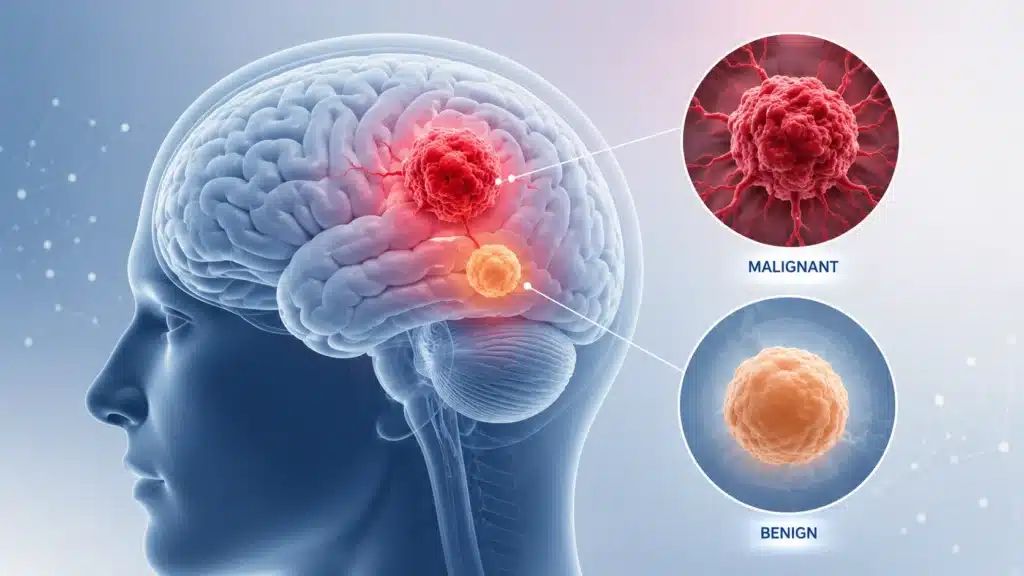
Benign vs Malignant Brain Tumors
Understanding the difference between benign and malignant brain tumors is important because patients often hear both terms and assume one is always harmless and the other always fatal. The reality is more complex.
Benign brain tumors
- They are not cancerous.
- They usually grow slowly.
- They often have well-defined borders.
- They do not usually spread to other parts of the body.
- They can still be dangerous if they press on nerves, blood vessels, or vital brain areas.
- They may cause headaches, seizures, vision changes, weakness, or hormonal problems depending on location.
- Some benign tumors can come back after surgery if they are not completely removed.
Malignant brain tumors
- They are cancerous.
- They usually grow faster than benign tumors.
- They may invade nearby brain tissue.
- They can cause more rapid neurological decline.
- They are more likely to recur after treatment.
- They often require surgery, radiation, and sometimes chemotherapy or other systemic treatment.
- Their treatment is more intensive and closely monitored.
Important point: A benign tumor does not always mean “safe,” and a malignant tumor does not always mean immediate death. The location of the tumor, the speed of growth, and whether it affects important functions often matter as much as the label itself.
Types of Brain Tumors
Brain tumors can be classified in different ways depending on the cell type, location, and biological behavior.
By origin
- Primary brain tumors, which begin in the brain or surrounding structures.
- Secondary brain tumors, which are cancers that have spread from elsewhere in the body.
By behavior
- Benign tumors, which are non-cancerous.
- Malignant tumors, which are cancerous and more aggressive.
By common cell type or structure involved
- Gliomas, which arise from glial cells that support the brain.
- Meningiomas, which arise from the membranes covering the brain and spinal cord.
- Pituitary adenomas, which arise from the pituitary gland.
- Vestibular schwannomas, which affect the nerve for hearing and balance.
- Craniopharyngiomas, which develop near the pituitary region.
- Pineal region tumors, which arise deep in the brain.
- Primary CNS lymphomas, which are malignant tumors involving immune cells.
- Brain metastases, which are secondary tumors from another cancer.
Common examples of benign tumors
- Meningioma.
- Pituitary adenoma.
- Vestibular schwannoma.
- Craniopharyngioma, which may behave in a locally aggressive way despite being non-cancerous.
- Low-grade some tumors that grow slowly and remain localized.
Common examples of malignant tumors
- Glioblastoma.
- Anaplastic astrocytoma.
- Oligodendroglioma in some cases.
- Medulloblastoma.
- Primary CNS lymphoma.
- Metastatic brain tumors.
Causes of Brain Tumors
In many cases, the exact cause of a brain tumor is not known. Most brain tumors develop because of changes in cell growth and gene behavior. Some risk factors are known, but many patients develop tumors without a clear reason.
Possible causes and contributing factors
- Genetic mutations that lead to uncontrolled cell growth.
- Family history of certain brain tumors or hereditary cancer syndromes.
- Radiation exposure to the head.
- Spread of cancer from another part of the body.
- Certain inherited disorders.
- Long-term abnormal cell signaling.
- Environmental and unknown triggers in some cases.
What is usually not a direct cause
- Stress alone does not cause a brain tumor.
- Using mobile phones has not been proven to cause brain tumors.
- A headache by itself does not mean there is a brain tumor.
Many people worry about common lifestyle habits, but in most cases, brain tumors are not caused by anything the patient did wrong. The problem usually starts at the cell level and is not something that can be blamed on routine daily activity.
Risk Factors for Brain Tumors
Some people are more likely to develop brain tumors than others.
Higher-risk groups
- People with a family history of brain tumors.
- People with genetic syndromes such as neurofibromatosis, tuberous sclerosis, Li-Fraumeni syndrome, or von Hippel-Lindau syndrome.
- People who had head radiation earlier in life.
- Older adults, who are more likely to develop some tumors.
- People with a history of cancer elsewhere in the body.
- People with long-standing neurological symptoms that worsen over time.
Why risk can increase?
- Some inherited conditions affect how cells grow.
- Prior radiation may damage cell DNA.
- Existing cancer can spread to the brain.
- Age can increase the chance of abnormal cell changes.
- Family history may indicate a genetic susceptibility.
Symptoms of Brain Tumors
Symptoms depend on the size, location, and type of tumor. Some tumors cause no symptoms for a long time. Others lead to noticeable changes early.
Common general symptoms
- Headaches, especially if they are new, worsening, or different from usual.
- Nausea or vomiting, especially in the morning.
- Seizures, especially in a person with no seizure history.
- Tiredness or low energy.
- Confusion.
- Memory changes.
- Personality or behavior changes.
- Reduced concentration.
- Drowsiness.
Symptoms related to pressure in the brain
- Headache that is worse in the morning.
- Headache that wakes the patient from sleep.
- Vomiting without a clear stomach cause.
- Blurred vision.
- Double vision.
- Unsteady walking.
- Slower thinking.
- Reduced alertness.
Symptoms related to specific brain areas
- Weakness or numbness in one arm or leg.
- Trouble speaking or finding words.
- Difficulty understanding speech.
- Balance problems or dizziness.
- Hearing loss or ringing in the ear.
- Vision loss or field cuts.
- Facial numbness or weakness.
- Hormonal problems such as weight change, menstrual disturbance, or sexual dysfunction if the pituitary is affected.
Emergency warning signs
- Sudden seizure.
- Sudden collapse.
- Severe headache with vomiting.
- Weakness on one side of the body.
- Sudden speech trouble.
- Sudden vision loss.
- Unusual sleepiness or confusion.
Symptoms in Children
Brain tumors in children may look different from adults. Parents should watch for warning signs carefully.
Possible signs in children
- Repeated vomiting.
- Morning headache.
- Trouble walking or balance problems.
- Changes in school performance.
- Irritability.
- Enlarged head in infants due to increased pressure.
- Seizures.
- Eye movement problems.
- Developmental delay or regression.
How Brain Tumors Are Diagnosed?
Diagnosis usually involves a neurological exam and imaging studies. In many cases, MRI is the most important test.
Steps in diagnosis
- Detailed symptom history.
- Neurological examination.
- Review of headache pattern, seizures, weakness, vision changes, or speech problems.
- Brain imaging.
- Tissue diagnosis if needed.
Common diagnostic tests
- MRI brain with contrast, which gives detailed information about the tumor.
- CT scan, which may be used in emergencies or when bleeding is suspected.
- PET or other advanced scans in selected cases.
- Blood tests to check general health before treatment.
- Biopsy, if tissue confirmation is needed.
- Hormonal testing if the pituitary region is involved.
Why imaging is important
Imaging helps doctors understand:
- Where the tumor is.
- How big it is.
- Whether it has affected surrounding brain tissue.
- Whether it has caused swelling or blocked fluid flow.
- Whether it looks benign, malignant, or uncertain.
Why biopsy may be needed: A scan can suggest the type of tumor, but the final diagnosis often requires tissue examination under a microscope. This is especially important for malignant tumors and for planning treatment.
Treatment for Brain Tumors
Treatment depends on whether the tumor is benign or malignant, how fast it grows, where it is located, and whether the patient is having symptoms.
1. Observation and monitoring
Some small, slow-growing benign tumors may be watched closely with periodic scans.
- Used when the tumor is not causing symptoms.
- Helpful for tumors in difficult surgical locations.
- Requires regular follow-up to watch for growth or new symptoms.
2. Surgery
Surgery is often the first major treatment for many brain tumors.
- It may remove the whole tumor or as much as safely possible.
- It helps relieve pressure on the brain.
- It may provide tissue for diagnosis.
- It can improve symptoms if the tumor is causing mass effect.
3. Radiation therapy
Radiation uses targeted high-energy beams to destroy tumor cells or slow their growth.
- May be used after surgery.
- May be used when surgery is not possible.
- Can be useful for malignant tumors and some benign tumors.
- Treatment is planned carefully to protect healthy brain tissue.
4. Chemotherapy
Chemotherapy uses medicines to kill or control tumor cells.
- Often used for malignant tumors.
- Sometimes combined with radiation.
- Depends on tumor type and molecular features.
- May be given orally, intravenously, or in other specialized ways.
5. Targeted therapy and advanced treatments
Some tumors have specific molecular features that can be treated with targeted drugs.
- These treatments act on tumor biology.
- Not all tumors are eligible.
- Testing may be needed to find the best option.
6. Steroids and supportive medicines
Supportive treatment is very important.
- Steroids may reduce brain swelling.
- Anti-seizure medicines may prevent or control seizures.
- Pain management may be needed.
- Medicines for nausea may help.
- Hormone replacement may be needed in pituitary-related cases.
Surgery for Brain Tumors
Surgery is one of the most common and important treatments for brain tumors. The exact procedure depends on the tumor’s type and location.
Surgical options may include
- Craniotomy, where part of the skull is opened to remove the tumor.
- Minimally invasive surgery in selected cases.
- Stereotactic biopsy, where a small sample is taken with precision.
- Endoscopic surgery for certain deep or skull base tumors.
- Transsphenoidal surgery for pituitary tumors through the nose.
Goals of surgery
- Remove as much tumor as possible.
- Reduce pressure in the brain.
- Improve symptoms.
- Confirm diagnosis.
- Support other treatments like radiation or chemotherapy.
When surgery may be difficult
- Tumor is very close to critical brain areas.
- Tumor is deep or difficult to reach.
- Tumor has spread widely in the brain.
- Patient has other medical problems that increase surgical risk.
Treatment for Benign Brain Tumors
Benign tumors are often treated successfully, but they still need proper evaluation.
Treatment options for benign tumors
- Monitoring if the tumor is small and not causing symptoms.
- Surgery if the tumor is growing or causing pressure.
- Radiation in selected cases when surgery cannot fully remove the tumor.
- Long-term follow-up to check for recurrence.
Important point: A benign tumor can still be dangerous if it is near the optic nerve, brainstem, pituitary gland, or other essential structures. So treatment decisions depend not only on whether it is benign, but also on where it is and what it is doing.
Treatment for Malignant Brain Tumors
Malignant tumors usually require a more aggressive and coordinated treatment approach.
Treatment may include
- Surgery to remove as much tumor as possible.
- Radiation therapy after surgery.
- Chemotherapy based on tumor type.
- Targeted treatment if the tumor has specific markers.
- Supportive care for seizures, swelling, and neurological symptoms.
- Rehabilitation after treatment.
Why treatment is often combined: Malignant tumors may not be fully removable because they can invade nearby tissue. That is why treatment often combines surgery, radiation, and medicine to control the disease as much as possible.
Recovery After Brain Tumor Treatment
Recovery depends on the type of tumor, the treatment used, and how much the brain was affected before surgery or therapy.
Recovery after surgery
- Hospital stay for monitoring.
- Pain control.
- Observation for swelling, bleeding, or seizures.
- Gradual return to eating, walking, and daily activity.
- Follow-up scans.
Recovery after radiation or chemotherapy
- Fatigue is common.
- Hair loss may occur in some patients.
- Nausea may occur depending on treatment.
- Follow-up is needed to check tumor response.
Rehabilitation support
- Physical therapy for weakness or balance issues.
- Speech therapy for communication problems.
- Occupational therapy for daily functioning.
- Memory and cognitive support if needed.
- Emotional support for patient and family.
Possible Complications
Brain tumors can cause problems from both the tumor itself and the treatment.
Tumor-related complications
- Seizures.
- Increased pressure in the brain.
- Brain swelling.
- Weakness or paralysis.
- Vision loss.
- Speech problems.
- Memory changes.
- Loss of coordination.
- Hormonal imbalance if pituitary structures are involved.
Treatment-related complications
- Temporary weakness after surgery.
- Infection.
- Bleeding.
- Swelling.
- Nerve injury in some cases.
- Side effects from radiation or chemotherapy.
- Long-term fatigue or cognitive changes.
Why complications happen: The brain is a delicate organ with many vital centers. Even small changes in pressure, blood flow, or tissue damage can affect function. This is why careful planning and experienced specialist care are important.
When Should You See a Doctor?
Medical help should be sought when symptoms are persistent, progressive, or severe.
- Recurrent headaches that are worsening.
- Seizures without a known reason.
- Weakness or numbness on one side.
- Changes in speech or vision.
- Trouble with balance.
- Memory loss or confusion.
- Repeated vomiting without stomach illness.
- Personality or behavior change.
- Hormonal symptoms with headaches.
Brain Tumor Prevention
Not all brain tumors can be prevented because many causes are not known. However, some risk reduction is possible.
- Avoid unnecessary radiation exposure.
- Get regular check-ups if you have a family history.
- Manage other cancers properly to reduce the chance of spread.
- Do not ignore new neurological symptoms.
- Seek early review if headaches or seizures change pattern.
- Maintain overall health with balanced food, sleep, and medical follow-up.
Important note: There is no guaranteed way to prevent every brain tumor, especially those caused by genetics or unknown cellular changes. Early detection is the most practical way to improve outcomes.
Why Choose Rama Hospital for Brain Tumor Treatment?
Brain tumor care requires a team approach and advanced facilities. A hospital-based system helps patients move from diagnosis to treatment to recovery more safely.
- Expert neurosurgical and neurology evaluation.
- Advanced MRI and imaging.
- Skilled surgical planning.
- Radiation and medical oncology support when needed.
- Intensive care monitoring for complex cases.
- Rehabilitation and long-term follow-up.
Frequently Asked Questions (FAQs)
1. What is the difference between a benign and malignant brain tumor?
A benign brain tumor is non-cancerous and usually grows slowly, while a malignant brain tumor is cancerous and may grow faster or invade nearby tissue. Even benign tumors can be serious if they are in a critical brain area.
2. Are all brain tumors cancer?
No. Many brain tumors are benign and not cancer. However, they can still cause major problems because the brain is very sensitive to pressure and location of growth.
3. What is the most common symptom of a brain tumor?
Headache is common, but not every headache is due to a brain tumor. Other common symptoms include seizures, vomiting, weakness, vision changes, and memory or behavior changes.
4. How is a brain tumor diagnosed?
Diagnosis usually begins with a neurological examination and MRI or CT scan. In many cases, a biopsy or surgery is needed to confirm the exact tumor type.
5. Can brain tumors be treated?
Yes. Treatment may include surgery, radiation, chemotherapy, or observation depending on the tumor type and size. Many benign tumors are treatable, and even malignant tumors can often be managed.
6. Do benign brain tumors need surgery?
Not always. Some can be monitored if they are small and not causing symptoms. Surgery is considered when the tumor grows, causes pressure, or affects function.
7. Can a brain tumor come back after treatment?
Yes, some tumors can recur, especially malignant tumors or benign tumors that were not completely removed. That is why follow-up scans and specialist review are important.
8. When should I worry about headaches?
You should worry if headaches are new, worsening, frequent, associated with vomiting, seizures, vision changes, weakness, or confusion. These symptoms need medical evaluation.
Conclusion
Brain tumors, whether benign or malignant, are serious conditions that require careful medical evaluation and treatment. A benign tumor may grow slowly, but it can still cause major symptoms if it affects important areas of the brain. A malignant tumor is more aggressive and often needs combined treatment with surgery, radiation, and medicine.
The most important step is early recognition. Persistent headaches, seizures, weakness, vision changes, vomiting, balance problems, or memory changes should never be ignored. With timely diagnosis and specialist care, many patients can receive effective treatment, symptom relief, and better long-term outcomes.
Rama Hospital can provide advanced evaluation, neurosurgical treatment, and long-term support for brain tumor patients, with care tailored to each person’s condition and needs.