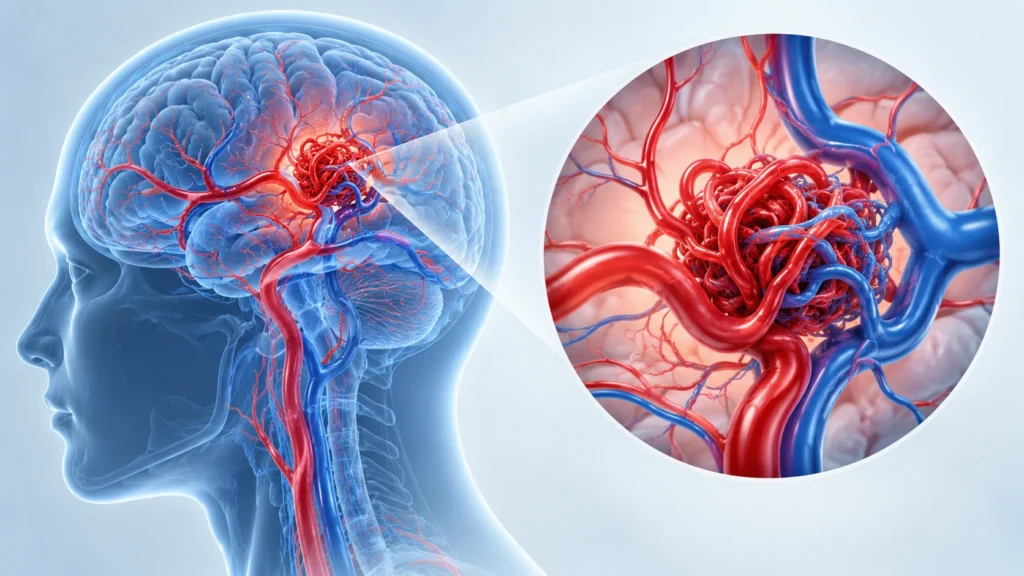
Arteriovenous Malformation, commonly called AVM, is a rare but serious condition that affects the blood vessels in the brain, spine, or other parts of the body. In a normal circulation system, blood flows from arteries to capillaries and then to veins. Capillaries are tiny vessels that slow down the blood flow and allow oxygen and nutrients to reach the tissues. In this, normal pathway is missing. Blood flows directly from arteries to veins without passing through capillaries.
This abnormal connection creates high pressure in the veins, which are not designed to handle such force. Over time, this can weaken the vessel walls and increase the risk of bleeding, seizures, headaches, or neurological problems. Some people are born with this, while others may develop it later in life. Many patients do not know they have this until it causes symptoms or is found during tests for another condition.
Arteriovenous Malformation is an abnormal tangle of blood vessels where arteries connect directly to veins without the normal capillary network. This creates a high-flow, high-pressure system that can affect nearby tissues and organs.
This can occur in different parts of the body, but the most common and clinically important locations are the brain and spinal cord. Brain AVMs are present from birth in most cases, although symptoms may appear later. Spinal arteriovenous malformation can affect movement, sensation, and bladder or bowel control depending on their location.
The main concern with this is the risk of rupture and bleeding. When bleeding happen, it can cause stroke-like symptoms, severe headache, weakness, or loss of consciousness. Not all arteriovenous malformation bleed, but the risk is significant enough to require careful evaluation and management.
This can be classified based on their location, structure, and whether they have caused bleeding.
Based on location
Based on structure
Based on clinical presentation
The exact cause of arteriovenous malformation is not fully understood. Most are believed to develop during fetal growth, before birth. They are not usually inherited, although rare genetic conditions can increase the risk.
Common factors and associations
Why AVM forms: During normal development, arteries and veins form a balanced network with capillaries in between. In this, process goes wrong, and direct connections form between arteries and veins. The high-pressure arterial blood flows into low-pressure veins, which can weaken them over time.
Most people with AVM have no clear risk factors. However, certain conditions and situations can increase the likelihood of complications.
Higher-risk groups
Why risk increases in these groups
Symptoms depend on the location, size, and whether the AVM has bled. Many people have no symptoms for years.
Symptoms of unruptured brain AVM
Symptoms of ruptured brain AVM
Symptoms of spinal AVM
Emergency warning signs
This can affect people of different ages, but the presentation may vary.
In children and young adults
In middle-aged adults
In older adults
Diagnosis is based on symptoms, neurological examination, and imaging tests. Since many people have no symptoms, there are sometimes found by chance during tests for other problems.
Diagnostic steps
Common tests that may be done
Why diagnosis matters: Early diagnosis of an unruptured lesion can help prevent rupture through monitoring or treatment. Ruptured AVM requires immediate emergency diagnosis and treatment to reduce brain or spinal cord damage and save life.
Treatment depends on whether the lesion is ruptured or unruptured, its size, location, and the patient’s overall health.
Treatment for unruptured AVM
1. Surgical removal
This is an open surgery where a neurosurgeon removes the lesion completely. This eliminates the risk of future bleeding from that AVM.
2. Endovascular embolization
This is a minimally invasive procedure where a thin tube is passed through a blood vessel in the leg or arm up to the brain or spine. Special materials are injected to block blood flow to the AVM.
3. Stereotactic radiosurgery
This is a non-invasive treatment where focused radiation is directed at the arteriovenous malformation. Over time, the blood vessels thicken and close off.
4. Supportive care
For patients with ruptured AVM, intensive care is often needed.
Recovery depends on whether the arteriovenous malformation was ruptured or unruptured, the type of treatment, and the patient’s overall health.
Recovery after treatment for unruptured AVM
Recovery after treatment for ruptured AVM
Rehabilitation support
This is, especially when ruptured, can lead to serious complications.
Complications of unruptured AVM
Complications of ruptured AVM
Why complications happen: When this ruptures, blood leaks into the space around the brain or spinal cord. This increases pressure, damages tissue, and reduces oxygen supply. The brain and spinal cord are very sensitive to bleeding and pressure changes, which is why complications can be severe.
Medical evaluation is important for people with risk factors or symptoms that suggest an AVM.
Most AVMs cannot be prevented because they are present from birth. However, complications can be reduced.
For people with family history
Arteriovenous Malformation is a complex condition that requires expert neurosurgical care, advanced imaging, and intensive support. A hospital with experienced neurosurgeons, neurologists, and critical care teams can make a major difference in outcomes.
No, this is not a tumor. It is a vascular malformation, meaning it involves blood vessels rather than abnormal tissue growth. However, it can press on brain structures and cause similar symptoms.
Many arteriovenous malformation can be treated effectively with surgery, embolization, or radiosurgery. Treatment aims to prevent bleeding and reduce symptoms. Complete cure depends on the size, location, and type of AVM.
Warning signs may include severe headache, seizures, weakness, vision changes, or difficulty speaking. Many people have no symptoms before rupture. Sudden severe headache is a common sign of a ruptured arteriovenous malformation.
Diagnosis is done using CT scan, MRI, CT angiography, MR angiography, or cerebral angiography. These tests help visualize the lesion and assess its size, location, and risk of bleeding.
Most AVMs are not inherited, but rare genetic conditions can increase the risk. People with a family history of vascular malformations may need screening and careful evaluation.
Treatment may include surgical removal, endovascular embolization, or stereotactic radiosurgery. Unruptured AVMs may be monitored or treated based on risk. Ruptured AVMs require emergency care and definitive treatment.
Many people recover well and return to normal life after treatment, especially if the arteriovenous malformation was unruptured. Recovery after rupture depends on the extent of damage and the complications.
Pregnancy increases blood volume and flow, which may affect AVM behavior. Women with known AVM should discuss risks and management with their doctors before and during pregnancy.
Recovery time varies. Some patients return to normal activities within weeks, while others may need months of rehabilitation. Follow-up imaging and medical care are important for long-term monitoring.
Arteriovenous Malformation is a serious but treatable condition that affects the blood vessels in the brain, spine, or other parts of the body. It can cause headaches, seizures, neurological problems, or life-threatening bleeding if it ruptures. The good news is that with modern diagnosis and treatment, many patients can be managed effectively and live full lives.
The most important steps are proper diagnosis, timely treatment, and long-term follow-up. For patients with persistent headaches, seizures, weakness, or other neurological symptoms, a medical evaluation can make a major difference. With expert care, patients can reduce risk, recover function, and protect their long-term health.
Rama Hospital can help evaluate Arteriovenous Malformation, identify individual risk factors, and provide a clear treatment plan that supports safe management, improved neurological function, and better overall health.
An arteriovenous malformation, also known as an AVM, is a tangle of blood vessels that creates irregular connections between arteries and veins.
No rows found.