
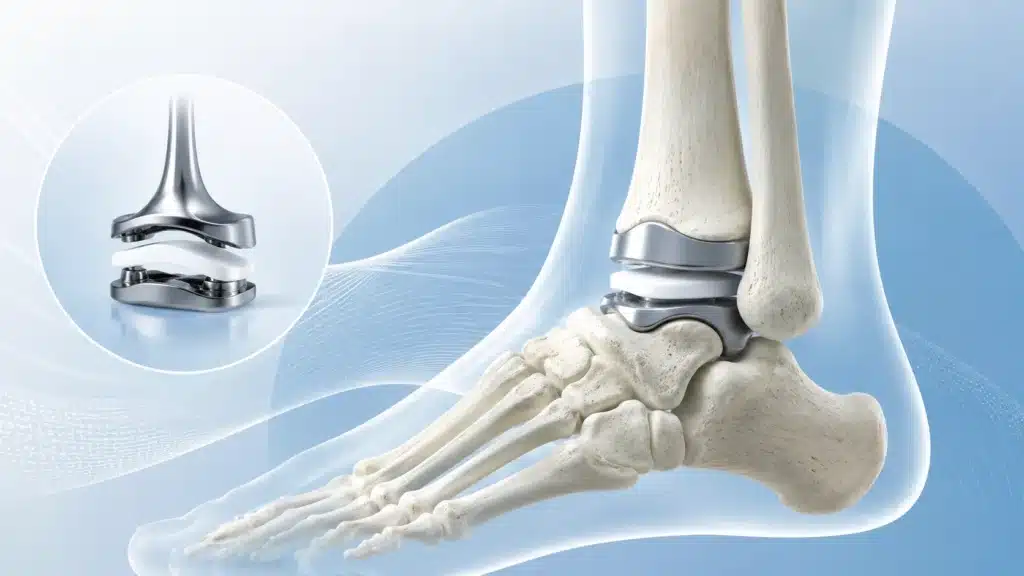
The ankle joint is one of the most important weight-bearing joints in the body. It supports walking, climbing stairs, balance, and daily movement. When this joint is damaged by arthritis, injury, or long-term wear and tear, the patient may develop pain, stiffness, swelling, and difficulty walking. Over time, even simple activities can become uncomfortable or limited.
Ankle replacement surgery is designed to relieve this pain by removing the damaged joint surfaces and replacing them with a prosthetic implant. Unlike ankle fusion, which removes movement at the joint, ankle replacement aims to preserve ankle motion while reducing pain. This makes it an important option for selected patients who want pain relief and improved function without losing flexibility.
Many patients search for this treatment because they are tired of chronic ankle pain, repeated swelling, morning stiffness, or difficulty standing and walking for long periods. Some have ankle arthritis after a previous injury, while others develop it because of degenerative joint disease, inflammatory conditions, or long-standing mechanical stress. A strong hospital-based ankle replacement page should answer these concerns clearly and guide the patient from symptoms to diagnosis, treatment, recovery, and long-term care.
Ankle replacement is a surgical procedure in which the damaged parts of the ankle joint are removed and replaced with an artificial implant. The goal is to reduce pain, restore smoother joint movement, and improve day-to-day mobility.
The ankle joint is made up of the tibia, fibula, and talus bones. When the cartilage between these bones wears down or becomes damaged, the bones rub against each other and cause pain and inflammation. An ankle replacement creates a new joint surface so the bones can move more smoothly again.
Ankle replacement is also called:
Ankle replacement is generally recommended for patients with advanced ankle arthritis or severe joint damage who have not improved with non-surgical treatment.
Not every patient with ankle pain is a candidate. The orthopedic team will decide whether ankle replacement is the right option based on bone quality, ligament stability, alignment, age, activity level, and the type of arthritis present.
You may need ankle replacement if you have:
Ankle replacement is used when the ankle joint has been damaged enough that everyday function is affected. The underlying cause matters because it helps the doctor decide whether ankle replacement is suitable and what additional procedures may be needed.
In many patients, ankle arthritis develops years after an injury. This is because the ankle joint may remain structurally vulnerable even after the original injury has healed.
Common causes of ankle joint damage include:
Patients often come to the hospital because the ankle is no longer just sore occasionally, it becomes a daily problem that affects movement and quality of life.
These symptoms may become more noticeable over time, especially when the patient is active, walks longer distances, or stands for work.
Common symptoms include:
Before recommending surgery, the orthopedic surgeon will confirm the diagnosis and study the joint carefully. The goal is to make sure ankle replacement is appropriate and likely to help.
Common diagnostic steps
|
Diagnostic Step |
Why It Matters |
What It Can Show |
| Physical examination | Assesses pain, swelling, motion, and stability. | Joint stiffness, deformity, tenderness. |
| X-ray | Shows joint damage and arthritis severity. | Bone wear, narrowing, deformity, collapse. |
| CT or MRI | Helps in complex or unclear cases. | Bone quality, cartilage damage, alignment issues. |
| Medical evaluation | Ensures surgical safety. | Diabetes, circulation issues, bone health, anesthesia fitness. |
Ankle replacement is often considered when the patient wants to preserve ankle motion. Ankle fusion, by contrast, removes motion at the joint to relieve pain. Both procedures have a place in orthopedic care, but they are not the same.
The surgeon decides which option is best after examining joint structure, alignment, bone quality, and the patient’s goals.
Surgery is usually considered only after non-surgical care has been tried and has not given enough relief.
These measures may reduce pain in the early stages, but they do not reverse advanced joint damage. If the joint is already severely worn out, ankle replacement may be the more effective option.
Non-surgical options may include:
A good candidate is usually someone with significant ankle arthritis who still has reasonable bone support and alignment for an implant.
Some patients may not be suitable if they have severe deformity, poor bone quality, active infection, poor circulation, or other factors that could affect healing or implant success. The final decision is made by the orthopedic surgeon after full assessment.
Possible candidates include:
Ankle replacement surgery should be explained clearly because patients often want to know exactly what happens before, during, and after the operation. The process may vary slightly depending on the implant system and the surgeon’s technique.
Step 1: Pre-operative planning
Step 2: Pre-surgery preparation
Step 3: Anesthesia
Step 4: Surgical incision and joint exposure
Step 5: Removal of damaged bone and cartilage
Step 6: Implant placement
Step 7: Stability check and final adjustment
Step 8: Closure and dressing
Step 9: Immediate post-operative care
| Procedure Stage |
Key Points |
| Planning | Review arthritis severity, anatomy, and suitability for implant surgery. |
| Anesthesia | Surgery is performed under general or regional anesthesia. |
| Incision | The surgeon accesses the ankle through a controlled surgical approach. |
| Bone preparation | Damaged cartilage and bone surfaces are removed and shaped. |
| Implant placement | Artificial joint parts are inserted and aligned |
| Final testing | Stability, motion, and fit are checked before closure. |
| Closure | The wound is closed and protected with a dressing or splint |
| Early recovery | Pain control, elevation, and movement restrictions begin immediately. |
Many patients stay in the hospital for observation after ankle replacement surgery, although the exact length of stay depends on the patient’s health and surgical plan.
Immediate care focuses on:
The hospital team also teaches the patient how to keep the ankle elevated, how to protect the incision, and when to begin limited activity.
Recovery is gradual and can take several months. Patients should expect a staged process rather than immediate full function.
Recovery time varies based on age, overall health, bone quality, surgical complexity, and whether additional procedures were needed.
|
Recovery Phase |
Typical Focus |
| First 1–2 weeks | Rest, wound healing, elevation, and protection of the ankle. |
| First 4 weeks | Usually non-weight-bearing or very limited weight-bearing depending on the surgeon’s plan. |
| Around 4–6 weeks | Gradual weight-bearing may begin in a boot with guidance. |
| Around 6–8 weeks | Many patients begin more active rehabilitation and may transition toward regular shoes in selected cases. |
| Around 3 months | Light daily activity often improves, with ongoing physiotherapy. |
| Around 6 months | Many patients report major functional improvement, though recovery continues. |
| Up to 12 months | Full recovery and return to most activities may take a year. |
Ankle replacement can provide meaningful relief for patients with painful, stiff ankle arthritis.
For many patients, the biggest benefit is being able to move more naturally while living with less pain.
Benefits include:
As with any surgery, ankle replacement has risks that must be explained before the procedure.
The risk level depends on the patient’s medical condition, surgical complexity, and how closely post-operative instructions are followed.
Possible complications include:
Patients often want to know whether ankle replacement is better than ankle fusion. The answer depends on the patient’s age, anatomy, arthritis pattern, lifestyle, and surgical goals.
This decision should always be made with a specialist after full evaluation.
|
Feature |
Ankle Replacement |
Ankle Fusion |
| Motion | Preserves movement. | Eliminates movement at the joint. |
| Pain relief | Good pain relief in selected patients. | Also gives pain relief. |
| Function | Can feel more natural for walking. | Stable but less flexible. |
| Longevity | Implant may need future revision in some cases. | No implant wear, but altered mechanics. |
| Best use | Suitable candidates who want mobility. | Suitable candidates with poor implant suitability. |
Good recovery depends on discipline, patience, and close follow-up. Patients who follow the recovery plan usually do better.
Helpful tips include:
Rama Hospital provides orthopedic care for patients with advanced ankle arthritis, chronic pain, and joint damage. The goal is to provide safe evaluation, accurate surgical planning, and reliable recovery support.
You should see an orthopedic specialist if you have:
Ankle replacement is a procedure where damaged ankle joint surfaces are replaced with an artificial implant. It is used to reduce pain and improve movement in selected patients with severe arthritis.
It depends on the patient. Replacement preserves motion and may feel more natural, while fusion removes motion but can be better for some complex cases. The surgeon decides after evaluation.
Recovery usually takes several months and can continue for up to a year. The timeline depends on healing, physiotherapy, and the complexity of the surgery.
Many patients need a splint, cast, or boot during the first phase of recovery. The exact support depends on the surgical plan and the surgeon’s instructions.
Weight-bearing is usually restricted at first. Some patients begin limited walking around 4 to 6 weeks, but this depends on healing and the surgeon’s guidance.
The lifespan of an implant varies, but many modern ankle replacements are designed for long-term use. The exact duration depends on activity level, bone quality, and follow-up care.
There is pain after surgery, but it is managed with medicines and careful post-operative care. The goal of surgery is to reduce the long-term pain caused by arthritis.
Ankle replacement is an important treatment for selected patients with severe ankle arthritis, long-standing pain, stiffness, and loss of mobility. It can help restore smoother joint movement, reduce pain, and improve day-to-day function when non-surgical methods are no longer enough.
At Rama Hospital, ankle replacement surgery is planned with careful orthopedic evaluation, patient education, and structured recovery support.



Ankle replacement surgery (ankle arthroplasty) treats ankle arthritis by replacing damaged parts of your ankle joint with an artificial implant.
No rows found.