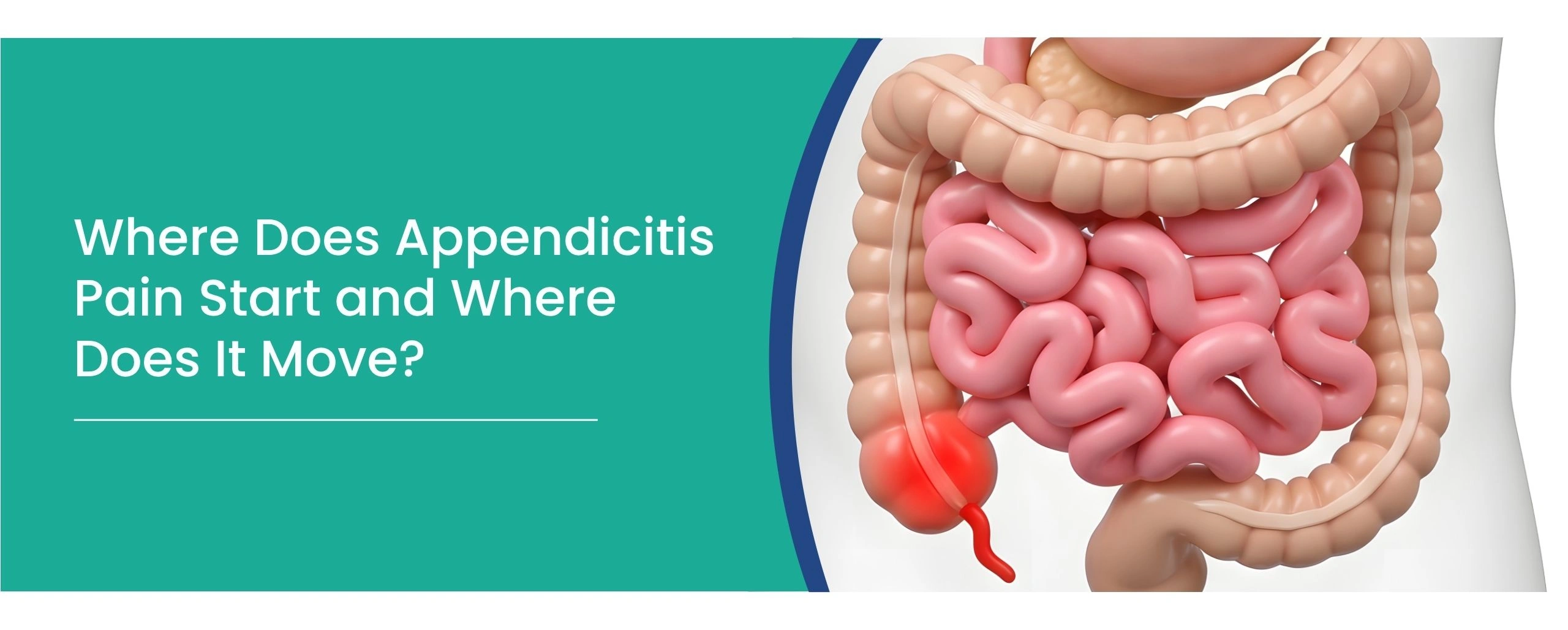
In many people, appendicitis pain begins around the belly button or in the middle of the abdomen. Over the next few hours, the pain may become more focused and move toward the lower-right side of the abdomen. As inflammation increases, the pain often becomes stronger and more persistent.
This pattern is one of the most recognised signs of appendicitis, but it does not happen in exactly the same way for everyone. Some people may have pain that starts directly in the lower-right abdomen or develops more slowly. The location can also vary depending on the position of the appendix, age and pregnancy.
What matters is not just where the pain is, but how it changes.
If abdominal pain is getting worse, becoming more focused on the lower-right side, or occurring with fever, nausea, vomiting or significant tenderness, it should not be ignored. Appendicitis requires prompt medical assessment because an untreated inflamed appendix can rupture and cause a more serious infection.
Where Does Appendicitis Pain Usually Start?
Early appendicitis pain often starts around the belly button or in the middle of the abdomen.
At this stage, the pain may be difficult to pinpoint. You might describe it as a dull ache, discomfort or a vague pain across the middle of your stomach rather than pain in one specific spot.
This happens because the early pain associated with an inflamed appendix may initially be felt more centrally. As the inflammation progresses and affects the tissues around the appendix, the pain can become more localised.
Early appendicitis pain may:
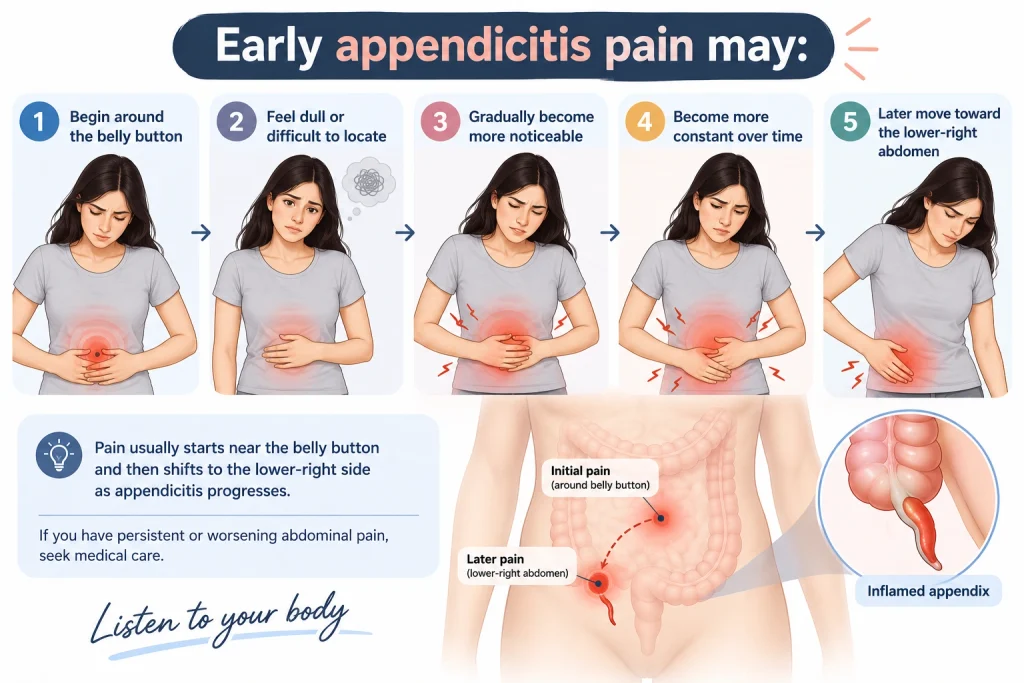
- Begin around the belly button
- Feel dull or difficult to locate
- Gradually become more noticeable
- Become more constant over time
- Later move toward the lower-right abdomen
Not everyone experiences this classic pattern. Some people, particularly young children, older adults and pregnant women, may have less typical pain locations or symptoms.
So, appendicitis pain location alone cannot confirm appendicitis. A healthcare professional needs to assess the symptoms and, when necessary, perform tests.
Where Does Appendicitis Pain Move?
In the typical pattern, appendicitis pain moves from around the belly button toward the lower-right side of the abdomen.
As the appendix becomes increasingly inflamed, the pain generally becomes more focused in the lower-right abdomen. It may also become sharper, stronger and more persistent. Movement, coughing, walking or other activities that jostle the abdomen can make the pain worse.
A simple way to understand the typical progression is:
Around the belly button → middle of the abdomen → lower-right abdomen → increasing and persistent pain
The lower-right abdomen is where the appendix is usually located, although the exact position can vary between individuals. This is why some people with appendicitis may feel pain somewhere other than the typical lower-right area.
Does appendicitis always cause right-side pain?
No.
Although lower-right abdominal pain is a classic feature, appendicitis does not always follow the textbook pattern. The pain can start elsewhere, remain less localised or develop differently depending on the appendix’s position and the individual.
Pregnancy can also change the location of pain because the growing uterus can shift the position of the appendix.
That is why you should not wait for pain to reach the lower-right abdomen before seeking medical attention if your symptoms are concerning.
What Does Appendicitis Pain Feel Like?
Appendicitis pain can feel different from person to person. Early pain may be dull and vague, while later pain is often more focused and intense.
As inflammation progresses, the pain may:
- Become sharper or more severe
- Increase steadily rather than settle
- Become persistent
- Become concentrated in the lower-right abdomen
- Feel worse when walking, coughing or moving
- Occur with tenderness when the abdomen is examined
A key feature is progression. Pain that keeps getting worse rather than gradually improving deserves medical attention.
However, pain intensity is not a reliable way to rule appendicitis in or out. Some people may experience less severe or atypical symptoms, so the overall pattern and associated symptoms matter.
How Appendicitis Pain Changes Over Time
Appendicitis does not always follow an identical timeline, but the classic pattern can be understood in four stages:
- Early stage: Pain begins around the belly button or in the middle of the abdomen.
- Progression: The pain becomes more noticeable and starts to localise.
- Typical location: Pain moves toward the lower-right abdomen.
- Worsening stage: The pain becomes more persistent and may become severe, particularly with movement or coughing.
7 Other Symptoms That Can Occur With Appendicitis
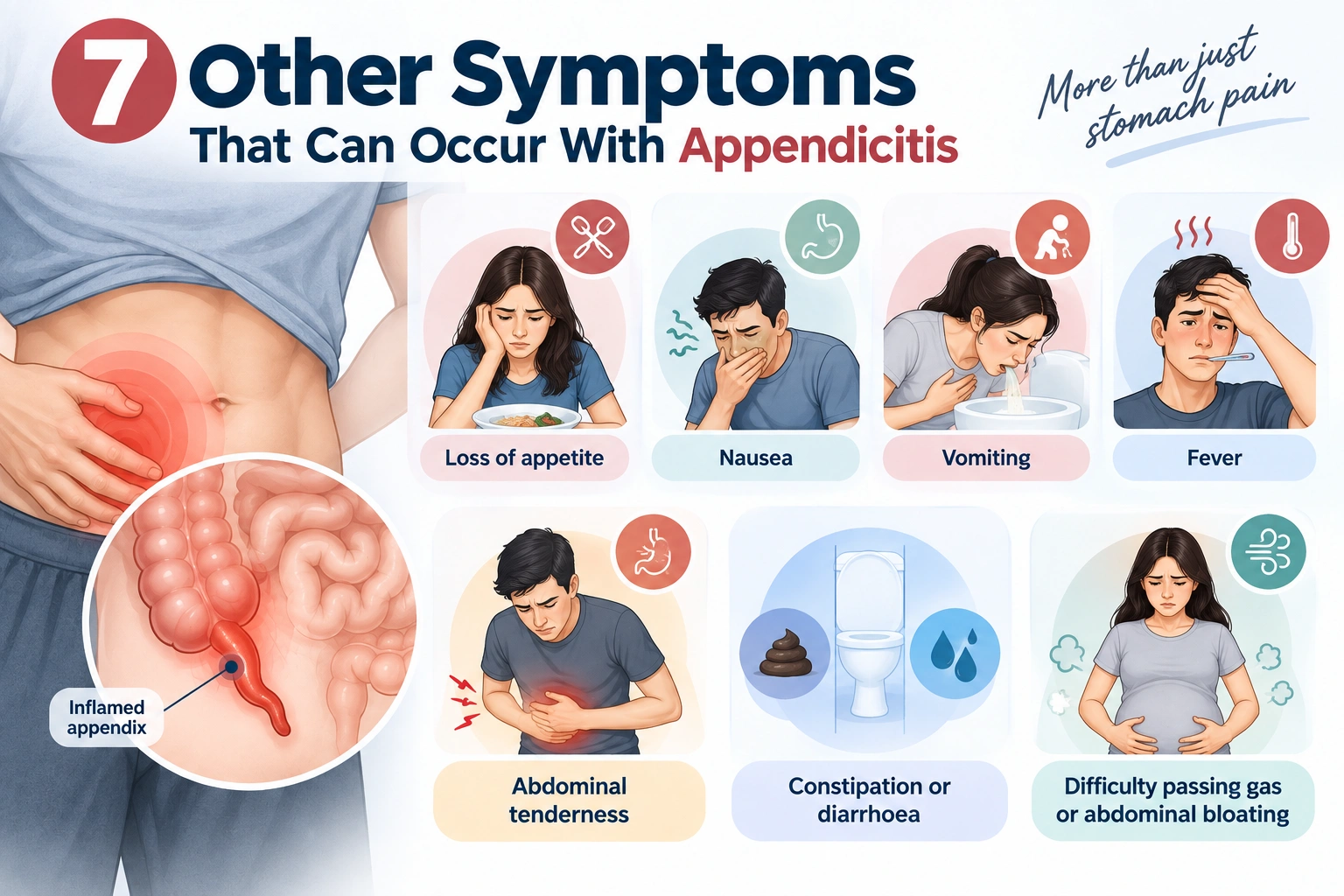
Abdominal pain is the main symptom, but appendicitis can cause several other symptoms. They may appear before, alongside or after the pain.
- Loss of appetite: You may suddenly lose interest in food or feel unable to eat normally.
- Nausea: Nausea can occur as the inflammation develops and may accompany abdominal pain.
- Vomiting: Some people develop vomiting, particularly as the abdominal symptoms progress.
- Fever: A low-grade fever may occur and can become more pronounced as inflammation or infection worsens.
- Abdominal tenderness: The abdomen may become increasingly sensitive, particularly around the area of the appendix.
- Constipation or diarrhoea: Appendicitis can affect bowel function. Some people develop constipation, while others experience diarrhoea.
- Difficulty passing gas or abdominal bloating: Some people experience bloating or difficulty passing gas, particularly when inflammation affects normal bowel movement.
Having one of these symptoms does not necessarily mean you have appendicitis. Many digestive conditions can cause similar symptoms. The combination of progressively worsening abdominal pain and other symptoms is more concerning.
Can Appendicitis Pain Come and Go?
Appendicitis pain is generally expected to progress rather than repeatedly disappear and return like typical cramping pain.
However, symptoms can vary. A temporary change in pain should not automatically be taken as a sign that appendicitis has resolved.
In particular, if severe pain suddenly improves and is followed by severe pain spreading across the abdomen, this can be a sign of a ruptured appendix and requires emergency medical attention.
This is why it is risky to rely on temporary pain relief as proof that everything is fine.
If abdominal pain has been worsening, has moved toward the lower-right abdomen, or is accompanied by fever, nausea or vomiting, seek medical assessment rather than waiting for the pain to return.
Appendicitis Pain vs Gas Pain: What’s the Difference?
Gas can cause abdominal discomfort, bloating and cramping, so it can sometimes be difficult to distinguish from other causes of stomach pain.
The following comparison can provide a general guide, but it cannot diagnose appendicitis.
| Feature | Appendicitis | Gas |
| Typical location | Often begins around the belly button and may move to the lower-right abdomen | Can occur in different areas of the abdomen |
| Pain pattern | Often becomes progressively worse and more localised | Often comes and goes or feels crampy |
| Movement of pain | May shift from the centre toward the lower-right abdomen | Can move around the abdomen |
| Bloating | May occur | Common |
| Fever | May occur | Not typical |
| Nausea/vomiting | Can occur | May occur, but persistent vomiting is less typical |
| Relief after passing gas | Usually does not resolve the underlying pain | Passing gas or having a bowel movement may relieve discomfort |
The important distinction is what happens over time. Gas pain may improve after passing gas or having a bowel movement, while appendicitis pain typically becomes more persistent and may intensify.
If you are unsure whether stomach pain is gas or appendicitis, particularly when the pain is worsening or localised to the lower-right abdomen, it is safer to get evaluated.
Appendicitis Pain vs Other Causes of Abdominal Pain
Appendicitis is not the only condition that can cause abdominal pain. Several problems can produce symptoms that initially look similar.
- Kidney stones: Kidney stone pain often starts in the side or back and may travel toward the lower abdomen or groin. It can be severe and may come in waves.
- Gastroenteritis: Stomach infections commonly cause abdominal cramps along with diarrhoea, vomiting and sometimes fever.
- Constipation: Constipation can cause abdominal discomfort, bloating and difficulty passing stool or gas. Pain may improve after bowel movement.
- Gallbladder problems: Gallbladder conditions more commonly cause pain in the upper-right or upper-middle abdomen, sometimes after eating.
- Urinary tract problems: A urinary tract infection may cause lower abdominal discomfort along with urinary symptoms such as burning or frequent urination.
- Gynaecological causes: In women, abdominal or pelvic pain can have several causes, including ovarian cysts, pelvic inflammatory disease, menstrual pain and ectopic pregnancy. Some of these conditions can require urgent treatment.
Because these conditions can overlap in their symptoms, the location and progression of pain should not be used as a substitute for medical evaluation.
When Is Appendicitis Pain an Emergency?
Appendicitis can become serious if treatment is delayed. Seek urgent medical attention if abdominal pain is severe, worsening or becoming focused in the lower-right abdomen, especially when other symptoms are present.
Warning signs include:
- Severe or progressively worsening abdominal pain
- Pain moving toward or becoming focused in the lower-right abdomen
- Fever
- Persistent nausea or vomiting
- Significant abdominal tenderness
- Increasing weakness or feeling very unwell
- Severe pain that spreads across the abdomen
A ruptured appendix can cause infection inside the abdomen and requires urgent treatment. If you have severe abdominal pain or are becoming seriously unwell, do not wait for the symptoms to settle on their own.
How Is Appendicitis Diagnosed?
There is no single symptom or home test that can reliably confirm appendicitis. The choice of tests depends on the patient’s age, symptoms, pregnancy status, clinical findings and other factors.
Depending on the situation, diagnosis may involve:
- Physical examination: The abdomen is examined for tenderness, guarding and other signs.
- Blood tests: These may help identify signs of infection or inflammation.
- Urine testing: This can help rule out conditions such as urinary tract infections or kidney stones.
- Ultrasound: May be particularly useful in children, young people and pregnancy.
- CT scan or other imaging: Imaging may be recommended when the diagnosis is uncertain or when more detailed assessment is needed.
How Is Appendicitis Treated?
Appendectomy, or surgical removal of the appendix, is the standard treatment for many cases of appendicitis. Antibiotics are often given as part of treatment and may also be used as the main treatment in selected patients, depending on the clinical situation.
An appendectomy can be performed through:
- Laparoscopic surgery, using small abdominal incisions and a camera
- Open surgery, using a larger incision when clinically necessary
The appropriate approach depends on factors such as the severity of appendicitis, whether the appendix has ruptured and the patient’s overall condition.
If you are looking for appendicitis treatment in Noida, speak with a qualified surgical team promptly when symptoms suggest appendicitis. Early assessment can help determine the appropriate treatment before complications develop.
Frequently Asked Questions (FAQs)
Where does appendicitis pain start?
Appendicitis pain commonly starts around the belly button or in the middle of the abdomen. It may initially feel dull or difficult to pinpoint before becoming more localised.
Where does appendicitis pain move?
In the typical pattern, appendicitis pain moves from around the belly button toward the lower-right abdomen. The pain may become stronger and more persistent as inflammation progresses.
Does appendicitis always cause right-side pain?
No. Although lower-right abdominal pain is typical, some people experience pain in a different location or develop a less typical pattern. This can occur depending on the appendix’s position and in situations such as pregnancy.
Can appendicitis pain come and go?
Appendicitis pain generally becomes more persistent and progressively worse rather than repeatedly disappearing. Temporary improvement should not be assumed to mean the condition has resolved. Sudden improvement followed by severe, widespread abdominal pain can occur with a ruptured appendix and requires emergency care.
What does appendicitis pain feel like?
Early appendicitis pain may feel dull or vague around the belly button. It can later become sharper, more intense and focused in the lower-right abdomen. Pain may worsen with walking, coughing or other movement.
How do I know if my stomach pain is appendicitis?
You cannot reliably diagnose appendicitis based on pain alone. Worsening abdominal pain, particularly pain that moves toward the lower-right abdomen and occurs with fever, nausea, vomiting or tenderness, should be medically assessed.
Can gas pain feel like appendicitis?
Yes. Gas can cause abdominal pain, cramps and bloating, which may sometimes resemble early appendicitis. However, appendicitis pain typically becomes more persistent and may localise to the lower-right abdomen. If the pain is worsening or accompanied by fever or vomiting, seek medical attention.
When should I go to the hospital for appendicitis?
Seek urgent medical care for severe or worsening abdominal pain, especially when it moves to or becomes focused in the lower-right abdomen. Fever, persistent vomiting, significant tenderness or feeling increasingly unwell are additional reasons to seek prompt assessment.
Conclusion
Appendicitis pain often follows a recognisable pattern: it may begin around the belly button, then move toward the lower-right abdomen and become progressively more intense and persistent.
But not everyone experiences appendicitis in exactly the same way. Pain can develop in a different location, and symptoms may be less typical in children, older adults and pregnant women.
The most important thing is to pay attention to worsening or persistent abdominal pain, particularly when it is accompanied by fever, nausea, vomiting or significant tenderness visit best hospital in Noida.