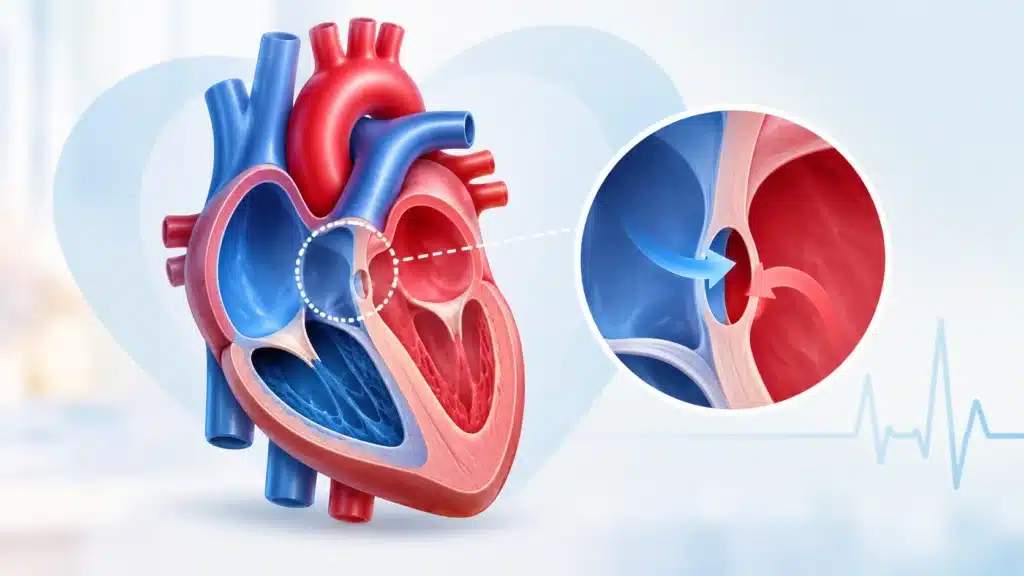
Atrial Septal Defect, commonly called ASD, is a type of congenital heart defect. This means it is present from birth. In a normal heart, there is a wall called the septum that separates the right and left upper chambers, known as the atria. In a person with ASD, this wall has a hole or gap. Because of this opening, blood can flow abnormally between the two chambers.
Many children with a small ASD may have no symptoms at all. They may grow normally, play normally, and the defect may only be discovered later during a routine check-up or when a doctor hears a heart murmur. In other cases, especially with larger defects, the extra blood flow to the lungs can cause breathlessness, fatigue, frequent chest infections, or poor weight gain in children. In adults, untreated ASD can lead to heart rhythm problems, lung pressure issues, or heart failure over time.
What is Atrial Septal Defect (ASD)?
Atrial Septal Defect is a hole in the septum, the wall that separates the right and left atria of the heart. During normal development in the womb, this wall forms completely before birth. In some babies, the wall does not close fully, leaving an opening.
Because of this opening, oxygen-rich blood from the left atrium can flow into the right atrium. This increases the amount of blood going to the lungs. Over time, the extra blood flow can strain the right side of the heart and the blood vessels in the lungs.
ASD can be small, medium, or large. Small defects may cause no problems and sometimes close on their own in early childhood. Larger defects are more likely to cause symptoms and may need treatment. The location and size of the hole determine the type of ASD and the best treatment approach.
Types of Atrial Septal Defect
ASD is classified based on where the hole is located in the septum.
Common types include:
- Ostium secundum ASD, which is the most common type and occurs in the central part of the septum.
- Ostium primum ASD, which is lower in the septum and may be associated with other heart valve problems.
- Sinus venosus ASD, which is near the entrance of the large veins returning blood to the heart.
- Coronary sinus ASD, which is a rare type involving the wall near the coronary sinus.
Why the type matters
- The type determines whether the defect can be closed with a device or needs surgery.
- Some types are more likely to be associated with other heart abnormalities.
- The location affects how the blood flows and which symptoms may appear.
- Treatment planning depends heavily on the exact type and size of the defect.
Causes of Atrial Septal Defect
In most cases, the exact cause of ASD is not known. It happens due to abnormal development of the heart during early pregnancy.
Possible contributing factors
- Genetic factors or family history of congenital heart disease.
- Chromosomal conditions such as Down syndrome in some cases.
- Maternal illnesses during pregnancy, such as uncontrolled diabetes.
- Certain infections during pregnancy.
- Use of some medicines or substances during early pregnancy.
- Environmental factors that may affect fetal heart development.
Important points for families
- In most families, ASD is not caused by anything the parents did or did not do.
- It is usually a random event in heart development.
- The chance of having another child with a heart defect is generally low but may be slightly higher than the general population.
- Genetic counseling may be suggested in selected cases with strong family history.
Risk Factors for ASD
Some factors may increase the likelihood of a baby being born with ASD.
Higher-risk situations
- Family history of congenital heart defects.
- Maternal diabetes that is not well controlled.
- Certain genetic or chromosomal conditions in the baby.
- Exposure to specific infections or medications during early pregnancy.
- Maternal alcohol use or smoking during pregnancy.
Why risk assessment matters
- It helps in planning early screening and evaluation.
- It guides counseling for future pregnancies.
- It supports early detection and timely management.
Symptoms of Atrial Septal Defect
Symptoms depend on the size of the defect, the amount of extra blood flow to the lungs, and the age of the patient.
In infants and young children
- Many children have no symptoms.
- Frequent chest infections or cough.
- Poor weight gain or slow growth.
- Tiring easily during feeding.
- Sweating while feeding.
- Fast breathing.
- Recurrent respiratory infections.
In older children and teenagers
- Breathlessness during exercise or play.
- Getting tired more easily than peers.
- Poor stamina.
- Occasional palpitations.
- Sometimes no symptoms at all, with ASD found incidentally.
In adults
- Breathlessness on exertion.
- Fatigue and low energy.
- Palpitations or irregular heartbeat.
- Swelling in the legs or abdomen in advanced cases.
- Increased risk of heart rhythm problems.
- Higher chance of stroke in some untreated cases.
- Some adults remain asymptomatic for many years.
Why symptoms may be mild or absent
- Small defects may not cause significant blood flow changes.
- The body can compensate for mild abnormalities for a long time.
- Symptoms often develop slowly over years, so people may not notice them.
How is Atrial Septal Defect Diagnosed?
Diagnosis is based on clinical evaluation, heart examination, and imaging tests.
Diagnostic steps
- Detailed history of symptoms, growth, and exercise tolerance.
- Family history of heart defects.
- Physical examination, including listening to the heart with a stethoscope.
- Detection of a heart murmur or extra heart sounds.
- Assessment of growth in children.
- Evaluation of breathing and oxygen levels.
Common tests that may be done
- Echocardiogram, which is the main test to visualize the heart and the defect.
- Doppler study to assess blood flow across the defect.
- Electrocardiogram to check heart rhythm and chamber size.
- Chest X-ray to evaluate heart size and lung blood flow.
- Transesophageal echocardiogram in selected cases for better views.
- Cardiac MRI or CT in complex cases.
- Cardiac catheterization in some patients to measure pressures before closure.
Why diagnosis matters
- It confirms the presence, size, and type of ASD.
- It helps decide whether monitoring or treatment is needed.
- It identifies any associated heart abnormalities.
- It guides the timing and method of closure.
Treatment for Atrial Septal Defect
Treatment depends on the size of the defect, symptoms, age, and impact on the heart and lungs.
1. Observation and monitoring
- Small ASDs with no symptoms may only need regular follow-up.
- Many small defects in children close on their own in early years.
- Regular echocardiograms are used to monitor size and heart function.
- No immediate intervention is needed if the heart is not strained.
2. Medical management
- Medicines do not close the hole but may help manage symptoms.
- Diuretics may be used if there is fluid overload or heart strain.
- Medicines for heart rhythm control if arrhythmias develop.
- Treatment of lung infections promptly in children.
- Management of any associated conditions such as anemia or thyroid issues.
3. Device closure (minimally invasive)
- This is the preferred method for suitable secundum ASDs.
- A small device is placed through a vein in the leg to close the hole.
- No large incision on the chest is needed.
- Hospital stay is usually short.
- Recovery is faster compared to open surgery.
- Not all types of ASD are suitable for device closure.
4. Surgical closure
- Surgery is recommended when the defect is not suitable for device closure.
- It is also used for large defects or complex types.
- The hole is closed using a patch or stitches during open-heart surgery.
- Performed under general anesthesia with heart-lung support.
- Provides excellent long-term results in experienced centers.
5. Timing of treatment
- Closure is usually recommended in childhood if the defect is significant.
- In adults, closure is considered if there is evidence of heart strain or symptoms.
- Very small defects with no impact may be observed lifelong.
- The decision is individualized based on tests and clinical findings.
Procedure Details for ASD Closure
Device closure overview
- Performed by a pediatric or adult congenital cardiologist.
- A thin tube is passed through a vein in the groin to the heart.
- The device is delivered through the tube and positioned across the defect.
- Once in place, the device opens and seals the hole.
- The device remains in the heart permanently and is covered by tissue over time.
- Most patients go home within one to two days.
Surgical closure overview
- Performed by a cardiac surgeon.
- A small incision is made on the chest.
- The heart is temporarily stopped and supported by a heart-lung machine.
- The hole is closed using a patch or sutures.
- The chest is closed and the patient is moved to recovery or ICU.
- Hospital stay is typically a few days, depending on recovery.
Recovery After ASD Treatment
Recovery depends on the type of procedure, age, and overall health.
Recovery after device closure
- Short hospital stay, often one to two days.
- Mild discomfort at the groin puncture site.
- Most children and adults resume normal activities within a week.
- Avoid heavy exercise for a short period as advised.
- Follow-up echocardiogram to confirm device position.
- Long-term outlook is excellent in suitable candidates.
Recovery after surgical closure
- Hospital stay of several days, including ICU monitoring.
- Pain at the incision site managed with medicines.
- Gradual increase in activity over weeks.
- Avoid heavy lifting or strenuous activity for a few weeks.
- Regular follow-up to monitor heart function and healing.
- Most patients return to normal life within a few weeks to months.
Long-term care after closure
- Periodic cardiology follow-up as advised.
- Monitoring for heart rhythm in some patients.
- Good dental hygiene to reduce infection risk.
- Healthy lifestyle to support heart health.
- Most patients do not need long-term restrictions after successful closure.
Possible Complications
Most patients do well, but complications can occur, especially if ASD is large or left untreated for a long time.
Complications of untreated ASD
- Enlargement of the right side of the heart.
- High blood pressure in the lungs over time.
- Heart rhythm abnormalities such as atrial fibrillation.
- Increased risk of stroke in some adults.
- Heart failure in advanced cases.
- Reduced exercise tolerance and fatigue.
Complications related to treatment
- Bleeding or infection at the procedure site.
- Device displacement in rare cases.
- Irregular heart rhythms after closure.
- Reaction to anesthesia or medicines.
- Need for re-intervention in selected complex cases.
Why follow-up is important
- To ensure the heart is adapting well after closure.
- To detect any rhythm issues early.
- To monitor lung pressures and heart function.
- To provide guidance on activity and lifestyle.
When Should You See a Doctor?
Medical evaluation is important for children or adults with suspected or known ASD.
- Frequent chest infections.
- Poor weight gain in infants.
- Breathlessness during activity.
- Easy fatigability.
- Palpitations or irregular heartbeat.
- Swelling in legs or abdomen.
- A known heart murmur or suspected heart defect.
Prevention of Complications
While ASD itself cannot be prevented, complications can be reduced with proper care.
- Regular cardiology follow-up as advised.
- Timely closure when recommended.
- Prompt treatment of chest infections in children.
- Good dental hygiene to reduce infection risk.
- Healthy diet and regular physical activity.
- Avoid smoking and limit alcohol in adults.
- Control of blood pressure, diabetes, and cholesterol.
- Adherence to prescribed medicines and appointments.
For pregnant women with heart conditions
- Pre-pregnancy counseling with a cardiologist.
- Close monitoring during pregnancy.
- Delivery planning in a center with cardiac support if needed.
Why Choose Rama Hospital for ASD Treatment?
Atrial Septal Defect requires specialized care from a team experienced in congenital heart disease. A hospital with dedicated pediatric and adult congenital cardiology, advanced imaging, and interventional and surgical expertise can provide comprehensive care.
- Accurate diagnosis with advanced echocardiography and imaging.
- Individualized decision on monitoring versus closure.
- Availability of both device closure and surgical options.
- Experienced cardiologists and cardiac surgeons.
- Dedicated ICU and post-procedure care.
- Long-term follow-up for children and adults.
Frequently Asked Questions (FAQs)
Is ASD serious?
It depends on the size and impact. Small ASDs may cause no problems, while large ones can lead to heart enlargement, lung pressure issues, and rhythm problems. Many cases are treatable with excellent outcomes.
Can ASD close on its own?
Yes, small ASDs in young children can close spontaneously in the first few years of life. Larger defects usually do not close on their own and may need device or surgical closure.
At what age is ASD treatment done?
Treatment timing depends on the size and symptoms. Many children undergo closure in early childhood. Adults with significant ASD are also treated to prevent long-term complications.
Is surgery always needed for ASD?
No, not always. Many suitable ASDs can be closed using a minimally invasive device procedure. Surgery is reserved for defects not suitable for device closure or for complex cases.
Can adults live with untreated ASD?
Some adults live for years with mild symptoms, but untreated ASD can increase the risk of heart rhythm problems, lung pressure issues, and heart failure over time. Evaluation is recommended.
What is device closure for ASD?
Device closure is a minimally invasive procedure where a small device is placed through a vein to seal the hole in the heart. It avoids a large chest incision and has a faster recovery.
Is life normal after ASD closure?
Yes, most patients lead normal, active lives after successful closure. Regular follow-up is advised, but long-term restrictions are usually minimal.
Conclusion
Atrial Septal Defect is a common congenital heart condition that can affect children and adults. While small defects may cause no symptoms, larger ones can strain the heart and lungs over time. The good news is that ASD is highly treatable with modern device closure and surgical techniques.
The most important steps are early diagnosis, regular monitoring, and timely intervention when needed. For patients with breathlessness, fatigue, frequent chest infections, or a known heart murmur, a cardiology evaluation can make a major difference. With proper care, most people with ASD can expect excellent long-term health and quality of life.
Rama Hospital can help evaluate ASD, determine the best treatment approach, and provide comprehensive care from diagnosis through closure and long-term follow-up for both children and adults.