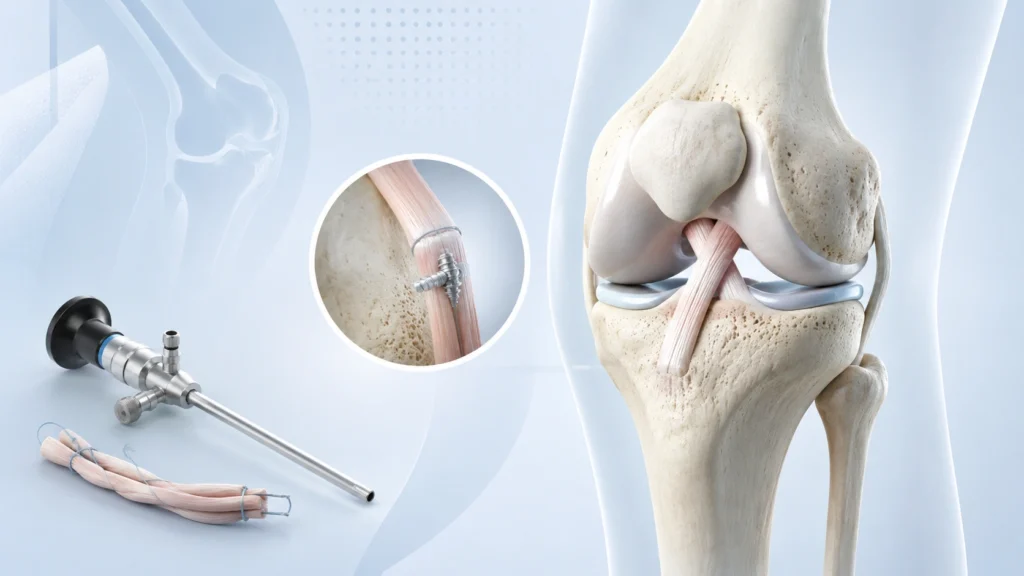
The anterior cruciate ligament, or ACL, is one of the major ligaments inside the knee. It helps keep the knee stable, especially during sudden stops, twists, turns, jumping, and pivoting movements. When the ACL is torn, the knee may feel loose, painful, swollen, weak, or unsafe during daily activities and sports.
ACL injuries often happen during sports, twisting injuries, falls, or accidents. Some patients can manage a partial injury with conservative treatment, but a complete tear or persistent instability often needs ACL reconstruction to restore function and reduce the risk of future knee damage.
ACL reconstruction is not simply about repairing a ligament. It is about restoring knee stability, protecting the meniscus and cartilage, improving movement confidence, and helping the patient return to normal life, work, and sport with a lower risk of repeated injury.
ACL reconstruction is surgery to replace a torn ACL with a new graft. The graft may be taken from the patient’s own tissue, such as the hamstring tendon, patellar tendon, or quadriceps tendon, or in some cases from a donor graft.
In simple terms, the damaged ACL is not stitched back together in most complete tears. Instead, the surgeon creates a new ligament-like structure to take over its function. This helps the knee regain stability and allows safer movement during daily life and physical activity.
ACL reconstruction is commonly done using arthroscopic or minimally invasive techniques. Small incisions are made around the knee, a camera is used to guide the surgery, and the graft is fixed inside bone tunnels created in the femur and tibia.
ACL reconstruction is recommended when the knee is unstable, the ligament is fully torn, or the patient needs a strong and reliable knee for work, sport, or daily movement.
You may need ACL reconstruction if you have:
ACL reconstruction is particularly important for athletes and active adults because an unstable knee can lead to repeated falls, meniscus damage, cartilage injury, and longer-term joint problems.
ACL tears usually happen from sudden force or twisting. Some injuries occur during sports, while others happen in falls or road accidents.
Common causes and risk factors include:
Some patients may also have increased risk because of body mechanics, ligament laxity, or sports exposure. In many cases, the injury happens during a single movement, but the underlying tissue stress and movement pattern contribute to the tear.
An ACL tear often produces immediate or early symptoms, but in some patients the full problem becomes clear only after swelling decreases and the knee remains unstable.
Common symptoms include:
If the ACL injury is associated with meniscus damage or other ligament tears, pain, swelling, and instability may be more severe.
Before surgery, the orthopedic team confirms the tear and checks whether reconstruction is the right treatment.
Common diagnostic steps
Why diagnosis matters
Accurate diagnosis helps decide:
Not every ACL injury needs immediate reconstruction. Some partial injuries or low-demand patients may start with conservative treatment first.
Non-surgical management may include:
However, if the knee keeps giving way, the tear is complete, or the patient wants to return to active sports or physical work, ACL reconstruction becomes the more reliable treatment.
| Treatment Option | Best For | Limitations |
| Physiotherapy and bracing | Partial tears, lower activity patients, or temporary symptom control. | Does not restore a torn ACL in unstable knees. |
| ACL reconstruction | Complete tears, unstable knees, athletes, and active adults. | Requires surgery and structured rehab. |
| Delayed surgery after rehab | Patients who need swelling reduction and prehab before operation. | Still requires surgery if instability continues. |
ACL reconstruction is a planned orthopedic surgery usually performed in a hospital operating theatre using arthroscopic technique. The exact steps may differ depending on the surgeon, graft type, and additional knee injuries.
Step 1: Pre-operative assessment
Step 2: Surgical preparation
Step 3: Anesthesia
Step 4: Arthroscopic access to the knee
Step 5: Graft selection and harvest
Step 6: Tunnel creation
Step 7: Graft placement
Step 8: Graft fixation
Step 9: Final inspection
Step 10: Closure and dressing
Different grafts may be used in ACL surgery depending on activity level, surgeon experience, and patient anatomy.
| Graft Type | Main Feature | Common Use |
| Hamstring tendon graft | Strong, commonly used, less front-knee pain than some alternatives. | Active adults and sports injuries. |
| Patellar tendon graft | Very strong fixation and often used in sports patients. | Selected athletes and high-demand patients. |
| Quadriceps tendon graft | Increasingly used in ACL surgery. | Patients needing a strong graft option. |
| Donor graft (allograft) | Tissue from donor source. | Selected cases depending on surgeon plan. |
ACL reconstruction offers several important benefits when the knee is unstable or the tear is complete.
Benefits include:
For active patients, the most important advantage is often stability. A stable knee makes it safer to move, exercise, and live without constant fear of the joint buckling.
ACL reconstruction is a common and well-established orthopedic surgery, but it still carries risks that patients should understand clearly.
Possible complications include:
Some patients may also have delayed recovery if they return to activity too soon or do not follow physiotherapy instructions properly. Rehabilitation is therefore just as important as the surgery itself.
Recovery after ACL reconstruction is gradual and structured. Many patients need months of rehabilitation before they can safely return to sports or demanding physical activity.
Early recovery
Intermediate recovery
Late recovery
Recovery time varies, but many patients need at least several months, and return to high-intensity sport may take longer depending on healing, strength, and confidence.
| Recovery Stage | Typical Focus |
| First 1-2 weeks | Reduce swelling, control pain, protect the graft, begin gentle exercises. |
| Weeks 2-6 | Restore motion, improve muscle activation, walk more safely, reduce crutch use. |
| Weeks 6-12 | Build strength, balance, and movement control. |
| Months 3-6 | Advance functional training and sport preparation in suitable patients. |
| Months 6-12 | Return-to-sport phase for selected patients after proper clearance. |
A good outcome depends heavily on disciplined rehabilitation. Patients who follow their surgeon and physiotherapist closely usually recover more safely. Helpful tips include:
Rama Hospital offers structured orthopedic care for ACL injury, reconstruction, rehabilitation, and return-to-activity planning. The goal is not only to perform surgery, but to guide the patient from injury to recovery with confidence.
Seek prompt medical care if the injury is severe, the knee is very swollen, or you cannot bear weight properly. Early evaluation can help prevent additional damage to the meniscus or cartilage. You should see an orthopedic specialist if you have:
ACL reconstruction is surgery that replaces a torn ACL with a graft to restore knee stability. It is commonly done when the ligament is fully torn or when the knee keeps giving way.
Yes, in many cases it is done with arthroscopic or minimally invasive techniques. Small incisions and a camera help the surgeon place the graft accurately.
Recovery varies, but it often takes several months and may extend up to 9 to 12 months for full return to sport in selected patients. The pace depends on healing, physiotherapy, and strength recovery.
Yes, physiotherapy is a very important part of ACL reconstruction recovery. It helps restore strength, motion, balance, and safe movement patterns after surgery.
Most patients start walking with support soon after surgery, usually with crutches at first. Weight-bearing is increased gradually based on the surgeon’s advice and the patient’s progress.
There is some pain and swelling after surgery, but it is usually controlled with medicines, rest, ice, elevation, and physiotherapy. Pain generally improves gradually during recovery.
Some partial tears or lower-demand patients may improve with non-surgical care. But a complete torn ACL with instability often needs reconstruction for reliable knee function.
ACL reconstruction is one of the most effective treatments for a torn anterior cruciate ligament when the knee is unstable or the patient needs a strong, functional joint for work, activity, or sport. By replacing the damaged ligament with a graft, the surgery helps restore stability, reduce repeated injury, and improve confidence in movement.
At Rama Hospital, ACL treatment is planned in a patient-centered way, with careful diagnosis, surgical expertise, and a rehab-focused recovery plan.
Management of anterior cruciate ligament (ACL) tears has continuously evolved since its first description in approximately 170 A.D.
No rows found.