
If you are considering hip replacement surgery, one question naturally comes up: “How long will my new hip last?”
There is no single number that applies to everyone. Many modern replacements can last 20 years or longer, and some may function well for several decades. However, the lifespan of an artificial hip depends on several factors, including your age, activity level, weight, overall health, implant design, surgical technique and how the joint is used over time.
For most people, the goal is not simply to make an artificial joint last for a certain number of years. It is to relieve pain, restore mobility and help you return to everyday activities while protecting the implant for the long term.
So, how long does a hip replacement last, and what can you do to make it last longer? Let’s look at what affects hip implant longevity and when a replacement may eventually need revision.
How Long Does a Hip Replacement Last?
A modern hip replacement can often last 20 years or longer, although its exact lifespan varies from person to person. Some people may never need another hip replacement, while younger or highly active patients may have a greater lifetime chance of requiring revision surgery. Implant materials, surgical technique, activity level, weight, overall health and complications can all affect how long the replacement lasts.
Research reviewed by Healthline found that approximately 58% of hip replacements were still functioning at 25 years in registry data, while estimates from independent studies were higher. This does not mean an individual implant will fail at 25 years; rather, it shows that implant survival varies considerably between patients and studies.
In simple terms:
The important point is that 20 or 25 years is not an expiration date for a hip replacement.
- Many hip replacements last 20 years or more
- Some continue functioning for several decades
- Not everyone will need revision surgery
- Younger patients may have a higher lifetime risk of revision
- High-impact activity can increase wear
- Implant loosening, infection or fracture can sometimes require earlier treatment
What Is a Hip Replacement?
Hip replacement, also called hip arthroplasty, is a procedure in which damaged parts of the hip joint are removed and replaced with artificial components.
The hip is a ball-and-socket joint. In a total hip replacement, the damaged femoral head is replaced with an artificial ball, while the damaged socket is replaced with an artificial component. These components may use combinations of metal, ceramic and durable plastic materials.
Hip replacement may be recommended when conditions such as severe arthritis, osteonecrosis or a hip fracture cause significant pain and interfere with everyday activities.
The main goals are to:
- Reduce hip pain
- Improve movement
- Restore mobility
- Improve daily functioning
- Improve quality of life
Why Does a Hip Replacement Eventually Wear Out?
An artificial hip is designed to withstand repeated movement, but it is not completely immune to wear.
Every time you walk, climb stairs or move your hip, the artificial components experience mechanical stress. Over many years, this can gradually affect the bearing surfaces or the way the implant is fixed to the bone.
One possible sequence is: Repeated movement → gradual wear → debris or changes around the implant → loosening or other implant problems → pain or reduced function → possible revision surgery
However, wear is only one reason a hip replacement may need further treatment.
Other problems, such as infection, dislocation or a fracture around the implant, can also affect the joint.
What Factors Affect How Long a Hip Replacement Lasts?
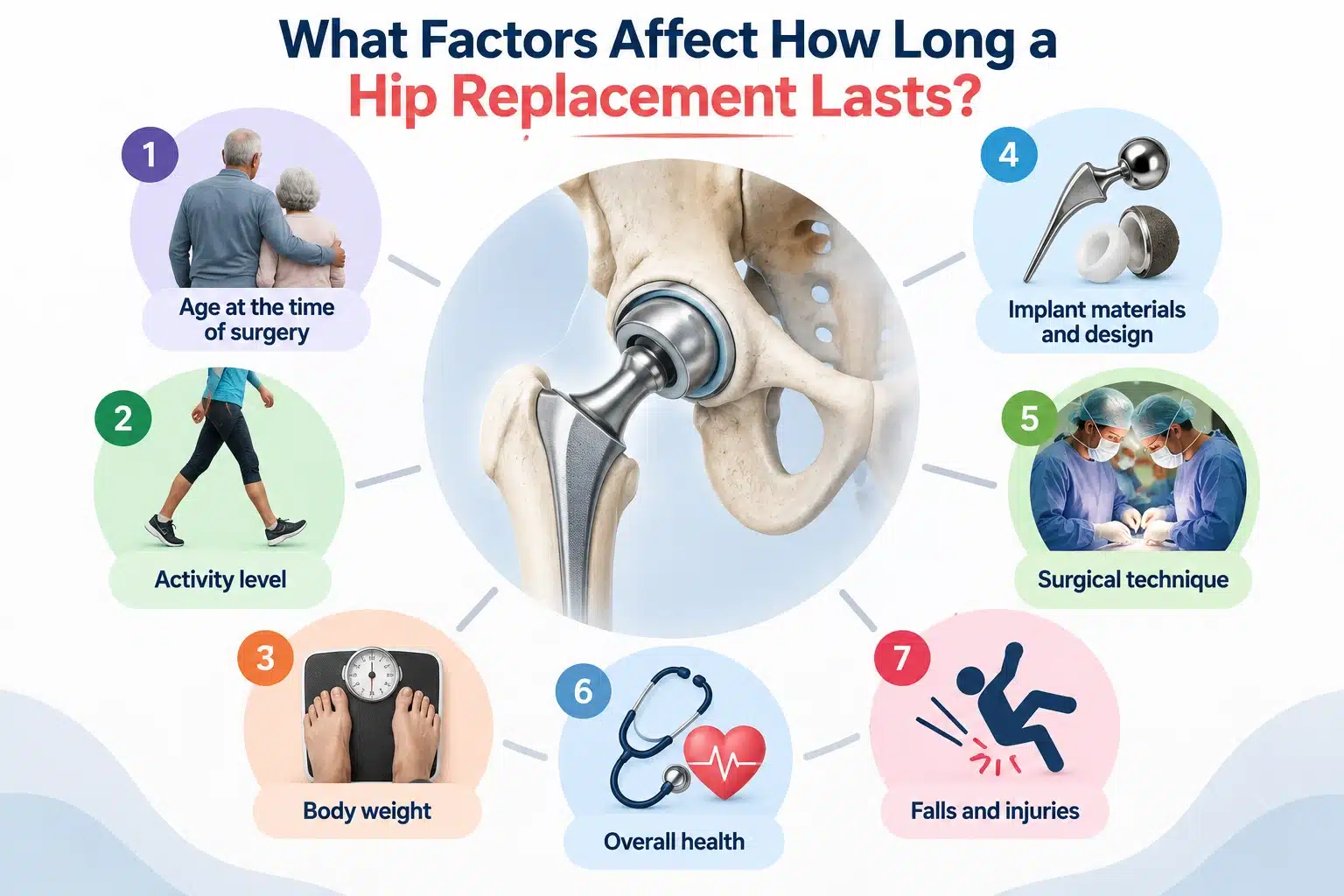
There is no universal lifespan because every patient’s circumstances are different.
1. Age at the time of surgery
A younger patient may place more years of demand on the artificial joint.
For example, someone who receives a hip replacement at 45 may potentially live with the implant for many decades. This gives more opportunity for wear or other problems to develop compared with someone who receives a replacement later in life.
Younger age does not mean the replacement will fail early. It simply means there may be a longer period during which revision could become necessary.
2. Activity level
Regular low-impact activity is generally encouraged after recovery.
However, repeated high-impact activities can place greater stress on an artificial joint. NIAMS notes that many doctors recommend avoiding activities such as jogging, basketball and vigorous tennis because they can contribute to excessive wear or loosening.
3. Body weight
Higher body weight can increase the mechanical load placed on the hip.
Maintaining a healthy weight, where appropriate, can help reduce stress on the joint and support overall mobility.
4. Implant materials and design
Modern hip replacements use durable materials and different combinations of bearing surfaces.
These can include:
- Ceramic
- Metal
- Polyethylene
The choice depends on factors such as the patient’s age, anatomy, activity level and surgeon’s assessment.
5. Surgical technique
Correct positioning and fixation of the implant are important for long-term function.
The surgeon considers your anatomy, bone quality and other individual factors when selecting and positioning the components.
6. Overall health
Bone health, muscle strength, medical conditions and the ability to participate in rehabilitation can all influence recovery and long-term function.
7. Falls and injuries
A fall can cause a fracture around the artificial joint or, in some cases, contribute to dislocation.
Taking precautions to reduce fall risk becomes especially important as you age.
Can an Active Lifestyle Shorten the Life of a Hip Replacement?
Being active does not mean you have to avoid exercise after hip replacement.
In fact, regular movement and appropriate exercise can help maintain muscle strength, mobility and overall health. The difference is between healthy activity and repeated high-impact stress.
Lower-impact activities may include:
- Walking
- Swimming
- Cycling
- Golf
- Appropriate strengthening exercises
What Are the Signs That a Hip Replacement May Be Wearing Out?
A hip replacement does not necessarily cause obvious symptoms when it begins to develop a problem.
However, certain changes should not be ignored.
Possible warning signs include:
- New or increasing hip pain
- Pain while walking
- Reduced mobility
- New stiffness
- Limping
- A feeling of instability
- Repeated dislocation
- Swelling around the hip
- A change in how the leg feels or functions
What Can Cause a Hip Replacement to Fail Early?
Most hip replacements are successful, but complications can occasionally affect implant survival. Not every complication means that the entire hip replacement has to be removed. Treatment depends on the specific problem.
- Implant loosening: The implant may gradually become loose from the surrounding bone. This can cause pain and reduced function.
- Infection: An infection involving the artificial joint can be a serious complication and may require prolonged treatment or additional surgery.
- Dislocation: The artificial ball can move out of the socket. This is known as dislocation.
- Fracture around the implant: A fall or injury can sometimes cause a fracture around the artificial joint.
- Excessive wear: Over time, the bearing surfaces can wear down. This is one reason younger and highly active patients may have a greater long-term revision risk.
- Implant-related problems: Changes in the implant or surrounding bone can sometimes affect stability or function.
Can a Hip Replacement Be Replaced Again?
Yes. If an artificial hip becomes severely worn, loose, infected or otherwise damaged, revision hip replacement surgery may be considered.
Revision surgery is different from the original hip replacement because the surgeon has to address the existing implant and the condition of the surrounding bone and tissues.
Not every patient with an older hip replacement needs revision surgery.
If the implant is functioning well and you have no concerning symptoms, your doctor may simply recommend appropriate follow-up.
How Can You Make a Hip Replacement Last Longer?
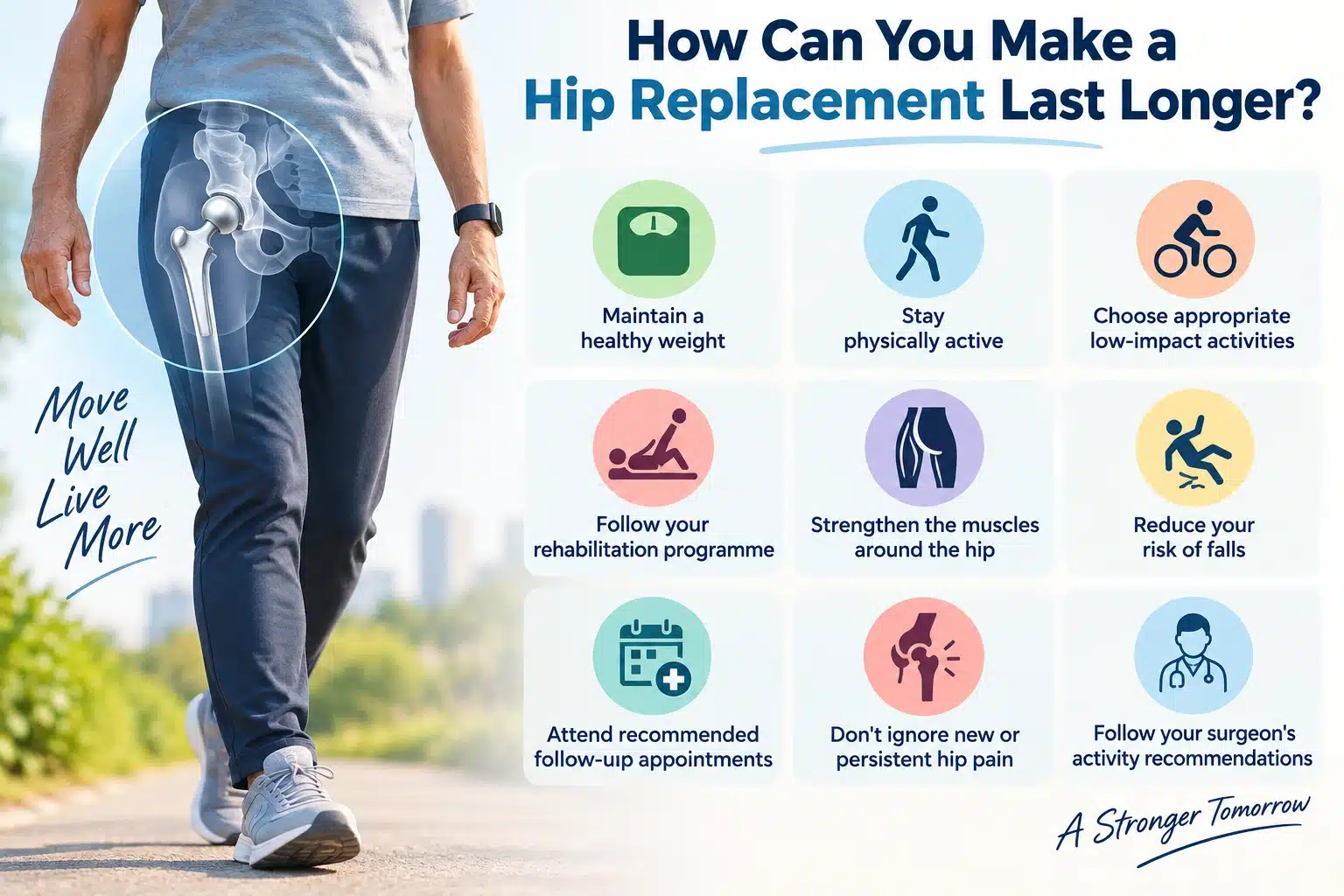
There is no guaranteed way to make an implant last a specific number of years. However, protecting the joint and maintaining overall health can support long-term function.
The aim is not to avoid movement. The aim is to move in a way that supports your new joint rather than repeatedly overloading it.
Focus on:
- Maintain a healthy weight
- Stay physically active
- Choose appropriate low-impact activities
- Follow your rehabilitation programme
- Strengthen the muscles around the hip
- Reduce your risk of falls
- Attend recommended follow-up appointments
- Don’t ignore new or persistent hip pain
- Follow your surgeon’s activity recommendations
What Activities Can You Do After Hip Replacement?
Most people can return to many everyday activities after recovery.
The exact timeline depends on your surgery, health and rehabilitation progress.
Activities such as walking, swimming, cycling and other lower-impact exercises are often suitable once your medical team clears you for them. Mayo Clinic notes that many people can participate in lower-impact activities such as swimming, golfing and bicycling after recovery.
High-impact activities may be discouraged because of the additional stress they can place on the artificial joint.
Your surgeon or physiotherapist should guide you based on your individual situation.
Does Hip Replacement Last Longer in Older Adults?
Not necessarily because of the implant itself.
The important difference is how long the implant needs to serve the patient.
For example, a person receiving a hip replacement at an older age may have a lower lifetime probability of requiring revision simply because the implant may function for the remainder of their life.
Younger patients may have many more active years ahead, so they have a greater lifetime opportunity to require revision.
This is one reason age is considered when discussing the long-term outlook of hip replacement.
Can a Hip Replacement Last a Lifetime?
Yes, a hip replacement can last for the rest of a person’s life, particularly when it continues to function well without major complications.
However, doctors cannot guarantee that an individual implant will last a lifetime.
Modern hip replacements can remain functional for 20 years or longer, and some patients may never require another operation. At the same time, younger age, high activity levels, implant wear and complications can increase the likelihood of revision.
When Should You See an Orthopaedic Doctor After Hip Replacement?
You do not need to wait until severe pain develops. Early assessment can help determine whether the problem is related to the implant or another condition.
Consider an orthopaedic evaluation if you notice:
- New hip pain after a period of improvement
- Increasing stiffness
- Difficulty walking
- New limping
- Reduced range of movement
- Repeated instability
- Pain after a fall
- Symptoms that are gradually getting worse
Frequently Asked Questions (FAQs)
1. How long does a hip replacement last?
Many modern hip replacements can last 20 years or longer, although individual results vary. Some may function for several decades, while others may require revision earlier because of wear, loosening, injury or complications.
2. Can a hip replacement last 25 years?
Yes. Long-term studies show that a substantial proportion of hip replacements remain functional at 25 years. However, survival rates vary depending on the patient population, implant and other factors.
3. Can a hip replacement last 30 years?
It can. Some hip replacements continue functioning for 30 years or longer, although this cannot be guaranteed for every patient.
4. Does a hip replacement need to be replaced after 20 years?
Not necessarily. If the implant is functioning well and there are no significant problems, it may not need to be replaced simply because 20 years have passed.
5. What causes a hip replacement to wear out?
Wear can result from long-term mechanical stress on the artificial joint. Loosening, infection, dislocation, fracture and other implant-related problems can also lead to revision surgery.
6. Can exercise damage a hip replacement?
Appropriate exercise is generally important for maintaining strength and mobility. However, repeated high-impact activities can place additional stress on an artificial hip. Your doctor can recommend activities based on your recovery and individual circumstances.
7. What are the signs that a hip replacement is wearing out?
New or increasing pain, stiffness, reduced mobility, limping or instability may indicate a problem. These symptoms can have several causes, so an orthopaedic evaluation is needed rather than assuming the implant has failed.
8. Can a failed hip replacement be replaced?
Yes. Revision hip replacement surgery may be performed when an implant has significant wear, loosening, infection, fracture or another serious problem. The exact procedure depends on the cause and condition of the existing implant.
Conclusion
A hip replacement is designed to provide long-term pain relief and restore mobility, not to come with a fixed expiry date.
Many modern hip replacements last 20 years or longer, and some continue working for several decades. However, the lifespan of your artificial hip depends on factors such as age, activity level, body weight, implant characteristics, surgical technique, bone health and complications.
You do not need to stop living an active life after hip replacement. The goal is to choose appropriate activities, maintain strength and mobility, protect the joint from unnecessary stress and seek medical advice if new symptoms appear.
If you are experiencing persistent hip pain or difficulty walking despite non-surgical treatment, an orthopaedic evaluation can help determine whether hip replacement may be appropriate for you.