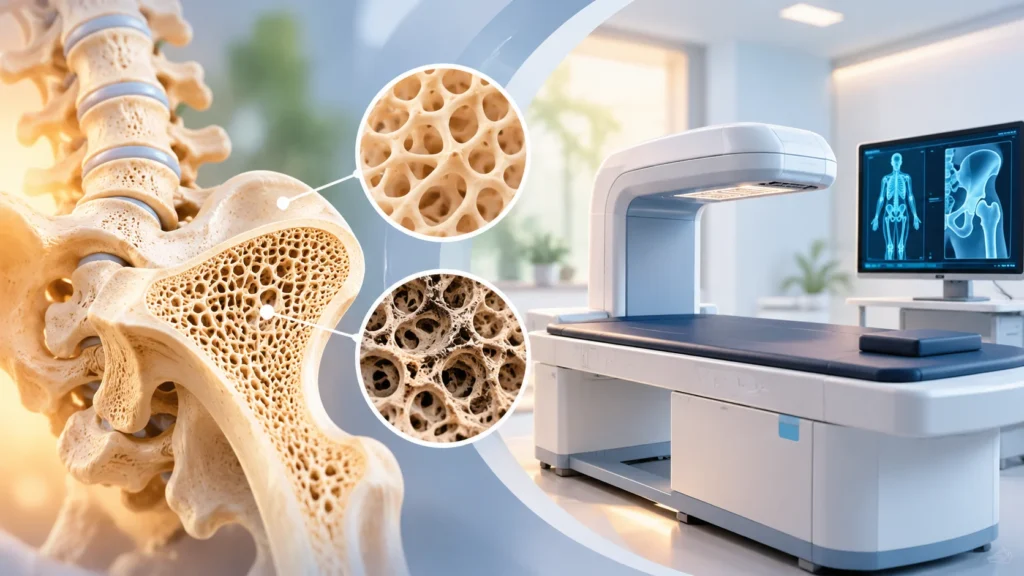
Bone densitometry, commonly known as a DEXA or DXA scan, is one of the most accurate and widely used tests to measure bone strength and assess the risk of fractures. The test uses low-dose X-rays to measure the amount of calcium and other minerals in specific bones, usually the spine, hip, and sometimes the forearm. This measurement is called bone mineral density or BMD.
Many people think bone loss only happens in old age, but bone density begins to decline gradually after the age of thirty. In women, the decline accelerates after menopause due to reduced estrogen levels. In men, bone loss occurs more slowly but can still lead to fractures if not monitored. Osteoporosis, or weak and brittle bones, often has no symptoms until a fracture occurs. That is why early detection through DEXA scanning is so important.
What is Bone Densitometry (DEXA)?
Bone densitometry is a specialized imaging test that measures how dense or strong your bones are. The most common type is called dual-energy X-ray absorptiometry, or DEXA. It is painless, non-invasive, and uses very low radiation, much less than a standard chest X-ray.
The test focuses on areas where fractures are most common and most serious, such as the lower spine and hip. In some cases, the forearm may also be scanned. The machine calculates how much X-ray is absorbed by the bone versus soft tissue. This gives a precise measurement of bone mineral content.
The results help doctors determine whether bones are normal, show early bone loss called osteopenia, or have progressed to osteoporosis. This information guides treatment decisions, lifestyle changes, and monitoring over time.
Why is DEXA Scan Done?
The main purpose of a DEXA scan is to detect low bone density before a fracture occurs. It is also used to monitor how well treatment is working in people already diagnosed with osteoporosis or bone loss.
Common reasons for DEXA scan
- To diagnose osteoporosis in at-risk individuals.
- To assess fracture risk in postmenopausal women.
- To evaluate bone health in older men.
- To monitor bone density in people on long-term steroid therapy.
- To check bone status in patients with rheumatoid arthritis or other chronic diseases.
- To evaluate unexplained fractures or height loss.
- To guide treatment decisions for bone-strengthening medicines.
- To monitor response to osteoporosis treatment over time.
Why early detection matters
Osteoporosis is often silent until a fracture happens. A hip or spine fracture can lead to pain, disability, loss of independence, and even increased risk of death in older adults. Detecting low bone density early allows for lifestyle changes, nutrition support, and medicines that can strengthen bones and prevent fractures.
Who Should Get a DEXA Scan?
Not everyone needs a DEXA scan, but certain groups benefit greatly from testing.
Recommended groups
- Women aged sixty-five and older.
- Men aged seventy and older.
- Postmenopausal women under sixty-five with risk factors.
- Older men with risk factors such as smoking, low weight, or family history.
- Adults who have had a fracture after age fifty.
- People on long-term corticosteroid therapy.
- Patients with rheumatoid arthritis, chronic kidney disease, or malabsorption.
- Individuals with significant height loss or stooped posture.
- People with a family history of hip fracture or osteoporosis.
- Those planning to start or already on osteoporosis treatment.
Risk factors that increase need
- Early menopause or surgical removal of ovaries.
- Low body weight or thin body frame.
- Smoking or excessive alcohol use.
- Sedentary lifestyle with little weight-bearing exercise.
- Low calcium or vitamin D intake.
- Long-term use of certain medicines such as steroids or anti-seizure drugs.
- Medical conditions affecting hormone levels or nutrient absorption.
How is the DEXA Scan Performed?
The DEXA scan is a simple, painless procedure that usually takes ten to twenty minutes. It is done in the radiology department by a trained technologist.
Procedure steps
- The patient lies on a padded table, usually on their back.
- The technologist positions the body according to the area being scanned.
- A scanner arm passes over the body, emitting low-dose X-rays.
- The machine measures bone density in the spine, hip, or forearm.
- The patient needs to stay still and may be asked to hold their breath briefly.
- No injections, contrast, or special preparation is needed during the scan.
What the patient experiences
- The test is painless and non-invasive.
- There is no feeling of heat, pressure, or discomfort.
- The patient can breathe normally except during brief instructions.
- Clothing with metal zippers or buttons may need to be adjusted.
- Jewelry or accessories near the scan area should be removed.
Preparation for DEXA Scan
Proper preparation helps ensure accurate results and a smooth experience.
Before the test
- Wear comfortable, loose clothing without metal parts.
- Avoid taking calcium supplements for at least twenty-four hours before the test.
- Inform the staff if you have had a recent barium study, CT scan with contrast, or nuclear medicine test.
- Inform the staff if there is any chance of pregnancy.
- Bring any previous bone density reports for comparison.
- Follow any specific instructions given by the radiology team.
On the day of the test
- Eat normally unless instructed otherwise.
- Arrive a few minutes early to complete paperwork.
- Remove belts, jewelry, or objects that may interfere with imaging.
- Inform the technologist about any implants, surgeries, or spinal hardware.
Understanding DEXA Scan Results
The results of a DEXA scan are reported as T-scores and Z-scores. These numbers compare the patient’s bone density to that of a healthy young adult or someone of the same age and sex.
T-score interpretation
- A T-score of negative one or higher is considered normal.
- A T-score between negative one and negative two point five indicates osteopenia or low bone mass.
- A T-score of negative two point five or lower indicates osteoporosis.
- The lower the T-score, the higher the fracture risk.
Z-score interpretation
- Z-score compares the patient to others of the same age, sex, and body size.
- A Z-score significantly below negative two may suggest an underlying cause other than aging.
- This is more useful in younger adults, children, or premenopausal women.
What the report includes
- Bone mineral density values for spine, hip, or forearm.
- T-scores and Z-scores for each area.
- Comparison with previous scans if available.
- Overall assessment by the radiologist.
- Recommendations for follow-up or treatment if needed.
Benefits of DEXA Scan
Bone densitometry offers several important benefits for patients and doctors.
Key benefits
- Early detection of low bone density before fractures occur.
- Accurate measurement of bone strength in key areas.
- Guidance for starting or adjusting osteoporosis treatment.
- Monitoring of treatment response over time.
- Low radiation exposure compared to other imaging tests.
- Painless, quick, and non-invasive procedure.
- Helps assess fracture risk and plan preventive care.
- Supports long-term bone health management.
Why it is the gold standard
DEXA is considered the most reliable and validated method for measuring bone density. It is recommended by major medical organizations worldwide for osteoporosis diagnosis and monitoring. Its accuracy and low radiation make it suitable for repeated testing when needed.
Limitations of DEXA Scan
While DEXA is highly useful, it has some limitations that patients should understand.
Limitations to consider
- It measures bone density but not bone quality or microarchitecture.
- Results can be affected by arthritis, spinal deformities, or previous fractures.
- It may not be accurate in people with significant obesity or very small body frame.
- It does not diagnose the cause of bone loss, only the degree.
- It is not a substitute for clinical evaluation and risk assessment.
- Recent contrast studies or calcium supplements can affect accuracy.
Why clinical context matters
A DEXA report should always be interpreted by a doctor who knows the patient’s full history. Risk factors, medications, lifestyle, and other health conditions all influence treatment decisions. The scan is one part of a comprehensive bone health assessment.
After the DEXA Scan
After the test, patients can resume normal activities immediately. There is no recovery time or restriction.
Next steps
- The radiologist analyzes the images and prepares a report.
- The report is shared with the referring doctor.
- The doctor discusses results and recommendations with the patient.
- If bone density is low, further evaluation or treatment may be advised.
- Follow-up scans may be scheduled in one to two years depending on risk.
When treatment is recommended
- If T-score indicates osteoporosis or high fracture risk.
- If there is a history of fragility fracture.
- If risk factors are significant even with osteopenia.
- If the patient is on medicines that weaken bones.
- If lifestyle changes alone are not enough to reduce risk.
Role of DEXA in Osteoporosis Management
DEXA scanning plays a central role in diagnosing and managing osteoporosis.
Diagnostic role
- Confirms low bone density objectively.
- Helps distinguish between normal aging and disease.
- Identifies patients who need treatment versus monitoring.
- Provides baseline data for future comparison.
Monitoring role
- Tracks changes in bone density over time.
- Assesses response to calcium, vitamin D, and medications.
- Helps adjust treatment if bone loss continues.
- Supports long-term follow-up and prevention planning.
Preventive role
- Encourages early lifestyle changes in at-risk individuals.
- Motivates patients to improve diet, exercise, and habits.
- Reduces fear and uncertainty with clear information.
- Supports proactive bone health rather than reactive care.
Safety and Radiation Exposure
One common concern is radiation exposure from DEXA scans.
Safety points
- DEXA uses very low-dose X-rays, much less than a chest X-ray.
- The radiation is minimal and considered safe for most patients.
- The benefit of detecting osteoporosis outweighs the small risk.
- Pregnant women should inform the staff before the test.
- The test is not recommended routinely during pregnancy unless essential.
Why it is safe
The amount of radiation is so low that it is comparable to natural background radiation received in a day. Modern machines are calibrated for minimal exposure while maintaining accuracy. Repeated scans over years are generally safe when medically indicated.
When Should You See a Doctor?
Medical advice is important for anyone concerned about bone health or fracture risk.
- Height loss or stooped posture.
- Back pain or spine discomfort.
- History of fracture after minor fall.
- Family history of osteoporosis or hip fracture.
- Long-term steroid or certain medication use.
- Early menopause or hormonal issues.
- Interest in bone density testing.
Why Choose Rama Hospital for DEXA Scan?
Bone densitometry requires accurate equipment, trained staff, and expert interpretation. A hospital-based radiology department can provide comprehensive bone health services.
- Advanced DEXA machines with high accuracy.
- Trained radiologists and technologists.
- Integration with orthopedics, endocrinology, and medicine teams.
- Comprehensive reports with clear recommendations.
- Follow-up care for osteoporosis management.
- Patient education on bone health and prevention.
Frequently Asked Questions (FAQs)
Is DEXA scan painful?
No, the DEXA scan is completely painless and non-invasive. The patient lies on a table while a scanner passes over the body. There is no discomfort, injection, or recovery time needed.
How long does the test take?
The test usually takes ten to twenty minutes depending on the areas scanned. The patient can return to normal activities immediately afterward. Results are typically available within a short time for doctor review.
Who should get a DEXA scan?
Women over sixty-five, men over seventy, and younger adults with risk factors should consider a DEXA scan. This includes postmenopausal women, people on steroids, or those with fractures or family history.
What do T-scores mean?
T-scores compare bone density to a healthy young adult. A score above negative one is normal, between negative one and negative two point five is osteopenia, and negative two point five or lower is osteoporosis.
Can DEXA scan detect fractures?
No, DEXA measures bone density, not fractures. However, it can identify weak bones that are at high risk of fracture. Other imaging tests are used if a fracture is suspected.
How often should DEXA be repeated?
Repeat testing depends on results and risk factors. It may be done every one to two years for monitoring. The doctor will advise based on individual needs and treatment response.
Is DEXA safe for everyone?
DEXA is safe for most people due to very low radiation. Pregnant women should inform the staff before the test. The benefits of detecting bone loss generally outweigh the minimal risks.
Conclusion
Bone densitometry or DEXA scan is a simple, safe, and highly accurate test to measure bone strength and assess fracture risk. It plays a central role in diagnosing osteoporosis, guiding treatment, and monitoring bone health over time. Early detection can prevent painful fractures and support long-term independence and quality of life.
The most important steps are knowing who should be tested, preparing properly, understanding results, and following medical advice for bone care. For patients with risk factors, age-related concerns, or interest in bone health, a DEXA scan can provide valuable information for prevention and treatment.
Rama Hospital can provide accurate DEXA scanning, expert interpretation, and coordinated care to support strong bones, reduce fracture risk, and promote overall health and well-being.