-

-

Carotid Angioplasty

Carotid Angioplasty

Carotid Angioplasty

Carotid Angioplasty and Stenting: Procedure, Benefits, Risks, Recovery, and Stroke Prevention

A narrowed carotid artery may reduce blood flow to the brain or allow small pieces of plaque or blood clot to travel into the brain. This can cause a transient ischaemic attack, commonly called a TIA or mini-stroke, or a major stroke. Some people have no symptoms and are diagnosed during a health check or imaging test. Others may experience sudden weakness, facial drooping, speech difficulty, vision loss, or loss of balance.

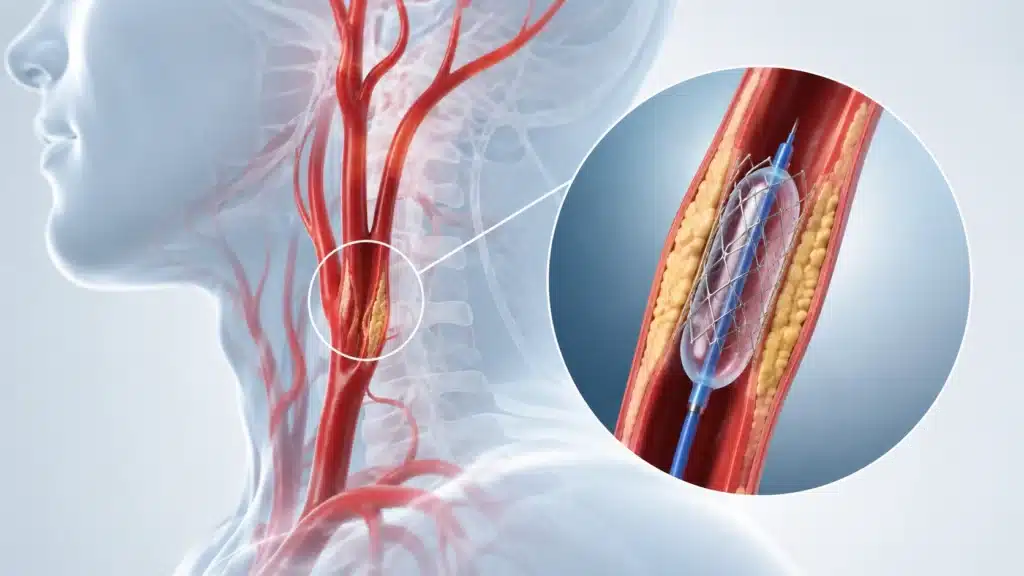
Carotid angioplasty and stenting is a minimally invasive procedure used to widen a narrowed carotid artery and improve blood flow to the brain. During the procedure, a thin catheter is guided through a blood vessel, usually from the groin or wrist, to the narrowed area in the neck. A small balloon may be inflated to open the artery, and a metal mesh tube called a stent is placed to help keep it open. Embolic protection devices may be used to reduce the chance of plaque particles travelling toward the brain.

What is Carotid Angioplasty?

Carotid angioplasty is a procedure used to open a narrowed carotid artery. It is often performed together with the placement of a stent, so it is commonly called carotid angioplasty and stenting, or CAS.

During angioplasty:

  • A catheter is inserted into a blood vessel.
  • The catheter is guided toward the narrowed carotid artery.
  • A small balloon is positioned at the site of narrowing.
  • The balloon is inflated briefly to widen the artery.
  • A stent may be placed to support the artery wall.
  • A protection device may be used to catch plaque particles that could otherwise travel toward the brain.

What are the Carotid Arteries?

The carotid arteries are two major blood vessels located on either side of the neck.

  • The right carotid artery supplies blood to the right side of the brain.
  • The left carotid artery supplies blood to the left side of the brain.
  • Each carotid artery divides into smaller branches within the neck.
  • These vessels supply oxygen and nutrients to parts of the brain, face, and neck.

The area where the main carotid artery divides into branches is especially vulnerable to plaque accumulation because blood flow changes direction there. If plaque becomes large or unstable, it can reduce blood flow or break apart and travel into smaller blood vessels in the brain.

What is Carotid Artery Disease?

Carotid artery disease occurs when plaque builds up inside the carotid arteries. Plaque is made up of cholesterol, fat, calcium, inflammatory cells, and other substances. This process is known as atherosclerosis.

Over time, plaque may:

  • Narrow the artery.
  • Reduce blood flow to the brain.
  • Become unstable and rupture.
  • Form a blood clot.
  • Send small particles into the brain.
  • Cause a TIA or stroke.

Carotid artery disease may progress slowly without symptoms. A person may not know about it until a stroke or TIA occurs. This is why controlling blood pressure, cholesterol, diabetes, smoking, and other risk factors is important.

Degrees of carotid narrowing

The percentage of narrowing is only one part of the decision-making process. Symptoms, plaque characteristics, brain imaging, overall health, and the patient’s risk from treatment also matter. Doctors may describe carotid stenosis as:

  • Mild narrowing.
  • Moderate narrowing.
  • Severe narrowing.
  • Near-total blockage.
  • Complete blockage.

Causes of Carotid Artery Narrowing

The most common cause is atherosclerosis, but other causes are possible.

Common causes include:

  • High cholesterol.
  • High blood pressure.
  • Diabetes.
  • Smoking.
  • Obesity.
  • Physical inactivity.
  • Increasing age.
  • Family history of vascular disease.
  • Kidney disease.
  • Inflammatory blood vessel conditions.
  • Previous radiation treatment to the neck.
  • Artery dissection after trauma or certain medical conditions.
  • Rare structural or congenital artery problems.

How plaque develops

The inner lining of an artery may become damaged by high blood pressure, smoking, high blood sugar, or abnormal cholesterol. The body responds with inflammation, and cholesterol particles collect in the damaged area. Over time, the plaque becomes thicker and may harden with calcium.

A plaque may be stable and cause gradual narrowing, or it may be fragile and rupture. A ruptured plaque can trigger a blood clot and cause a stroke even if the artery was not severely narrowed before.

Risk Factors for Carotid Artery Disease

Some risk factors can be changed, while others cannot.

  • Smoking or tobacco use.
  • High blood pressure.
  • High LDL cholesterol.
  • Diabetes.
  • Obesity.
  • Physical inactivity.
  • Unhealthy diet.
  • Excess alcohol use.
  • Poor sleep.
  • Uncontrolled stress.

Non-modifiable risk factors

  • Older age.
  • Family history of stroke or carotid disease.
  • Previous TIA or stroke.
  • Male sex in some age groups.
  • Certain inherited conditions.
  • Previous radiation to the neck.

Conditions that increase stroke risk

  • Irregular heartbeat such as atrial fibrillation.
  • Heart valve disease.
  • Previous stroke.
  • Peripheral artery disease.
  • Coronary artery disease.
  • High blood pressure.
  • Diabetes.
  • Chronic kidney disease.

Symptoms of Carotid Artery Disease

Carotid narrowing itself may not cause pain or obvious symptoms. The first sign may be a TIA or stroke caused by reduced blood flow or a clot.

Symptoms of a TIA or stroke may include:

  • Sudden weakness or numbness of the face, arm, or leg.
  • Symptoms affecting one side of the body.
  • Sudden difficulty speaking.
  • Trouble understanding speech.
  • Sudden loss or blurring of vision in one eye.
  • Loss of balance or coordination.
  • Sudden severe dizziness.
  • Difficulty walking.
  • Sudden confusion.
  • Severe unexplained headache in some cases.

The FAST warning signs

Do not wait to see whether symptoms improve. Even if symptoms disappear after a few minutes, the event may have been a TIA and requires urgent assessment. A simple way to remember major stroke signs is FAST:

  • F – Face: One side of the face droops when smiling.
  • A – Arms: One arm becomes weak or drifts downward.
  • S – Speech: Speech becomes unclear, confused, or difficult.
  • T – Time: Call emergency services immediately.

What is a TIA?

A transient ischaemic attack is a temporary episode in which part of the brain does not receive enough blood. Symptoms may resemble a stroke but resolve within minutes or hours.

A TIA is not harmless. It can be an early warning that a major stroke may occur soon. People who experience a TIA should receive urgent medical evaluation to identify the cause and reduce future risk.

TIA symptoms may include:

A person should not assume that the problem is resolved because symptoms have disappeared. Carotid imaging, brain imaging, heart evaluation, and blood tests may be required.

  • Temporary weakness on one side.
  • Brief loss of vision in one eye.
  • Short-term speech difficulty.
  • Sudden numbness.
  • Temporary loss of balance.
  • Brief confusion.

How is Carotid Artery Disease Diagnosed?

Diagnosis begins with a medical history and neurological examination. Imaging is then used to assess the carotid arteries and determine the degree and location of narrowing.

Common diagnostic tests

  • Carotid Doppler ultrasound.
  • CT angiography.
  • Magnetic resonance angiography.
  • Conventional cerebral angiography.
  • CT or MRI of the brain.
  • Blood tests for cholesterol, diabetes, kidney function, and clotting.
  • Heart rhythm evaluation.
  • Echocardiography in selected patients.

Carotid Doppler ultrasound

This is often the first test used because it is non-invasive and does not require radiation. It can estimate:

  • Blood flow speed.
  • Location of narrowing.
  • Approximate severity of stenosis.
  • Plaque characteristics.
  • Whether blood flow is significantly reduced.

CT angiography

CT angiography uses contrast dye and CT imaging to create detailed pictures of the carotid arteries. It can show:

  • The exact location of the blockage.
  • The length of the narrowed segment.
  • The anatomy of the artery.
  • Calcified plaque.
  • Other blood vessels supplying the brain.

Magnetic resonance angiography

Magnetic resonance angiography uses MRI technology to evaluate blood vessels. It may be useful when CT contrast or radiation needs to be avoided, although the choice depends on the patient’s condition and the quality of available images.

Cerebral angiography

Conventional angiography is an invasive test in which contrast dye is injected through a catheter. It provides highly detailed images and may be performed when other tests are inconclusive or when a procedure is being planned.

Who May Need Carotid Angioplasty?

Carotid angioplasty is considered for selected patients with significant carotid artery narrowing. The decision is individualised and may involve a vascular surgeon, neurologist, interventional specialist, cardiologist, or neurosurgeon.

  • There is significant carotid narrowing with recent TIA or stroke symptoms.
  • The patient has a high risk for carotid endarterectomy.
  • The narrowing has returned after previous endarterectomy.
  • The blockage is located in a difficult area for open surgery.
  • Previous radiation or neck surgery makes open surgery more complex.
  • The patient has serious heart or lung disease that increases surgical risk.
  • The patient’s anatomy is suitable for a catheter-based procedure.
  • The treating team believes the potential benefit outweighs the risks.

Carotid Angioplasty versus Carotid Endarterectomy

Carotid endarterectomy is an open surgical procedure in which an incision is made in the neck and plaque is removed from inside the artery. Carotid angioplasty and stenting is performed through a catheter without a large neck incision.

  • A minimally invasive approach.
  • No large neck incision.
  • Lower risk of some wound-related problems.
  • Reduced risk of injury to certain nerves in the neck.
  • Usefulness for patients with previous neck surgery or radiation.
  • Potentially shorter recovery in selected patients.

Carotid endarterectomy may offer:

  • Direct removal of plaque.
  • A well-established treatment for many patients with symptomatic carotid stenosis.
  • Lower risk of procedure-related stroke in some patient groups, particularly certain older adults.
  • Suitability when arterial anatomy makes stenting less favourable.

Preparation for Carotid Angioplasty

Before the procedure, the medical team evaluates the patient’s overall health and confirms that angioplasty is appropriate.

Pre-procedure evaluation may include:

  • Review of TIA or stroke symptoms.
  • Neurological examination.
  • Carotid imaging.
  • Brain imaging.
  • Blood pressure measurement.
  • Blood tests.
  • Kidney function testing.
  • Assessment of diabetes and cholesterol.
  • Heart rhythm evaluation.
  • Review of previous surgeries and medical conditions.
  • Review of allergies, especially contrast allergy.
  • Review of all medicines and supplements.

Medicines before the procedure

Patients may be prescribed antiplatelet medicines such as aspirin and clopidogrel before and after stenting. These medicines help reduce the risk of blood clot formation.

Patients should tell the doctor if they:

  • Have a history of bleeding.
  • Take blood thinners.
  • Have a stomach ulcer.
  • Have kidney disease.
  • Have had an allergic reaction to contrast dye.
  • Have difficulty taking medicines regularly.

Instructions before the procedure

The medical team may advise the patient to:

  • Avoid food and drink for a specified period.
  • Take selected medicines with a small amount of water.
  • Arrange transport and home support.
  • Bring previous reports and medication lists.
  • Inform the team about any new fever, infection, or symptoms.
  • Follow instructions about diabetes medicines.

How is Carotid Angioplasty Performed?

The procedure is performed in a specialised catheterisation or angiography suite.

Step-by-step overview

  • The patient lies on an imaging table.
  • The skin at the access site is cleaned and numbed.
  • The access site may be in the groin or wrist.
  • A small sheath is inserted into the artery.
  • A thin catheter is guided through the blood vessels toward the carotid artery.
  • Contrast dye is injected to visualise the narrowing.
  • A protection device may be placed beyond the narrowing.
  • A balloon may be inflated to widen the artery.
  • A stent is positioned across the narrowed segment.
  • The stent expands and presses against the artery wall.
  • The balloon and catheter are removed.
  • The access site is closed or compressed.
  • The patient is moved to a recovery area for monitoring.

Anaesthesia and awareness

Most procedures are performed under local anaesthesia with medication to help the patient relax. The patient may remain awake enough to respond to instructions and allow the team to monitor neurological function.

The exact approach depends on the patient, the equipment, and the treating team.

Embolic protection

During angioplasty, manipulating plaque can potentially release small particles. An embolic protection device may be used to reduce the chance that debris travels to the brain.

The type of protection device depends on the anatomy of the blood vessel and the specialist’s technique. It is an important part of planning carotid stenting.

What Does the Patient Feel During the Procedure?

Patients may feel:

  • A brief sting when local anaesthesia is given.
  • Pressure at the catheter insertion site.
  • Warmth when contrast dye is injected.
  • Mild neck pressure during balloon inflation.
  • Temporary changes in heart rate or blood pressure.
  • A need to remain still during imaging.

Patients should immediately tell the medical team if they experience:

  • Sudden weakness.
  • Difficulty speaking.
  • Vision changes.
  • Severe headache.
  • Chest discomfort.
  • Breathlessness.
  • Severe pain.
  • Nausea or an unusual sensation.

Benefits of Carotid Angioplasty

The main goal of carotid angioplasty is to reduce the risk of future stroke in an appropriate patient.

  • Improved blood flow through the carotid artery.
  • Reduced narrowing.
  • Prevention of future plaque-related emboli.
  • Reduced risk of recurrent TIA or stroke in selected patients.
  • Avoidance of a large neck incision.
  • Potentially shorter hospital recovery.
  • Treatment option for patients who may not be ideal candidates for open surgery.
  • Ability to treat certain recurrent or anatomically difficult blockages.

The procedure does not eliminate the underlying tendency to develop atherosclerosis. Patients still need long-term treatment for cholesterol, blood pressure, diabetes, smoking, and other vascular risk factors.

Risks and Possible Complications

Carotid angioplasty is performed to prevent stroke, but the procedure itself carries a risk of stroke and other complications. The medical team explains the expected benefits and risks before treatment.

  • Stroke.
  • TIA.
  • Bleeding or bruising at the catheter site.
  • Blood clot at the access site.
  • Injury to the artery.
  • Sudden closure of the carotid artery.
  • Stent movement or incorrect placement.
  • Blood clot forming inside the stent.
  • Re-narrowing of the artery.
  • Heart attack.
  • Irregular heart rhythm.
  • Low or high blood pressure.
  • Allergic reaction to contrast dye.
  • Kidney injury related to contrast.
  • Infection.
  • Emergency surgery.

Recovery After Carotid Angioplasty

After the procedure, the patient is taken to a recovery area or monitored hospital unit. Nurses and doctors check blood pressure, pulse, the catheter site, and neurological function.

  • Strength in the arms and legs.
  • Speech and facial movement.
  • Vision and alertness.
  • Blood pressure.
  • Heart rhythm.
  • Bleeding or swelling at the access site.
  • Urine output.
  • Kidney function in selected patients.

At the catheter site

The patient may notice:

  • Mild soreness.
  • Bruising.
  • A small lump.
  • Mild swelling.
  • Tenderness for a few days.

Activity after the procedure

Patients are commonly advised to:

  • Rest for the first day.
  • Avoid heavy lifting for the period recommended by the doctor.
  • Keep the catheter site clean and dry.
  • Avoid strenuous exercise until cleared.
  • Drink fluids if permitted to help clear contrast.
  • Take medicines exactly as prescribed.
  • Attend follow-up appointments.

Long-Term Lifestyle Changes

Carotid angioplasty treats the narrowed artery but does not cure atherosclerosis throughout the body. Long-term lifestyle measures are essential.

  • Stop smoking and avoid all tobacco products.
  • Take statins or other cholesterol medicines as prescribed.
  • Control blood pressure.
  • Manage diabetes carefully.
  • Follow a heart-healthy eating pattern.
  • Maintain a healthy body weight.
  • Exercise according to medical advice.
  • Limit alcohol.
  • Sleep adequately.
  • Attend regular medical reviews.
  • Take antiplatelet treatment as prescribed.
  • Report new neurological symptoms immediately.

Heart-healthy diet principles

  • Eat more vegetables and fruits.
  • Choose whole grains.
  • Include pulses, beans, and appropriate sources of protein.
  • Choose healthy fats in moderate amounts.
  • Reduce trans fats and excess saturated fats.
  • Limit salt if advised.
  • Reduce processed foods and sugary drinks.
  • Follow nutritional advice if kidney, heart, or liver disease is present.

When to Seek Emergency Care After the Procedure?

Call emergency services or seek urgent medical care if you develop:

  • Sudden weakness or numbness.
  • Facial drooping.
  • Difficulty speaking.
  • Loss of vision.
  • Severe dizziness or loss of balance.
  • Sudden severe headache.
  • Seizure.
  • Loss of consciousness.
  • Heavy bleeding from the catheter site.
  • Rapidly increasing swelling at the access site.
  • Severe chest pain.
  • Severe breathlessness.
  • Very little urine after contrast exposure.

Is Carotid Angioplasty a Permanent Treatment?

A stent is designed to remain in the artery permanently. However, the patient’s overall vascular disease can continue to progress if risk factors are not controlled.

Long-term success depends on:

  • Taking antiplatelet medicines.
  • Controlling cholesterol.
  • Stopping smoking.
  • Managing blood pressure and diabetes.
  • Maintaining physical activity.
  • Attending follow-up appointments.
  • Monitoring the stent and other arteries.

Why Choose Rama Hospital for Carotid Angioplasty?

Carotid angioplasty is a highly specialised procedure because the treated artery supplies the brain. It requires accurate imaging, careful patient selection, embolic protection, experienced intervention, and neurological monitoring.

  • Evaluation by a multidisciplinary vascular and neurological team.
  • Advanced imaging of carotid arteries and the brain.
  • Individualised comparison of angioplasty and carotid endarterectomy.
  • Specialist catheter-based intervention.
  • Access to emergency stroke evaluation.
  • Monitoring before, during, and after the procedure.
  • Support for blood pressure, cholesterol, diabetes, and smoking cessation.
  • Follow-up imaging to assess the stent and blood flow.
  • Rehabilitation support when a previous TIA or stroke has affected function.

Frequently Asked Questions (FAQs)

Is carotid angioplasty the same as heart angioplasty?

The basic catheter technique is similar, but the arteries and risks are different. Carotid angioplasty treats arteries supplying the brain, so preventing plaque or clot movement toward the brain is a major concern.

Is carotid angioplasty safe?

It can be safe and effective in carefully selected patients when performed by an experienced team. However, it carries risks such as stroke, bleeding, artery injury, contrast reaction, and re-narrowing.

How long does carotid angioplasty take?

The duration varies according to the anatomy and complexity of the blockage. Patients also spend additional time in preparation and recovery, where blood pressure and neurological function are monitored.

How long does a patient stay in the hospital?

Many patients stay overnight and may go home within about 24 hours if recovery is uncomplicated. A longer stay may be needed after an emergency procedure, a stroke, or if other medical problems require monitoring.

Is carotid angioplasty painful?

The access area is numbed with local anaesthesia, so significant pain is not usually expected. Patients may feel pressure, brief warmth from contrast dye, or mild soreness and bruising afterward.

Can carotid artery narrowing return after angioplasty?

Yes, re-narrowing called restenosis can occur, although follow-up and medicines help reduce risk. Doppler ultrasound and risk-factor control are important after the procedure.

Is carotid endarterectomy better than angioplasty?

Neither treatment is best for every patient. Endarterectomy may be preferred for some people, while angioplasty may be suitable for those with high surgical risk or challenging neck anatomy.

What happens if carotid artery disease is not treated?

Some patients remain stable with medical treatment, but significant or symptomatic disease may increase the risk of TIA or stroke. A specialist should assess the degree of narrowing and recommend monitoring, medicines, surgery, or angioplasty as appropriate.

Conclusion

Carotid angioplasty and stenting is a minimally invasive treatment for selected patients with narrowed carotid arteries. By widening the artery and placing a stent when appropriate, the procedure can improve blood flow and help reduce the risk of future stroke.

However, carotid angioplasty is not automatically the right treatment for every patient. The decision depends on symptoms, the severity and location of narrowing, age, artery anatomy, previous procedures, general health, and the relative risks of angioplasty and carotid endarterectomy. In some cases, medicines and lifestyle changes may be sufficient, while others may benefit from open surgery or catheter-based treatment.
Table of Contents

Explore More

What to Know More About Carotid Angioplasty

Find Ailments & Treatments

Search Ailments

Quickly find the information you need. Search our database to explore detailed information on various diseases and conditions, including symptoms, causes, and treatment options.

Search Treatments

Quickly find the information you need. Search our database to explore detailed information on various diseases and conditions, including symptoms, causes, and treatment options.

Recommended Reading

Video Playlist

No rows found.

Experience Healthcare the Rama Way

Emergency • OPD • Surgery • ICU Care

Need Help? Talk to our experts

Get a callback from our experts

Request a callback