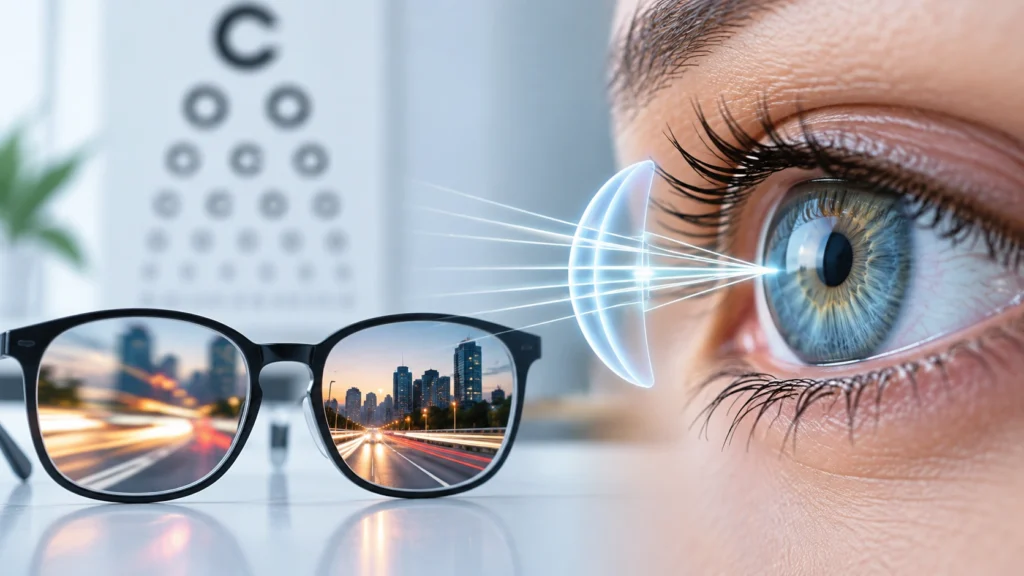
Astigmatism is one of the most common vision problems, yet many people do not fully understand what it means. It is not a disease of the eye, but rather a focusing problem caused by the shape of the eye. In a normal eye, the front surface called the cornea is smooth and curved like a perfect ball. In astigmatism, the cornea or the lens inside the eye is shaped more like a rugby ball or an oval. This irregular shape causes light to focus on more than one point instead of a single sharp point on the retina.
Because of this, vision becomes blurred or distorted at all distances. Some people think astigmatism only affects distance vision, but it can affect near vision as well. It can occur alone or along with other refractive errors such as myopia or hypermetropia. Many children and adults have mild astigmatism and may not even notice it. Others experience significant blurring, eye strain, headaches, and difficulty with reading or driving, especially at night.
What is Astigmatism?
Astigmatism is a refractive error, which means it is a problem with how the eye focuses light. It happens when the cornea or lens has an uneven curve. Instead of being perfectly round in all directions, one direction is steeper or flatter than the other. This causes light rays to focus at multiple points instead of one sharp point on the retina.
As a result, images look blurred, stretched, or shadowed. Straight lines may appear tilted or wavy. Vision may be unclear at all distances, not just far or near. Astigmatism can be present from birth or develop later in life. It can remain stable for years or change slowly over time.
Astigmatism is very common and often runs in families. Many people have a small amount of astigmatism that does not need treatment. When it is significant, it can affect daily activities such as reading, studying, driving, using screens, or recognizing faces.
Types of Astigmatism
Astigmatism can be classified in different ways based on the part of the eye involved, the pattern of curvature, and how it combines with other refractive errors.
Based on the part of the eye involved
- Corneal astigmatism, where the irregularity is mainly in the cornea.
- Lenticular astigmatism, where the irregularity is mainly in the lens inside the eye.
Based on the pattern of curvature
- Regular astigmatism, where the curvature is uneven but predictable and can be corrected with standard glasses or contact lenses.
- Irregular astigmatism, where the curvature is uneven in a more complex way, often due to corneal disease, scarring, or conditions like keratoconus.
Based on combination with other refractive errors
- Simple myopic astigmatism, where one main focus is in front of the retina and the other is on the retina.
- Simple hyperopic astigmatism, where one main focus is behind the retina and the other is on the retina.
- Compound myopic astigmatism, where both main focuses are in front of the retina but at different points.
- Compound hyperopic astigmatism, where both main focuses are behind the retina but at different points.
- Mixed astigmatism, where one focus is in front of the retina and the other is behind it.
Based on onset
- Congenital astigmatism, present from birth or early childhood.
- Acquired astigmatism, developing later due to injury, surgery, or corneal disease.
Causes of Astigmatism
The exact cause of astigmatism is not always clear, but it is usually related to the natural shape of the cornea or lens.
Common causes and contributing factors
- Natural variation in corneal shape from birth.
- Family history of astigmatism or other refractive errors.
- Changes in the lens with age.
- Eye injury affecting the cornea.
- Corneal scarring from infection or inflammation.
- Previous eye surgery such as cataract surgery or corneal procedures.
- Conditions like keratoconus, where the cornea becomes thin and cone-shaped.
- Chronic eye rubbing, which can worsen corneal shape in susceptible people.
- Certain eyelid conditions that press on the cornea over time.
Why the cornea becomes irregular: In many people, the cornea simply develops with a slightly oval shape instead of a round one. This is often genetic. In others, the corneal shape changes due to disease, injury, or pressure from the eyelids. In conditions like keratoconus, the corneal tissue weakens and bulges forward, causing increasing irregular astigmatism.
Risk Factors for Astigmatism
Some people are more likely to develop astigmatism or have more significant astigmatism than others.
Higher-risk groups
- People with a family history of astigmatism.
- Children born with other refractive errors.
- Individuals with keratoconus or corneal disease.
- People who have had eye injuries or corneal scarring.
- Patients who have undergone certain eye surgeries.
- Individuals with chronic allergic eye disease and frequent eye rubbing.
- People with certain genetic or connective tissue disorders.
Why risk increases in these groups
- Genetics influence corneal shape and structure.
- Corneal disease directly affects the focusing surface.
- Injury and scarring distort the corneal surface.
- Surgery can change corneal curvature.
- Eye rubbing can progressively alter corneal shape in vulnerable corneas.
Symptoms of Astigmatism
Symptoms depend on the degree of astigmatism, the age of the person, and whether it is combined with other vision problems.
Common symptoms
- Blurred vision at all distances.
- Distorted or wavy vision.
- Difficulty seeing fine details.
- Eye strain or tired eyes.
- Headaches, especially after reading or screen use.
- Squinting to see clearly.
- Difficulty with night vision.
- Glare or halos around lights.
- Double vision in some cases.
- Frequent changes in glasses prescription.
Symptoms in children
- Sitting too close to the television.
- Holding books very close.
- Rubbing eyes frequently.
- Avoiding reading or drawing.
- Poor school performance due to vision strain.
- Complaints of headache or eye discomfort.
- Tilting the head to see better.
Symptoms that affect daily life
- Difficulty recognizing faces at a distance.
- Trouble reading small print for long periods.
- Problems with driving at night due to glare.
- Eye fatigue during computer or phone use.
- Needing to squint to see clearly on screens or boards.
Astigmatism in Different Age Groups
Astigmatism can affect people of all ages, but the impact and management may vary.
In infants and young children
- Mild astigmatism is common and may improve as the eye grows.
- Significant astigmatism can affect visual development and lead to lazy eye if not corrected.
- Early detection through vision screening is important.
In school-age children and teenagers
- Astigmatism can affect learning and concentration.
- Children may complain of headaches or avoid reading.
- Regular eye exams are important to update glasses and monitor changes.
In adults
- Astigmatism may remain stable or change slowly.
- Symptoms may become more noticeable with increased screen time.
- Night driving and fine detail work may become more difficult.
In older adults
- Astigmatism can combine with presbyopia and cataract.
- Lens changes can alter the amount and type of astigmatism.
- Cataract surgery planning often includes astigmatism correction.
How is Astigmatism Diagnosed?
Diagnosis is based on a detailed eye examination by an eye specialist. Since symptoms can be similar to other vision problems, proper testing is important.
- Detailed history of vision symptoms and daily activities.
- Family history of eye problems or refractive errors.
- Visual acuity testing using a chart for distance and near.
- Refraction test to determine the exact glasses prescription.
- Keratometry to measure the curvature of the cornea.
- Corneal topography to map the surface of the cornea in detail.
- Slit-lamp examination to check the health of the cornea and lens.
- Retinal examination to rule out other eye diseases..
Why diagnosis matters: Accurate diagnosis ensures the correct glasses or contact lens prescription. It also helps detect conditions like keratoconus early, which need different management. Proper measurement is essential before considering any surgical correction.
Treatment for Astigmatism
Treatment depends on the degree of astigmatism, symptoms, age, lifestyle, and eye health. The goal is to provide clear, comfortable vision and reduce eye strain.
1. Glasses
Glasses are the simplest and safest way to correct astigmatism.
- Cylindrical lenses are used to compensate for the uneven corneal curvature.
- Suitable for most types of regular astigmatism.
- Easy to use and maintain.
- Can be combined with lenses for near vision in older adults.
- Regular prescription updates may be needed if astigmatism changes.
2. Contact Lenses
Contact lenses can provide sharp vision and a wider field of view.
- Soft toric contact lenses are designed for regular astigmatism.
- Rigid gas permeable lenses can correct higher or irregular astigmatism.
- Special lenses may be used for keratoconus.
- Require proper hygiene and regular follow-up.
- Not suitable for everyone, especially those with dry eye or certain corneal conditions.
3. Refractive Surgery
Surgery can reduce or eliminate the need for glasses or contact lenses in suitable candidates.
- LASIK can correct regular astigmatism by reshaping the cornea.
- PRK is another laser option for selected patients.
- SMILE may be an option for certain types of refractive error with astigmatism.
- Toric intraocular lenses can be used during cataract surgery to correct astigmatism.
- Not everyone is a candidate; thorough evaluation is essential.
4. Management of Underlying Corneal Disease
If astigmatism is due to conditions like keratoconus, additional treatment may be needed.
- Corneal collagen cross-linking to strengthen the cornea.
- Special contact lenses such as scleral lenses for better vision.
- Intracorneal ring segments in selected cases.
- Corneal transplant in advanced disease.
5. Observation for Mild Cases
Some people have very mild astigmatism that does not affect vision significantly.
- No treatment may be needed if there are no symptoms.
- Regular eye exams to monitor any changes.
- Glasses may be prescribed only for specific tasks like driving or reading.
Vision Correction Options in Detail
Different correction methods suit different needs and lifestyles.
Glasses for astigmatism
- Most common and non-invasive option.
- Provide stable and clear vision.
- Can include anti-reflective coating for screen use and night driving.
- Useful for children, adults, and older patients.
- May cause initial distortion that improves with adaptation.
Contact lenses for astigmatism
- Provide a more natural field of view.
- Useful for sports and active lifestyles.
- Toric soft lenses are designed to stay oriented correctly on the eye.
- Rigid lenses can give sharper vision in irregular astigmatism.
- Require discipline in cleaning and wearing schedule.
Surgical correction
- Can reduce dependence on glasses or lenses.
- Best for stable astigmatism in adults.
- Requires adequate corneal thickness and healthy eyes.
- Not recommended during pregnancy or in unstable refractive error.
- Needs detailed preoperative evaluation and realistic expectations.
Recovery After Treatment
Recovery depends on the type of treatment chosen.
Recovery with glasses
- Immediate improvement in vision once glasses are worn.
- Short adaptation period for new prescriptions.
- No downtime or restrictions.
- Regular follow-up to update prescription as needed.
Recovery with contact lenses
- Vision improves once lenses are properly fitted.
- Initial comfort may take a few days to adjust.
- Regular follow-up to check corneal health and lens fit.
- Important to follow hygiene instructions to prevent infection.
Recovery after refractive surgery
- Vision may be hazy for a few days after surgery.
- Dryness, glare, or halos may occur temporarily.
- Most people resume normal activities within a few days.
- Full visual stabilization may take weeks to months.
- Strict follow-up and use of prescribed drops are essential.
Recovery after corneal disease treatment
- Depends on the procedure and severity of disease.
- Vision may improve gradually over weeks to months.
- Long-term monitoring is important to ensure stability.
- Additional procedures may be needed in some cases.
Possible Complications
Untreated or poorly corrected astigmatism can affect quality of life and eye health.
Complications of uncorrected astigmatism
- Persistent eye strain and headaches.
- Reduced concentration and productivity.
- Poor academic or work performance in children and adults.
- Increased risk of accidents due to blurred vision.
- Development of lazy eye in children with significant uncorrected astigmatism.
Complications related to contact lens use
- Eye infection if hygiene is poor.
- Corneal irritation or ulcers with overuse.
- Dryness and discomfort with prolonged wear.
- Allergic reactions to lens solutions in some people.
Complications related to surgery
- Dry eye symptoms for some time after surgery.
- Glare, halos, or night vision issues in some cases.
- Under-correction or over-correction requiring enhancement.
- Rare risk of infection or corneal complications.
- Not all patients achieve perfect vision without any glasses.
When Should You See an Eye Specialist?
Regular eye exams are important for everyone, but some symptoms need prompt evaluation.
- Blurred or distorted vision at any distance.
- Frequent headaches related to eye use.
- Difficulty reading or working on screens.
- Problems with night driving or glare.
- Squinting to see clearly.
- Frequent changes in glasses prescription.
- A child who avoids reading or sits too close to screens.
- History of eye injury or corneal disease.
Prevention of Complications
Astigmatism itself cannot always be prevented, but complications can be reduced.
- Regular eye examinations from childhood onwards.
- Early correction of significant astigmatism in children.
- Proper glasses or contact lens prescription.
- Good contact lens hygiene and regular replacement.
- Avoiding excessive eye rubbing, especially in allergic eye disease.
- Prompt treatment of corneal infections or injuries.
- Realistic expectations and proper screening before surgery.
For children
- Vision screening at school entry or earlier if concerns exist.
- Encourage outdoor play and limit excessive screen time.
- Ensure proper lighting for reading and studying.
- Follow up regularly if astigmatism is detected.
For contact lens users
- Wash hands before handling lenses.
- Use fresh solution and clean cases.
- Do not sleep in lenses unless specifically advised.
- Remove lenses if eyes become red or painful.
- Attend regular check-ups to monitor corneal health.
Why Choose Rama Hospital for Astigmatism Care?
Astigmatism may seem like a simple glasses issue, but in some cases it is linked to corneal disease, irregular vision, or surgical planning that needs expert care. A hospital-based eye department can provide comprehensive evaluation and treatment under one roof.
- Detailed refraction and corneal mapping.
- Detection of early keratoconus and irregular astigmatism.
- Access to advanced contact lens options.
- Expert evaluation for refractive surgery suitability.
- Coordinated care with cornea and retina specialists if needed.
- Long-term follow-up for children and complex cases.
Frequently Asked Questions (FAQs)
Is astigmatism a disease?
No, astigmatism is not a disease. It is a refractive error like myopia or hypermetropia. It can be corrected with glasses, contact lenses, or in suitable cases, surgery. However, irregular astigmatism can sometimes be due to corneal disease that needs special care.
Can astigmatism get worse over time?
In many people, astigmatism remains stable for years. In some, especially with conditions like keratoconus or after eye injury, it can progress. Regular eye exams help monitor changes and update correction as needed.
Can children have astigmatism?
Yes, children can have astigmatism from an early age. Significant astigmatism can affect visual development and learning. Early detection and proper glasses can prevent lazy eye and support normal vision development.
Do I need glasses all the time for astigmatism?
It depends on the degree of astigmatism and symptoms. Some people need glasses for all activities, while others may use them mainly for driving, reading, or screen work. Your eye specialist will advise based on your vision and lifestyle.
Can contact lenses correct astigmatism?
Yes, toric soft contact lenses and rigid gas permeable lenses can correct astigmatism effectively. They are especially useful for people who do not tolerate glasses or want better peripheral vision. Proper fitting and hygiene are essential.
Is surgery safe for astigmatism?
Refractive surgery such as LASIK can safely correct regular astigmatism in suitable candidates. A detailed evaluation is needed to check corneal thickness, shape, and overall eye health. Surgery is not recommended for everyone, especially in irregular astigmatism or corneal disease.
Can astigmatism cause headaches?
Yes, uncorrected or under-corrected astigmatism can cause eye strain and headaches, especially after reading, studying, or screen use. Proper glasses or contact lenses usually reduce these symptoms significantly.
Conclusion
Astigmatism is a common and treatable vision problem that affects how clearly a person sees at all distances. It is caused by an uneven curvature of the cornea or lens, leading to blurred or distorted vision, eye strain, and headaches. Many people live with mild astigmatism without realizing it, while others need regular correction to function comfortably.
The most important steps are proper diagnosis, accurate prescription, and regular follow-up. For children, early detection is crucial to support normal visual development. For adults, the right correction can improve comfort, productivity, and safety, especially for driving and screen use. With modern glasses, contact lenses, and surgical options, most people with astigmatism can achieve clear and comfortable vision.
Rama Hospital can help evaluate astigmatism, detect any underlying corneal issues, and provide a clear treatment plan that supports optimal vision and long-term eye health.