
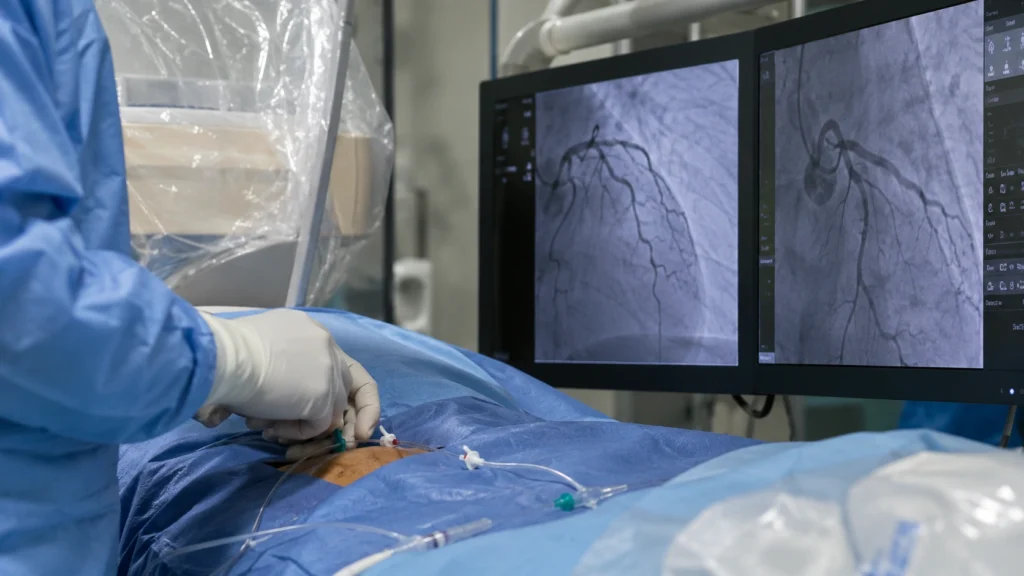
Coronary angiography is one of the most important tests used to find blockages or narrowing in the heart’s arteries. It helps doctors understand why a patient may be having chest pain, shortness of breath, abnormal stress test results, or signs of reduced blood flow to the heart. When done at the right time, it can guide life-saving treatment and help prevent a heart attack.
At a hospital like Rama Hospital, coronary angiography is not just a diagnostic test. It is part of a complete heart-care pathway that may include evaluation, medication planning, angioplasty referral, and follow-up with a cardiologist. For patients and families, understanding the test clearly can reduce fear and help them make better decisions.
The heart depends on a network of blood vessels called coronary arteries. These arteries supply oxygen-rich blood to the heart muscle. When these arteries become narrow or blocked because of plaque buildup, the heart may not receive enough blood, especially during physical activity or stress.
Coronary angiography is a specialized X-ray test that uses contrast dye to show the inside of the coronary arteries. It helps doctors see whether the arteries are normal, mildly narrowed, severely narrowed, or completely blocked. Because it gives a direct look at the coronary circulation, it remains the gold standard for diagnosing coronary artery disease in many cases.
This test is often recommended when symptoms suggest heart disease or when other tests such as ECG, echocardiogram, treadmill test, or stress imaging raise concern. It may also be used in emergency situations, especially when a heart attack is suspected.
For a patient, the idea of a catheter-based heart test can sound intimidating. But in reality, coronary angiography is a routine, widely performed procedure in modern cardiac care. With proper preparation, experienced doctors, and good monitoring, it is generally safe and highly informative.
Coronary angiography is a diagnostic procedure that uses a thin tube called a catheter, special contrast dye, and X-ray imaging to visualize the coronary arteries. The catheter is usually inserted through an artery in the wrist or groin and guided to the heart under imaging control.
Once the catheter reaches the opening of the coronary arteries, contrast dye is injected. The dye makes the arteries visible on live X-ray images so the cardiologist can see any narrowing, blockage, or abnormal blood flow. This information is crucial because treatment decisions depend on the exact location and severity of the blockage.
In simple language, coronary angiography answers questions like:
Coronary angiography is important because heart artery disease can be serious even when symptoms seem mild. Some patients have significant blockages without obvious signs, while others may have chest discomfort that turns out to be related to restricted blood flow. For many patients, the test becomes the turning point in treatment because it replaces guesswork with clarity.
This test helps in several ways:
Coronary angiography is not done for every person with chest discomfort. It is usually recommended when the doctor believes there is a significant chance of coronary artery disease or when further clarification is needed. It may also be advised in people who already have known heart disease and need assessment before a treatment decision is made.
You may need coronary angiography if you have:
Coronary angiography is used to investigate or confirm several heart-related concerns. It may also be used when test results do not match the patient’s symptoms, or when doctors need a final decision about intervention. These include:
Doctors may recommend coronary angiography if a patient has symptoms that suggest reduced blood flow to the heart.
Not all chest pain is due to coronary artery disease, but these symptoms often need proper evaluation.
Common symptoms include:
Coronary angiography is often considered when a patient has one or more major risk factors for heart disease.
The more risk factors a patient has, the more important it becomes to assess the coronary arteries when symptoms or test findings raise concern.
These include:
Coronary angiography is usually not the first test. Doctors often begin with an initial cardiac evaluation and then recommend angiography when needed.
Initial assessments may include:
Blood tests may include:
These tests help the cardiologist assess whether angiography is appropriate and safe.
| Test | What it shows | Best use | Limitations |
| ECG | Electrical activity of the heart | Initial screening of rhythm or heart attack signs | Does not show artery blockages directly |
| Echocardiogram | Heart structure and pumping function | Valve assessment, heart muscle function | Does not show coronary arteries clearly |
| Stress test | Heart response to exercise or medication | Detects reduced blood flow indirectly | Cannot define exact blockage location |
| CT coronary angiography | Non-invasive imaging of coronary arteries | Selected stable patients | May not be suitable in every case |
| Coronary angiography | Direct X-ray imaging of coronary arteries | Definitive diagnosis of blockages | Invasive procedure with small procedural risks |
There are different ways to perform coronary angiography depending on the situation.
Coronary angiography is highly valuable because it shows the problem directly. Many non-invasive tests can suggest ischemia or reduced blood flow, but angiography tells the doctor exactly where the artery is narrowed and how severe the blockage is.
This precision makes it one of the most trusted tests in cardiology.
Doctors prefer it when:
The procedure section should be detailed, because this is one of the highest-intent areas of the page. Patients want to know what will happen before, during, and after the test.
Before the procedure: The patient is evaluated by the cardiology team. The doctor reviews symptoms, medical history, allergies, medicines, and kidney function. The patient may be asked to fast for a certain number of hours before the test.
Preparation points before angiography
During the procedure
Procedure pointers
After the procedure
| Feature | Radial access | Femoral access |
| Entry point | Wrist artery | Groin artery |
| Comfort after procedure | Often more comfortable | May require longer rest |
| Bleeding risk | Generally lower | May be higher in some cases |
| Recovery | Often quicker | May be slower |
| Best use | Commonly preferred for many patients | Used when clinically appropriate |
The cardiologist uses this information to decide whether medication alone is enough or whether angioplasty or bypass surgery should be considered.
Coronary angiography provides detailed information about the coronary arteries. The report may show:
If the test shows a blockage, the doctor will decide the next step based on severity, symptoms, and overall health.
Not every blockage needs an immediate procedure. Some can be managed medically, while others need intervention.
Possible next steps include:
Many patients confuse coronary angiography with angioplasty. They are related but not the same. Sometimes angioplasty is done in the same sitting if the doctor sees a severe blockage and if the patient’s condition allows it. In other cases, the angiography is completed first and the treatment plan is decided later.
For patients with ongoing symptoms, the clarity provided by this test is often invaluable. Coronary angiography has several important benefits:
Coronary angiography is commonly performed and generally safe, but it is still an invasive procedure, so risks must be discussed. The risk level depends on the patient’s age, kidney function, heart condition, and other medical problems.
Possible risks include:
Some patients need additional planning before angiography. Doctors may take special precautions such as hydration, medicine adjustments, or alternate imaging if needed.
Extra caution is important in people with:
Recovery is usually straightforward, but proper aftercare is important. Most patients resume routine activities soon, depending on the access site and medical advice.
After the procedure, patients may be advised to:
When to contact the hospital after angiography
If angiography shows coronary artery disease, lifestyle changes are an important part of the long-term plan. These steps matter whether the patient is managed medically or undergoes a procedure.
Helpful changes include:
A hospital landing page should also answer why a patient should choose the institution. Patients want reassurance that the hospital has the right expertise, technology, and emergency support. The page should clearly communicate that coronary angiography is done with precision, safety, and patient comfort in mind.
Rama Hospital can be positioned as a trusted center for:
Immediate medical attention is required if chest pain is severe, persistent, or associated with sweating, nausea, fainting, or breathlessness. You should see a cardiologist if you have:
Most patients feel only mild discomfort, not major pain. The area where the catheter is inserted is numbed, and the test is closely monitored throughout.
The procedure is usually completed in a relatively short time, though the exact duration depends on how many views are needed and whether the case is complex. Patients are also observed afterward for safety.
Yes, it is a commonly performed cardiac procedure and is generally safe when done by an experienced team. Like all invasive procedures, it has small risks, which your doctor will explain before the test.
Some patients go home the same day, while others may need observation or admission depending on the findings and their overall condition. Emergency cases often require closer monitoring.
Follow fasting instructions, tell your doctor about allergies and kidney problems, and bring previous reports. You should also ask about medicines that may need adjustment before the procedure.
No, angiography is the diagnostic test that shows the arteries, while angioplasty is a treatment that opens blocked arteries. Sometimes both are done together, but they are different procedures.
Usually, patients are advised not to drive immediately after the procedure. It is better to have someone accompany you, especially if sedation was used or if you had groin access.
If a significant blockage is found, the cardiologist may recommend medicines, stenting, or bypass surgery depending on the location and severity. The angiography report helps decide the safest and most effective plan.
Coronary angiography is a highly important test for finding blockages in the heart’s arteries and guiding the right treatment at the right time. It is especially valuable for patients with chest pain, abnormal stress tests, reduced heart function, or suspected coronary artery disease.
At Rama Hospital, coronary angiography can be presented as part of a complete cardiology service that supports diagnosis, treatment planning, and ongoing heart care.



A coronary angiogram can help your cardiologist look for blockages in your coronary arteries.
No rows found.