PDA Closure: Procedure, Benefits, Recovery & Risks

Patent ductus arteriosus is one of the most common congenital heart defects. It occurs when the ductus arteriosus, a normal blood vessel in the fetus, does not close after birth as it should. In the womb, this vessel helps blood bypass the lungs because the baby receives oxygen from the mother. After birth, the lungs take over, and the ductus arteriosus should close within a few days. When it does not, blood continues to flow from the aorta into the pulmonary artery, causing the lungs to receive too much blood and the heart to work harder.

Many children with a small PDA have no symptoms and may only be diagnosed when a doctor hears a heart murmur during a routine checkup. Larger PDAs can cause poor feeding, breathlessness, frequent chest infections, slow weight gain, and poor exercise tolerance. In adults, an untreated PDA may eventually lead to heart strain, pulmonary hypertension, or heart failure.

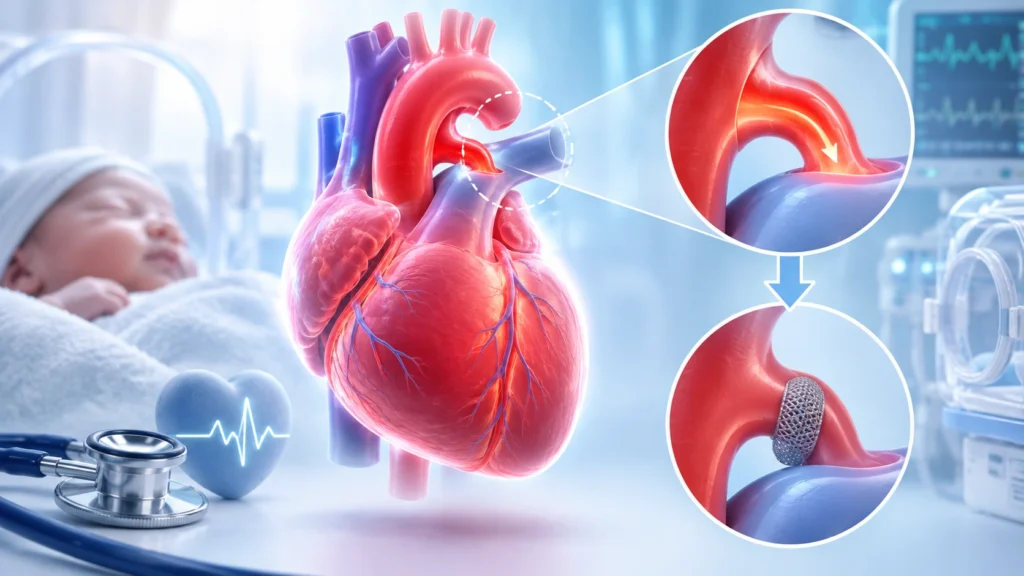
PDA closure is the treatment that closes this abnormal vessel. In most children and many adults, the procedure can be done through a catheter-based approach where a small device is placed inside the PDA to block blood flow through it. In some cases, especially in very small infants or complex anatomy, surgery may be needed instead. The goal of treatment is to stop the abnormal blood flow, reduce the workload on the heart, prevent complications, and allow normal growth and development.

What is PDA?

PDA stands for patent ductus arteriosus. It is a congenital heart defect where a fetal blood vessel called the ductus arteriosus remains open after birth. Normally, this vessel closes within the first few days of life as the baby begins to breathe and the lungs take over the work of oxygenating the blood.

When the ductus arteriosus stays open:

  • Blood flows from the high-pressure aorta to the low-pressure pulmonary artery.
  • Extra blood is sent to the lungs.
  • The heart has to pump more blood than normal.
  • Over time, the left side of the heart can become enlarged.
  • The lungs can become over-circulated.

In simple terms, a PDA is like an extra tunnel between two major blood vessels that should have closed after birth. If left open for a long time, it can cause strain on the heart and lungs.

Who Needs PDA Closure?

Not every PDA needs to be closed. Very small PDAs with no symptoms and no heart enlargement may sometimes be monitored. However, most PDAs are closed to prevent long-term complications.

PDA closure is usually recommended when:

  • The PDA is moderate to large in size.
  • The child has symptoms such as breathlessness or poor feeding.
  • There is evidence of heart enlargement on echocardiography.
  • The child has frequent chest infections.
  • There is poor weight gain or growth delay.
  • The patient is an adult with a diagnosed PDA.
  • There is a risk of pulmonary hypertension or heart strain.
  • The cardiologist feels that closure will prevent future complications.

The decision to close the PDA is made by a pediatric cardiologist or congenital heart specialist after reviewing the echocardiogram, symptoms, and overall health of the patient.

What Causes PDA?

The exact cause of PDA is not always clear. In many cases, it occurs as an isolated finding without a known reason. Certain factors may increase the risk of PDA.

Possible risk factors include:

  • Premature birth.
  • Low birth weight.
  • Family history of congenital heart disease.
  • Genetic syndromes in some cases.
  • Maternal infections during pregnancy.
  • Certain exposures during pregnancy.

Most cases of PDA are not caused by anything the parents did or did not do. It is simply a developmental variation that happens during fetal growth.

Signs and Symptoms of PDA

The symptoms of PDA depend on the size of the defect and the amount of extra blood flowing to the lungs. Many infants and children with a small PDA have no symptoms at all.

In infants and young children

  • Fast breathing.
  • Difficulty feeding.
  • Sweating during feeding.
  • Poor weight gain.
  • Frequent chest infections.
  • Tiring easily.
  • Recurrent cough or cold.
  • Heart murmur detected by the doctor.

In older children and adults

  • Shortness of breath on exertion.
  • Fatigue.
  • Reduced exercise tolerance.
  • Palpitations in some cases.
  • Heart murmur.
  • Symptoms of heart strain in advanced cases.

Some adults may have a PDA discovered incidentally during a checkup or evaluation for other heart issues.

Why PDA Closure Is Important?

Leaving a significant PDA untreated can lead to complications over time. The heart and lungs are not designed to handle extra blood flow indefinitely.

Long-term risks of untreated PDA include:

  • Enlargement of the heart.
  • Heart failure in severe cases.
  • Pulmonary hypertension.
  • Increased risk of infections in the lungs.
  • Reduced growth in children.
  • Arrhythmias in some patients.
  • Higher risk of complications in adulthood.

Closing the PDA helps prevent these complications, reduces the workload on the heart, and allows more normal cardiovascular function.

Diagnosis for PDA

Diagnosis of PDA usually begins with a physical examination and a careful review of symptoms. Many children are first suspected to have a heart problem when a doctor hears a heart murmur during a routine checkup.

Common diagnostic steps:

  • Clinical examination.
  • Listening for heart murmur.
  • Echocardiography, which is the key test.
  • ECG to assess heart rhythm and strain.
  • Chest X-ray in some cases.
  • Oxygen saturation monitoring.
  • Review of growth and feeding pattern in infants.
  • Cardiac catheterization in selected complex cases.

Echocardiography is the most important test. It shows the size of the PDA, the direction of blood flow, and whether the heart chambers are enlarged. It also helps the cardiologist decide whether catheter-based closure is possible or whether surgery may be needed.

Understanding Patent Ductus Arteriosus (PDA)

Feature

What it means

Full name Patent ductus arteriosus.
Type Congenital heart defect.
Problem A fetal blood vessel fails to close after birth.
Main effect Extra blood flow to the lungs and increased heart workload.
Common age at diagnosis Infancy, childhood, or sometimes adulthood.
Main treatment PDA closure using a catheter device or surgery.

Treatment Options for PDA

Not all PDAs are treated the same way. The treatment depends on the size of the PDA, the age and weight of the patient, and the anatomy of the heart and vessels.

Observation

  • Very small PDAs with no heart enlargement may sometimes be monitored.
  • The cardiologist may recommend regular follow-up and repeat echocardiograms.
  • Closure may still be advised later to prevent long-term risk.

Catheter-based PDA closure

  • This is the most common approach in children and adults.
  • A small device is placed inside the PDA through a catheter inserted from the groin.
  • The device blocks blood flow through the PDA.
  • No large surgical incision is needed.
  • Hospital stay is usually short.

Surgical PDA closure

  • Surgery may be needed in very small infants, complex anatomy, or when catheter closure is not safe.
  • The surgeon closes the PDA through a small incision in the chest.
  • This is done under general anesthesia.
  • It is a well-established and safe procedure in experienced hands.

Medication in premature infants

  • In some premature babies, medicines may be used to help the PDA close.
  • This is more common in neonatal intensive care units.
  • If medicines do not work, closure may still be needed.

Catheter-Based PDA Closure Procedure

Catheter-based PDA closure is a minimally invasive procedure performed in a cardiac catheterization lab. It is often preferred because it avoids a large chest incision and has a faster recovery.

Step 1: Pre-procedure evaluation

  • The cardiologist reviews the echocardiogram and other tests.
  • The patient’s weight, age, and anatomy are assessed.
  • The family is counseled about the procedure, benefits, and risks.
  • Consent is taken after all questions are answered.
  • Fasting instructions are given before the procedure.

Step 2: Anesthesia and preparation

  • The procedure is usually done under general anesthesia in children.
  • In some adults, sedation or local anesthesia may be used.
  • The groin area is cleaned and numbed.
  • Sterile drapes are placed to maintain a clean field.
  • Monitoring equipment is attached to track heart rate, oxygen, and blood pressure.

Step 3: Catheter insertion

  • A small puncture is made in the groin vein or artery.
  • A thin tube called a catheter is inserted.
  • The catheter is guided through the blood vessels to the heart.
  • X-ray guidance and sometimes echocardiography are used.
  • The PDA is carefully studied from inside the heart.

Step 4: Device placement

  • A closure device is advanced through the catheter.
  • The device is positioned inside the PDA.
  • The cardiologist checks the position carefully.
  • Once the position is correct, the device is released.
  • The device blocks blood flow through the PDA.

Step 5: Confirmation and closure

  • The cardiologist confirms that the PDA is closed.
  • Blood flow is checked to ensure normal circulation.
  • The catheter is removed.
  • Pressure is applied to the puncture site.
  • A small bandage is placed over the site.

Step 6: Post-procedure monitoring

  • The patient is moved to a recovery area.
  • Heart rate, oxygen, and puncture site are monitored.
  • Pain relief is given if needed.
  • The patient is observed for a few hours or overnight.
  • Discharge instructions are provided to the family.

PDA Closure: Catheter vs Surgery

Feature

Catheter-Based Closure

Surgical Closure

Incision Small puncture in the groin. Small incision in the chest.
Anesthesia Usually general anesthesia in children. General anesthesia.
Hospital stay Usually 1–2 days. Usually a few days.
Recovery Faster recovery in most cases. Slightly longer recovery.
Best for Most children and adults with suitable anatomy. Very small infants or complex anatomy.

Non-Surgical Management Before Closure

In some cases, especially in premature infants or borderline PDAs, the doctor may try non-surgical approaches before deciding on closure.

Medication in premature babies

  • Certain medicines may help the ductus close.
  • This is more effective in very early life.
  • If medicines fail, closure may still be needed.

Supportive care

  • Treatment of chest infections.
  • Nutritional support for poor weight gain.
  • Management of breathlessness.
  • Monitoring of heart function.
  • Regular follow-up with echocardiography.

These measures may help stabilize the child, but they do not close the PDA permanently in most cases.

Benefits of PDA Closure

PDA closure offers several important benefits for children and adults with a significant defect.

Benefits include:

  • Stops abnormal blood flow to the lungs.
  • Reduces workload on the heart.
  • Prevents heart enlargement.
  • Improves feeding and growth in infants.
  • Reduces breathlessness and fatigue.
  • Lowers risk of chest infections.
  • Prevents long-term complications such as pulmonary hypertension.
  • Improves quality of life and exercise tolerance.

For most patients, PDA closure is a one-time treatment that provides long-term benefit.

Risks and Complications of PDA Closure

Like any medical procedure, PDA closure carries some risks. Most procedures are safe, especially when performed by experienced teams, but it is important to understand the possible complications.

Possible risks

  • Bleeding or bruising at the puncture site.
  • Device movement in rare cases.
  • Narrowing of nearby vessels.
  • Residual leak through the PDA.
  • Allergic reaction to contrast or materials.
  • Anesthesia-related risks.
  • Infection at the puncture site.
  • Very rare risk of damage to nearby structures.

The cardiologist will explain these risks in detail and discuss how they are minimized during the procedure.

Recovery After PDA Closure

Recovery after PDA closure is usually smooth, especially with catheter-based procedures. Most children go home within a day or two if there are no complications.

Early recovery

  • Rest on the day of the procedure.
  • Keep the puncture site clean and dry.
  • Avoid heavy activity for a few days.
  • Monitor for swelling or bleeding at the groin.
  • Follow discharge instructions carefully.

Return to normal activity

  • Most children resume normal activity within a week.
  • School can often be resumed as advised by the doctor.
  • Sports and heavy exercise may be restricted for a short period.
  • Follow-up echocardiogram is done to confirm closure.
  • Long-term follow-up is arranged as needed.

Long-term outlook

  • Most patients live a normal life after closure.
  • No special restrictions are needed in many cases.
  • Regular cardiac checkups are advised.
  • The risk of future heart problems is significantly reduced.

Why PDA Closure Should Not Be Delayed?

Delaying PDA closure in a significant defect can allow the heart and lungs to remain under strain for longer. Over time, this can lead to enlargement of the heart, increased pulmonary pressure, and reduced exercise capacity. In some cases, long-standing PDA can lead to irreversible changes in the lung vessels.

Early closure is usually recommended when:

  • The PDA is moderate to large.
  • There are symptoms.
  • There is evidence of heart enlargement.
  • The child is failing to gain weight.
  • There is a risk of future complications.

Your pediatric cardiologist will advise the best timing based on the individual case.

Why this matters: PDA closure is not just about closing a hole. It is about protecting the heart and lungs, supporting normal growth, and preventing long-term complications. A hospital-based approach ensures that every step, from diagnosis to recovery, is handled with expertise and care.

When should you see a doctor?

You should consult a pediatric cardiologist or heart specialist if:

  • Your child has a heart murmur.
  • There is breathlessness or fast breathing.
  • The child has poor feeding or poor weight gain.
  • There are frequent chest infections.
  • There is fatigue or reduced activity.
  • An adult has been diagnosed with PDA on evaluation.
  • There is a known congenital heart defect in the family.

Frequently Asked Questions (FAQs)

Is PDA a serious heart defect?

PDA can range from mild to significant depending on the size. Many children do well after closure, but untreated large PDAs can strain the heart and lungs over time.

Does every PDA need closure?

Not every PDA needs closure. Very small PDAs with no heart enlargement may be monitored, but most PDAs are closed to prevent long-term complications.

Is PDA closure safe for babies?

Yes, PDA closure is generally safe when performed by experienced pediatric cardiologists and cardiac teams. Risks are explained in detail before the procedure.

Will my child need surgery for PDA?

Many children can be treated with a catheter-based device closure. Surgery is reserved for specific cases such as very small infants or complex anatomy.
Table of Contents

Explore More

What to Know More About PDA Closure

Find Ailments & Treatments

Search Ailments

Quickly find the information you need. Search our database to explore detailed information on various diseases and conditions, including symptoms, causes, and treatment options.

Search Treatments

Quickly find the information you need. Search our database to explore detailed information on various diseases and conditions, including symptoms, causes, and treatment options.

Recommended Reading

Video Playlist

No rows found.

Experience Healthcare the Rama Way

Emergency • OPD • Surgery • ICU Care

Need Help? Talk to our experts

Get a callback from our experts

Request a callback