
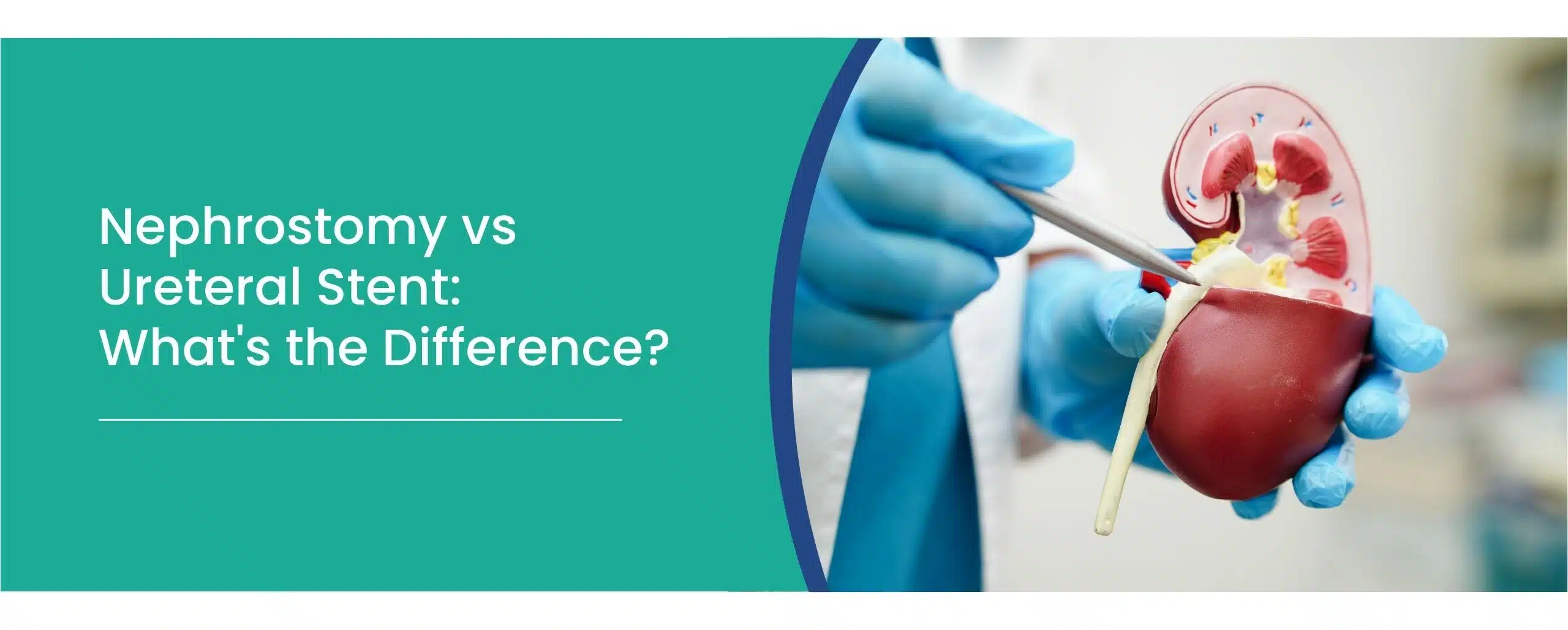
A blocked urinary tract can prevent urine from flowing normally from the kidney to the bladder. If the blockage is severe or causes infection, pain, or kidney problems, doctors may need to drain the kidney quickly.
Two common ways to restore urine drainage are a nephrostomy tube and a ureteral stent.
Both procedures have the same broad goal: to help urine drain from the kidney when its normal pathway is blocked. But they do this in very different ways.
A ureteral stent sits inside the ureter and allows urine to flow from the kidney into the bladder. A nephrostomy tube, on the other hand, enters the kidney through the skin of the back and drains urine into an external bag.
So, which one is better?
There isn’t one answer for everyone. The right option depends on what is causing the blockage, where it is located, whether there is an infection, and whether the ureter can be safely accessed.
What Is a Ureteral Stent?
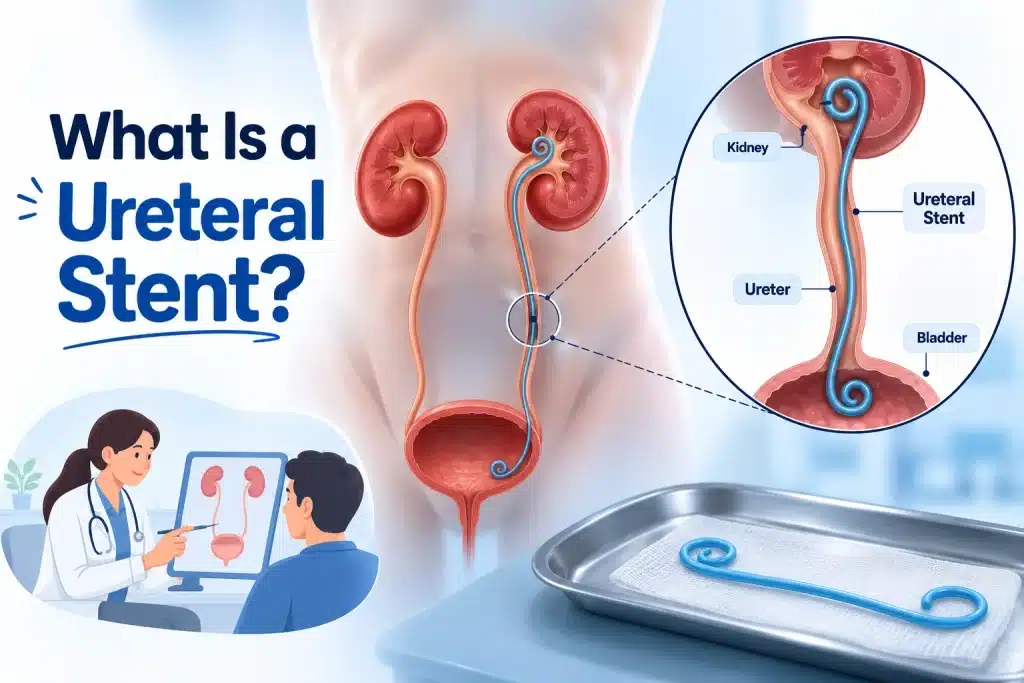
A ureteral stent is a thin, flexible tube placed inside the ureter. The ureters are the narrow tubes that carry urine from the kidneys to the bladder.
The stent helps keep the ureter open so urine can move around a blockage and continue into the bladder. Most ureteral stents have curled ends that sit inside the kidney and bladder, helping keep the tube in place.
Doctors may recommend a ureteral stent when urine flow is blocked because of:
- Kidney or ureteral stones
- Scar tissue or narrowing of the ureter
- Swelling after a procedure
- Tumors or pressure from nearby tissues
- Certain urinary tract conditions
A stent is often temporary. Depending on the underlying problem, it may remain in place for weeks or longer, with replacement or removal planned by the treating doctor.
What happens during ureteral stent placement?
A doctor generally places the stent through the urinary tract, using instruments to guide it into the ureter.
The exact technique and type of anesthesia depend on the patient’s condition and the reason for the procedure.
Once positioned, the stent provides an internal pathway for urine to travel from the kidney to the bladder.
What Is a Nephrostomy?
A nephrostomy is a procedure in which a thin tube is placed directly into the kidney through the skin of the back.
Instead of allowing urine to travel down the blocked ureter, the nephrostomy creates an alternative drainage route. Urine passes from the kidney through the tube and collects in an external drainage bag.
A nephrostomy may be needed when normal urine drainage cannot be restored effectively through the ureter.
Some situations in which doctors may consider nephrostomy include:
- Severe urinary obstruction
- Kidney or ureteral stones
- Urinary infection with obstruction
- Tumors causing blockage
- Scar tissue or narrowing
- Certain injuries or urinary leaks
- Situations where a ureteral stent cannot be placed successfully
The tube may remain in place for several days, weeks, or longer depending on why it was needed.
Nephrostomy vs Ureteral Stent: What’s the Difference?
The biggest difference is where the tube is placed and where the urine goes.
A ureteral stent stays inside the urinary system and allows urine to drain naturally into the bladder.
A nephrostomy tube enters the kidney through the back and directs urine outside the body into a collection bag.
Both procedures are designed to relieve obstruction and protect the kidney from the effects of urine buildup. The choice is based on the patient’s anatomy, cause of obstruction, infection status, and treatment plan.
| Feature | Ureteral Stent | Nephrostomy |
| Where it is placed | Inside the ureter | Directly into the kidney through the back |
| Urine drainage | Kidney → ureter → bladder | Kidney → tube → external bag |
| External bag | Usually no | Yes |
| Main purpose | Keep the ureter open | Provide direct kidney drainage |
| Common use | Ureteral obstruction, stones, narrowing | Severe obstruction or when internal drainage isn’t possible |
| Visibility | Completely internal | Tube exits through the skin |
| Follow-up | Removal or replacement may be needed | Tube care and scheduled replacement/removal may be needed |
Why Might You Need One of These Procedures?
Urine normally flows from the kidneys through the ureters and into the bladder.
If something blocks that pathway, urine can build up inside the kidney. This can cause swelling of the kidney, known as hydronephrosis, and prolonged obstruction can damage kidney function.
If obstruction is accompanied by infection, urgent drainage may be particularly important. For an infected, obstructed urinary system, guidelines recognise both ureteral stenting and percutaneous nephrostomy as methods of urgent decompression.
The blockage can happen because of:
- Kidney stones
- Ureteral stones
- Scar tissue
- Tumors
- Blood clots
- Swelling after surgery
- Certain congenital conditions
- Other structural problems affecting urine flow
When Is a Ureteral Stent Usually Preferred?
A ureteral stent may be a suitable option when doctors can safely pass a tube through the urinary tract and into the affected ureter.
For example, a stent may be used to:
- Bypass a kidney stone
- Keep a narrowed ureter open
- Improve urine flow after certain procedures
- Relieve obstruction caused by swelling or other conditions
One advantage is that the stent remains inside the body, so there is generally no external drainage bag.
However, some people experience discomfort, urinary urgency, frequent urination, or pain while the stent is in place. These symptoms can vary from person to person.
When Is a Nephrostomy Usually Preferred?
A nephrostomy may be considered when urine needs to be drained directly from the kidney.
This can be particularly useful when:
- The ureter is completely blocked
- A stent cannot be placed
- The anatomy makes internal drainage difficult
- An urgent alternative drainage route is needed
- A blockage is caused by a tumor or severe narrowing
- Doctors need direct access to the kidney for further treatment
In some situations, a nephrostomy may be used temporarily until the underlying blockage can be treated.
For example, if a stone is causing severe obstruction, the immediate priority may be to drain the kidney. Definitive stone treatment can then be planned once the patient is stable and, when infection is present, after the infection has been appropriately treated.
Nephrostomy vs Ureteral Stent for Kidney Stones
Kidney and ureteral stones are common reasons why doctors may need to restore urine flow.
If a stone blocks urine drainage, either a ureteral stent or nephrostomy may be used to decompress the urinary system.
For an infected and obstructed system, both methods are considered effective for drainage. Current EAU guidance notes that there is no clear difference in success or complication rates between the two methods, although the choice can depend on the patient’s circumstances and clinical judgment.
The important point is that neither procedure necessarily removes the stone itself.
They may be used as a temporary measure to restore drainage while the underlying cause is treated.
For example, definitive stone treatment may later involve procedures such as ureteroscopy, lithotripsy, or another appropriate stone-removal technique.
What Are the Risks and Side Effects?

Like any medical procedure, both nephrostomy and ureteral stenting have potential risks.
Ureteral stent
Stent-related symptoms can sometimes affect daily activities and quality of life. Some people may experience:
- Flank or bladder discomfort
- Frequent urination
- Urinary urgency
- Blood in the urine
- Discomfort during urination
Nephrostomy
A nephrostomy can involve:
- Pain or discomfort around the tube
- Bleeding
- Infection
- Tube blockage
- Tube displacement
- Leakage around the tube
Because the tube exits through the skin, patients also need to follow instructions for tube and drainage-bag care.
| Consideration | Ureteral Stent | Nephrostomy |
| External equipment | No external bag in most cases | External drainage bag |
| Common discomfort | Urinary symptoms, flank/bladder discomfort | Discomfort around insertion site |
| Tube care | Mainly follow-up for removal/replacement | Regular skin, tube and bag care |
| Infection risk | Possible | Possible |
| Bleeding | Possible | Possible |
| Tube movement/blockage | Possible | Possible |
| Lifestyle impact | May cause urinary symptoms | External tube and bag may require adjustments |
Which One Is Better: Nephrostomy or Ureteral Stent?
It is tempting to think of one as being better than the other. In reality, they solve the same problem in different ways.
A ureteral stent may be preferable when the ureter can be accessed and kept open.
A nephrostomy may be more appropriate when direct kidney drainage is needed or a stent cannot provide adequate drainage.
In some cases, doctors may use one method first and change the approach later depending on how the patient responds.
For this reason, the decision should be made by the treating urologist or relevant specialist rather than based on the procedure alone.
The decision can depend on:
- Location and cause of the blockage
- Severity of obstruction
- Presence of infection
- Kidney function
- Urinary tract anatomy
- Previous procedures
- Whether the ureter can be accessed
- The planned treatment for the underlying condition
What Happens After Drainage?
A nephrostomy or ureteral stent often addresses the immediate drainage problem, but the underlying cause still needs treatment.
If a stone caused the blockage, for example, the stone may need to be removed or broken up.
If scar tissue caused the obstruction, the narrowing may need further treatment.
If a tumor is responsible, the medical team will plan treatment based on the underlying disease.
The drainage device may therefore be temporary until normal urine flow is restored.
Follow-up is important because both stents and nephrostomy tubes need appropriate monitoring, removal, or replacement when they are no longer required.
When Should You Seek Medical Attention?
A fever with urinary obstruction can be particularly concerning because an infected blocked urinary system can require urgent treatment and drainage.
If you have a nephrostomy tube or ureteral stent, contact your healthcare team if you develop symptoms such as:
- Fever or chills
- Increasing or severe pain
- Heavy or persistent blood in the urine
- Very little or no urine drainage
- Leakage around a nephrostomy tube
- A nephrostomy tube that appears to have moved or fallen out
- Symptoms that are suddenly getting worse
Conclusion
A nephrostomy and a ureteral stent are both used to restore urine drainage when the urinary tract is blocked, but they work differently.
A ureteral stent is placed inside the ureter and allows urine to flow from the kidney to the bladder.
A nephrostomy tube is placed directly into the kidney through the back and drains urine into an external bag.
Neither option is automatically better. The appropriate choice depends on the cause and location of the blockage, whether there is an infection, the patient’s anatomy, and the overall treatment plan in best hospital in Noida.
If you have been told that you need a nephrostomy or ureteral stent, ask your doctor why the particular option is recommended and how long it is expected to remain in place.
Frequently Asked Questions (FAQs)
1. Is a nephrostomy more serious than a ureteral stent?
Not necessarily. They are different methods of draining a blocked urinary system. A nephrostomy is more invasive externally because the tube passes through the skin, while a ureteral stent remains inside the urinary tract.
2. Can a nephrostomy be replaced by a ureteral stent?
Sometimes. If the cause of the blockage is treated or the ureter becomes accessible, doctors may be able to change from external kidney drainage to an internal stent. The decision depends on the cause and anatomy of the obstruction.
3. Can you urinate normally with a nephrostomy?
Yes, in many cases. A nephrostomy drains urine directly from the affected kidney, while the other kidney and bladder may continue to function normally. How much urine reaches the bladder depends on the individual’s condition and whether one or both kidneys are drained.
4. How long can a ureteral stent or nephrostomy stay in?
The duration varies depending on why it was placed. Some are needed for only a short period, while others require longer-term management with scheduled removal or replacement. Your doctor will give you a specific follow-up plan.
5. Which is better for an infected blocked kidney?
Both ureteral stenting and percutaneous nephrostomy can be used to urgently drain an infected obstructed urinary system. The appropriate choice depends on the patient’s condition, anatomy, blockage, and whether one approach can be performed safely.