The heart needs a continuous supply of oxygen-rich blood to function properly. This blood reaches the heart muscle through the coronary arteries. Over time, fatty deposits called plaque can build up inside these arteries. This condition is known as coronary artery disease. As plaque increases, the artery becomes narrower, reducing blood flow to the heart.
A narrowed coronary artery may cause chest pain, breathlessness, tiredness, or reduced exercise tolerance. If a blood clot suddenly blocks the artery, it can cause a heart attack. In such an emergency, coronary angioplasty and stenting may be performed urgently to restore blood flow and protect the heart muscle.
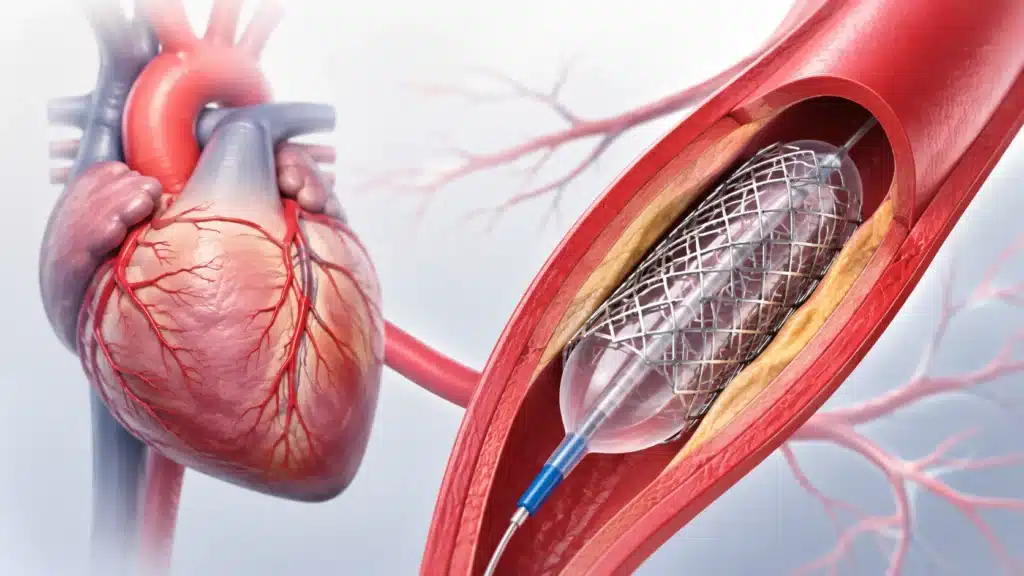
During coronary stenting, a small mesh tube called a stent is placed inside the narrowed artery. The stent expands against the artery wall and helps keep the vessel open. Most modern stents are drug-eluting stents, which slowly release medicine to reduce the chance of the artery narrowing again.
Coronary stenting can provide rapid relief from symptoms and restore blood flow, but it is not a complete cure for coronary artery disease. Plaque can develop in other parts of the heart’s blood vessels if risk factors such as smoking, high cholesterol, diabetes, high blood pressure, obesity, and inactivity are not addressed.
Coronary stenting is a procedure in which a small tube-shaped mesh device is placed inside a narrowed or blocked coronary artery. The stent acts like internal scaffolding. It supports the artery wall and helps maintain an open passage for blood flow.
The procedure is generally performed along with balloon angioplasty.
Coronary arteries may become narrowed due to a process called atherosclerosis. In atherosclerosis, cholesterol, fat, calcium, inflammatory cells, and other materials accumulate in the artery wall. This collection is called plaque.
Over time, plaque can:
Common causes and risk factors
A person can have more than one narrowing, and the disease may affect several coronary arteries at the same time.
Coronary stenting may be recommended when a coronary artery is significantly narrowed or blocked and the patient has symptoms or evidence of reduced blood flow.
Common situations where stenting may be considered
A blockage in a coronary artery may cause symptoms when the heart needs more oxygen, such as during walking, climbing stairs, exercise, or emotional stress.
Common symptoms
Symptoms in women, older adults, and people with diabetes
Symptoms may be less typical in some patients.
Diabetes can affect nerves and sometimes reduce the intensity of chest pain. This is called a silent or less typical heart attack. Any unexplained sudden breathlessness, sweating, weakness, or chest discomfort should be medically evaluated.
Emergency symptoms
Call emergency services immediately if you experience:
Do not drive yourself to the hospital during a suspected heart attack. Urgent medical care is important because early restoration of blood flow can reduce permanent damage to the heart.
The cardiologist uses symptoms, examination, blood tests, ECG findings, and imaging to determine whether a coronary artery is blocked and whether stenting is appropriate.
Common diagnostic tests
Electrocardiogram
An ECG records the electrical activity of the heart. It may show signs of a current or previous heart attack, reduced blood supply, or abnormal rhythm.
Blood tests
Cardiac troponin is commonly checked when a heart attack is suspected. Other tests may evaluate:
Echocardiogram
An echocardiogram uses ultrasound to assess:
Coronary angiography
Coronary angiography is commonly used to identify the exact location and severity of a blockage. A contrast dye is injected through a catheter, and X-ray images show how blood moves through the coronary arteries.
If the angiogram shows a blockage suitable for treatment, the cardiologist may proceed with angioplasty and stenting during the same session, depending on the clinical situation and consent.
Bare-metal stents
Bare-metal stents are metal mesh tubes without a drug coating. They are used less often than drug-eluting stents in modern practice because the risk of re-narrowing may be higher in some situations.
Drug-eluting stents
Drug-eluting stents are coated with medicine that is released slowly into the surrounding artery wall. The medicine helps reduce excessive tissue growth and lowers the chance of restenosis, which means narrowing again inside or near the stent.
Most patients who receive a coronary stent today receive a drug-eluting stent, although the choice depends on the patient’s condition, anatomy, bleeding risk, and treatment plan.
Bioresorbable or dissolving stent technologies
Some newer devices are designed to provide temporary support and gradually break down. Their use depends on availability, clinical suitability, and the cardiologist’s assessment.
Coronary stenting is performed in a cardiac catheterisation laboratory under sterile conditions.
Step 1: Preparation
The patient may be asked not to eat or drink for a specified period before the procedure, particularly if sedation is planned. The patient is connected to monitoring equipment. The team checks:
Step 2: Local anaesthesia
The access area is cleaned and numbed with local anaesthesia. Most procedures use an artery in the wrist, called radial access, or an artery in the groin, called femoral access.
The patient is generally awake but may receive a sedative to help them relax.
Step 3: Catheter insertion
A small puncture is made in the artery. A sheath is placed to provide access. A thin catheter is guided through the blood vessel toward the heart.
The patient may feel brief pressure at the access site but should not feel the catheter travelling through the arteries.
Step 4: Coronary angiography
Contrast dye is injected, and X-ray images are taken. These images help the cardiologist locate the blockage and assess the coronary artery.
Step 5: Guidewire placement
A very thin guidewire is passed through the narrowed area. The wire provides a pathway for the balloon and stent.
Step 6: Balloon angioplasty
A small deflated balloon is advanced along the guidewire to the blockage. It is inflated for a short period to press plaque against the artery wall and widen the passage.
Some blockages are heavily calcified and may require additional preparation using specialised techniques before the stent can be placed.
Step 7: Stent deployment
The stent is mounted on a balloon and positioned across the narrowed segment. When the balloon is inflated, the stent expands and presses against the artery wall.
Step 8: Confirmation of blood flow
The balloon and guidewire are removed. Additional angiography confirms that:
The duration depends on the number and complexity of blockages.
The procedure may take longer when the artery is heavily calcified, the blockage is very long, multiple stents are required, or the patient has complex heart disease.
Most patients remain awake during the procedure. Local anaesthesia reduces discomfort at the access site.
A patient may experience:
Coronary stenting may offer important benefits when appropriately selected.
Potential benefits include:
Coronary stenting is commonly performed, but like any invasive procedure, it carries risks.
Access-site complications
Procedure-related complications
Stent-related complications
The risk depends on:
Medicines are an essential part of care after stenting. The most important medicines are antiplatelet drugs, which help prevent blood clots forming inside the stent.
Antiplatelet treatment
Many patients are prescribed:
This combination is often called dual antiplatelet therapy. The duration depends on:
Before a planned procedure, the cardiology team may provide specific instructions.
Before the procedure
Tests before the procedure may include:
Patients may be given medicines before the procedure to reduce the risk of blood clotting or contrast-related complications.
Recovery depends on whether the procedure was planned or performed during a heart attack.
Immediately after the procedure
Some patients go home the same day after an uncomplicated planned procedure. Others may stay overnight or longer, especially after emergency treatment or when complications are present.
The time required depends on the type of work and the patient’s recovery.
Do not compare your recovery with another patient’s. The appropriate timeline depends on heart function, the reason for stenting, access site, additional disease, and overall health.
Cardiac rehabilitation is a structured programme designed to support recovery and prevent future heart problems.
It may include:
A stent opens a specific blocked artery, but it does not eliminate coronary artery disease. Lifestyle changes are necessary to protect the stent and reduce the risk of future blockages.
Heart-healthy diet
Physical activity
Stop smoking
Smoking damages the artery lining, increases clotting, and raises the risk of another heart attack. Stopping smoking is one of the most important steps after coronary stenting.
Yes, a stent can develop narrowing again, although modern drug-eluting stents have reduced this risk.
Re-narrowing is called restenosis. It may occur due to tissue growth inside the stent, inadequate stent expansion, or progression of plaque near the stent.
Symptoms that may suggest restenosis
New symptoms should not automatically be assumed to be restenosis. They may also be caused by disease in another coronary artery, heart rhythm problems, valve disease, anaemia, or other conditions. A cardiologist should evaluate them.
Contact the cardiology team if you develop:
Coronary stenting requires accurate diagnosis, skilled interventional cardiology, appropriate equipment, and careful follow-up. The quality of care includes not only the stent procedure but also emergency response, medicine planning, rehabilitation, and prevention of future heart disease.
Coronary stenting is usually performed during angioplasty, but the two terms are not identical. Angioplasty uses a balloon to widen the artery, while the stent provides lasting support to help keep it open.
A stent may be recommended when a coronary artery is significantly narrowed or blocked and blood flow is reduced. It may relieve angina or urgently restore blood flow during a heart attack.
A coronary stent is designed to remain in the artery permanently. With prescribed medicines and healthy lifestyle changes, many stents function effectively for many years.
Yes, some patients need more than one stent if there are multiple blockages or a long diseased segment. The number depends on coronary angiography and the cardiologist’s treatment plan.
Stenting treats a specific narrowed artery and improves blood flow, but it does not cure the underlying tendency to develop plaque. Medicines, smoking cessation, exercise, diet, and risk-factor control remain essential.
Do not stop aspirin or other prescribed antiplatelet medicines without consulting your cardiologist. Stopping them suddenly may increase the risk of a dangerous clot forming inside the stent.
Yes, although modern drug-eluting stents have reduced the risk. New chest pain or breathlessness may indicate restenosis or disease elsewhere and should be evaluated promptly.
People with diabetes can undergo coronary stenting, but they may have more complex coronary disease and require careful glucose, kidney, and cardiovascular management. The cardiologist will assess whether stenting or bypass is more suitable.
Neither is universally better. Stenting may suit selected blockages, while bypass may provide better outcomes for certain complex or widespread disease. The recommendation depends on angiography, diabetes, heart function, and overall health.
It can restore blood flow in the treated artery and reduce immediate risk, especially during a heart attack. Preventing another event also requires medicines, cholesterol control, smoking cessation, healthy eating, and regular follow-up.
Coronary stenting is an important treatment for blocked or narrowed heart arteries. It can restore blood flow, relieve angina, improve exercise tolerance, and save heart muscle during an acute heart attack. The procedure is performed through a catheter inserted into an artery in the wrist or groin, so it usually does not require open-heart surgery.
Although stenting can provide major benefits, it is only one part of coronary artery disease treatment. Long-term protection depends on taking antiplatelet and other prescribed medicines, controlling cholesterol and blood pressure, managing diabetes, stopping smoking, maintaining a heart-healthy diet, exercising safely, and attending follow-up appointments.
Coronary angioplasty (AN-jee-o-plas-tee) is a treatment to open clogged blood vessels of the heart.
No rows found.