Most people ignore a hernia for months. They think it’s just a muscle pull, a little gas, or the result of lifting something heavy. They move on with their day.
That’s exactly how a manageable condition becomes a surgical emergency.
Early signs of a hernia are often subtle: a soft bulge here, a dragging sensation there. But if you know what to look for, you can catch it early, manage it better, and avoid complications that are far harder to treat.
What is a hernia?
Before we get into symptoms, let’s get the basics right.
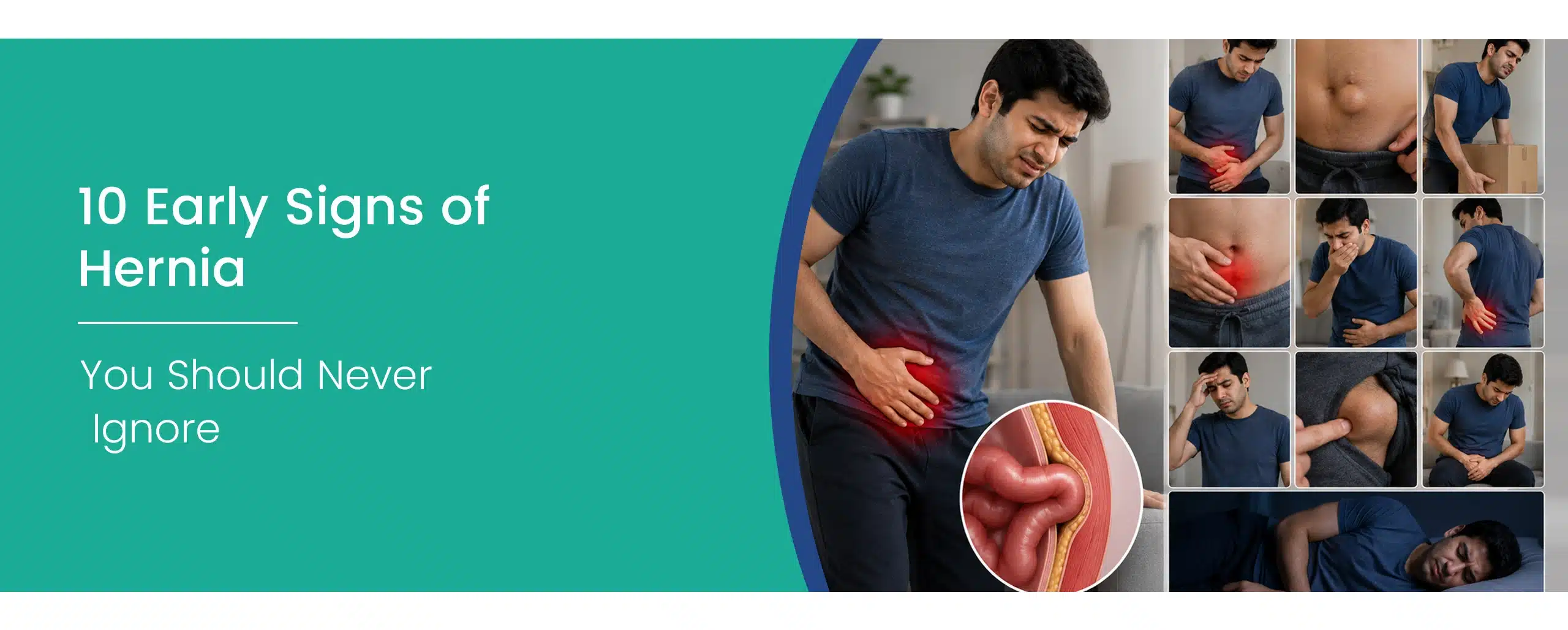
A hernia happens when an internal organ or tissue pushes through a weak spot in the surrounding muscle or connective tissue. Think of it like a tire wall that develops a bubble; the inner tube pushes through where the rubber is thin. One of the early signs of hernia is a noticeable bulge that may become more prominent during coughing, lifting, or straining.
The most common types in India:
| Type | Location | Most Common In |
| Inguinal Hernia | Groin area | Men (especially 40+) |
| Umbilical Hernia | Around the belly button | Infants, obese adults, post-pregnancy women |
| Hiatal Hernia | Upper stomach / chest | Adults with acid reflux history |
| Femoral Hernia | Upper thigh / groin | Women |
| Incisional Hernia | Previous surgical scar site | Post-surgery patients |
Why early detection matters
Hernias don’t usually get better on their own. They tend to grow over time. This is why knowing the early signs of hernia can genuinely change your outcome.
A small hernia caught early can sometimes be managed with lifestyle changes and monitoring. Left untreated, it can:
- Strangulate, cutting off blood supply to the trapped tissue.
- Incarcerate, becoming stuck and irreducible.
- Lead to an emergency surgery that carries far higher risks than a planned procedure.
The 10 early signs of hernia you should watch for
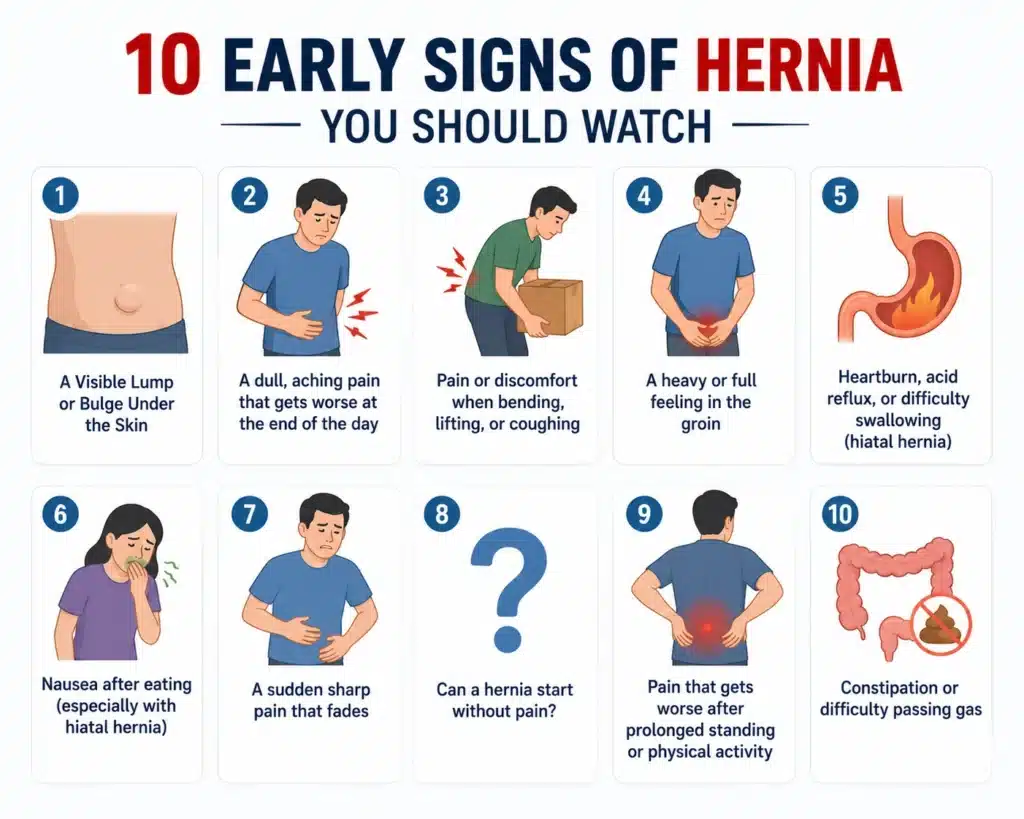
1. A Visible Lump or Bulge Under the Skin
This is the most recognizable of all hernia symptoms.
- Usually appears in the groin, belly button, or near a previous surgical scar
- The lump may come and go; it often disappears when you lie down
- It tends to reappear when you stand, cough, sneeze, or strain
- In the early stage, it’s soft and painless, which is why many people ignore it
What to do: One of the early signs of hernia is a lump that may appear and disappear. Avoid pushing it back repeatedly without medical advice, as it could be tissue or an organ protruding through a weakened muscle.
2. A dull, aching pain that gets worse at the end of the day
One of the most common questions people ask is, “How does hernia pain feel?
Hernia pain is not always sharp or sudden. It often feels like
- A constant dull ache or dragging sensation.
- Discomfort that’s worse after standing for long hours.
- Pain that builds up through the day and eases when you lie down.
- A burning or pressure feeling around the affected site.
If you feel this kind of everyday heaviness in your groin or abdomen that you can’t explain, it could be one of the early signs of hernia.
3. Pain or discomfort when bending, lifting, or coughing
One of the early signs of hernia is a bulge that becomes more noticeable during coughing, lifting, or straining. Increased abdominal pressure pushes more tissue through the weak spot, so don’t ignore it as a simple muscle strain.
A very specific pattern: everyday symptoms of hernia tend to get worse with physical effort.
- Bending forward triggers a pulling sensation.
- Picking up something heavy causes a sudden sharp twinge.
- Even coughing or sneezing creates noticeable pressure in the affected area.
4. A heavy or full feeling in the groin
For men especially, this is an early warning that often goes unnoticed.
This is one of the early signs of hernia that men frequently mistake for a muscular issue and delay getting checked.
- A sensation of heaviness or fullness in the groin, even without a visible bulge.
- Can feel like something is “sitting” or “stuck” in that area.
- May be accompanied by mild swelling in the scrotum in advanced inguinal hernias.
5. Heartburn, acid reflux, or difficulty swallowing (hiatal hernia)
If you experience frequent heartburn along with the early signs of hernia, don’t ignore the symptoms. Many people in India live with undiagnosed hiatal hernias, making timely evaluation important.
Not all hernias are in the abdomen. A hiatal hernia affects the upper stomach and often shows up as:
- Persistent acid reflux that doesn’t respond well to antacids.
- A sour taste in the mouth after meals.
- Difficulty swallowing, especially solid food.
- Chest pain or a burning sensation in the chest (often mistaken for a heart issue).
- Feeling uncomfortably full very quickly after eating.
6. Nausea after eating (especially with hiatal hernia)
Nausea is one of those everyday symptoms of hernia that people connect to everything except a hernia.
On its own, this symptom isn’t conclusive. However, when it appears alongside acid reflux, chest discomfort, or difficulty swallowing, it may be one of the early signs of hernia that should not be ignored.
Recognizing these early signs of hernia and seeking medical evaluation can help prevent complications and ensure timely treatment.
- Feeling queasy after meals.
- Food sitting heavily in the stomach.
- Mild bloating that doesn’t resolve normally.
7. A sudden sharp pain that fades
Some people experience an initial sharp pain (often during heavy lifting or straining) that fades quickly.
This initial sharp pain is often the moment the hernia first forms or enlarges. It’s one of the clearest early signs of hernia, but because the pain fades, it’s consistently ignored.
- They assume they “pulled something.”
- The pain goes away, so they move on.
- Weeks later, they notice a bulge, or the pain returns more frequently
8. Can a hernia start without pain?
Yes. Absolutely yes.
Can a hernia start without pain? This is one of the most important things to understand.
This is exactly why how to detect a hernia early requires paying attention to physical changes, not just to pain. A painless bulge is still a hernia.
- Many hernias are completely painless in the early stage.
- The only sign might be a small, soft bulge you notice while bathing or dressing.
- There may be zero discomfort during daily activities.
- Some hernias are discovered accidentally during routine checkups or scans for other issues.
9. Pain that gets worse after prolonged standing or physical activity
If this pattern keeps repeating, it’s one of the everyday symptoms of hernia that strongly warrants evaluation.
Here’s a pattern worth tracking across a few days:
| Situation | What You Might Feel |
| After standing for 4–5 hours | Dragging ache in groin or abdomen |
| After moderate exercise | Pulling sensation in affected area |
| After lifting at work or home | Sharp twinge followed by soreness |
| After lying down for a while | Discomfort reduces or disappears |
10. Constipation or difficulty passing gas
This one surprises most people.
Persistent constipation along with an abdominal bulge or groin pain can be among the early signs of hernia. If these symptoms occur together, seek medical evaluation without delay.
When part of the bowel gets pushed into the hernia sac, it can affect gut motility. This leads to:
- Infrequent, difficult bowel movements.
- Trapped gas and bloating.
- Abdominal discomfort that feels like constipation.
- In serious cases, complete obstruction (a medical emergency).
How does a hernia develop?
The window to act safely is between stages 1 and 4. Most people don’t act until stage 5 or 6.

How to know if you have a hernia: A simple self-check
If you answered yes to more than two of the above, it’s time to see a doctor. Don’t wait for the pain to become unbearable.
This is not a replacement for a medical diagnosis, but recognizing the early signs of hernia can help you seek timely treatment. Here are the most common early signs of hernia you should never ignore:
Stand in front of a mirror. Look for:
- Any soft bulge in the groin, belly button area, or near an old scar.
- A bulge that appears when you cough or strain.
Pay attention to whether you feel:
- A dragging or heavy sensation in your groin, especially after standing.
- Pain that worsens with physical effort but eases when lying down.
Check your digestion:
- Unusual constipation or gas difficulty alongside abdominal discomfort.
Track the pattern:
- If symptoms appear consistently under the same conditions (standing, lifting, coughing), that’s a clear signal to get evaluated.
When is it a medical emergency?
These are signs of strangulation, a surgical emergency. Do not wait. Do not try to push the lump back in.
Seek immediate care if you notice:
- A bulge that suddenly becomes hard, red, or very tender.
- Severe, sudden pain in the hernia area.
- Nausea and vomiting alongside the pain.
- Inability to pass gas or have a bowel movement.
- Fever with hernia symptoms.
Risk factors: who gets a hernia?
Knowing who is more likely to develop one helps with early vigilance.
| Risk Factor | Why It Increases Hernia Risk |
| Heavy lifting (construction, gym) | Repeated strain on abdominal wall |
| Chronic cough or sneezing | Continuous pressure on muscle wall |
| Chronic constipation | Repeated straining during bowel movements |
| Obesity | Excess pressure on abdominal muscles |
| Pregnancy | Stretching and weakening of abdominal muscles |
| Previous abdominal surgery | Scar tissue creates weakness |
| Smoking | Weakens connective tissue |
| Age (40+) | Natural weakening of muscle walls |
Diagnosis of Hernia
If you visit a hernia specialist in Noida or any general surgeon with these symptoms, here’s what to expect:
Step 1: Physical examination: The doctor examines the affected area while you stand and cough. This helps confirm whether there’s a visible or palpable hernia.
Step 2: Ultrasound: Most inguinal and umbilical hernias are diagnosed with a simple ultrasound. It’s quick, painless, and highly accurate.
Step 3: CT Scan (if needed): For complex or internal hernias (like hiatal), a CT scan or endoscopy may be required.
Step 4: Treatment discussion: Depending on the type, size, and symptoms, the doctor will discuss watchful waiting versus surgical repair (laparoscopic or open).
Finding the best doctor for hernia near you
Rama Hospital is a trusted name in Noida for hernia diagnosis and surgical management. With experienced surgical specialists and modern laparoscopic facilities, Rama Hospital helps patients get the right diagnosis and the right treatment without unnecessary delay.
If you’re in the Noida/NCR region and searching for the best doctor for hernias near me, here’s what to look for:
- A qualified general surgeon with experience in laparoscopic hernia repair.
- A hospital with dedicated surgical infrastructure and post-op care.
- A team that explains your options clearly, not just surgery but monitoring if appropriate.
- Strong patient outcomes and transparent process.
Frequently Asked Questions (FAQ)
Q1. I have a soft lump near my belly button. Is it definitely a hernia?
A soft lump near the belly button that disappears when you lie down is one of the early signs of hernia, particularly an umbilical hernia. Consult a doctor for an accurate diagnosis, as early treatment is often simple and effective.
Q2. I don’t have any pain. Can I still have a hernia?
Yes. One of the early signs of hernia is a painless bulge that may appear without any discomfort. Even if there is no pain, these early signs of hernia should not be ignored and require medical evaluation.
Many early signs of hernia develop silently, with a visible lump being the only symptom. Don’t wait for pain to take these warning signs seriously.
Q3. I feel a dragging sensation in my groin after walking for a while. Should I be worried?
That kind of heaviness or dragging feeling in the groin, especially one that eases when you sit or lie down, is a classic early sign of hernia. It’s worth getting an ultrasound to rule it out.
Q4. How does hernia pain feel different from a muscle pull?
A muscle pull usually improves within a few days with rest. Hernia pain tends to:
- Return consistently under the same conditions (standing, lifting, coughing)
- Be accompanied by a visible or palpable lump
- Worsen over weeks, not improve
If your “muscle pull” keeps coming back in the same spot, it probably isn’t a muscle pull.
Q5. Can I just leave a hernia alone if it doesn’t bother me much?
Small, asymptomatic hernias in older or high-risk patients are sometimes monitored rather than immediately operated on. But this is a medical decision, not one to make on your own. Untreated hernias don’t disappear. They generally grow and eventually require surgery anyway, often under more difficult circumstances. See a doctor and get a professional recommendation.
Q6. Is hernia surgery risky? I’m scared to go for an operation.
Laparoscopic hernia repair is one of the most commonly performed surgical procedures in India. It is minimally invasive, done under general anesthesia, and most patients go home within 24–48 hours. Recovery is typically 1–2 weeks. The risks of delaying treatment far outweigh the risks of a planned surgical procedure.
Q7. I had a hernia operation years ago. Can it come back?
Yes, this is called a recurrent hernia or an incisional hernia if it appears at the surgery site. If you notice a new bulge near your old scar, that is one of the early signs of hernia recurrence and should be evaluated promptly.
Q8. How do I find a good hernia specialist in Noida?
Look for a general surgeon with experience in laparoscopic hernia repair. Rama Hospital in Noida has experienced surgical specialists who handle both routine and complex hernia cases. You can call or walk in for a consultation if you’re experiencing any symptoms.
Conclusion
A hernia rarely announces itself dramatically. It starts quietly, a soft bulge, a dull ache, a heaviness you can’t quite explain.
The early signs of hernia are easy to dismiss. That’s exactly why so many people end up in emergency rooms when a simple planned procedure could have solved the problem months earlier.
How to detect a hernia early comes down to one thing: paying attention to your body and not normalizing discomfort.
If something feels off, like a lump, a dragging pain, or recurring discomfort that gets worse with activity, get it checked. A proper diagnosis takes less than 30 minutes. It could save you from a far more complicated situation later.
If you’re looking for the best doctor for hernia near me in the Noida region, the team at Rama Hospital is here to help. Early consultation, accurate diagnosis, and the right treatment plan, that’s what good hernia care looks like.
For appointments and consultations, contact Rama Hospital, Noida.