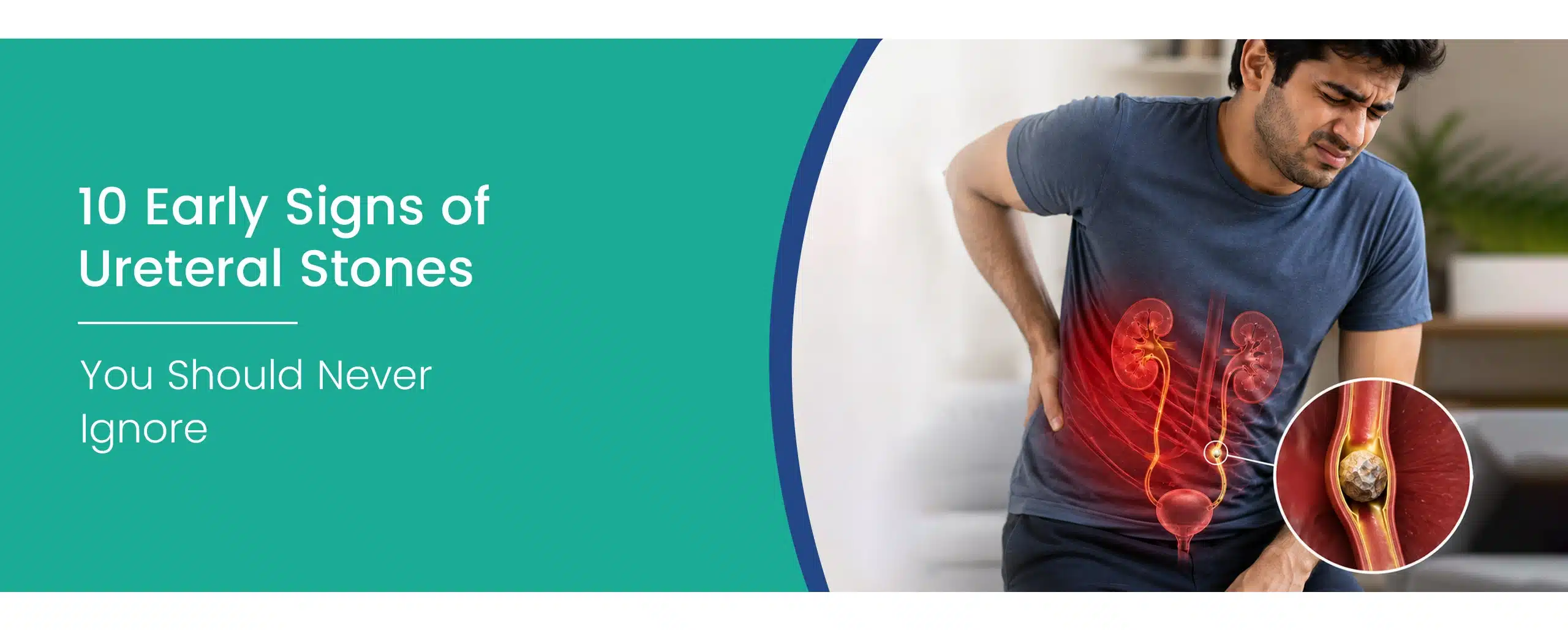
Most people don’t know they have a ureter stone until the pain becomes unbearable.
That’s the problem.
The early signs of ureteral stones are easy to miss or misread. A little back pain? Must be muscle strain. Burning sensation while urinating? Maybe a UTI. Feeling nauseous? Probably something you ate.
But here’s the truth: ureter stones rarely announce themselves dramatically at first. They build up quietly. And by the time the pain becomes “impossible to ignore,” the stone may have already moved deeper into the urinary tract, complicating treatment.
Catching the early signs of ureteral stones gives you a massive advantage. Earlier diagnosis means less pain, simpler treatment, and a faster recovery.
What is a ureter stone, and why does it hurt so much?
Before jumping into symptoms, a quick explanation helps.
Your kidneys filter waste from your blood and produce urine. That urine travels through two narrow tubes called ureters down to your bladder. When mineral deposits, usually calcium or uric acid, crystallize and form a stone inside the kidney, that stone can slip into the ureter.
The ureter is a very narrow tube. A stone stuck inside it creates a blockage. Your body tries to push the stone out by squeezing the ureter walls. That squeezing causes cramping. That cramping is what you feel as pain.
The bigger the stone, the harder your body works, and the more intense the pain becomes.
Common causes of ureter stones in India:
- Low water intake (very common, especially in summer months).
- Diet high in salt, red meat, and oxalate-rich foods (spinach, tomatoes, nuts).
- Genetics and family history.
- Sedentary lifestyle.
- Obesity and metabolic disorders.
- Recurrent UTIs.
The 10 early signs of ureteral stones
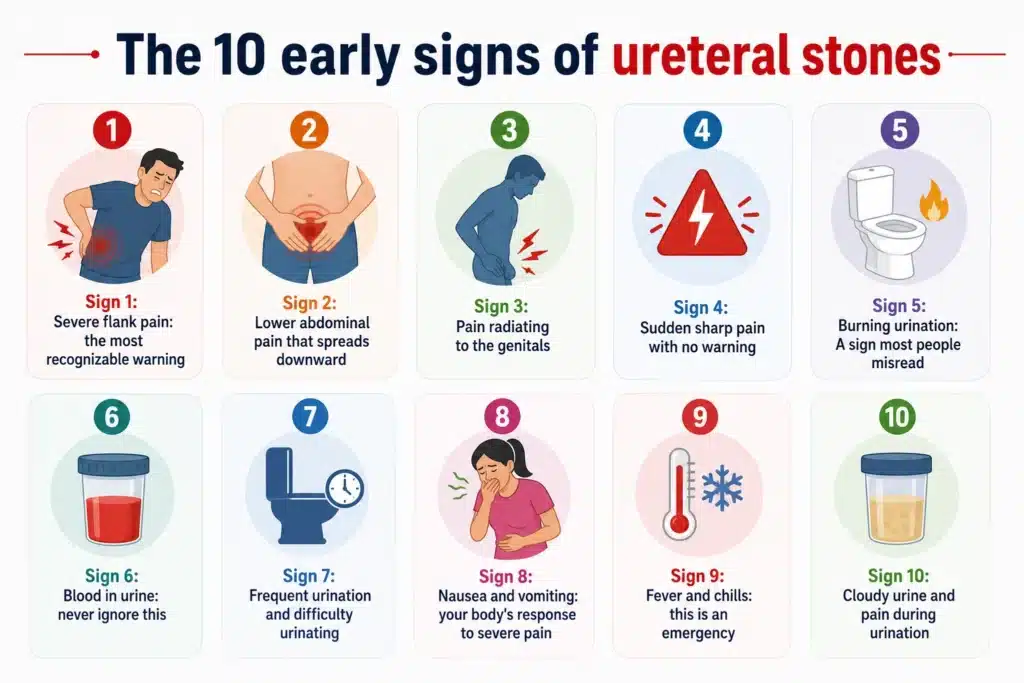
Sign 1: Severe flank pain: the most recognizable warning
This is the classic ureter stone signal.
Severe flank pain refers to sharp, intense pain on one side of your lower back, just below the ribs. It doesn’t stay in one place. It moves. It comes in waves, sometimes intense, sometimes easing off, then hitting hard again.
- Pain is usually one-sided (left or right depending on which ureter is blocked).
- It can come on suddenly, without any obvious trigger.
- Attacks can last anywhere from 20 minutes to several hours.
- The intensity often gets described as “worse than childbirth” by patients who have experienced both.
This type of cramping wave pattern is called renal colic. It’s one of the clearest early signs of ureteral stones, and it should never be dismissed as muscle pain.
When to act: If you have sudden, severe flank pain that you’ve never felt before, go to a urologist. Don’t wait it out.
Sign 2: Lower abdominal pain that spreads downward
As the stone moves from the ureter closer to the bladder, the pain shifts.
Lower abdominal pain is one of the early signs of ureteral stones that many patients confuse with appendicitis, gas pain, or even menstrual cramps in women.
- Pain begins in the side and gradually moves toward the lower abdomen
- It can be sharp and stabbing, or dull and aching
- The location of pain often tells doctors roughly where the stone is positioned in the ureter
- In men, the pain sometimes extends toward the scrotum
This shifting pain pattern is important. If your pain is traveling, starting from your back and slowly moving toward your front, that’s a key symptom that points toward a ureter stone.
Sign 3: Pain radiating to the genitals
This one surprises many patients.
This is one of the more misunderstood early signs of ureteral stones but a very real one. If you have unexplained genital pain along with back discomfort, a ureter stone deserves consideration.
Pain radiating to genitals in men means pain spreading to the testicles; in women, the pain may radiate to the labia or inner thigh. This happens because the nerves that serve the ureter and the genitals overlap.
- The stone itself is in the ureter, not the genitals.
- The pain feels “referred”; your brain associates the nerve signal with the genital area.
- Many men rush to a urologist thinking something is wrong with their testes, only to discover the real issue is higher up.
Sign 4: Sudden sharp pain with no warning
Ureter stone pain doesn’t always build gradually.
The restlessness this causes is actually medically significant. Unlike kidney infections, where patients often prefer lying still, ureter stone pain tends to make people pace, shift, and move constantly, trying to find relief. This restlessness due to pain is a distinctive feature that urologists note during diagnosis.
One of the most frightening aspects is sudden sharp pain that hits without any warning. You’re sitting, sleeping, or walking normally, and then a severe stabbing pain arrives out of nowhere.
- No preceding injury or exertion.
- Pain can be severe enough to make standing or sitting still impossible.
- Patients often describe feeling “unable to get comfortable” in any position.
Sign 5: Burning urination: A sign most people misread
Here’s where many patients get misled.
Burning urination is often assumed to be a urinary tract infection (UTI). And while UTIs are common, especially in Indian women, burning while urinating is also one of the key urinary symptoms associated with ureteral stones.
If burning urination comes along with flank pain or blood in urine, see a urologist immediately. Don’t self-treat with antibiotics.
The difference matters because the treatment is completely different.
| Feature | Ureter Stone | UTI |
| Burning on urination | Yes | Yes |
| Blood in urine | Often | Occasionally |
| Fever | If infected | Common |
| Flank pain | Yes (sharp, cramping) | Yes (dull, constant) |
| Frequency of urination | Increased | Significantly increased |
| Response to antibiotics | No improvement | Improves in 2–3 days |
Sign 6: Blood in urine: never ignore this
Blood in urine (medically known as hematuria) is one of the most important early signs of ureteral stones.
Blood in urine is never “normal.” Even if it appears once, it needs to be investigated. Apart from ureter stones, it can also indicate infections, tumors, or other kidney problems, all of which require early attention.
As the stone scrapes against the ureter walls while moving, it can cause small tears. This leads to blood mixing with urine.
- Sometimes the blood is visible, and urine appears pink, red, or cola-colored.
- Other times the blood is microscopic, not visible to the naked eye, and only detectable on a urine test.
- Blood in urine may come and go.
- It may be the only symptom some patients notice initially.
Sign 7: Frequent urination and difficulty urinating
When a stone sits near the junction of the ureter and bladder, it creates pressure and irritation. The result: your bladder feels full even when it isn’t.
Frequent urination becomes a daily disruption. You feel an urgent need to urinate repeatedly, but when you do, very little comes out. This can easily be mistaken for a bladder problem or prostate enlargement in older men.
Alongside this, difficulty urinating or a reduced urine flow can develop if the stone creates enough of a blockage.
Key indicators:
- Urinating more than 8 times during the day.
- Waking up multiple times at night to urinate.
- Feeling like your bladder never fully empties.
- Weak stream while urinating.
- Stopping and starting midstream.
Sign 8: Nausea and vomiting: your body’s response to severe pain
Many patients are confused when nausea accompanies back pain.
This symptom, when paired with flank or lower abdominal pain, is a major indicator. Don’t treat the nausea in isolation; address the root cause.
The connection is real. The ureter and the gastrointestinal tract share nerve connections. When pain signals from the ureter become intense, the nervous system responds by triggering nausea. This is why nausea and vomiting are one of the commonly reported associated symptoms of ureteral stones.
- Nausea can appear even before pain becomes severe.
- Vomiting may follow intense pain episodes.
- Some patients vomit repeatedly, making it difficult to take oral medications or stay hydrated.
- Dehydration from vomiting can actually worsen stone movement.
Sign 9: Fever and chills: this is an emergency
When fever and chills accompany ureter stone symptoms, the situation becomes urgent. Fever signals infection.
A blocked ureter creates a backup of urine. This stagnant urine becomes a breeding ground for bacteria. The resulting infection, called pyelonephritis or, in severe cases, urosepsis, can be life-threatening if not treated immediately.
Signs that your ureter stone has become an emergency:
- Temperature above 38.5°C (101.3°F).
- Chills that come in waves.
- Rapid heartbeat.
- Feeling very sick, weak, or confused.
- Flank pain combined with fever.
Do not wait. If you have a fever along with any of the other early signs of ureteral stones mentioned here, go to a hospital emergency immediately. This is not a “wait and see” situation.
Sign 10: Cloudy urine and pain during urination
Cloudy urine signals that something is off in your urinary tract. Clear urine is normal. Cloudy, murky, or foul-smelling urine can indicate infection, pus, or debris from a stone.
Together, cloudy urine and pain during urination make up two of the more commonly reported later-stage early signs of ureteral stones that indicate the stone has moved significantly through the ureter.
- Cloudiness combined with a strong odor suggests bacterial activity.
- Pain during urination (at the start or throughout) is common when the stone is close to the bladder.
- Some patients describe a gritty sensation while urinating; that’s often the stone or stone fragments passing through.
How do the early signs progress?
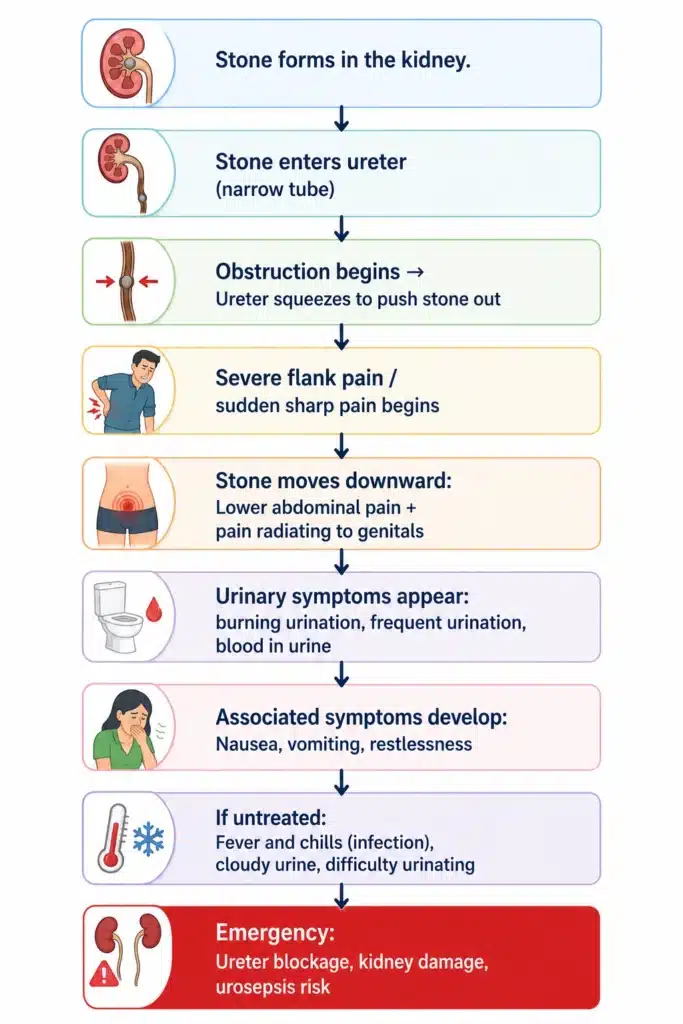
The earlier you recognize symptoms and get evaluated, the simpler the treatment path. Here’s how ureter stone symptoms typically develop over time:
What are the first signs of a ureter stone?
These first signs can appear within hours of a stone entering the ureter. In some cases, especially with small stones, symptoms are mild and come and go for days before becoming severe.
The answer depends on where the stone is located when symptoms begin. However, the most common first signs are:
- Sudden severe flank pain on one side (often the first and most alarming sign).
- Restlessness, an inability to get comfortable in any position.
- Nausea arriving with the pain.
- A vague urge to urinate more frequently than usual.
The key takeaway: any unexplained back pain on one side that is different from typical muscle soreness deserves a urological evaluation.
When should you see a doctor?
Early diagnosis with a urine test, ultrasound, or CT scan can confirm a stone within hours, and treatment options available today are far less invasive than they were a decade ago.
Don’t wait until the pain becomes unbearable. See a urologist if:
- Pain in your flank or lower abdomen is sudden, severe, or recurring.
- You notice blood in your urine, even once.
- Burning or painful urination doesn’t resolve in 2–3 days.
- You develop a fever along with any urinary or pain symptoms.
- Urine is consistently cloudy or foul-smelling.
- You experience ureter blockage symptoms like reduced urine output or inability to urinate.
Getting treated: what to expect
Most small ureter stones (under 5mm) pass on their own with adequate hydration and pain management. But many stones need medical intervention.
The right treatment depends on the stone’s size, location, and your overall health. A qualified urologist makes that call after proper imaging.
Common treatment options:
- Medical expulsive therapy: Medications that relax the ureter muscles to help pass the stone naturally.
- Ureteroscopy (URS): A minimally invasive procedure where a thin scope is inserted through the urethra to remove or break the stone.
- ESWL (Shock Wave Lithotripsy): Using sound waves from outside the body to break the stone into smaller fragments.
- PCNL (Percutaneous Nephrolithotomy): For larger or complex stones, a small incision in the back allows stone removal.
- Stenting: Placing a small stent to keep the ureter open if blockage is severe.
Ureter stone treatment in Noida: why rama hospital
If you are in Noida or the NCR region and experiencing any of these early signs of ureteral stones, timely evaluation is critical.
Rama Hospital offers comprehensive urological care with experienced specialists who handle everything from simple stone passage management to complex minimally invasive surgeries.
If you’ve been searching for the best urologist in Noida, Rama Hospital’s urology department provides evidence-based, patient-centered care to get you back to normal life as quickly as possible.
Why patients choose Rama Hospital for ureter stone treatment in Noida:
- Advanced diagnostic imaging, ultrasound, and CT urogram are available.
- Experienced urology team with expertise in URS, ESWL, and PCNL procedures.
- Minimally invasive treatment approach with a focus on faster recovery.
- Transparent treatment planning and patient-friendly care.
- Accessible location for patients across Noida and surrounding areas.
Book a consultation today. Don’t let a stone become a bigger problem than it has to be.
Frequently Asked Questions
Q1. My back has been hurting for two days on one side. Could it be a ureter stone?
It’s possible, especially if the pain is sharp, comes in waves, and is different from usual muscle soreness. Back pain from a ureter stone is typically more intense than muscle pain and doesn’t improve with rest or a hot compress. If the pain is on one side (flank area), get a urine test and ultrasound done. Don’t diagnose yourself; a simple scan gives a clear answer.
Q2. I saw a little blood in my urine once, but I have no pain. Do I need to worry?
Yes, you should get it checked. Blood in urine, even once, is not normal and should not be ignored. It could be from a small stone, an infection, or something else entirely. A single episode without pain still warrants a urine test and consultation with a urologist.
Q3. I thought I had a UTI and took antibiotics, but I still have burning. What’s happening?
This is a common situation. If burning urination doesn’t improve with antibiotics, the cause may not be a bacterial infection. Ureter stones can cause very similar burning and frequency symptoms. Ask your doctor for an ultrasound to rule out a stone.
Q4. The pain was very severe yesterday, but it’s much better today. Should I still see a doctor?
Absolutely yes. The pain reducing often means the stone has moved to a new position, not that it’s gone. A stone can cause less pain temporarily and then cause a serious blockage later. Get evaluated while the symptoms have settled. It’s far better to treat it before the next painful episode.
Q5. I have a mild fever along with back pain. Is this serious?
Fever with back pain and urinary symptoms is a medical concern that needs same-day evaluation. It could indicate a urinary infection on top of a stone blockage. This combination can escalate quickly, so don’t wait. Go to a hospital or urology clinic today.
Q6. How long does it take for a ureter stone to pass on its own?
Small stones (under 4–5mm) often pass within 1 to 4 weeks with plenty of water and prescribed medication. Larger stones rarely pass on their own and usually need a procedure. Your urologist will advise based on the size and position seen on imaging.
Q7. Can a ureter stone damage my kidney permanently?
Yes, if a blockage goes untreated for a prolonged period, weeks to months, it can cause lasting kidney damage. This is why the early signs of ureteral stones must be taken seriously and treated promptly. Early treatment almost always prevents permanent kidney damage.
Q8. Is ureter stone surgery painful?
Modern minimally invasive procedures like ureteroscopy are done under anesthesia. Recovery is generally quick; most patients go home the same day or the next morning. The procedure itself causes no pain. Post-procedure discomfort is manageable with medication.
Conclusion
Ureter stones are more common than most people realize, and more treatable than most people fear.
The problem is delay.
Every one of the early signs of ureteral stones listed in this article is your body sending a message. Severe flank pain, blood in urine, burning urination, nausea, and fever, these are not random. They’re clues.
The right response to those clues is simple: see a urologist early, get the right scan, and get the right treatment. The technology and expertise available today mean that most stones can be handled quickly, with minimal disruption to your life.
Don’t wait for the pain to become unbearable before you act. Catch it early. Treat it well. Get back to living normally.
For ureter stone treatment in Noida, consult the urology specialists at Rama Hospital. Early evaluation, advanced diagnostics, and patient-first care, all in one place.