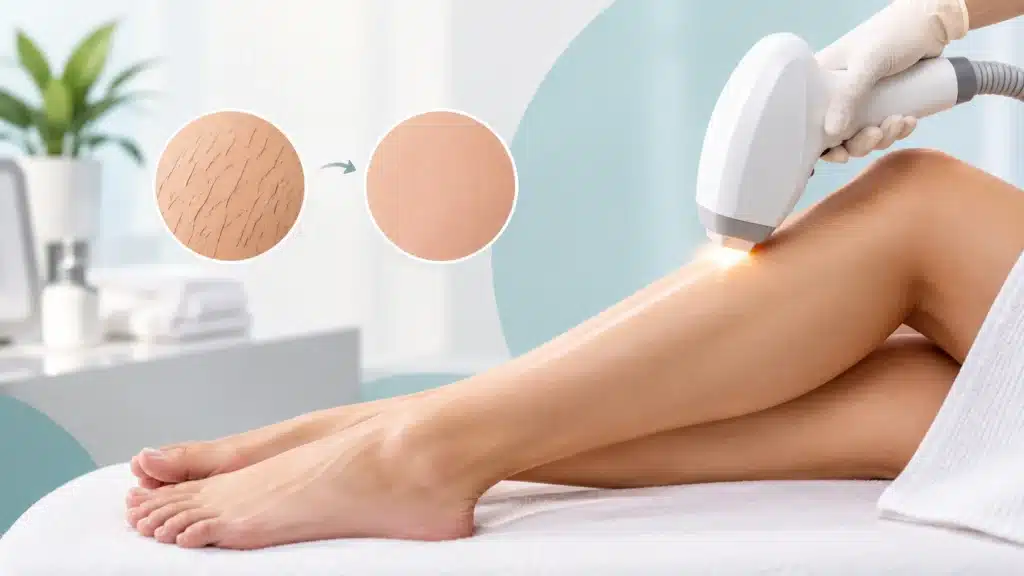
Laser hair reduction is one of the most popular and effective procedures for long-term reduction of unwanted hair. It uses focused laser light to target hair follicles and reduce their ability to grow hair again. Over multiple sessions, this leads to smoother skin, fewer ingrown hairs, and less dependence on shaving, waxing, or threading.
Many people consider laser hair reduction for areas such as the face, underarms, arms, legs, bikini line, chest, back, and abdomen. It is especially helpful for those who struggle with frequent hair regrowth, skin irritation from shaving, painful waxing, or ingrown hairs. While it is often described as “permanent,” it is more accurate to call it long-term hair reduction, as some fine or light hair may still grow over time.
What is Laser Hair Reduction?
Laser hair reduction is a medical procedure that uses concentrated laser light to target the pigment in hair follicles. The laser energy is absorbed by the melanin in the hair, which then damages the follicle and reduces its ability to produce new hair.
The procedure does not remove all hair permanently in one session. Hair grows in cycles, and laser works best on hair in the active growth phase. That is why multiple sessions are needed to treat all follicles effectively. Over time, hair becomes finer, lighter, and grows more slowly. Many people experience a significant and long-lasting reduction in hair density.
Laser hair reduction is different from temporary methods such as shaving, waxing, or depilatory creams. It offers longer-lasting results and can improve skin texture by reducing ingrown hairs and irritation caused by frequent hair removal.
How Does Laser Hair Reduction Work?
The laser device emits a specific wavelength of light that is absorbed by the pigment in the hair shaft and follicle. This energy is converted into heat, which damages the follicle and slows down or stops future hair growth.
Key points about the mechanism
- The laser targets melanin, the pigment that gives hair its color.
- Dark, coarse hair responds best because it contains more pigment.
- The surrounding skin is protected by cooling systems and appropriate settings.
- Only follicles in the active growth phase are affected in each session.
- Multiple sessions are needed to cover all hair follicles in different growth phases.
- Over time, treated follicles produce finer and fewer hairs.
Why multiple sessions are needed
- Hair grows in cycles: growth, rest, and shedding.
- Laser is most effective during the growth phase.
- Not all hairs are in the same phase at the same time.
- Repeat sessions ensure that more follicles are treated as they enter the growth phase.
Suitable Candidates for Laser Hair Reduction
Not everyone is an ideal candidate for laser hair reduction. A proper evaluation by a dermatologist is important to ensure safety and realistic expectations.
Good candidates include:
- People with dark, coarse hair and light to medium skin tone.
- Individuals bothered by frequent shaving, waxing, or threading.
- Those with ingrown hairs or skin irritation from hair removal.
- People seeking long-term reduction rather than immediate permanent removal.
- Patients who can commit to multiple sessions and follow pre- and post-care instructions.
People who may need special consideration:
- Individuals with very light, blonde, red, or grey hair, which may respond less.
- Those with very dark skin, who require specific laser settings and devices.
- People with active skin infections, open wounds, or recent sunburn in the area.
- Pregnant women, where treatment is usually postponed as a precaution.
- Patients on certain medications that increase light sensitivity.
Why evaluation matters
- To choose the right laser type and settings for the skin and hair type.
- To assess medical history and medication use.
- To set realistic expectations about results and sessions.
- To minimize risks and optimize outcomes.
Treatment Areas for Laser Hair Reduction
Laser hair reduction can be performed on many areas of the body, depending on patient needs and safety considerations.
Common treatment areas
- Upper lip and chin.
- Full face or specific facial zones.
- Underarms.
- Arms and forearms.
- Legs, including full legs or lower legs.
- Bikini line and Brazilian area.
- Abdomen and chest.
- Back and shoulders.
- Neck and sideburns.
- Areola area in selected cases.
Area-specific considerations
- Facial hair may require more sessions due to hormonal influence.
- Underarms and bikini areas often show good response.
- Large areas such as legs and back may take longer per session.
- Sensitive areas need careful settings and cooling for comfort.
Number of Sessions and Treatment Plan
Laser hair reduction is not a one-time procedure. A structured plan is needed for best results.
Typical session plan
- Most people need 6 to 8 sessions for significant reduction.
- Sessions are usually spaced 4 to 6 weeks apart for face and 6 to 8 weeks for body.
- The exact number depends on hair type, skin type, area, and response.
- Some patients may need additional sessions for maintenance.
Factors affecting number of sessions
- Hair thickness and color.
- Skin tone and laser type used.
- Hormonal factors, especially in facial hair.
- Area being treated.
- Individual response to treatment.
Why consistency matters
- Skipping sessions can reduce overall effectiveness.
- Regular intervals help target new hair in the growth phase.
- Following the plan improves long-term reduction.
Procedure Steps for Laser Hair Reduction
The procedure is usually quick and performed in an outpatient setting.
Before the procedure
- The area is cleaned and shaved if needed.
- Protective eyewear is provided to the patient and staff.
- A test patch may be done to check skin response.
- Cooling gel or cooling device is applied for comfort.
During the procedure
- The dermatologist uses a handheld laser device over the treatment area.
- The laser delivers pulses of light to the hair follicles.
- Patients may feel a mild snapping or warming sensation.
- Cooling systems help protect the skin and reduce discomfort.
- Small areas may take 10 to 15 minutes, larger areas may take longer.
After the procedure
- The area may appear slightly red or swollen for a few hours.
- Soothing gel or moisturizer may be applied.
- Patients can usually resume normal activities the same day.
- Sun protection and aftercare instructions are provided.
Safety of Laser Hair Reduction
When performed by a trained dermatologist using appropriate devices, laser hair reduction is generally safe.
Safety measures
- Use of medical-grade laser devices.
- Proper selection of wavelength and settings for skin type.
- Eye protection for patient and staff.
- Cooling systems to protect the skin.
- Trained personnel to monitor skin response during treatment.
Important safety points
- Treatment should be done by qualified medical professionals.
- Avoid treatment on tanned or sunburned skin.
- Inform the doctor about all medications and skin conditions.
- Do not undergo treatment over tattoos, moles, or suspicious lesions without evaluation.
Side Effects and Risks
Most side effects are mild and temporary, but patients should be aware of possible risks.
Common temporary side effects
- Redness in the treated area.
- Mild swelling around hair follicles.
- Temporary warmth or tenderness.
- Mild itching or dryness.
- Temporary darkening or lightening of skin in some cases.
Less common risks
- Blistering or crusting if settings are too aggressive.
- Burns in rare cases, especially with improper technique.
- Changes in pigmentation, more common in darker or tanned skin.
- Scarring in very rare cases.
- Paradoxical hair growth in rare instances, especially on the face.
How risks are minimized
- Proper patient selection and skin assessment.
- Appropriate laser type and settings.
- Test patch before full treatment.
- Strict sun protection before and after sessions.
- Adherence to pre- and post-care instructions.
Pre-Treatment Care
Proper preparation helps improve safety and results.
Before starting laser hair reduction
- Avoid sun exposure and tanning for at least 2 to 4 weeks.
- Do not wax, pluck, or thread the area for 3 to 4 weeks before treatment.
- Shave the area 1 to 2 days before the session as advised.
- Inform the doctor about all medications, especially those increasing light sensitivity.
- Avoid active skin infections, rashes, or open wounds in the area.
- Remove makeup, deodorant, or lotions before the session.
Why pre-care matters
- Reduces risk of pigmentation changes and burns.
- Ensures the laser can target the hair follicle effectively.
- Improves comfort and treatment response.
Post-Treatment Care
Aftercare is important to support healing and optimize results.
After each session
- Apply soothing gel or moisturizer as advised.
- Avoid hot showers, saunas, or intense exercise for 24 to 48 hours.
- Do not scratch or rub the treated area.
- Avoid waxing, plucking, or threading between sessions.
- Shaving is usually allowed once redness subsides.
- Use a broad-spectrum sunscreen daily on treated areas.
- Avoid direct sun exposure as much as possible.
When to contact the doctor
- If there is severe pain, blistering, or crusting.
- If redness or swelling persists beyond a few days.
- If there are signs of infection such as pus or increasing warmth.
- If there are unexpected changes in skin color.
Results and Expectations
Understanding realistic outcomes is important for satisfaction.
What to expect
- Gradual reduction in hair density over sessions.
- Hair becomes finer and lighter with each session.
- Some areas respond faster than others.
- Occasional maintenance sessions may be needed in the future.
What laser cannot guarantee
- Complete permanent removal of all hair in all patients.
- Same degree of reduction for light, blonde, red, or grey hair.
- Immediate results after one session.
- No regrowth ever, especially in hormonally sensitive areas.
Why expectations matter
- Helps patients stay motivated through multiple sessions.
- Reduces disappointment from unrealistic claims.
- Supports informed decision-making.
Maintenance and Long-Term Care
After the initial course of sessions, some patients may benefit from maintenance.
Maintenance considerations
- Occasional touch-up sessions once or twice a year.
- More likely in hormonally influenced areas such as the face.
- Depends on individual hair regrowth pattern.
- Can be planned based on follow-up assessment.
Long-term skin care
- Continue sun protection on treated areas.
- Maintain good skin hydration and gentle care.
- Avoid harsh hair removal methods that irritate the skin.
- Report any unusual hair growth or skin changes to the dermatologist.
Why Choose Rama Hospital for Laser Hair Reduction?
Laser hair reduction is a medical procedure that should be performed by trained dermatologists using appropriate devices and safety protocols. A hospital-based dermatology department can offer comprehensive care with a focus on safety and results.
- Evaluation by qualified dermatologists.
- Use of medical-grade laser devices.
- Customized settings for different skin and hair types.
- Proper management of side effects if they occur.
- Integrated care for underlying skin or hormonal issues.
Frequently Asked Questions (FAQs)
Does laser hair reduction work on all skin types?
It can be performed on many skin types, but the device and settings must be chosen carefully. Darker skin requires specific lasers and experienced operators to reduce the risk of pigmentation changes.
How many sessions are needed for laser hair reduction?
Most people need 6 to 8 sessions for good results, spaced several weeks apart. The exact number depends on hair type, skin type, area treated, and individual response.
Is laser hair reduction painful?
Most patients describe the sensation as mild snapping or warmth. Cooling systems and gels are used to improve comfort. Sensitive areas may feel more sensation but are usually well tolerated.
Can laser hair reduction be done during pregnancy?
Laser hair reduction is usually postponed during pregnancy as a precaution, even though there is limited evidence of harm. It is best to discuss timing with a dermatologist and obstetrician.
What areas can be treated with laser hair reduction?
Common areas include the face, underarms, arms, legs, bikini line, chest, back, and abdomen. The suitability of each area is assessed based on skin type, hair type, and safety.
What should I avoid before and after laser sessions?
Avoid sun exposure, tanning, waxing, plucking, and threading before treatment. After treatment, avoid heat, friction, and sun exposure, and use sunscreen regularly as advised by your dermatologist.
Can laser hair reduction cause cancer?
There is no evidence that laser hair reduction causes cancer. The laser targets hair follicles in the skin and does not penetrate deeply enough to affect internal organs or DNA in a way that causes cancer.
Conclusion
Laser hair reduction is a safe and effective option for long-term management of unwanted hair when performed by trained dermatologists using appropriate devices. It offers smoother skin, reduced ingrown hairs, and less dependence on temporary hair removal methods. While it is not always completely permanent, most patients experience significant and lasting improvement.
The most important steps are proper patient selection, realistic expectations, adherence to pre- and post-care instructions, and completion of the recommended number of sessions. For people struggling with frequent hair regrowth, skin irritation, or ingrown hairs, a dermatology evaluation can help determine if laser hair reduction is suitable.
Rama Hospital can provide expert assessment, personalized treatment plans, and safe laser hair reduction performed by qualified dermatologists, with a focus on results, comfort, and long-term skin health.