Most patients ask this question before surgery. And it’s the right question to ask.
Walking after knee replacement is not just possible; for the majority of patients, it becomes better than anything they experienced in years. The chronic pain, the limping, the fear of stairs. All of that can change.
But recovery doesn’t happen overnight. It happens step by step, literally.
This guide breaks down everything you need to know about walking after knee replacement: what the first steps feel like, what physiotherapy looks like week by week, and when most patients reach normal, pain-free movement.
Why is knee replacement surgery performed?
Before we talk about recovery, it helps to understand what’s happening inside the joint.
Total knee replacement removes the damaged cartilage and bone surfaces from the knee and replaces them with metal and plastic implants. These implants mimic the smooth gliding movement of a healthy knee.
Common reasons patients need this surgery:
- Severe osteoarthritis that doesn’t respond to medication.
- Rheumatoid arthritis causing joint destruction.
- Post-injury deformity or damage.
- Constant knee pain that limits daily activities.
- Failed conservative treatments like injections and bracing.
Once the damaged joint is replaced, the mechanical cause of pain is gone. What remains is healing, and that’s where knee replacement rehabilitation begins.
What happens to your knee during surgery?
Modern implants are designed to last 15–20 years and support full weight-bearing activity, making walking after knee replacement safer, stronger, and more natural.
Understanding the surgery helps patients trust the recovery process.
| Stage | What Happens |
| Anesthesia | Spinal or general anesthesia is administered |
| Incision | The surgeon accesses the knee joint through an incision |
| Bone preparation | Damaged cartilage and bone ends are removed |
| Implant placement | Metal and plastic components are fixed in place |
| Closure | Layers are sutured; drain may be placed temporarily |
| Immediate post-op | The knee is bandaged; physiotherapy begins within 24 hours |
When does walking after knee replacement begin?
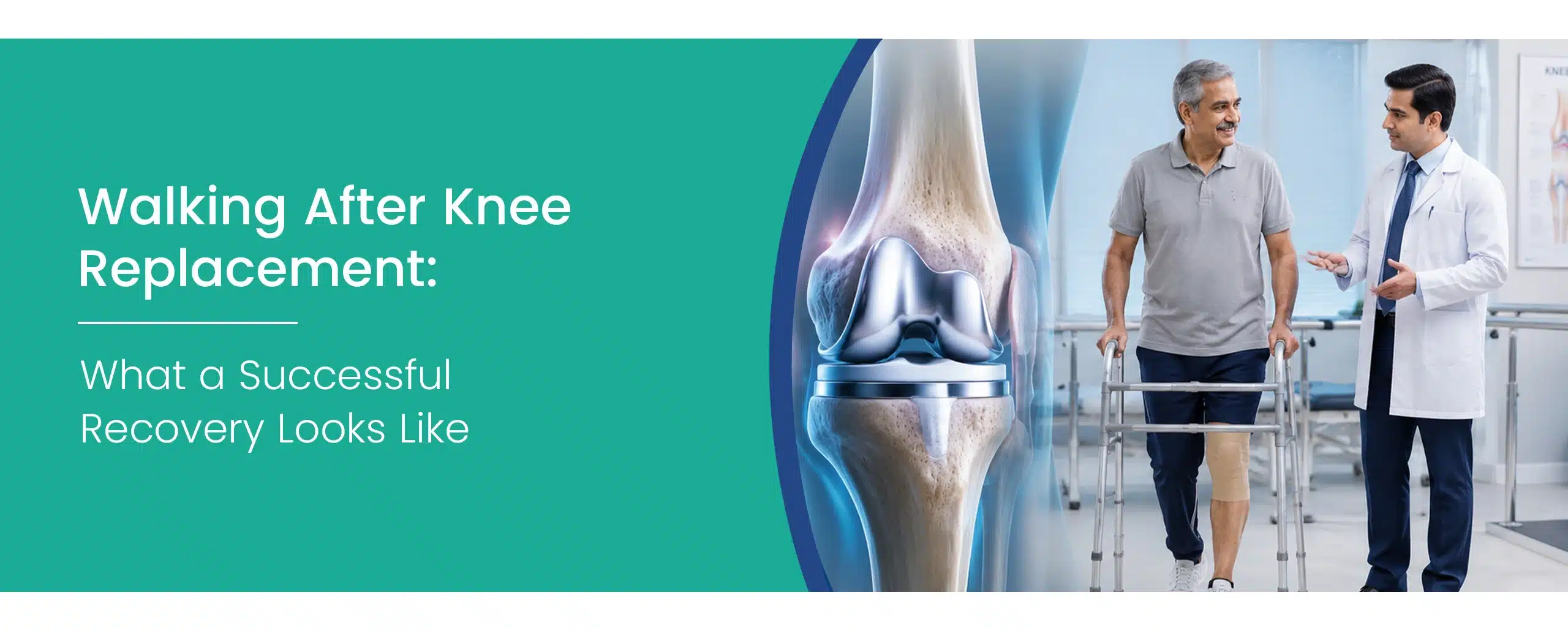
This surprises most patients: walking after knee replacement starts the same day or the next morning.
Your physiotherapist will assist you in standing and taking your first steps within 12 to 24 hours of surgery. This is not just possible; it is medically recommended. You will use a walker or crutches initially. But you will walk.
Early movement helps:
- Prevent blood clots (deep vein thrombosis).
- Reduce swelling and stiffness.
- Rebuild muscle strength faster.
- Improve circulation and healing.
Knee replacement recovery: week by week
This is the section most patients want to read before they agree to surgery.
Walking after knee replacement follows a predictable pattern when rehabilitation is done correctly. Here is the honest, realistic timeline.
Don’t push too hard. Rest between movement sessions. Ice and elevation reduce swelling significantly.
Week 1: The first steps
What to expect:
- Walking short distances with a walker or Zimmer frame.
- Significant swelling and bruising; this is normal.
- Bending the knee to 40-60 degrees.
- Pain managed with prescribed medications.
- Knee replacement physiotherapy begins immediately.
Recovery milestones after TKR in Week 1:
- Standing with support.
- Walking to the bathroom independently.
- Basic knee bending and straightening exercises.
- Getting in and out of bed without assistance.
Week 2-3: Building confidence
This is also when patients begin feeling more human. Pain is still present, but it shifts; it becomes the pain of healing rather than the pain of damage, making walking after knee replacement increasingly comfortable and confident.
What to expect:
- Walking for 5-10 minutes with reduced support.
- Knee bending improving to 70-90 degrees.
- Transitioning from walker to crutch in some cases.
- Stairs with support (one step at a time).
- Swelling starting to reduce gradually.
Walking exercises after knee replacement in this phase:
- Assisted walking circuits indoors.
- Seated knee bends (heel slides).
- Quad sets and ankle pumps.
- Short standing balance exercises.
Week 4-6: Independence returns
Most patients at this stage feel a genuine shift. The question changes from “Can I walk?” to “How far can I go today?”
What to expect:
- Walking without pain indoors with a cane.
- Bending the knee to 90 degrees or beyond.
- Driving (usually cleared after 4-6 weeks for right knee).
- Light household activities resume.
- Sleeping through the night with less discomfort.
Strengthening exercises after TKR in this phase:
- Straight leg raises.
- Mini squats against a wall.
- Step-ups on a low block.
- Standing hip abduction.
- Stationary cycling (very light resistance).
Week 6-12: Regaining mobility after knee surgery
This is the phase where walking after knee replacement often improves the most. Patients who stay consistent with their rehabilitation exercises during weeks 6–12 typically achieve better strength, mobility, and long-term recovery outcomes.
What to expect:
- Walking outside on flat ground independently.
- Full knee bend approaching 110-120 degrees.
- Climbing stairs with alternating feet.
- Reduced dependence on pain medication.
- Improved movement after knee replacement is visible to family and friends.
Physical therapy for knee replacement in this phase:
- Treadmill walking (slow pace, flat surface).
- Resistance band exercises.
- Balance board training.
- Pool walking if available (low-impact, high benefit).
- Progressive strengthening of quads, hamstrings, and glutes.
Month 3-6: Fast recovery after knee replacement
By month 3, most patients are:
- Walking 20-30 minutes continuously.
- Shopping independently.
- Climbing stairs normally.
- Resuming light recreational activities.
- Sleeping in any position comfortably.
By month 6:
- Walking after knee replacement feels close to natural.
- Most daily activities are unrestricted.
- Many patients return to light hiking, cycling, or swimming.
- Knee replacement healing time for soft tissues is largely complete.
Month 6-12: Full recovery
Studies consistently show that more than 90% of patients are satisfied with their total knee replacement outcomes at the one-year mark, with many reporting significant pain relief, improved mobility, and better walking after knee replacement.
The one-year mark is where outcomes are typically evaluated.
By this point:
- Most patients report complete freedom from knee pain they had pre-surgery.
- Walking 45-60 minutes or more is common.
- Low-impact sports (swimming, cycling, golf) are often permitted.
- Knee function scores show significant improvement.
Recovery timeline at a glance
| Timeframe | Walking Ability | Key Milestone |
| Day 1 | Assisted walking with walker | First steps post-surgery |
| Week 1 | Short distances indoors | Bathroom independence |
| Week 2-3 | 5-10 min with cane/crutch | Stairs with support |
| Week 4-6 | Indoor walking without support | Driving cleared |
| Week 6-12 | Outdoor walking | 110+ degree knee bend |
| Month 3-6 | 20-30 min walks | Daily activity independence |
| Month 6-12 | Normal walking pattern | Sports and recreation |
What does knee replacement physiotherapy look like?
Knee replacement physiotherapy plays a vital role in walking after knee replacement, improving strength, balance, and mobility throughout recovery.
The role of the physiotherapist is critical. They monitor your progress, correct your gait, prevent overloading the joint, and push you forward at the right pace. Skipping sessions or doing exercises incorrectly significantly delays recovery.
A structured physiotherapy program typically includes three phases:
Phase 1: Acute Phase (Week 1-2)
Goals: Reduce swelling, restore range of motion, prevent complications.
Exercises:
- Ankle pumps and circles (every 1-2 hours while awake).
- Quad sets (tightening thigh muscles while lying flat).
- Heel slides (sliding heel toward body while lying down).
- Assisted knee straightening.
- Assisted standing and walking circuits.
Phase 2: Intermediate Phase (Week 3-8)
Goals: Build strength, improve balance, restore walking mechanics.
Exercises:
- Straight leg raises.
- Mini squats and wall sits.
- Step-ups (low height, both legs).
- Stationary cycling.
- Standing calf raises.
- Side-lying hip abduction.
Phase 3: Advanced Phase (Week 8 onwards)
Goals: Return to normal activities, build endurance.
Exercises:
- Progressive resistance training.
- Balance and proprioception training.
- Treadmill walking with incline.
- Functional activities (climbing, descending stairs).
- Pool walking or aqua therapy.
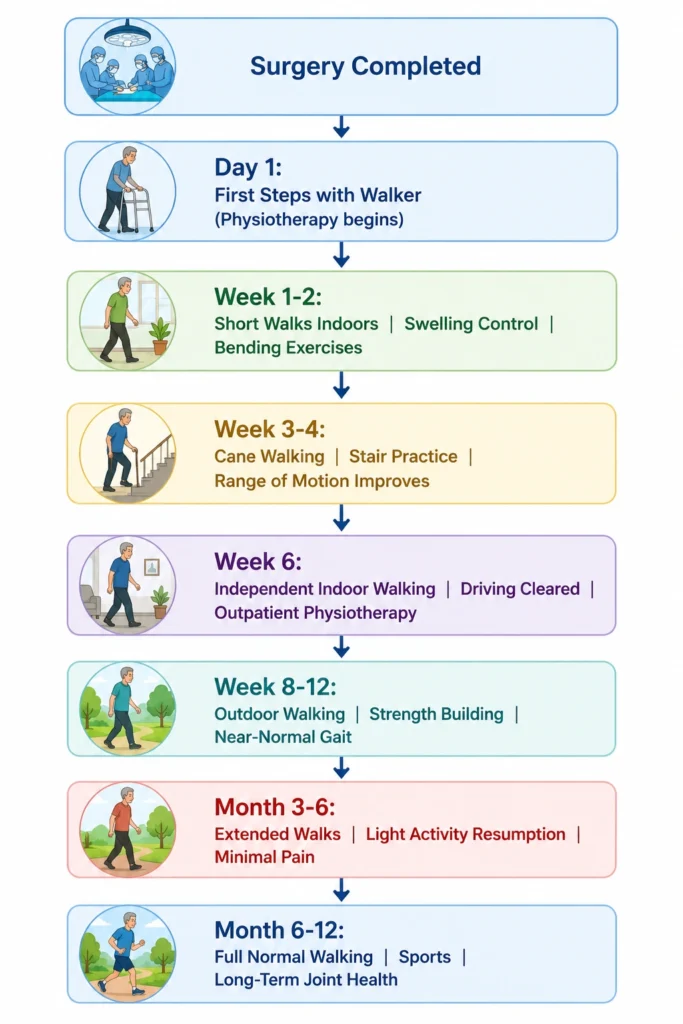
Flowchart: Your Journey from Surgery to Normal Walking
Factors that affect how well you walk after surgery
Not every patient recovers at the same pace. Several factors determine walking ability after knee surgery.
Most of these factors are within your control or can be managed with the right medical team.
| Factor | Impact on Recovery |
| Pre-surgery fitness level | Higher fitness equals faster recovery |
| Body weight | Excess weight slows recovery and stresses the joint |
| Age | Older patients recover, but may take slightly longer |
| Physiotherapy compliance | Direct correlation with outcomes |
| Diabetes or heart conditions | May slow healing; needs careful management |
| Bilateral vs. single knee | Single knee recovery is typically faster |
| Surgeon technique and implant quality | Directly affects long-term function |
| Patient motivation and mindset | Underrated but hugely important |
What should you avoid during recovery?
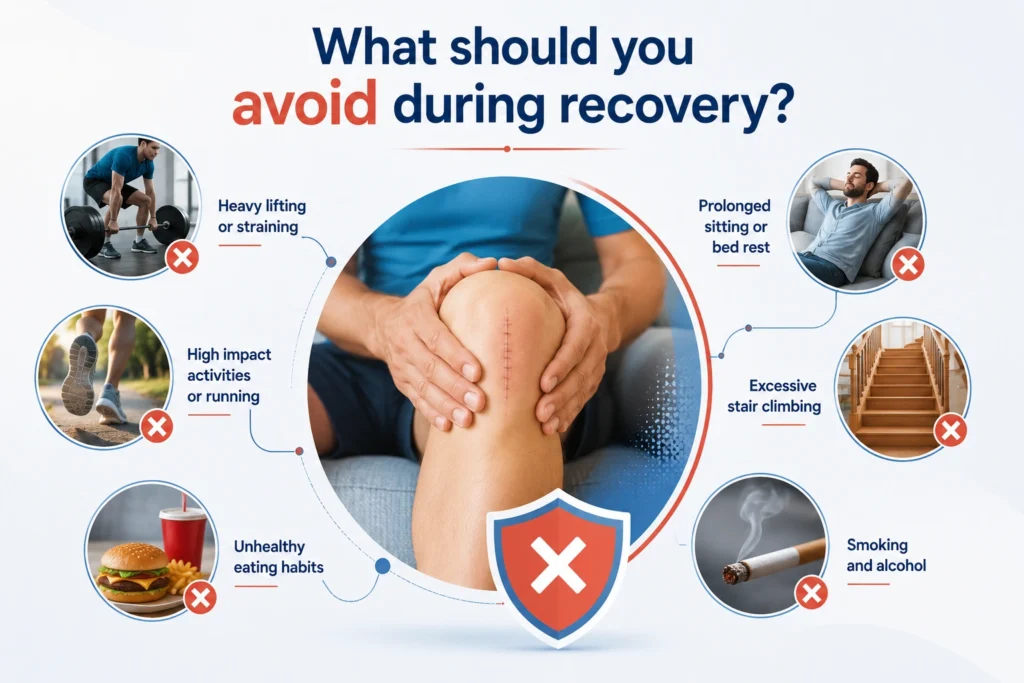
Equally important as what to do is what not to do. Every knee is different. Every patient is different. Trust your timeline.
Avoid these during knee replacement recovery:
- Sitting for long periods without moving your ankles and feet.
- Twisting the knee while the foot is planted.
- High-impact activities like running or jumping before 12 months.
- Kneeling directly on the replaced knee in early recovery.
- Skipping physiotherapy sessions.
- Ignoring swelling, redness, or sudden increase in pain.
- Comparing your recovery to someone else’s timeline.
Signs your recovery is going well
Look for these positive indicators:
- Swelling is gradually reducing each week.
- Range of motion is improving (you can bend the knee further).
- You need less pain medication over time.
- Walking distances are increasing without significant discomfort.
- You feel confident putting weight on the operated leg.
- Sleep is improving.
- Your mood is improving (this matters more than people acknowledge).
Warning signs to watch for
At Rama Hospital, patients have 24/7 access to their orthopedic team during recovery. Quick communication between patient and surgeon is one of the most underrated parts of a safe recovery.
Call your doctor immediately if you notice:
- Sudden severe pain not controlled by medication.
- Significant increase in swelling after it had been reducing.
- Redness, warmth, or streaking around the incision.
- Fever above 101°F / 38.5°C.
- Calf pain or swelling (possible DVT).
- Wound discharge or opening of the incision.
- Inability to bear weight you were managing before.
Knee replacement surgery
Knee replacement surgery in Noida has become significantly more accessible and sophisticated over the last decade. Patients from Delhi NCR, western UP, and beyond now choose Noida for their joint replacement surgery because of the quality and convenience combination. Rama Hospital brings together all of these elements under one roof.
What makes a difference in outcomes:
- Surgeon experience and volume of procedures performed.
- Implant quality (international vs. local grade).
- Availability of physiotherapy from Day 1.
- Infection control protocols.
- Post-operative monitoring and follow-up systems.
Knee pain treatment options
Rama Hospital is one of the most trusted names for knee pain treatment in Noida. The orthopedic department at Rama Hospital handles the full spectrum of knee conditions, from early-stage arthritis to complex revision surgeries.
If you are searching for the best orthopedic surgeon in Noida, Rama Hospital is where patients across the region come to restore their mobility, end their pain, and walk normally again.
- Experienced orthopedic surgeons with high-volume knee replacement practice.
- International-grade implants with documented outcomes.
- In-house knee replacement physiotherapy from Day 1.
- Dedicated rehabilitation team for knee replacement rehabilitation.
- Patient education and counseling before and after surgery.
- Transparent communication about knee replacement recovery week by week.
- Affordable and insurance-friendly packages.
- Strong post-operative follow-up program.
Frequently Asked Questions (FAQs)
Q1. I’m scared of the surgery. Will I be able to walk normally again?
Yes, and for most patients, walking after knee replacement is better than it has been in years. The goal of the surgery is to restore pain-free movement and improve quality of life. With proper physiotherapy, most patients achieve a near-normal walking pattern within 3–6 months, making walking after knee replacement feel natural, comfortable, and confident again.
Q2. How soon will I be able to walk without a walker?
Most patients transition away from the walker to a cane by weeks 3-4. By weeks 6-8, many patients walk indoors without any support. Outdoor independence typically comes around weeks 8-12.
Q3. Will I feel pain while walking during recovery?
Some discomfort is expected, especially in the first few weeks. This is healing pain, different from the arthritis pain you had before surgery. It reduces steadily with each week of consistent knee replacement rehabilitation.
Q4. How many hours a day should I do physiotherapy exercises?
In the early weeks, short exercise sessions 3-4 times a day work better than one long session. Your physiotherapist will give you a specific schedule. The key is consistency even on the days when you don’t feel like it.
Q5. My neighbor had the same surgery but recovered faster. Am I doing something wrong?
Not everyone experiences the same recovery timeline. Factors such as age, fitness level, weight, implant type, and healing response can influence walking after knee replacement. Focus on steady progress rather than comparisons, and stay in close contact with your physiotherapist and surgeon.
Q6. Can I climb stairs after knee replacement?
Yes. Most patients begin stair practice with support in weeks 2–3 as part of their walking after knee replacement recovery. Climbing stairs with alternating legs, rather than one step at a time, typically becomes possible between weeks 8–12 as strength, balance, and confidence improve.
Q7. When can I go back to normal life, shopping, travel, and temple visits?
Light shopping and local travel are usually possible by weeks 4–6. As walking after knee replacement continues to improve, longer trips and extended walking become more comfortable after the 3rd month. Uneven terrain, such as temples with multiple steps, requires extra caution; it’s best to wait until months 3–4 and progress gradually.
Q8. Will I need knee replacement again later?
Modern implants are designed to last 15–20 years. Most patients do not require revision surgery if they maintain a healthy weight, stay active with low-impact exercises, and follow their surgeon’s long-term recommendations. These factors also help support successful walking after knee replacement for many years to come.
Q9. I have diabetes. Can I still have knee replacement surgery and walk normally?
Yes, but diabetes requires careful management before and after surgery. Good blood sugar control significantly improves healing, recovery outcomes, and walking after knee replacement. Consult your orthopedic surgeon and physician together to ensure the safest and most successful recovery.
Q10. How do I know which hospital is right for me for knee replacement surgery in Noida?
Look for a hospital with an experienced orthopedic team, an in-house physiotherapy program, quality implants, strong follow-up systems, and transparent communication. Rama Hospital combines all of these for patients seeking knee replacement surgery in Noida.
Conclusion
The fear before surgery is real. The question, “Will I ever walk normally again?” is one every knee replacement patient asks.
The answer, backed by millions of surgeries and decades of evidence, is yes.
Walking after knee replacement is not just possible. For the vast majority of patients, it becomes genuinely better than what they had been living with for years.
The road involves effort. Physiotherapy, consistency, patience, and trust in the process. But the destination, walking to the market; climbing the stairs in your own home; and going on a family trip without dreading the return, is real and reachable.
If you or someone in your family is considering knee replacement surgery in Noida, speak to the orthopedic team at Rama Hospital. The first step toward walking without pain starts with a single conversation.
For consultations and appointments, contact Rama Hospital, your trusted destination for knee pain treatment in Noida and comprehensive orthopedic care.