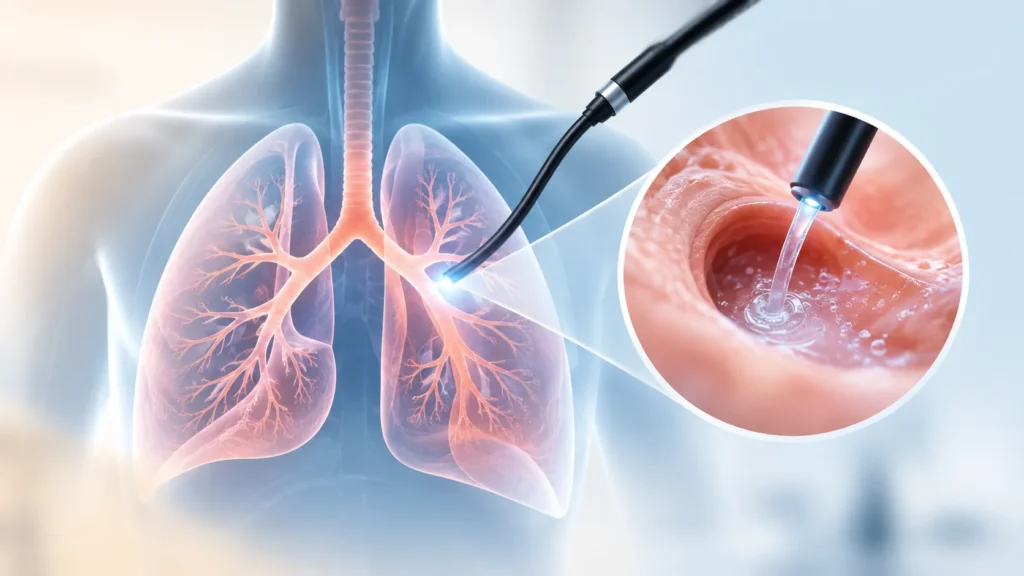
Bronchoalveolar Lavage, commonly called BAL, is a specialized diagnostic procedure used to collect fluid and cells from the lungs. It is performed during a bronchoscopy, when a thin flexible tube is passed through the nose or mouth into the airways. Once the tube reaches a specific area of the lung, a small amount of sterile saline is gently introduced and then suctioned back. This fluid contains cells, proteins, and sometimes microbes from the lung lining, which can be analyzed in the laboratory.
BAL is not a treatment by itself. It is mainly a diagnostic tool that helps doctors understand what is happening inside the lungs when imaging and blood tests are not enough. It is often used in cases of unexplained lung infection, interstitial lung disease, alveolar hemorrhage, certain cancers, or immune-related lung conditions. The information from BAL can guide treatment decisions, antibiotic selection, and long-term management.
What is Bronchoalveolar Lavage?
Bronchoalveolar Lavage is a procedure in which sterile fluid is introduced into a small part of the lung and then collected for analysis. The term broncho refers to the airways, alveolar refers to the tiny air sacs where gas exchange occurs, and lavage means washing. During the procedure, the doctor uses a bronchoscope to reach the targeted area and gently washes it with saline.
The collected fluid contains cells from the lung lining, immune cells, proteins, and sometimes bacteria, viruses, fungi, or cancer cells. By studying this sample, doctors can identify infections, inflammation patterns, bleeding sources, or abnormal cell types. This helps in making a more accurate diagnosis when chest X-ray, CT scan, or blood tests do not provide a clear answer.
BAL is usually performed in a hospital setting by a pulmonologist, also known as a chest specialist. It is done under local anesthesia with sedation, so the patient is comfortable and relaxed during the procedure. Although it sounds complex, BAL is a well-established and widely used technique in modern respiratory medicine.
Why is Bronchoalveolar Lavage Done?
BAL is recommended when there is a need to understand the cause of lung symptoms that are not clear from non-invasive tests.
Common reasons for BAL include:
- Unexplained lung infection or pneumonia that is not responding to treatment.
- Suspected fungal, viral, or atypical infection in the lungs.
- Interstitial lung disease or diffuse lung disease requiring cell analysis.
- Alveolar hemorrhage or bleeding inside the lung air sacs.
- Suspected lung cancer or abnormal cells in the lung.
- Immune-related lung conditions such as sarcoidosis or hypersensitivity pneumonitis.
- Lung involvement in patients with weak immunity, such as after transplant or in HIV.
- Unexplained cough, breathlessness, or infiltrates on imaging.
- Evaluation of lung involvement in systemic diseases.
- Collection of samples for culture, sensitivity, or specialized testing.
What Bronchoalveolar Lavage helps doctors understand
- Type of infection and which medicine may work best.
- Whether inflammation is due to immune cells or other causes.
- Presence of bleeding or abnormal fluid in the lungs.
- Whether cancer cells are present in the airways or lung tissue.
- How severe the lung involvement is at a cellular level.
How is Bronchoalveolar Lavage Performed?
BAL is performed as part of a bronchoscopy procedure. The steps are carefully planned to ensure safety, comfort, and accurate sampling.
Before the procedure
- The patient is assessed by the pulmonologist.
- Medical history, medications, and allergies are reviewed.
- Blood tests may be done to check clotting and overall health.
- Imaging such as chest X-ray or CT scan is reviewed.
- Fasting instructions are given, usually for a few hours before the procedure.
- Arrangements are made for someone to accompany the patient home.
During the procedure
- The patient is given local anesthesia to numb the nose or throat.
- Sedation is provided to help the patient relax and reduce discomfort.
- A bronchoscope, which is a thin flexible tube with a camera, is passed through the nose or mouth.
- The tube is guided into the airways and positioned in the targeted lung segment.
- A small amount of sterile saline is gently injected into the airway.
- The fluid is then suctioned back into a collection trap.
- This may be repeated in one or more areas depending on the clinical need.
- The collected fluid is sent to the laboratory for analysis.
After the procedure
- The patient is monitored in a recovery area until sedation wears off.
- Vital signs such as pulse, oxygen level, and blood pressure are checked.
- The patient is observed for any immediate complications such as bleeding or breathing difficulty.
- Once stable, the patient is allowed to go home with instructions.
Preparation for Bronchoalveolar Lavage
Proper preparation helps make the procedure safer and more comfortable.
Preparation pointers
- Inform the doctor about all current medications, especially blood thinners.
- Share any history of bleeding problems or allergies.
- Follow fasting instructions as advised, usually no food or drink for a few hours before.
- Arrange for a family member or friend to accompany you.
- Wear comfortable clothing and avoid heavy meals before the procedure.
- Bring previous reports, scans, and medication lists.
- Inform the doctor if you have fever, active infection, or worsening breathlessness before the scheduled date.
Medication adjustments
- Blood thinners may need to be paused temporarily.
- Diabetes medicines may need adjustment due to fasting.
- Asthma or lung medicines are usually continued unless advised otherwise.
- Always follow the specific instructions given by the treating team.
What to Expect During and After Bronchoalveolar Lavage
Understanding what happens during and after the procedure can reduce anxiety and help patients prepare mentally.
During the procedure
- You will be awake but relaxed due to sedation.
- You may feel some pressure or mild discomfort in the throat or chest.
- Coughing is common when the bronchoscope is in the airway.
- The procedure usually lasts between twenty to forty minutes, depending on the complexity.
- The medical team will monitor your oxygen level and comfort throughout.
After the procedure
- You may feel sleepy or groggy for a few hours due to sedation.
- Your throat may feel sore or irritated for a day or two.
- Mild cough or a small amount of blood-tinged sputum can occur.
- You may be advised to avoid eating or drinking until the throat numbness wears off.
- Most patients can go home the same day once stable.
Risks and Side Effects of Bronchoalveolar Lavage
BAL is generally safe when performed by an experienced pulmonologist, but like any medical procedure, it has some risks.
Common and mild side effects
- Sore throat.
- Mild cough.
- Low-grade fever for a short time.
- Small amount of blood in sputum.
- Temporary discomfort in the chest or nose.
Less common risks
- Bleeding from the airway, usually mild and self-limiting.
- Bronchospasm or temporary tightening of the airways.
- Drop in oxygen level during the procedure.
- Infection, though this is rare with sterile technique.
- Reaction to sedation or anesthesia.
Rare but serious complications
- Significant bleeding requiring intervention.
- Pneumothorax or air leak causing lung collapse, though this is uncommon with BAL alone.
- Severe breathing difficulty requiring oxygen or hospital stay.
- Heart rhythm changes in patients with underlying heart disease.
Why risks are usually low
- The procedure is done under direct vision with a camera.
- Sterile technique is used to reduce infection risk.
- Monitoring is continuous during the procedure.
- Experienced teams can manage complications quickly if they arise.
Recovery After Bronchoalveolar Lavage
Recovery is usually quick, but it depends on the patient’s overall health and the reason for the procedure.
Recovery pointers
- Rest for the remainder of the day after the procedure.
- Avoid driving or operating machinery until the next day due to sedation.
- Drink plenty of fluids to soothe the throat and clear secretions.
- Use throat lozenges or warm saline gargles if the throat is sore.
- Avoid smoking or exposure to irritants for a few days.
- Resume normal activities gradually as comfort allows.
- Follow all discharge instructions given by the medical team.
When to seek medical help after BAL
- High fever that does not improve.
- Increasing shortness of breath.
- Chest pain that worsens.
- Coughing up more than a small amount of blood.
- Severe dizziness or fainting.
- Any symptom that feels alarming or unusual.
How are Bronchoalveolar Lavage Results Interpreted?
The fluid collected during BAL is sent to the laboratory for various tests. The results help guide diagnosis and treatment.
Common analyses done on BAL fluid
- Cell count and differential to see types of immune cells present.
- Microbial culture to identify bacteria, fungi, or mycobacteria.
- Viral testing if viral infection is suspected.
- Cytology to look for abnormal or cancer cells.
- Special stains for tuberculosis or fungal infection.
- Protein levels or other markers in selected cases.
What different findings may suggest
- High neutrophils may suggest bacterial infection or acute inflammation.
- High lymphocytes may be seen in certain interstitial lung diseases or viral infections.
- Presence of eosinophils may indicate allergic or eosinophilic lung disease.
- Positive culture confirms infection and helps select antibiotics.
- Abnormal cells may raise suspicion of cancer and prompt further testing.
- Blood-laden fluid may confirm alveolar hemorrhage.
Why results take time
- Some cultures need several days to grow organisms.
- Specialized tests may require additional processing.
- The doctor may combine BAL results with imaging, blood tests, and clinical findings before finalizing the diagnosis.
When is Bronchoalveolar Lavage Recommended?
BAL is not done for every lung problem. It is reserved for situations where the information gained will change management.
Situations where Bronchoalveolar Lavage is often recommended
- Persistent pneumonia not responding to standard treatment.
- Suspected atypical or opportunistic infection in immunocompromised patients.
- Unexplained diffuse lung infiltrates on imaging.
- Suspected interstitial lung disease requiring cell pattern analysis.
- Evaluation of suspected alveolar hemorrhage.
- Assessment of lung involvement in systemic or autoimmune disease.
- Suspicion of lung cancer when other sampling methods are not suitable.
- Unexplained chronic cough or breathlessness with abnormal imaging.
Situations where Bronchoalveolar Lavage may not be needed
- Simple, mild respiratory infection that is improving with treatment.
- Clear diagnosis already established by non-invasive tests.
- Patients who are too unstable to safely undergo bronchoscopy.
- Cases where the result will not change the treatment plan.
Benefits of Bronchoalveolar Lavage
BAL provides information that cannot be obtained from blood tests or imaging alone.
Key benefits include:
- Direct sampling from the lung airways and air sacs.
- Ability to identify specific infections and guide antibiotic choice.
- Help in diagnosing complex or rare lung diseases.
- Support in planning long-term treatment for interstitial lung disease.
- Early detection of certain lung cancers or abnormal cells.
- Clarification of unexplained symptoms when other tests are inconclusive.
- Safer alternative to more invasive surgical lung biopsy in many cases.
Limitations of Bronchoalveolar Lavage
While BAL is very useful, it also has some limitations that patients should understand.
Limitations to consider
- It is an invasive procedure, though minimally so.
- It may not always provide a definitive diagnosis on its own.
- Results can be influenced by prior antibiotic use or sampling site.
- Some conditions may still require tissue biopsy for confirmation.
- It requires an experienced pulmonologist and proper facility support.
Why Choose Rama Hospital for Bronchoalveolar Lavage?
Bronchoalveolar Lavage requires expertise, proper equipment, and strong support services. A hospital with an experienced pulmonary team can make the procedure safer and more informative.
- Experienced pulmonologists trained in advanced bronchoscopy.
- Proper monitoring and emergency support during the procedure.
- On-site laboratory for faster processing of samples.
- Coordination with radiology, microbiology, and pathology teams.
- Clear communication of results and treatment plan.
Frequently Asked Questions (FAQs)
Is Bronchoalveolar Lavage painful?
Most patients do not find BAL painful. Local anesthesia and sedation are used to keep you comfortable. You may feel some pressure, coughing, or throat irritation, but severe pain is uncommon.
How long does the Bronchoalveolar Lavage procedure take?
The procedure usually takes between twenty to forty minutes, depending on the complexity and the number of areas sampled. Recovery and monitoring may add a few more hours before discharge.
Do I need to stay in the hospital overnight?
Most patients can go home the same day after observation. Overnight stay may be advised only if there are complications, severe lung disease, or other medical reasons.
When will I get the Bronchoalveolar Lavage results?
Some results may be available within a day or two, while culture reports can take several days. Your doctor will explain the expected timeline based on the tests ordered.
Can BAL detect cancer?
BAL can sometimes detect cancer cells in the lung fluid, especially when the tumor involves the airways. However, a tissue biopsy may still be needed for confirmation in many cases.
Is Bronchoalveolar Lavage safe for elderly or weak patients?
BAL can be performed safely in many elderly or medically complex patients with proper assessment and monitoring. The doctor will evaluate risks and benefits before recommending the procedure.
What should I do if I cough up blood after Bronchoalveolar Lavage?
A small amount of blood-tinged sputum can be normal for a short time. If you cough up more than a few teaspoons of blood, or if bleeding increases, you should contact your doctor or seek urgent care.
Conclusion
Bronchoalveolar Lavage is a valuable diagnostic tool that helps doctors understand complex lung conditions when other tests are not enough. It provides direct information from the lung airways and air sacs, helping identify infections, inflammation, bleeding, or abnormal cells. Although it is an invasive procedure, it is generally safe when performed by an experienced pulmonologist in a proper hospital setting.
The key to benefiting from BAL is proper patient selection, careful preparation, and expert interpretation of results. For patients with unexplained lung symptoms, persistent infection, or suspected interstitial lung disease, BAL can provide clarity and guide the right treatment. With appropriate care and follow-up, most patients tolerate the procedure well and gain important diagnostic information.
Rama Hospital can provide expert evaluation, safe performance of Bronchoalveolar Lavage, and comprehensive follow-up care to ensure accurate diagnosis and effective treatment planning for lung conditions.