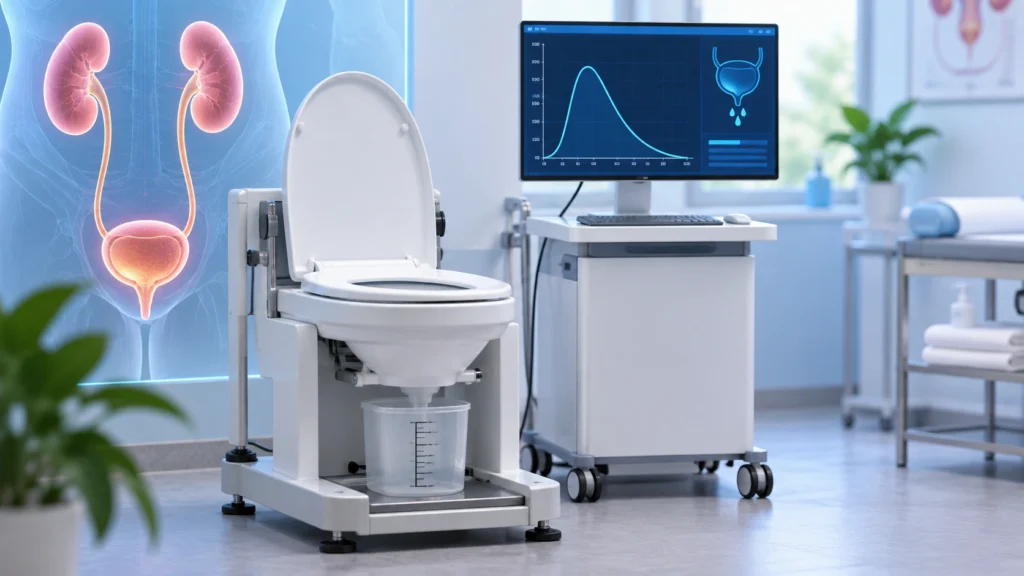
Uroflowmetry is a simple, non-invasive test that measures how urine flows out of the body. It is one of the most common tests used in urology to evaluate urinary symptoms such as weak stream, difficulty starting urination, frequent urination, urgency, incomplete emptying, or dribbling. The test helps doctors understand how well the bladder and urethra are working together during urination.
During uroflowmetry, the patient urinates into a special toilet or funnel connected to a machine. The machine records the speed and pattern of urine flow over time. This information helps identify problems such as bladder outlet obstruction, weak bladder muscle, prostate enlargement, urethral narrowing, or nerve-related bladder issues.
What is Uroflowmetry?
Uroflowmetry is a diagnostic test that measures the rate and pattern of urine flow during urination. It provides objective information about how quickly and smoothly urine leaves the bladder through the urethra. The test is painless, does not involve any needles or instruments inside the body, and usually takes only a few minutes.
The machine records several parameters, including the maximum flow rate, average flow rate, total volume passed, time taken to start urination, and the shape of the flow curve. These values help the urologist assess whether there is any blockage, weak bladder contraction, or coordination problem between the bladder and urethra.
Uroflowmetry is often the first test done when a patient comes with lower urinary tract symptoms. It is commonly used in men with prostate symptoms, women with voiding difficulties, children with urinary issues, and patients with neurological conditions affecting the bladder.
Why is Uroflowmetry Done?
Uroflowmetry is done to evaluate urinary symptoms and guide further management. It helps answer important questions about bladder and urethral function.
Common reasons for doing uroflowmetry
- To assess weak or slow urine stream.
- To evaluate difficulty in starting urination.
- To check for incomplete bladder emptying.
- To investigate frequent urination or urgency.
- To assess urinary hesitancy or straining.
- To evaluate dribbling after urination.
- To screen for prostate enlargement in men.
- To assess urethral narrowing or stricture.
- To evaluate bladder function in neurological conditions.
- To monitor response to treatment for urinary symptoms.
Conditions where uroflowmetry is useful
- Benign prostatic hyperplasia or enlarged prostate.
- Urethral stricture or narrowing.
- Bladder outlet obstruction.
- Weak bladder muscle or detrusor underactivity.
- Neurogenic bladder due to diabetes, spinal cord injury, or stroke.
- Post-surgical evaluation after prostate or urethral surgery.
- Pediatric urinary dysfunction.
- Overactive bladder with voiding difficulties.
How is Uroflowmetry Performed?
Uroflowmetry is a straightforward test that is performed in a private room with a special uroflowmetry machine.
Step-by-step procedure
- The patient is asked to arrive with a comfortably full bladder.
- The test is explained, and consent is taken if required.
- The patient is given privacy to urinate in a normal, comfortable position.
- The patient urinates into a funnel or special toilet connected to the machine.
- The machine records the flow of urine in real time.
- The test is completed once the patient finishes urination.
- The results are printed as a graph and numerical values.
- The urologist reviews the results along with symptoms and examination.
What the machine measures
- Maximum flow rate, which is the highest speed of urine flow.
- Average flow rate, which is the mean speed over the entire void.
- Total voided volume, which is the amount of urine passed.
- Time to maximum flow, which is how long it takes to reach peak flow.
- Total flow time, which is the duration of urination.
- Flow pattern or curve shape, which shows how flow changes over time.
Patient experience during the test
- The test is painless and non-invasive.
- No instruments are inserted into the body.
- The patient urinates in a private, comfortable setting.
- The test feels similar to normal urination.
- Most patients complete the test within minutes.
Preparation for Uroflowmetry
Proper preparation helps ensure accurate and meaningful results.
Before the test
- Arrive with a comfortably full bladder, but not overfilled.
- Do not force excessive fluid intake just before the test.
- Avoid urinating for two to three hours before the test if possible.
- Inform the doctor about any medicines that affect urination.
- Mention any recent urinary infections or procedures.
- Wear comfortable clothing that is easy to manage.
On the day of the test
- Follow normal fluid intake unless advised otherwise.
- Avoid caffeine or alcohol just before the test if they affect your bladder.
- Inform the staff if you feel too urgent or uncomfortable.
- Relax and try to urinate as naturally as possible.
- Do not strain or push unless that is your usual pattern.
Special considerations
- Children may need extra explanation and reassurance.
- Elderly patients may need assistance or more time.
- Patients with mobility issues may require support.
- Patients with catheters or recent surgery need individualized planning.
Normal Uroflowmetry Results
Normal results vary based on age, sex, and voided volume, but certain patterns are generally considered normal.
Normal findings
- Smooth, bell-shaped flow curve.
- Quick time to reach maximum flow.
- Adequate maximum flow rate for age and sex.
- Total voided volume in a reasonable range.
- No significant straining or interruption.
- Complete emptying without significant post-void residual.
Typical flow patterns
- Continuous flow without breaks or drops.
- Gradual rise to peak flow and gradual decline.
- No plateau or flat pattern.
- No prolonged tailing at the end.
- Consistent pattern across repeated tests if done.
Factors affecting normal values
- Age, as flow tends to decrease with advancing age.
- Sex, as men and women have different normal ranges.
- Voided volume, as very low or very high volumes can affect results.
- Position during urination.
- Comfort level and privacy during the test.
Abnormal Uroflowmetry Results
Abnormal results suggest a problem with urine flow, bladder function, or urethral patency.
Common abnormal patterns
- Low maximum flow rate suggesting obstruction or weak bladder.
- Prolonged flow time indicating difficulty in emptying.
- Intermittent or interrupted flow pattern.
- Flat or plateau curve suggesting fixed obstruction.
- Delayed time to reach maximum flow.
- Tailing at the end suggesting incomplete emptying.
- Very low voided volume with poor flow.
What abnormal results may indicate
- Bladder outlet obstruction such as enlarged prostate.
- Urethral stricture or narrowing.
- Weak bladder muscle or poor contraction.
- Coordination problem between bladder and urethra.
- Neurogenic bladder dysfunction.
- Post-surgical changes affecting flow.
- Severe urinary retention or incomplete emptying.
Limitations of uroflowmetry
- A single test may not represent usual voiding.
- Anxiety or discomfort can affect results.
- Very low or very high volumes can distort interpretation.
- It does not measure bladder pressure directly.
- Additional tests may be needed for complete evaluation.
Interpretation of Uroflowmetry
Interpretation is done by a urologist who combines the flow results with symptoms, examination, and other tests.
How results are interpreted
- Maximum flow rate is compared with age and sex norms.
- Flow pattern is analyzed for shape and consistency.
- Voided volume is considered to ensure adequate filling.
- Symptoms are correlated with flow findings.
- Need for further tests is assessed based on results.
Common interpretations
- Low flow with normal volume suggests possible obstruction.
- Low flow with low volume may indicate poor bladder filling or function.
- Intermittent flow may suggest straining or coordination issues.
- Flat curve may suggest fixed narrowing or stricture.
- Normal flow with significant symptoms may need further evaluation.
When further tests are needed?
- If results are unclear or inconsistent with symptoms.
- If there is significant obstruction or retention.
- If neurological bladder dysfunction is suspected.
- If surgery is being considered for prostate or urethra.
- If there is recurrent urinary infection or retention.
Additional Tests That May Be Done
Uroflowmetry is often part of a broader evaluation of urinary function.
Common additional tests
- Post-void residual urine measurement by ultrasound.
- Urinalysis to check for infection or blood.
- Blood tests for kidney function and sugar.
- Ultrasound of kidneys, bladder, and prostate.
- Cystoscopy to look inside the urethra and bladder.
- Urodynamic studies for detailed bladder pressure assessment.
- PSA test in men for prostate evaluation.
- Imaging studies if structural problems are suspected.
Why additional tests may be needed?
- To confirm the cause of abnormal flow.
- To assess bladder emptying more accurately.
- To evaluate prostate size and structure.
- To rule out infection or other conditions.
- To plan treatment such as medicines or surgery.
Uroflowmetry in Different Patient Groups
Uroflowmetry is useful in various patient populations with different urinary concerns.
In men with prostate symptoms
- Helps assess severity of obstruction.
- Guides decision for medical or surgical treatment.
- Monitors response to prostate medications.
- Evaluates flow before and after surgery.
In women with voiding difficulties
- Assesses bladder outlet function.
- Evaluates post-surgical voiding after pelvic surgery.
- Helps diagnose urethral narrowing or dysfunction.
- Supports management of complex urinary symptoms.
In children with urinary issues
- Evaluates abnormal voiding patterns.
- Assesses bedwetting or daytime wetting with flow problems.
- Helps diagnose congenital or functional issues.
- Guides pediatric urology management.
In patients with neurological conditions
- Assesses bladder function in spinal cord injury, stroke, or diabetes.
- Helps plan bladder management strategies.
- Monitors changes over time.
- Supports coordination with neurology and rehabilitation.
Benefits of Uroflowmetry
Uroflowmetry offers several advantages as a diagnostic tool.
Key benefits
- Non-invasive and painless procedure.
- Quick and easy to perform.
- Provides objective data on urine flow.
- Helps guide treatment decisions.
- Useful for monitoring response to therapy.
- Safe for most patients including elderly and children.
- Can be repeated as needed for follow-up.
Why it is valuable
- Reduces guesswork in evaluating urinary symptoms.
- Helps distinguish between obstruction and weak bladder.
- Supports evidence-based treatment planning.
- Improves patient counseling and expectations.
- Enhances overall urology care quality.
Limitations of Uroflowmetry
While useful, uroflowmetry has certain limitations that should be understood.
Common limitations
- Does not measure bladder pressure directly.
- Results can be affected by patient comfort and anxiety.
- Requires adequate bladder volume for accurate interpretation.
- May need to be repeated for consistency.
- Does not provide a complete diagnosis on its own.
When results may be less reliable
- If the patient is unable to relax during the test.
- If the bladder is too full or not full enough.
- If there is pain or discomfort during urination.
- If the patient has mobility or positioning issues.
- If there is active urinary infection or severe inflammation.
When Should You See a Doctor?
Medical evaluation is important for people with persistent urinary symptoms.
- Weak or slow urine stream.
- Difficulty starting urination.
- Frequent urination, especially at night.
- Urgency or inability to hold urine.
- Feeling of incomplete emptying.
- Dribbling after urination.
- Pain or burning during urination.
- Blood in urine.
- Recurrent urinary infections.
- Known prostate enlargement with worsening symptoms.
Why Choose Rama Hospital for Uroflowmetry?
Uroflowmetry is a key test in urology, but its value depends on proper technique, interpretation, and integration with overall care. A hospital with experienced urologists and modern diagnostics can provide accurate assessment and meaningful guidance.
- Expert urology team with focus on urinary disorders.
- Modern uroflowmetry equipment for accurate results.
- Proper privacy and patient comfort during testing.
- Comprehensive evaluation including additional tests if needed.
- Clear explanation of results and treatment options.
Frequently Asked Questions (FAQs)
Is uroflowmetry painful?
No, uroflowmetry is not painful. You simply urinate into a special funnel or toilet connected to a machine. No instruments are inserted into the body. Most patients find the test comfortable and easy.
How long does the test take?
The actual urination takes only a few minutes. The entire process including explanation and setup may take ten to fifteen minutes. You can usually resume normal activity immediately after the test.
Do I need to prepare for uroflowmetry?
Yes, you should arrive with a comfortably full bladder. Avoid urinating for two to three hours before the test if possible. Follow normal fluid intake and inform the doctor about any medicines affecting urination.
What do normal results look like?
Normal results show a smooth, bell-shaped flow curve with adequate maximum flow rate for your age and sex. The flow should be continuous without significant interruption. Total voided volume should be in a reasonable range.
What if my results are abnormal?
Abnormal results suggest a problem with urine flow, bladder function, or urethral patency. Your urologist will correlate the results with your symptoms and may recommend further tests or treatment based on the findings.
Can uroflowmetry diagnose prostate enlargement?
Uroflowmetry can suggest obstruction that may be due to prostate enlargement, but it does not diagnose the cause on its own. Additional tests such as ultrasound, PSA, or examination are needed for complete evaluation.
Can children undergo uroflowmetry?
Yes, children can undergo uroflowmetry if they have urinary symptoms. The test is adapted to their age and comfort level. It helps evaluate voiding dysfunction, bedwetting, or congenital urinary issues.
Conclusion
Uroflowmetry is a simple, painless, and valuable test that provides important information about urine flow and bladder function. It helps evaluate urinary symptoms, guide treatment decisions, and monitor response to therapy. While it has some limitations, it is an essential part of modern urology care.
For patients with weak stream, difficulty urinating, frequent urination, or other urinary concerns, uroflowmetry can provide clarity and direction. With proper preparation and expert interpretation, the test supports accurate diagnosis and effective management.
Rama Hospital can perform uroflowmetry with modern equipment, ensure patient comfort and privacy, and provide clear explanation of results along with comprehensive urology care.