When the air outside turns grey and hazy, a child’s cough can quickly become a source of worry for parents. A little coughing after playing outdoors, repeated throat clearing, a runny nose or unusual wheezing may seem like a seasonal problem. But during severe pollution episodes, these symptoms deserve attention.
In Delhi-NCR, smog can make outdoor air unhealthy for children, particularly those with asthma, allergies or other respiratory conditions. When the Air Quality Index (AQI) crosses 300, parents need to be especially careful about how much time their children spend outdoors and whether they develop breathing symptoms.
If your child is coughing due to air pollution, the first step is to reduce further exposure and assess how your child is breathing. Not every cough is an emergency, and not every cough is caused by pollution. However, persistent coughing, wheezing or difficulty breathing should never be ignored.
This guide explains what AQI 300+ means, how smog affects children’s lungs, what parents can do at home, and when to seek medical help.
What Does AQI 300+ Mean for Your Child?
The Air Quality Index measures outdoor air quality using information about pollutants such as particulate matter and certain gases. A higher AQI generally indicates a greater potential health risk.
Under India’s National Air Quality Index, an AQI of 201–300 is classified as Poor, while 301–400 is classified as Very Poor. The 401–500 range is classified as Severe. These categories are important because the potential health effects increase as pollution levels rise.
At AQI 300, prolonged exposure can cause breathing discomfort. Once the reading rises above 300, the air enters the Very Poor category, where prolonged exposure can increase the risk of respiratory illness. Children with existing lung conditions may be particularly vulnerable.
Children are not simply smaller adults when it comes to air pollution. Their lungs and airways are still developing, and they may spend considerable time running, playing and breathing faster during physical activity. This can increase their exposure to airborne pollutants.
Why should parents pay attention?
During high-pollution days, children may experience:
- A dry or irritating cough.
- Throat irritation or a scratchy throat.
- Runny nose, sneezing or nasal irritation.
- Wheezing or noisy breathing.
- Chest tightness or shortness of breath.
- Worsening asthma symptoms in children who already have asthma.
These symptoms do not prove that pollution is the cause. Viral infections, allergies and other respiratory conditions can produce similar problems. The AQI provides useful context, but your child’s symptoms and medical history matter just as much.
Why Does Smog Make Children Cough?
Smog contains a mixture of pollutants that can irritate the respiratory tract. One of the main concerns is particulate matter, particularly PM2.5, which consists of very fine particles that can penetrate deep into the lungs.
When a child breathes polluted air, these particles and other pollutants can irritate the lining of the nose, throat and airways. This irritation may trigger coughing, mucus production and inflammation.
For children with asthma, exposure to polluted air may also contribute to airway narrowing and worsening symptoms.
Air pollution has been linked to respiratory illness and other health problems in children. Reducing exposure during pollution episodes is therefore an important preventive step.
Does every child react to smog in the same way?
No. Some children may develop throat irritation or an occasional cough, while others may experience more noticeable symptoms. Children with asthma, recurrent wheezing or other respiratory illnesses may be more sensitive to polluted air.
Age, underlying health conditions, the intensity and duration of exposure, and the pollutants present can all influence how a child responds.
A child who appears comfortable indoors may develop coughing or wheezing after outdoor play. This pattern is worth discussing with a paediatrician, especially if it happens repeatedly.
A Parent’s Checklist: What to Do When Your Child Coughs During Smog Days
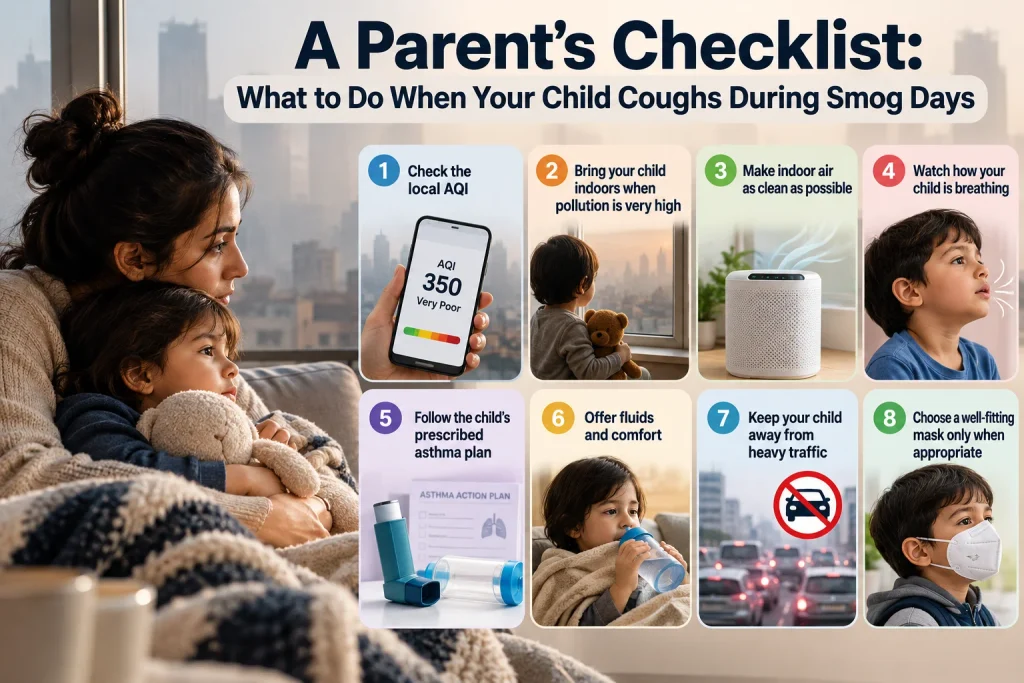
If your child starts coughing when air quality is very poor, use the following checklist to reduce exposure and identify signs that need medical attention.
1. Check the local AQI
Before sending your child to school, a playground or an outdoor activity, check the current AQI for your specific area.
Air quality can vary between neighbourhoods, and a city-wide average may not reflect the conditions near your home or school.
Use official CPCB air-quality information or another reliable local monitoring service. Check the reading again if conditions change during the day.
What parents can do:
- Check the AQI before outdoor activities.
- Pay attention to official health and school advisories.
- Reduce outdoor exposure when pollution is high.
- Avoid assuming that clear-looking skies mean clean air.
2. Bring your child indoors when pollution is very high
If your child is coughing during an AQI 300+ episode, move them away from outdoor pollution and reduce further exposure.
Avoid outdoor running, cycling, sports and strenuous play. Children with asthma or other respiratory conditions may need additional precautions according to their doctor’s advice.
Staying indoors can reduce exposure, although indoor air is not automatically clean. Smoke from cooking, incense, tobacco or other sources can also irritate a child’s airways.
3. Make indoor air as clean as possible
During severe smog, keeping doors and windows closed can help limit the entry of outdoor pollutants. However, ventilation needs also depend on indoor pollution sources and the conditions in your home.
If possible, use a properly sized air purifier with a high-efficiency particle filter, such as a HEPA filter, in the room where your child spends the most time. Follow the manufacturer’s instructions for filter replacement and maintenance.
Avoid generating additional indoor smoke or fumes.
Try to avoid:
- Smoking or vaping inside the home.
- Burning incense or dhoop unnecessarily.
- Using mosquito coils indoors where alternatives are available.
- Burning wood, coal or waste near children.
- Using strong sprays or cleaning products that trigger irritation.
If cooking produces smoke, use an exhaust system that vents outdoors where possible. The aim is to reduce both outdoor pollution entering the home and indoor sources of respiratory irritation.
4. Watch how your child is breathing
Do not focus on the cough alone. Pay attention to whether your child is breathing comfortably, speaking normally, drinking fluids and behaving as usual.
Look for changes such as:
- Breathing faster than usual while resting.
- Wheezing or whistling sounds while breathing.
- Complaints of chest tightness or pain.
- Unusual tiredness during simple activities.
- Difficulty keeping up with normal play.
- A cough that is persistent, worsening or disturbing sleep.
These signs do not all indicate the same level of urgency. A child with mild irritation who is otherwise comfortable may need observation and medical advice if symptoms persist. A child who is struggling to breathe needs emergency assessment.
5. Follow the child’s prescribed asthma plan
If your child has asthma, high pollution may trigger symptoms or make existing symptoms worse.
Keep prescribed medicines available and follow the asthma action plan provided by your child’s doctor. If a reliever inhaler has been prescribed, use it according to the plan and the child’s prescribed instructions.
Do not start a new inhaler, change a dose or use someone else’s medication without appropriate medical advice.
Contact your child’s doctor if symptoms are more frequent than usual, the prescribed reliever is needed more often than directed, or the treatment is not providing the expected relief.
6. Offer fluids and comfort
If your child is coughing but breathing comfortably, encourage regular fluids appropriate for their age. Warm drinks may soothe throat irritation in children old enough to drink them safely.
For children older than one year, a small amount of honey may help ease a cough. Never give honey to a baby younger than 12 months.
Avoid very hot drinks, steam inhalation over bowls of boiling water, and other home remedies that can cause burns or delay medical care.
Fluids and comfort measures may help with irritation, but they do not remove pollutants from the lungs or treat serious breathing problems.
7. Keep your child away from heavy traffic
Roadside pollution can be particularly high near congested roads, bus stops, construction sites and busy intersections.
If you need to travel with your child, reduce time spent waiting beside traffic. Where practical, choose routes away from heavy congestion and keep car windows closed during high-pollution periods.
A vehicle’s recirculation setting and cabin filter may help reduce some exposure, depending on the vehicle and filter condition. They do not guarantee protection from all pollutants.
8. Choose a well-fitting mask only when appropriate
Masks are not a substitute for staying indoors during severe pollution. If outdoor exposure cannot be avoided, a properly fitted particulate respirator may reduce inhalation of some airborne particles, but protection depends on the mask’s filtration, fit and correct use.
Children must be able to breathe comfortably and remove the mask if needed. Do not put masks on infants or use them on children who cannot remove them independently or safely.
A loose-fitting cloth or surgical mask should not be relied upon to provide the same particle filtration as a properly fitted respirator. Ask a healthcare professional for age-appropriate guidance, especially if your child has a respiratory condition.
The most effective first step on very polluted days remains reducing time spent outdoors and avoiding strenuous activity.
Child Coughing Due to Air Pollution: When Should You Worry?
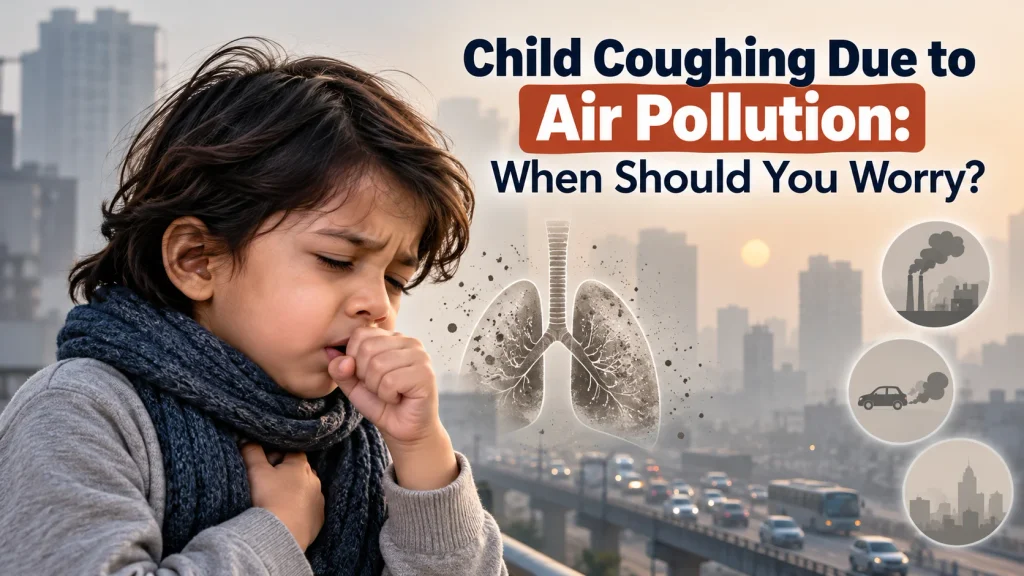
A cough during smog season does not automatically mean your child has developed a serious lung problem. The important question is whether the child is comfortable and breathing normally, and whether symptoms improve after exposure is reduced.
Symptoms that need medical advice
Arrange a medical assessment if your child has:
- A persistent or worsening cough.
- Repeated coughing episodes during high-pollution days.
- Wheezing or recurrent noisy breathing.
- A cough that repeatedly wakes them at night.
- Fever or symptoms suggesting a respiratory infection.
- Reduced appetite, unusual tiredness or reduced activity.
- Symptoms that continue even after moving indoors.
Seek advice sooner if your child is very young or has asthma, a history of premature birth, chronic lung disease or another condition that increases respiratory risk.
Warning signs that require emergency care
Seek emergency medical help immediately if your child:
- Is struggling to breathe or gasping.
- Has pronounced pulling-in of the skin between or below the ribs while breathing.
- Cannot speak, cry, drink or feed normally because of breathlessness.
- Develops blue or grey lips or skin.
- Becomes unusually drowsy, confused or difficult to wake.
- Has severe breathing difficulty or rapidly worsening symptoms.
Do not wait for the AQI to improve or assume that these symptoms will settle once your child is indoors. Severe breathing difficulty is an emergency regardless of the suspected cause.
Can Air Pollution Trigger Asthma in Children?
Air pollution can irritate sensitive airways and may trigger asthma symptoms in children who already have the condition. Symptoms can include coughing, wheezing, chest tightness and shortness of breath.
Some children mainly cough rather than produce the typical wheezing sound. However, a cough alone is not enough to diagnose asthma.
If your child repeatedly coughs during exercise, at night, or on high-pollution days, arrange an evaluation with a paediatrician. Depending on the child’s age and symptoms, the doctor may consider asthma, allergies, infections or other causes.
What if your child already has asthma?
During smog episodes:
- Follow the prescribed asthma action plan.
- Keep medicines and prescribed inhalers accessible.
- Avoid strenuous outdoor activity when pollution is high.
- Monitor changes in cough, wheezing and breathing.
- Seek medical advice if symptoms become more frequent or harder to control.
Do not stop controller medication or increase doses independently. If your child’s prescribed rescue treatment is not working as expected, seek urgent medical help.
Is a Smog-Related Cough Different From a Viral Cough?
It can be difficult to distinguish a pollution-related cough from a cough caused by a cold, flu or another respiratory infection based on symptoms alone.
Pollution-related irritation may become noticeable during or after outdoor exposure and may improve when exposure is reduced. Viral infections may be accompanied by fever, sore throat, body aches, nasal congestion or contact with someone who is ill.
However, these patterns overlap. Pollution can also aggravate symptoms in a child who already has a respiratory infection.
| Feature | Possible pollution-related irritation | Possible respiratory infection |
| Timing | May worsen during high-pollution exposure | May develop over hours or days |
| Associated symptoms | Throat irritation, cough, wheezing or eye irritation | May include fever, runny nose, sore throat or body aches |
| Effect of reducing exposure | Irritation may improve | Symptoms may continue |
| What to do | Reduce exposure and monitor symptoms | Seek advice based on age, severity and symptoms |
This comparison is only a guide, not a diagnostic tool. Neither the presence nor absence of fever can reliably identify the cause of a cough.
If symptoms persist, worsen or interfere with normal breathing, a clinical assessment is appropriate.
Should You Send Your Child to School When AQI Is 300+?
The decision should consider local air quality, official advisories, the child’s symptoms and any underlying health conditions.
When the AQI is very poor or severe, outdoor sports, assemblies and strenuous physical activities may need to be reduced or moved indoors. Follow local school and government guidance.
If your child is coughing, wheezing or feeling breathless, do not send them to participate in outdoor physical activity. Seek medical advice if symptoms persist or worsen.
For children with asthma or other respiratory conditions, follow the individual advice provided by their doctor.
Parents should also remember that indoor school environments differ. An indoor classroom may reduce exposure compared with an outdoor playground, but it cannot guarantee clean air unless pollution entry and indoor sources are appropriately managed.
Can an Air Purifier Help During Smog Season?
A suitable air purifier can reduce airborne particles in an indoor room when it is correctly sized, maintained and operated. It may be useful during high-pollution periods, especially for families whose children spend much of their time indoors.
For particle removal, look for a unit with a high-efficiency particle filter and a clean-air delivery rate appropriate for the room size. Keep up with filter maintenance and follow the manufacturer’s guidance.
However, air purifiers have limitations. They do not prevent all exposure, may not remove every gaseous pollutant, and cannot replace medical assessment when a child has breathing symptoms.
Avoid devices that intentionally generate ozone, which can irritate the lungs.
If buying an air purifier is not possible, focus first on reducing indoor smoke, limiting outdoor exposure during high pollution and following official health advisories.
A Simple Daily Smog Checklist for Parents
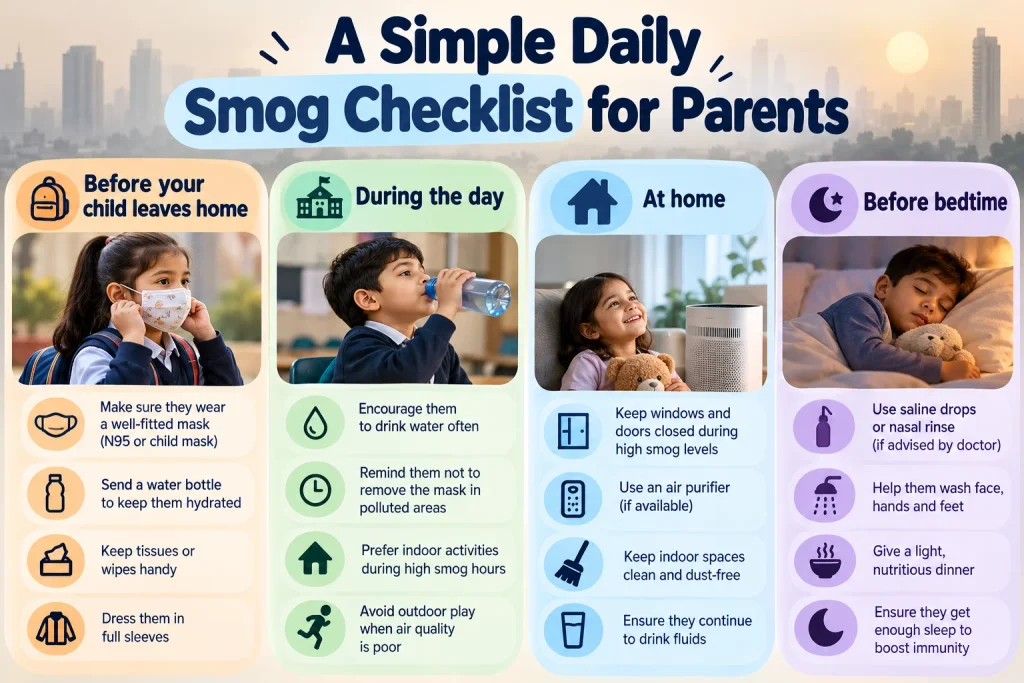
Use this checklist during pollution episodes, especially when the AQI reaches 300 or higher.
Before your child leaves home
- Check the local AQI and official advisories.
- Review any symptoms from the previous night.
- Keep prescribed medicines available.
- Adjust outdoor activities according to pollution levels.
During the day
- Avoid strenuous outdoor play when pollution is very high.
- Keep children away from traffic and visible smoke.
- Watch for coughing, wheezing or unusual breathlessness.
- Follow the child’s asthma action plan, if applicable.
At home
- Reduce outdoor pollution entering the room where possible.
- Avoid smoking, incense and other unnecessary sources of indoor smoke.
- Use a suitable air purifier if available.
- Offer fluids and monitor your child’s comfort.
Before bedtime
- Check whether the cough is worsening or interrupting sleep.
- Look for wheezing or changes in breathing.
- Seek medical advice if symptoms persist.
- Obtain emergency care for severe breathing difficulty.
Remember: a checklist helps you monitor your child, but it should never delay medical care when warning signs appear.
When Should You Consult a Paediatrician in Noida?
If your child develops a persistent cough, repeated wheezing or breathing discomfort during smog season, a paediatrician can help assess the possible causes and recommend appropriate care.
A consultation may include questions about when the cough started, whether it worsens outdoors or at night, the child’s medical history, exposure to pollution and any other symptoms. The doctor will examine your child and decide whether further testing or specialist evaluation is needed.
If you are looking for a paediatrician in Noida or a child specialist in Noida, choose a healthcare provider who can assess your child’s symptoms and guide you on the next steps.
For children with recurring respiratory symptoms, it is particularly important to distinguish pollution-related irritation from asthma, allergies, infection or another underlying condition.
If your child is struggling to breathe, has blue or grey lips, or becomes unusually drowsy, seek emergency medical care rather than waiting for a routine appointment.
Frequently Asked Questions (FAQs)
1. Can AQI 300 cause coughing in children?
Yes. Air pollution at these levels can irritate the respiratory tract and contribute to coughing, throat irritation and breathing discomfort, particularly with prolonged exposure. Children with asthma or other respiratory conditions may be more vulnerable. A cough can also have other causes, so persistent or severe symptoms need medical evaluation.
2. What should I do if my child starts coughing during smog?
Move your child away from the polluted outdoor environment, reduce further exposure and check whether they are breathing comfortably. Avoid strenuous activity and monitor symptoms. If the cough persists, worsens or is accompanied by wheezing, seek medical advice. Severe breathing difficulty requires emergency care.
3. Is AQI 300 dangerous for children?
An AQI of 201–300 falls in India’s Poor category, while 301–400 is Very Poor. Prolonged exposure can cause breathing discomfort, and respiratory risks increase as air quality worsens. Children with asthma and other lung conditions may need additional protection.
4. Can smog cause asthma in children?
Air pollution can aggravate asthma and trigger symptoms in children who have the condition. It may also contribute to respiratory irritation. A cough alone does not establish an asthma diagnosis; recurring symptoms should be evaluated by a healthcare professional.
5. Should children wear masks when AQI is high?
Reducing outdoor exposure is the priority. If exposure cannot be avoided, a properly fitted particulate respirator may reduce inhalation of some particles, but fit, age and safe use matter. Masks are not appropriate for infants or children unable to remove them safely. Follow age-appropriate medical guidance.
6. Does an air purifier help with a pollution-related cough?
A properly sized air purifier with a high-efficiency particle filter can reduce airborne particles indoors. It does not eliminate all pollutants or treat the underlying cause of a cough. Seek medical advice if your child’s symptoms persist or worsen.
7. When should I take my child to a doctor for a smog-related cough?
Consult a doctor if the cough persists, worsens, repeatedly disturbs sleep or occurs with wheezing, fever or reduced activity. Seek emergency care if your child has severe breathing difficulty, blue or grey lips, or unusual drowsiness.
8. Can children play outside when AQI is above 300?
Outdoor physical activity should be avoided when air quality is very poor, particularly for children with asthma or respiratory symptoms. Choose indoor activities, follow official advisories and check local air quality before resuming outdoor play.
Conclusion
When air pollution reaches AQI 300 or higher, protecting your child’s respiratory health starts with simple, timely decisions. Check the local AQI, reduce outdoor exposure, avoid strenuous activity, keep indoor air as clean as possible and watch for changes in breathing.
A cough during smog season may be caused by airway irritation, but it should not automatically be blamed on pollution. Persistent coughing, wheezing and recurring breathing discomfort deserve medical attention.
If you are concerned about your child’s cough or breathing, consult a paediatrician for an appropriate assessment. Families looking for a child specialist in Noida can seek professional guidance on recurring respiratory symptoms and age-appropriate care.
And if your child is struggling to breathe, seek emergency medical help immediately. Acting promptly matters more than waiting for the air to clear.