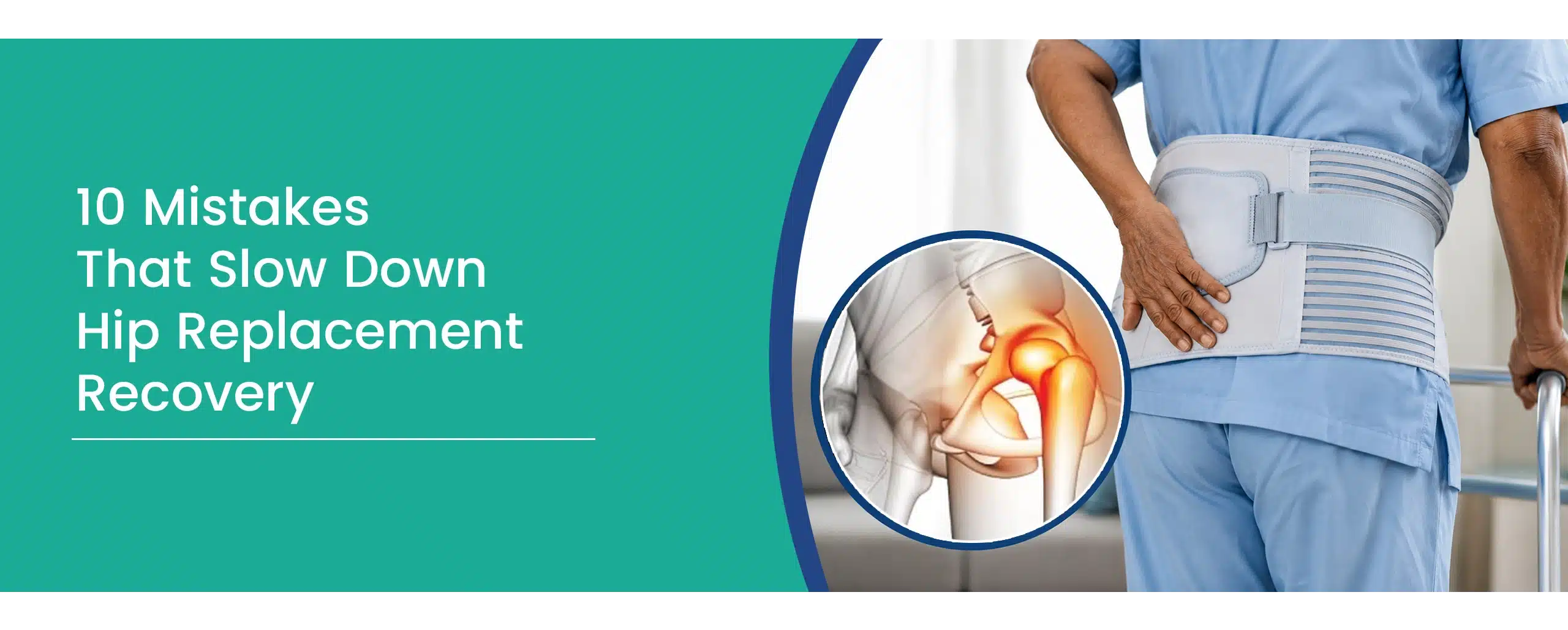
You just had hip replacement surgery. The hard part is done.
Or so you think.
The truth is, what you do after surgery matters just as much as the surgery itself. Many patients who go through successful procedures still end up with slow, painful recoveries because of avoidable mistakes. Some push too hard too soon. Others don’t move enough. And many simply don’t know what good hip replacement recovery actually looks like.
Why hip replacement recovery gets complicated
Hip replacement recovery is not a passive process. It demands active participation from the patient, consistent follow-through on rehabilitation, and close communication with your care team.
On average, full recovery takes 3 to 6 months. But patients who make the mistakes listed below often extend that timeline to 9 to 12 months, or longer.
The good news? Every single mistake on this list is preventable.
The 10 mistakes that delay hip replacement recovery
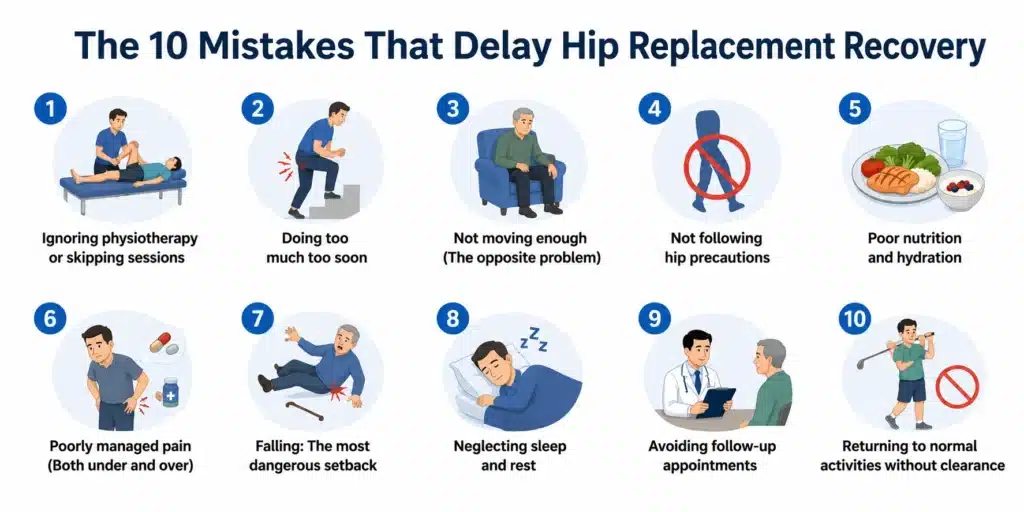
Mistake 1: Ignoring physiotherapy or skipping sessions
This is the single most common reason for slow recovery after hip replacement.
Many patients feel that once they are back home and walking without pain, physiotherapy is optional. It is not.
- The muscles around your new joint are weak and need targeted rehabilitation.
- Skipping sessions leads to stiffness, poor gait, and compensatory movement patterns.
- Missed sessions during the first 6 weeks can permanently affect your range of motion.
What to do: Commit to every scheduled session. Rehabilitation tips from your physiotherapist exist for a reason. Follow them consistently, not selectively.
Mistake 2: Doing too much too soon
Pain decreases faster than tissue heals. This is one of the most dangerous realities of hip replacement recovery.
Just because you feel better does not mean your hip is fully healed. Overloading the joint early on can
- Dislocate the prosthetic joint.
- Cause internal soft tissue damage.
- Trigger inflammation that sets back your hip replacement recovery by weeks.
What to do: Follow your surgeon’s activity milestones. Introduce load and activity in stages. Faster healing after hip surgery comes from patience, not speed.
Mistake 3: Not moving enough (The opposite problem)
Just as dangerous as overdoing it is doing nothing at all.
Bed rest beyond what is prescribed causes the following:
- Deep vein thrombosis (blood clots in the leg veins).
- Muscle wasting and joint stiffness.
- Psychological setbacks that further delay hip replacement recovery.
What to do: Start walking as directed, even if it is short distances. Movement is medicine during hip replacement recovery. The goal is controlled, purposeful activity.
Mistake 4: Not following hip precautions
After hip replacement surgery, your surgeon will give you a list of movements to avoid. These are not suggestions. They are safety rules.
Common precautions include:
| Movement to Avoid | Why It’s Dangerous |
| Bending the hip beyond 90 degrees | Can dislocate the joint |
| Crossing your legs | Twists the prosthetic components |
| Rotating your foot inward | Stresses the new joiner. |
| Sitting on low chairs or toilets | Puts the hip in a risky angle |
| Leaning forward to pick up objects | High dislocation risk |
Patients who ignore these precautions are at serious risk, especially during the first 6 to 12 weeks of hip replacement recovery.
What to do: Keep a copy of your precautions list. Share it with every family member in your home. Modify your environment before you are discharged.
Mistake 5: Poor nutrition and hydration
Hip replacement recovery is a tissue-repair process. And tissue repair runs on nutrients.
Many patients underestimate how much their diet affects faster healing after hip surgery. Common nutritional mistakes:
- Not eating enough protein (the building block of muscle and tissue).
- Ignoring iron and vitamin C intake (critical for wound healing).
- Not drinking enough water, which slows circulation and healing.
- Eating processed foods that increase inflammation.
What to do: Focus on protein-rich meals, dal, eggs, paneer, fish, and chicken. Include fruits rich in vitamin C like amla, guava, and oranges. Drink at least 8 to 10 glasses of water daily throughout your hip replacement recovery.
Mistake 6: Poorly managed pain (Both under and over)
Pain management is often handled incorrectly on both ends.
Under-managed pain means patients avoid movement, which delays rehabilitation and hip replacement recovery.
Over-reliance on painkillers masks important signals from the body and can lead to dependency or masked complications.
What to do: Communicate honestly with your surgeon about your pain levels. Use medication as prescribed. As your hip replacement recovery progresses, the goal is to gradually reduce pain medication with guidance, not independently.
Mistake 7: Falling: The most dangerous setback
A fall during hip replacement recovery can be catastrophic. It can fracture the bone around the implant, dislocate the joint, or require emergency revision surgery.
Fall risks go up when patients:
- Walk without assistive devices before they are ready
- Navigate stairs too soon
- Have a home environment that is not modified for safety
- Feel overconfident at the 4 to 6-week mark when energy returns
What to do: Remove rugs, install grab bars in bathrooms, avoid wet floors, and use a walker or cane as long as your surgeon recommends. Hip replacement rehabilitation tips always include home safety assessments. Take them seriously.
Mistake 8: Neglecting sleep and rest
Rest is not the same as doing nothing. During deep sleep, your body releases growth hormones that repair muscle and tissue. Poor sleep actively slows hip replacement recovery.
Common sleep mistakes:
- Sleeping in positions that stress the operated hip.
- Not using positioning pillows (especially to prevent leg crossing at night).
- Disrupted sleep due to unmanaged pain.
What to do: Sleep on your back with a pillow between your knees. Treat sleep as part of hip replacement rehabilitation the same way you treat physiotherapy. It is non-negotiable.
Mistake 9: Avoiding follow-up appointments
Many patients stop attending follow-up visits once they feel better. This is a serious mistake.
Regular follow-ups exist to:
- Monitor implant positioning via X-rays.
- Catch complications early (infection, blood clots, nerve issues).
- Adjust your hip replacement rehabilitation plan based on actual progress.
- Ensure bone healing around the prosthesis is on track.
Missing even one follow-up during early hip replacement recovery can mean missing a developing complication that is still easy to treat.
What to do: Attend every scheduled follow-up, especially the 2-week, 6-week, and 3-month appointments. If you experience unusual pain, swelling, redness, or fever between appointments, contact your surgeon immediately.
Mistake 10: Returning to normal activities without clearance
Driving, climbing stairs freely, resuming sexual activity, returning to work, and exercise, all of these must be restarted on a schedule cleared by your surgeon, not by how you feel.
Patients who go back to full activity without clearance during hip replacement recovery risk:
- Implant loosening.
- Muscle tears around the new joint.
- Long-term gait problems.
- Revision surgery.
What to do: Have a structured return-to-activity conversation with your surgeon at every follow-up. Do not rely on internet forums or personal judgment for this. Every hip replacement recovery timeline is different.
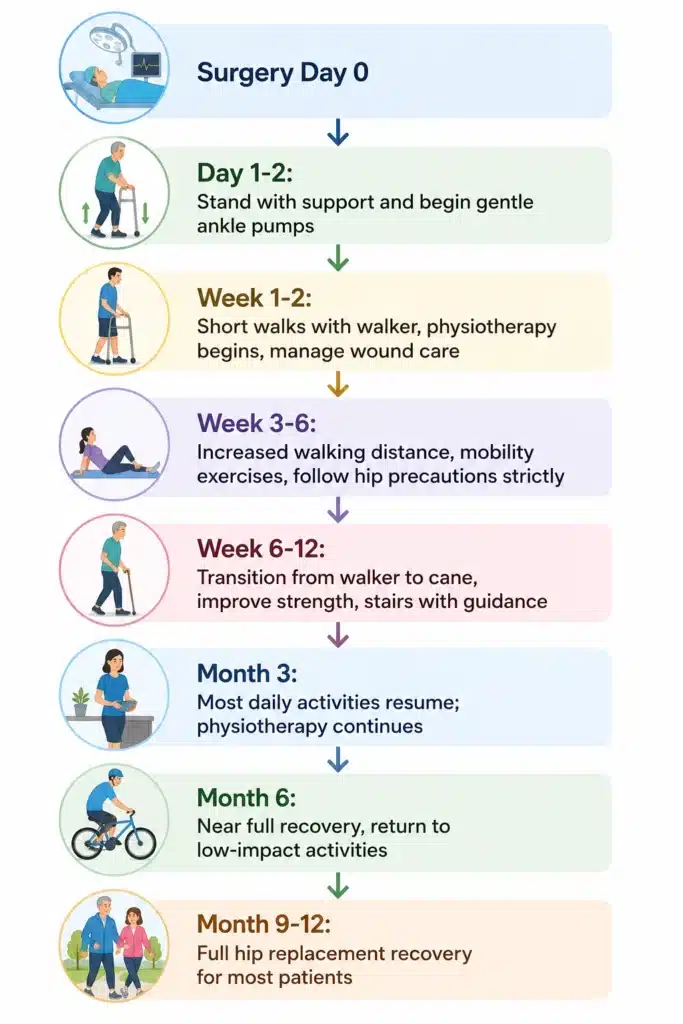
What good hip replacement recovery actually looks like?
This is a general guide. Your surgeon and physiotherapist will give you a personalized timeline based on your age, fitness level, and specific implant
Here is a general recovery flowchart to help you understand what milestones look like across time:
Hip replacement recovery: dos and don’ts at a glance
| What To Do | What To Avoid |
| Attend all physiotherapy sessions | Skipping rehabilitation exercises |
| Follow hip precautions strictly | Bending hip beyond 90 degrees |
| Eat protein-rich, anti-inflammatory foods | Processed foods and sugary drinks |
| Stay hydrated throughout the day | Alcohol and excessive caffeine |
| Walk as prescribed | Complete bed rest |
| Sleep with positioning pillow | Crossing legs during sleep |
| Keep all follow-up appointments | Self-discharging from follow-up care |
| Use walker or cane as advised | Walking unsupported too soon |
| Communicate pain levels honestly | Masking pain or ignoring it |
| Get clearance before resuming activities | Resuming driving or work without approval |
Where did you get hip replacement surgery?
Even perfect post-surgery behavior cannot compensate for a poorly performed procedure. The surgical technique, implant quality, and surgeon experience directly affect how smooth your hip replacement recovery will be.
If you or a family member is considering hip replacement surgery in the Delhi NCR region, the quality of your surgical team and hospital is a decision that shapes everything that comes after.
Rama Hospital is a trusted name in hip replacement surgery in Noida, with experienced orthopedic specialists who guide patients through every stage, from pre-surgical planning through full hip replacement recovery. With a dedicated team for hip replacement rehabilitation in Delhi NCR, patients receive structured physiotherapy, regular follow-ups, and personalized recovery plans.
The best orthopedic surgeon in Noida will not just perform the surgery. They will ensure you understand your recovery, your precautions, and your milestones clearly before you leave the hospital.
When you choose the best hospital in Noida for your procedure, you are not just choosing a surgeon. You are choosing a recovery pathway.
Frequently Asked Questions (FAQs)
Q: How long does hip replacement recovery take before I can walk normally?
Most patients walk with a cane or walker within a week of surgery. Walking without any support typically happens between 6 to 12 weeks, depending on individual progress. Full, normal walking is usually possible by 3 to 6 months during hip replacement recovery.
Q: I am feeling very little pain now. Can I stop physiotherapy early?
No. Pain reduction is not the same as tissue healing. Stopping physiotherapy early is one of the top reasons for slow recovery after hip replacement. Muscles around the new joint still need weeks of strengthening even after pain has reduced significantly.
Q: Is it normal to feel more tired during hip replacement recovery than expected?
Yes, completely. Surgery is a major physical event, and your body is diverting significant energy to healing. Fatigue during early hip replacement recovery is normal and expected, especially in the first 4 to 6 weeks.
Q: Can I sleep on my side after hip replacement surgery?
Usually not on the operated side, at least for the first 6 weeks. Ask your surgeon specifically about sleeping positions. Most patients are advised to sleep on their back with a pillow between their knees during hip replacement recovery.
Q: When can I climb stairs normally after hip replacement?
Most patients begin stair practice with guidance during the first 2 to 4 weeks of hip replacement recovery. Independent stair climbing without handrail support typically happens around 6 to 8 weeks, with your surgeon’s clearance.
Q: My hip swells every evening. Is this a problem?
Some swelling in the evening is normal during hip replacement recovery, especially in the first few months. Keep your leg elevated when resting and continue wearing compression stockings if prescribed. However, sudden, significant, or one-sided swelling with warmth should be reported to your surgeon immediately.
Q: I missed a few physiotherapy sessions. Will it badly affect my recovery?
Missing sessions, especially during the first 8 to 10 weeks, does slow hip replacement recovery. Inform your physiotherapist, reschedule as soon as possible, and continue your home exercises in between sessions.
Q: Which hospital should I go to for hip replacement surgery in Noida or Delhi NCR?
Look for a hospital with experienced orthopedic surgeons, a structured post-operative rehabilitation program, and a track record of successful outcomes. Rama Hospital in Noida offers comprehensive hip replacement rehabilitation in Delhi NCR and is known for supporting patients through every stage of hip replacement recovery with dedicated care teams.
Conclusion
Hip replacement recovery is a journey. It takes time, consistency, and discipline.
The surgery gives you a new joint. What you do next determines whether that joint gives you your life back.
Avoid these 10 mistakes. Follow your surgeon’s guidance. Commit to your physiotherapy. And choose a hospital and surgical team that will stand with you through every stage of hip replacement recovery, not just in the operating room.
If you are looking for expert hip replacement surgery in Noida or hip replacement rehabilitation in Delhi NCR, Rama Hospital and the best orthopedic surgeon in Noida on their team are equipped to guide you from surgery through a full, confident recovery.
Your new hip deserves the best possible start. Give it one.