Skin grafting and flap surgery are reconstructive procedures used to restore skin and soft tissue after injury, infection, tumour removal, or chronic wounds. They are commonly performed when a wound is too large or complex to heal on its own or when simple closure would cause excessive tension, deformity, or loss of function.
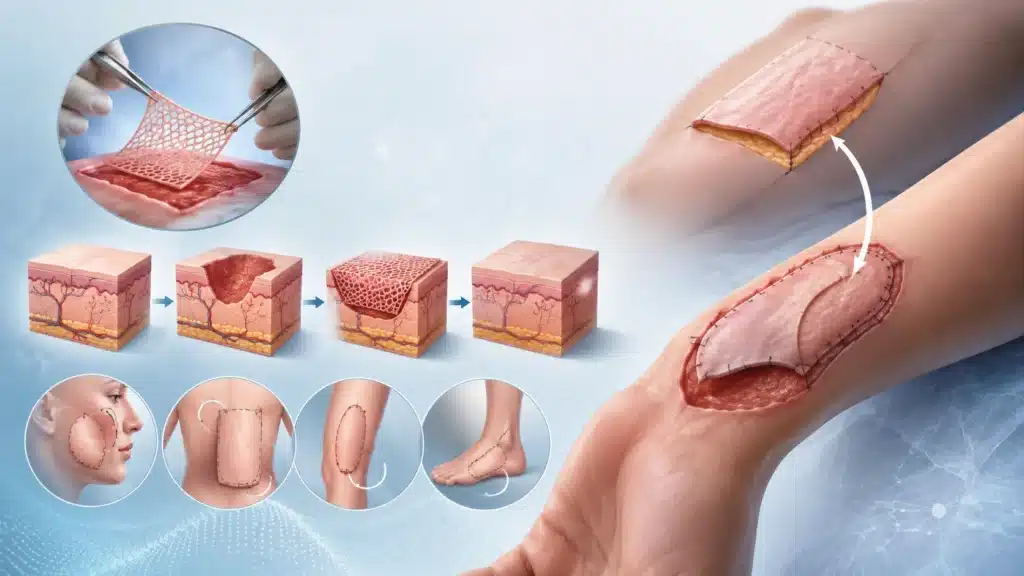
A skin graft involves taking a thin layer of skin from one part of the body and placing it over a wound. A flap is a more complex technique that moves skin along with its underlying blood supply to cover a defect. Both procedures aim to protect deeper structures, improve healing, restore appearance, and preserve function.
These surgeries are used in many situations, including burns, trauma, pressure sores, diabetic foot ulcers, cancer reconstruction, breast reconstruction, facial reconstruction, and complex wounds that have not responded to standard treatment.
What is Skin Grafting?
Skin grafting is a surgical procedure in which healthy skin is taken from one area of the body, called the donor site, and placed over a wound or defect, called the recipient site. The graft relies on the blood supply from the wound bed to survive and integrate.
Skin grafting is used when:
- The wound is too large to close directly.
- The skin loss is significant.
- The area needs thin, flexible coverage.
- The wound bed has adequate blood supply.
- The goal is to speed up healing and reduce infection risk.
What is a Flap?
A flap is a piece of tissue that is moved from one area to another while maintaining its own blood supply. Unlike a graft, a flap carries its own circulation, which makes it more reliable for covering areas with poor blood supply or deeper structures.
Flaps may include:
- Skin.
- Subcutaneous fat.
- Muscle.
- Fascia.
- Bone in some complex cases.
Flaps are used when:
- The wound bed is not suitable for a graft.
- Deeper structures such as bone, tendon, or vessels are exposed.
- A thicker or more robust coverage is needed.
- Functional restoration is required.
- Complex three-dimensional reconstruction is needed.
Flaps can be moved locally, regionally, or from distant sites using microsurgical techniques.
Indications for Skin Grafting and Flaps
Skin grafting and flap surgery are indicated in a wide range of conditions.
Common indications
- Large burns.
- Traumatic wounds with skin loss.
- Chronic ulcers such as pressure sores or diabetic foot ulcers.
- Wounds after removal of skin cancers or other tumours.
- Reconstruction after mastectomy or breast surgery.
- Facial reconstruction after injury or cancer.
- Coverage of exposed bone, tendon, or hardware.
- Reconstruction of the hand, foot, or other functional areas.
- Complex wounds that have failed to heal with conservative care.
Why these procedures are chosen
The choice between a graft and a flap depends on the wound characteristics, location, depth, blood supply, patient health, and surgical goals.
- To close wounds that cannot heal on their own.
- To protect vital structures.
- To reduce infection risk.
- To improve function and mobility.
- To restore appearance.
- To shorten healing time.
- To allow earlier rehabilitation.
Types of Skin Grafts
Skin grafts are classified based on their thickness and source. The surgeon selects the type of graft based on the wound size, location, cosmetic needs, and functional requirements.
Split-thickness skin graft
- Includes the epidermis and part of the dermis.
- Taken from areas such as the thigh, buttock, or abdomen.
- Can cover larger areas.
- Donor site usually heals on its own.
- May contract more during healing.
- Often used for burns and large wounds.
Full-thickness skin graft
- Includes the entire epidermis and dermis.
- Provides better colour and texture match.
- Used for smaller defects, especially on the face or hands.
- Donor site usually requires closure with stitches.
- Less contraction compared to split-thickness grafts.
- Requires a well-vascularised wound bed.
Other graft types
- Sheet grafts, which are placed as a single piece.
- Meshed grafts, which are expanded to cover a larger area.
- Composite grafts, which may include skin and cartilage in selected cases.
Types of Flaps
Flaps are classified based on their blood supply, movement, and distance from the defect. The choice of flap depends on the defect size, location, depth, available donor tissue, and the patient’s overall condition.
Local flaps
- Use nearby tissue.
- Rotate, advance, or transpose skin to cover the defect.
- Commonly used for small to medium defects.
- Examples include rotation flaps, advancement flaps, and transposition flaps.
- Often used on the face, scalp, and trunk.
Regional flaps
- Use tissue from a nearby region.
- Maintain a known blood supply.
- Used for moderate to large defects.
- Examples include pedicled flaps from the chest, back, or thigh.
- Useful when local tissue is insufficient.
Distant flaps
- Use tissue from a distant part of the body.
- May be attached temporarily until new blood supply develops.
- Less commonly used now due to advances in microsurgery.
Free flaps
- Completely detached from the donor site.
- Reattached using microsurgical techniques.
- Blood vessels are connected to recipient vessels under a microscope.
- Allow coverage of complex defects anywhere in the body.
- Commonly used in head and neck reconstruction, breast reconstruction, limb salvage, and complex trauma.
Perforator flaps
- Based on small blood vessels that perforate through muscle or fascia.
- Allow thin, tailored coverage.
- Reduce donor site morbidity.
- Examples include DIEP flap for breast reconstruction and ALT flap for limb reconstruction.
Procedure Overview – Step by Step
Anaesthesia
- Many skin grafts and flaps are performed under general anaesthesia.
- Some smaller procedures may be done under regional or local anaesthesia with sedation.
- The choice depends on the size, location, and complexity of the surgery.
Preparation of the wound
- The wound is cleaned and debrided if needed.
- Non-viable tissue is removed.
- Infection is controlled.
- The wound bed is prepared to receive the graft or flap.
Harvesting the graft
- The donor area is marked.
- A special instrument is used to harvest a split-thickness or full-thickness graft.
- The graft is carefully placed over the wound.
- It is secured with sutures, staples, or adhesive.
- A dressing is applied to protect the graft.
Harvesting and transferring a flap
- The flap is designed based on the defect and blood supply.
- The tissue is raised carefully to preserve its vessels.
- For local and regional flaps, the flap is rotated or advanced into position.
- For free flaps, the tissue is completely detached and reattached using microsurgery.
- Blood vessels are connected under a microscope.
- The flap is secured in place.
- Drains may be placed to prevent fluid collection.
- Dressings are applied.
Duration of surgery
- Simple skin grafts may take one to two hours.
- Complex flaps, especially free flaps, may take several hours.
- Some cases may require staged procedures.
Recovery After Skin Grafting and Flaps
Recovery depends on the type of procedure, the size of the wound, and the patient’s overall health.
Hospital stay
- Simple grafts may be done as day care or with a short stay.
- Complex flaps often require several days in hospital.
- Free flaps may need intensive monitoring in the early postoperative period.
Pain management
- Pain is usually managed with prescribed medicines.
- Discomfort is common in the first few days.
- Donor site pain may be more noticeable than the recipient site in some cases.
- Pain usually improves gradually over days to weeks.
Wound care
- Dressings are kept clean and dry.
- The graft or flap is protected from pressure and trauma.
- Elevation may be advised to reduce swelling.
- Specific instructions are given for bathing and dressing changes.
- Follow-up visits are scheduled to monitor healing.
Donor site care
- Split-thickness donor sites often heal like a large superficial burn.
- Full-thickness donor sites are closed with stitches.
- Dressings are changed as advised.
- Itching and tightness are common during healing.
- Scar care may be recommended later.
Activity restrictions
- Heavy lifting and strenuous activity are restricted initially.
- Movement of the affected area may be limited for a period.
- Physiotherapy may be advised for functional areas.
- Gradual return to normal activity is guided by the surgeon.
Risks and Complications
Like any surgery, skin grafting and flap surgery carry risks. Patients are advised to report increasing pain, swelling, redness, discharge, fever, colour change in the graft or flap, or any sudden change in the appearance of the surgical area.
General surgical risks
- Bleeding.
- Infection.
- Poor wound healing.
- Scarring.
- Reaction to anaesthesia.
- Blood clots.
Graft-specific risks
- Graft failure or partial loss.
- Infection of the graft.
- Fluid collection under the graft.
- Excessive contraction.
- Colour or texture mismatch.
- Donor site complications.
Flap-specific risks
- Flap failure due to blood supply problems.
- Partial flap loss.
- Venous congestion.
- Arterial insufficiency.
- Infection.
- Donor site weakness or deformity.
- Need for revision surgery.
Factors that increase risk
- Smoking.
- Uncontrolled diabetes.
- Poor nutrition.
- Vascular disease.
- Infection at the wound site.
- Previous radiation therapy.
- Immunosuppression.
- Non-compliance with postoperative instructions.
Aftercare and Long-Term Care
Proper aftercare is essential for good outcomes.
Early aftercare
- Keep dressings intact until advised otherwise.
- Avoid pressure on the graft or flap.
- Elevate the operated area when possible.
- Take prescribed medicines on time.
- Attend all follow-up appointments.
- Report any warning signs promptly.
Scar management
- Scar massage may be advised once healing is adequate.
- Silicone gel or sheets may be recommended.
- Sun protection is important to prevent darkening of scars.
- Compression garments may be used in selected cases.
- Physiotherapy may help with mobility and scar pliability.
Long-term monitoring
- Regular follow-up to assess function and appearance.
- Monitoring for contractures, especially over joints.
- Evaluation of donor site healing.
- Assessment of need for revision or additional procedures.
- Ongoing wound care for chronic conditions.
Lifestyle measures
- Maintain good nutrition.
- Avoid smoking.
- Control blood sugar if diabetic.
- Follow activity restrictions until cleared.
- Protect the area from trauma and excessive sun.
Special Considerations in Specific Situations
Burns
- Skin grafting is commonly used for deep burns.
- Early grafting can reduce infection and improve healing.
- Multiple grafting sessions may be needed for extensive burns.
- Physiotherapy is important to prevent contractures.
Diabetic foot ulcers
- Grafts or flaps may be used after adequate debridement and infection control.
- Blood sugar control is critical.
- Offloading and footwear modification are essential.
- Vascular assessment is important before surgery.
Pressure sores
- Flaps are often preferred for large or deep pressure ulcers.
- Nutritional support is important.
- Pressure relief and positioning are critical after surgery.
- Recurrence risk remains if underlying factors are not addressed.
Cancer reconstruction
- Grafts and flaps are used after removal of skin cancers or other tumours.
- Clear margins are confirmed before reconstruction.
- Functional and cosmetic outcomes are considered.
- Additional treatments such as radiation may influence timing.
Breast reconstruction
- Flaps such as DIEP, TRAM, or latissimus dorsi flaps are commonly used.
- Grafts may be used for nipple-areola reconstruction.
- Timing may be immediate or delayed.
- Coordination with oncology care is essential.
Why Choose Rama Hospital for Skin Grafting and Flaps?
Skin grafting and flap surgery require specialised skills, careful planning, and dedicated postoperative care. A hospital with experienced plastic and reconstructive surgeons, anaesthesia support, intensive care, and wound care services can significantly improve outcomes.
- Evaluation by experienced plastic and reconstructive surgeons.
- Comprehensive assessment of wounds and donor sites.
- Access to microsurgical facilities for free flaps.
- Coordinated care with orthopaedics, oncology, vascular surgery, and critical care.
- Dedicated wound care and nursing support.
- Physiotherapy and rehabilitation services.
- Scar management and long-term follow-up.
- Patient education and counselling.
Frequently Asked Questions (FAQs)
Is skin grafting painful?
Some pain and discomfort are expected after surgery, especially in the first few days. Pain is managed with prescribed medicines. Donor site discomfort may be more noticeable than the recipient site in some cases.
How long does it take for a skin graft to heal?
Initial healing usually occurs within one to two weeks, but full maturation takes months. The graft may change colour and texture over time. Donor sites also heal gradually and may require scar care.
Can a skin graft fail?
Yes, grafts can partially or completely fail due to infection, poor blood supply, movement, or fluid collection. Careful preparation, immobilisation, and aftercare reduce this risk. Revision may be needed in some cases.
Are flaps safer than grafts?
Flaps have their own blood supply, which can make them more reliable in certain situations. However, they are more complex surgeries. The choice depends on the wound, location, and patient factors.
Will there be scarring?
Scarring is expected at both the recipient and donor sites. Scars usually fade over time but may remain visible. Scar management techniques can help improve appearance and flexibility.
Can skin grafting be done in diabetic patients?
Yes, but blood sugar control and wound preparation are critical. Diabetic patients have a higher risk of infection and delayed healing. Careful evaluation and optimisation are essential before surgery.
How long is the hospital stay?
Simple grafts may require a short stay or day care. Complex flaps, especially free flaps, often need several days in hospital for monitoring and care. The duration depends on the procedure and recovery.
What should I avoid after surgery?
Avoid smoking, heavy lifting, pressure on the graft or flap, and activities that may strain the surgical area. Follow all instructions regarding dressing care, bathing, medicines, and follow-up visits.
Conclusion
Skin grafting and flap surgery are essential reconstructive procedures used to cover complex wounds, restore function, and improve appearance. Skin grafts are useful for large surface defects with a good wound bed, while flaps provide robust coverage with their own blood supply for deeper or more complex defects.
These procedures are commonly used in burns, trauma, chronic ulcers, cancer reconstruction, breast reconstruction, and other situations where simple closure is not possible. Success depends on careful patient selection, surgical planning, microsurgical expertise when needed, and dedicated postoperative care.
Risks such as graft or flap failure, infection, scarring, and donor site problems can be reduced with proper technique, optimisation of medical conditions, and strict adherence to aftercare instructions. Long-term follow-up and scar management further improve outcomes.