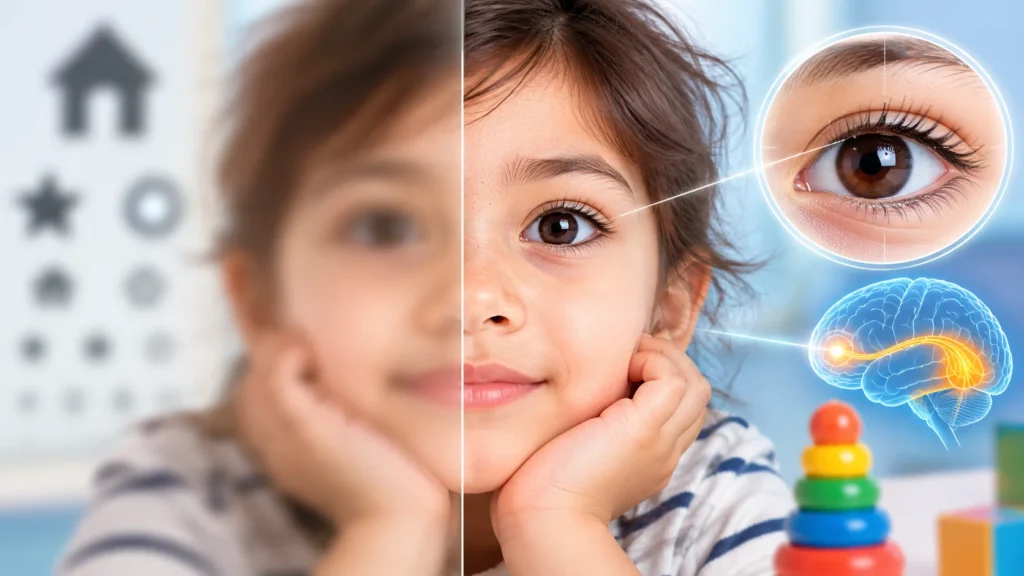
Amblyopia, commonly known as lazy eye, is a vision development disorder that usually begins in early childhood. In this condition, one eye does not develop normal vision even with glasses. The brain starts to favor the stronger eye and ignores signals from the weaker eye. Over time, the weaker eye becomes progressively weaker, and if not treated early, the vision loss can become permanent.
Amblyopia is one of the most common causes of reduced vision in children. It often goes unnoticed because the child may not complain of any problem. The child may see well enough with the good eye and appear completely normal. Parents may only notice the issue during a routine eye check-up or when one eye seems to wander or turn.
Early detection and treatment are very important. The younger the child is when treatment starts, the better the chances of improving vision. If left untreated, amblyopia can lead to permanent vision loss in the affected eye, poor depth perception, and difficulties in activities that require good vision from both eyes.
What is Amblyopia?
Amblyopia is a condition where vision in one eye does not develop properly during early childhood. The eye itself may look normal, but the brain does not receive clear images from that eye. As a result, the brain relies more on the stronger eye and suppresses the weaker one.
This is different from other vision problems where the eye has a structural defect. In amblyopia, the problem lies in the connection between the eye and the brain. The brain learns to ignore the blurry or misaligned image from the weaker eye.
Amblyopia usually affects one eye, but in some cases, both eyes can be involved. It most commonly develops before the age of seven, which is the critical period for visual development. After this age, treatment becomes more difficult, and the chances of full recovery decrease.
Types of Amblyopia
Amblyopia can be classified based on the underlying cause.
Strabismic amblyopia
- Occurs when the eyes are misaligned, such as in squint or crossed eyes.
- The brain ignores the image from the turned eye to avoid double vision.
- This is one of the most common types of amblyopia.
Refractive amblyopia
- Happens when there is a significant difference in vision between the two eyes.
- One eye may have high power for nearsightedness, farsightedness, or astigmatism.
- The brain favors the eye with clearer vision and ignores the other.
Deprivation amblyopia
- Occurs when something blocks light from entering the eye.
- Causes may include congenital cataract, cloudy cornea, or droopy eyelid.
- This type can be severe and needs urgent treatment.
Bilateral amblyopia
- Affects both eyes, usually due to high uncorrected refractive error in both eyes.
- Common in children who have not had early eye screening.
- Both eyes have reduced vision even with glasses initially.
Causes of Amblyopia
Amblyopia develops when the visual pathway between the eye and the brain does not develop normally. Several factors can contribute to this.
Common causes include:
- Misalignment of the eyes or squint.
- Significant difference in vision between the two eyes.
- High uncorrected refractive error such as farsightedness, nearsightedness, or astigmatism.
- Congenital cataract blocking vision.
- Cloudy cornea or other structural problems.
- Droopy eyelid covering part of the pupil.
- Family history of amblyopia or childhood eye problems.
- Premature birth or low birth weight.
- Developmental delays affecting vision.
Why the brain ignores the weaker eye
The brain receives two images, one from each eye. If one image is blurry, misaligned, or blocked, the brain finds it confusing. To avoid double vision or poor quality images, the brain suppresses the weaker eye. Over time, the visual pathway for that eye does not develop fully, leading to permanent vision loss if not treated.
Risk Factors for Amblyopia
Some children are more likely to develop amblyopia than others.
Higher-risk groups
- Children with a family history of amblyopia or squint.
- Premature babies or those with low birth weight.
- Children with developmental delays.
- Those with significant refractive errors.
- Children with eye misalignment or strabismus.
- Kids with congenital cataract or other eye abnormalities.
- Children who have not had early vision screening.
Why early screening matters
Many children with amblyopia do not show obvious symptoms. They may pass basic vision checks because the good eye compensates. Routine eye screening between ages three and five can detect problems early when treatment is most effective.
Symptoms of Amblyopia
Amblyopia can be difficult to detect because children often do not complain. They may not realize that one eye sees poorly.
Common signs and symptoms
- One eye wandering inward or outward.
- Poor depth perception.
- Clumsiness or bumping into objects.
- Difficulty with tasks requiring fine vision.
- Closing one eye to see better.
- Tilting the head to use the stronger eye.
- Squinting or shutting one eye in bright light.
- Complaints of blurry vision in one eye in older children.
- Poor performance in school or difficulty reading.
Signs parents may notice
- The child covers one eye while watching TV or reading.
- One eye appears to drift when the child is tired.
- The child avoids activities that need good vision.
- Frequent eye rubbing or eye strain.
- Complaints of headaches after visual tasks.
Amblyopia in Different Age Groups
The presentation and treatment response vary with age.
In infants and toddlers
- May show eye turning or wandering.
- May not track objects well with one eye.
- Often diagnosed during routine screening.
- Treatment response is usually excellent at this age.
In preschool and school-age children
- May have difficulty reading or recognizing letters.
- May complain of one eye being weaker.
- May show head tilt or eye closure habits.
- Treatment is still effective but may take longer.
In older children and teenagers
- Vision improvement is possible but slower.
- May require more intensive therapy.
- Compliance with patching or exercises may be challenging.
- Early detection remains the best approach.
How is Amblyopia Diagnosed?
Diagnosis is based on a comprehensive eye examination by a pediatric ophthalmologist or eye specialist.
Diagnostic steps
- Detailed history of vision and development.
- Family history of eye problems.
- Observation of eye alignment and movement.
- Visual acuity testing for each eye separately.
- Refraction test to determine glasses power.
- Examination of the front and back of the eye.
- Assessment of binocular vision and depth perception.
Common tests that may be done
- Vision chart testing appropriate for age.
- Retinoscopy or autorefraction for glasses power.
- Cover test to check for eye misalignment.
- Dilated eye examination to rule out structural problems.
- Stereo vision tests to assess depth perception.
- Special tests for infants and non-verbal children.
Why early diagnosis matters
The visual system develops rapidly in early childhood. Treatment started before age seven has the highest success rate. After this age, the brain becomes less flexible, and vision improvement becomes more challenging.
Treatment for Amblyopia
Treatment aims to improve vision in the weaker eye and encourage the brain to use it properly. The approach depends on the cause and severity of amblyopia.
1. Corrective glasses
- Glasses are often the first step in treatment.
- They correct refractive errors such as farsightedness, nearsightedness, or astigmatism.
- In some cases, vision improves significantly with glasses alone.
- Glasses must be worn consistently as prescribed.
2. Patching therapy
- A patch is placed over the stronger eye to force the brain to use the weaker eye.
- Patching duration depends on the severity and age of the child.
- It may range from a few hours to most of the day.
- Regular follow-up is needed to monitor progress and adjust treatment.
3. Atropine eye drops
- Atropine drops are used to blur vision in the stronger eye temporarily.
- This encourages the brain to use the weaker eye.
- It is an alternative to patching for some children.
- Must be used only under medical supervision.
4. Vision therapy and exercises
- Specific exercises may be prescribed to improve eye coordination.
- Activities may include drawing, puzzles, or computer-based vision tasks.
- Therapy is often combined with patching or glasses.
- Helps improve binocular vision and depth perception.
5. Treatment of underlying causes
- Surgery may be needed for congenital cataract or droopy eyelid.
- Squint surgery may be required to align the eyes properly.
- Treatment of any structural eye problem is essential for success.
- Addressing the root cause improves treatment outcomes.
6. Compliance and parental support
- Success depends heavily on consistent treatment at home.
- Parents play a crucial role in ensuring patching or drops are used regularly.
- Positive reinforcement and encouragement help children cooperate.
- Regular follow-up visits are essential to track progress.
Recovery and Follow-up
Recovery from amblyopia takes time and patience. Vision improvement is usually gradual.
What to expect during treatment
- Vision may improve over weeks to months.
- Patching or drops may need to continue for several months or years.
- Some children may need maintenance therapy to prevent regression.
- Regular monitoring ensures the stronger eye does not become weak.
Long-term follow-up
- Children should continue eye check-ups even after vision improves.
- Amblyopia can recur if treatment is stopped too early.
- Ongoing monitoring helps detect any changes early.
- Some children may need glasses into adolescence or adulthood.
When treatment is most effective
- Treatment works best when started early, ideally before age seven.
- Younger children tend to respond faster and more completely.
- Older children can still improve but may require more intensive therapy.
- Consistency and compliance are key to success.
Possible Complications
If left untreated, amblyopia can lead to permanent vision problems.
Complications of untreated amblyopia
- Permanent vision loss in the weaker eye.
- Poor depth perception affecting daily activities.
- Difficulty with sports, driving, or certain professions.
- Increased risk of vision loss if the good eye is injured.
- Reduced quality of life and self-confidence.
Complications during treatment
- Skin irritation from patching in some children.
- Temporary blur or light sensitivity with atropine drops.
- Resistance or emotional distress from patching.
- Rare risk of reverse amblyopia if the good eye is over-patched.
- These are usually manageable with proper medical guidance.
When to See a Doctor
Early evaluation is important for any child with suspected vision problems.
- One eye wandering or turning.
- Child closing one eye frequently.
- Difficulty with reading or recognizing objects.
- Poor depth perception or clumsiness.
- Family history of amblyopia or squint.
- Child failing a vision screening test.
- Complaints of blurry vision or headaches.
Prevention of Amblyopia
While not all cases can be prevented, early detection and management can reduce risk.
Prevention pointers
- Routine eye screening for all children between ages three and five.
- Early evaluation for children with family history of eye problems.
- Prompt treatment of refractive errors with glasses.
- Management of squint or eye misalignment early.
- Treatment of congenital cataract or other structural issues.
- Awareness among parents about early signs of vision problems.
- Regular follow-up for children at higher risk.
For parents and caregivers
- Watch for signs of eye turning or vision difficulties.
- Encourage regular eye check-ups even if the child seems fine.
- Ensure glasses are worn as prescribed.
- Support the child during patching or therapy.
- Maintain good communication with the eye specialist.
Why Choose Rama Hospital for Amblyopia Treatment?
Amblyopia requires specialized pediatric eye care, accurate diagnosis, and long-term management. A hospital with experienced pediatric ophthalmologists and vision therapists can provide comprehensive care.
- Expert evaluation by pediatric eye specialists.
- Accurate diagnosis using age-appropriate tests.
- Personalized treatment plans for each child.
- Access to vision therapy and counseling.
- Surgical support for squint or cataract if needed.
- Long-term follow-up to ensure lasting results.
Frequently Asked Questions (FAQs)
Can amblyopia be cured?
Yes, amblyopia can often be improved or cured if detected and treated early. Treatment may include glasses, patching, eye drops, or vision therapy. Success depends on the age of the child and consistency with treatment.
At what age should amblyopia be treated?
Treatment is most effective when started before age seven. The visual system develops rapidly in early childhood. Older children can still improve, but treatment may take longer and be less complete.
Does patching work for all children?
Patching is effective for many children but not all. Success depends on the cause, severity, and compliance. Some children may benefit more from atropine drops or vision therapy instead.
How long does amblyopia treatment take?
Treatment duration varies from child to child. It may take several months to years depending on severity. Regular follow-up is needed to monitor progress and adjust the plan.
Can adults be treated for amblyopia?
Treatment in adults is more challenging but may still provide some improvement. Vision therapy and specialized exercises may help. Early childhood treatment remains the most effective approach.
Will my child need glasses forever?
Some children may need glasses long-term, especially if they have significant refractive error. Others may outgrow the need as vision develops. This depends on the individual case and follow-up findings.
Can amblyopia come back after treatment?
Yes, amblyopia can recur if treatment is stopped too early. Maintenance therapy and regular follow-up help prevent this. Parents should continue monitoring even after vision improves.
Is squint the same as amblyopia?
No, squint and amblyopia are related but different. Squint is eye misalignment, while amblyopia is reduced vision in one eye. Squint can cause amblyopia if not treated early.
How can parents help during treatment?
Parents can ensure consistent patching or drop use, encourage the child, and attend all follow-up visits. Positive reinforcement and patience are important. Good communication with the doctor helps track progress.
Conclusion
Amblyopia or lazy eye is a common but serious childhood vision problem that can lead to permanent vision loss if not treated early. It affects how the brain and eyes work together and often goes unnoticed because the child may not complain. Early detection through routine eye screening is the key to successful treatment.
The most important steps are proper diagnosis, consistent use of glasses, patching or drops as prescribed, and regular follow-up. For parents noticing eye turning, vision difficulties, or failed screening tests, prompt evaluation by a pediatric eye specialist can make a major difference. With timely and appropriate care, most children can achieve significant improvement in vision and quality of life.
Rama Hospital can help evaluate amblyopia, provide personalized treatment plans, and support families through the recovery process with expert pediatric ophthalmology care.