A healthy heart should be able to increase its activity when the body needs more oxygen. During exercise, the heart beats faster, pumps more blood, and works harder to supply the muscles. Sometimes, a heart problem may not be visible when a person is resting but may become apparent when the heart is placed under controlled physical stress.
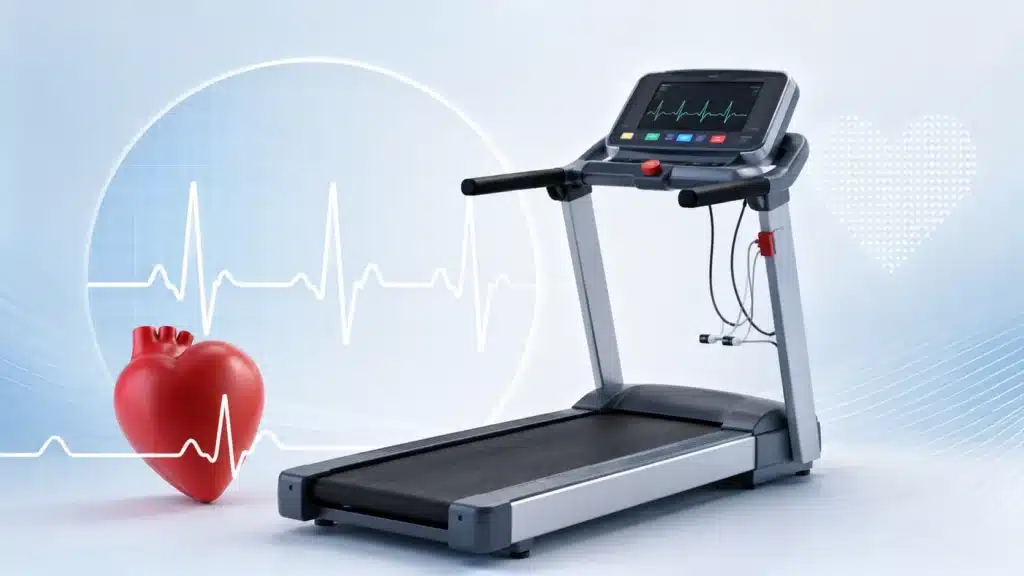
A Treadmill Test, commonly called a TMT, is a cardiac stress test used to observe how the heart responds to exercise. During the test, the patient walks on a treadmill while the healthcare team continuously monitors the heart rate, heart rhythm, blood pressure, symptoms, and electrocardiogram, or ECG. The speed and incline of the treadmill are gradually increased according to a standard protocol or the patient’s physical capacity.
A TMT may help doctors evaluate chest pain, breathlessness during exertion, abnormal heart rhythms, exercise tolerance, and possible reduced blood supply to the heart muscle. It may also be used after a heart attack, angioplasty, bypass surgery, or during the evaluation of known heart disease.
What is a TMT Test?
A TMT, or treadmill test, is a non-invasive test that records the heart’s electrical activity while the patient exercises.
The heart is monitored using ECG electrodes attached to the chest. Blood pressure is measured before, during, and after exercise. The patient walks on a treadmill that gradually becomes faster or steeper. The medical team observes how the heart responds to increasing workload.
A TMT can provide information about:
- How the heart responds to physical activity.
- Whether exercise causes symptoms such as chest pain or breathlessness.
- Whether the ECG shows signs of reduced blood flow to the heart.
- Whether abnormal heart rhythms occur during exercise.
- Whether the blood pressure response is appropriate.
- How much physical activity the patient can safely tolerate.
- Whether treatment for known heart disease is working effectively.
How Does the TMT Test Work?
When the body is at rest, the heart may not require its maximum blood supply. If a coronary artery is narrowed, the heart may still receive enough blood while resting. During exercise, however, the heart needs more oxygen. If the blood supply cannot increase adequately, the patient may develop symptoms or ECG changes.
The TMT creates a controlled increase in the heart’s workload.
During the test:
- The patient walks on a treadmill.
- The speed and incline increase gradually.
- ECG electrodes record the electrical activity of the heart.
- Heart rate is monitored continuously.
- Blood pressure is checked at regular intervals.
- The patient is asked about chest pain, breathlessness, dizziness, or fatigue.
- The test is stopped when the target is reached or if concerns develop.
Why is a TMT Recommended?
A cardiologist may recommend a TMT for several reasons.
- Evaluation of chest pain: A TMT may be used when a patient has chest discomfort that occurs during walking, climbing stairs, exercising, or other physical activity. The test may help determine whether symptoms are related to reduced blood supply to the heart.
- Assessment of suspected coronary artery disease: Coronary artery disease occurs when plaque narrows or blocks the blood vessels supplying the heart. The condition may cause chest pain, breathlessness, reduced exercise tolerance, or silent changes without obvious symptoms.
- Evaluation after a heart attack: A TMT may be used at an appropriate stage after a heart attack to assess exercise capacity and guide rehabilitation. The timing depends on the patient’s recovery, heart function, symptoms, and cardiologist’s recommendation.
- Assessment after angioplasty or bypass surgery: A stress test may be recommended after coronary intervention or bypass surgery to evaluate symptoms, functional capacity, or possible recurrence of reduced blood flow.
- Investigation of exertional breathlessness: Breathlessness during activity can occur due to heart disease, lung disease, anemia, obesity, poor fitness, or other conditions. A TMT may help determine how the heart responds to exercise.
- Evaluation of abnormal ECG findings: If a resting ECG shows an abnormality, a TMT may provide additional information. It helps assess whether the abnormality becomes more pronounced during exercise.
- Detection of exercise-related arrhythmia: Some abnormal heart rhythms appear only during physical activity. A TMT can help identify changes in heart rhythm and guide further evaluation.
- Assessment of exercise capacity: A TMT may help determine how much activity the heart can tolerate. This can be useful for patients beginning cardiac rehabilitation or returning to work and exercise after illness.
- Monitoring treatment: In selected patients with known coronary disease, the test may help assess the effect of medicines, angioplasty, surgery, or lifestyle changes. It should be interpreted along with symptoms and other clinical findings.
Who May Need a TMT?
A doctor may consider a treadmill test for:
- People with exertional chest discomfort.
- Patients with breathlessness during activity.
- Individuals with risk factors for coronary artery disease.
- Patients with diabetes and possible silent heart disease.
- People with high blood pressure or high cholesterol.
- Individuals who smoke or have a strong family history of heart disease.
- Patients with known coronary artery disease.
- People recovering from a heart attack or heart procedure.
- Patients with palpitations that occur during exercise.
- Individuals who need a medical assessment before a specific level of physical activity.
Risk Factors for Heart Disease
A TMT is more likely to be considered when a patient has risk factors such as:
- Diabetes.
- High blood pressure.
- High cholesterol.
- Smoking.
- Obesity.
- Lack of physical activity.
- Family history of early heart disease.
- Chronic kidney disease.
- Previous heart disease.
- Older age.
- Stress and poor sleep.
- A diet high in saturated fat, salt, and processed foods.
When is a TMT Not Suitable?
A TMT may not be appropriate in every situation. The doctor may delay, modify, or replace the test if the patient has a condition that makes exercise unsafe or makes the result difficult to interpret.
- Ongoing or unstable chest pain.
- A recent heart attack without adequate recovery.
- Severe uncontrolled blood pressure.
- Serious heart rhythm disturbance.
- Severe heart failure symptoms.
- Severe narrowing of a heart valve.
- Acute infection or fever.
- Severe breathing difficulty.
- Inability to walk safely.
- Recent major surgery or injury.
- Severe joint, muscle, or balance problems.
- Certain active heart conditions.
Types of Stress Tests
A TMT is one type of stress test. Other types may be recommended depending on the patient’s condition.
- Exercise ECG or TMT: This is the standard treadmill test. It monitors ECG, heart rate, blood pressure, and symptoms during walking.
- Stress echocardiography: This combines exercise or medicine-induced stress with ultrasound imaging of the heart. It can show how the heart muscle moves when the heart is under stress.
- Nuclear stress test: This uses a small amount of tracer material and imaging to observe blood flow to the heart muscle during rest and stress.
- Pharmacological stress test: Medicines are used to increase the heart’s workload when the patient cannot exercise safely or sufficiently.
- Cardiopulmonary exercise testing: This is a more detailed exercise test that monitors breathing, oxygen use, carbon dioxide production, heart rate, and exercise capacity. It may be used for complex breathlessness, heart failure, or fitness assessment.
Preparing for a TMT Test
Preparation helps ensure patient safety and improves the quality of the test.
Follow the hospital’s instructions: Different patients may receive different instructions depending on their health, medicines, and the reason for testing. Always follow the specific instructions provided by the cardiologist or diagnostic team.
Food and drink
- Avoid a heavy meal before the test.
- Some centres may ask you not to eat for a few hours before the procedure.
- A light meal may be allowed depending on the timing and medical advice.
- Do not arrive excessively full.
- Do not exercise on an empty stomach if you are prone to low blood sugar.
- Patients with diabetes should ask specifically how to manage food and diabetes medicines.
- Water may be allowed, but follow the instructions given by the testing centre.
Medicines
Do not stop heart medicines on your own.
- Carry a list of all medicines.
- Tell the doctor about inhalers, insulin, diabetes tablets, blood pressure medicines, and heart medicines.
- Do not skip medicines unless instructed.
- Ask what to do if you use emergency medicines for chest pain.
- Inform the team about erectile dysfunction medicines or nitrates if relevant.
Caffeine and nicotine
Caffeine and nicotine can affect heart rate, blood pressure, and symptoms. The testing centre may ask you to avoid:
- Coffee.
- Tea.
- Energy drinks.
- Cola or other caffeinated drinks.
- Chocolate in large amounts.
- Smoking.
- Chewing tobacco.
- Nicotine products.
Clothing and footwear
Wear:
- Loose, comfortable clothing.
- A two-piece outfit that allows access to the chest.
- Supportive walking or sports shoes.
- Socks that are comfortable.
- Clothing that allows free movement.
Before arriving
- Bring previous ECGs, reports, and prescriptions.
- Carry your medicine list.
- Bring your inhaler if you use one.
- Inform the centre if you are unwell.
- Avoid strenuous exercise shortly before the test.
- Arrive early enough to complete the registration and preparation process.
What Happens Before the TMT?
Before the treadmill begins, the medical team performs a preliminary assessment.
- Record your medical history.
- Ask about chest pain or breathlessness.
- Check your blood pressure.
- Record a resting ECG.
- Measure your heart rate.
- Ask about current medicines.
- Check whether you can walk safely.
- Explain the test and warning symptoms.
- Obtain consent where required.
What Happens During the TMT?
The patient is connected to an ECG monitor using adhesive electrodes placed on the chest. A blood pressure cuff is placed on the arm.
The treadmill begins at a slow speed. At regular intervals, the speed or incline increases. The patient continues walking while the medical team monitors the response.
During the test, the technician or doctor may ask about:
- Chest pressure or pain.
- Pain in the arm, shoulder, neck, jaw, or back.
- Breathlessness.
- Dizziness.
- Lightheadedness.
- Palpitations.
- Leg fatigue.
- Unusual weakness.
- Any other discomfort.
When is the TMT Stopped?
The test may be stopped for several reasons.
Patient-related reasons
- The patient reaches the target heart rate.
- The patient becomes too tired to continue.
- Severe shortness of breath develops.
- Chest discomfort occurs.
- Dizziness or lightheadedness appears.
- Leg pain prevents safe walking.
- The patient asks to stop.
Medical reasons
- Concerning ECG changes.
- Dangerous heart rhythm.
- Abnormal blood pressure response.
- Severe symptoms.
- Signs of reduced blood flow to the heart.
- Technical problems with the ECG recording.
- Safety concerns noticed by the medical team.
What Happens After the TMT?
After the treadmill stops, the patient usually continues to rest while the team monitors heart rate, blood pressure, and ECG recovery.
- Heart rate gradually returns toward baseline.
- Blood pressure is checked.
- ECG monitoring continues for a short period.
- The electrodes are removed.
- The skin is cleaned.
- The patient is observed for any ongoing symptoms.
- The doctor interprets the results along with the history and resting ECG.
What Does a TMT Measure?
A TMT provides several types of information.
- Heart rate response: The doctor assesses whether the heart rate rises appropriately during exercise and returns toward normal after stopping.
- Blood pressure response: Blood pressure usually changes during exercise. An unusually high, low, or abnormal response may need further evaluation.
- ECG changes: The ECG is examined for changes that may suggest reduced blood flow or abnormal heart rhythm.
- Exercise capacity: The test helps estimate how much activity the patient can perform. This may be described using exercise duration, workload, or metabolic equivalents.
- Symptoms: The relationship between symptoms and exercise is important. Chest pain that appears at a certain workload may provide valuable information.
- Recovery: How quickly heart rate, blood pressure, symptoms, and ECG return toward baseline may also be considered.
What Does a Normal or Negative TMT Mean?
A negative or normal TMT generally means that the test did not show clear evidence of exercise-induced reduced blood flow or a dangerous rhythm under the conditions of the test.
It may suggest:
- No significant ECG changes during the test.
- No concerning symptoms.
- Appropriate heart-rate response.
- Acceptable blood-pressure response.
- Adequate exercise capacity.
- No dangerous arrhythmia during monitoring.
What Does a Positive TMT Mean?
A positive TMT means that the test showed findings that may suggest reduced blood flow to the heart during exercise or another cardiac abnormality.
Possible findings include:
- Specific ECG changes.
- Reproduction of typical chest discomfort.
- Abnormal blood-pressure response.
- Exercise-induced arrhythmia.
- Reduced exercise capacity.
- Concerning symptoms during exertion.
A positive TMT does not automatically prove that a major coronary artery is blocked. False-positive results can occur, particularly in people with a low overall risk or certain baseline ECG patterns.
What is an Inconclusive TMT?
Sometimes a TMT does not provide a clear answer.
This may happen when:
- The patient cannot walk long enough.
- The target heart rate is not reached.
- Leg pain limits exercise.
- Breathlessness stops the test early.
- The ECG is difficult to interpret.
- The patient is taking medicines that slow the heart rate.
- Technical problems affect the recording.
- The symptoms and ECG findings do not match.
Limitations of the TMT
A treadmill test is useful but not perfect.
- It may not detect every coronary blockage.
- It can produce false-positive results.
- It can produce false-negative results.
- The patient must be able to walk safely.
- Some ECG abnormalities make interpretation difficult.
- Medicines can affect heart-rate response.
- It may not identify problems that occur only at rest.
- It may not provide detailed information about heart structure.
- It does not directly show the coronary arteries.
Benefits of a TMT
A TMT may offer several clinical benefits.
- It is non-invasive.
- It does not require an injection in the standard form.
- It provides real-time information during exercise.
- It monitors ECG, heart rate, blood pressure, and symptoms together.
- It can help evaluate exertional chest pain.
- It may help detect exercise-related rhythm abnormalities.
- It can assess functional capacity.
- It may guide further testing.
- It can support cardiac rehabilitation planning.
- It is generally quick and widely available.
Risks and Safety of a TMT
A TMT is generally safe when performed after appropriate medical assessment. However, exercise can temporarily increase stress on the heart.
Possible symptoms during or after the test
- Fatigue.
- Breathlessness.
- Sweating.
- Leg discomfort.
- Dizziness.
- Palpitations.
- Chest discomfort.
Rare but serious risks
- Sustained abnormal heart rhythm.
- Severe chest pain.
- Fainting.
- Heart attack.
- Sudden severe blood-pressure changes.
TMT and Cardiac Rehabilitation
After a heart attack, angioplasty, bypass surgery, or certain heart conditions, a TMT may help assess exercise tolerance before beginning or progressing rehabilitation.
It may help the rehabilitation team determine:
- A safe starting level of activity.
- Target exercise intensity.
- Heart-rate response.
- Symptoms that should be monitored.
- Whether the patient needs a slower progression.
- How the patient is responding to treatment.
Lifestyle After a TMT
The next steps depend on the result, but heart-protective habits are beneficial for most people.
- Walking or exercising according to medical advice.
- Controlling blood pressure.
- Managing diabetes.
- Keeping cholesterol within the recommended range.
- Stopping tobacco use.
- Maintaining a healthy weight.
- Eating more vegetables, fruits, pulses, and whole grains.
- Reducing excess salt and processed foods.
- Sleeping adequately.
- Managing stress.
- Taking prescribed medicines consistently.
- Attending follow-up appointments.
When to Seek Emergency Care?
A TMT is a scheduled diagnostic test, but symptoms occurring at home require appropriate attention.
Seek emergency medical care for:
- Severe or persistent chest pressure.
- Chest pain spreading to the arm, shoulder, jaw, or back.
- Sudden severe breathlessness.
- Fainting.
- Cold sweat with nausea.
- Sudden weakness on one side.
- Difficulty speaking.
- New severe palpitations with dizziness.
- Chest symptoms that do not improve with rest.
Why Choose Rama Hospital for TMT and Cardiac Evaluation?
A TMT should be performed in a setting where the test can be safely supervised and interpreted in relation to the patient’s overall condition.
- Cardiology consultation before testing.
- Proper assessment of whether a TMT is appropriate.
- ECG and blood-pressure monitoring during exercise.
- Trained technicians and medical supervision.
- Emergency support if symptoms occur.
- Interpretation by qualified cardiac specialists.
- Access to additional tests when required.
- Follow-up guidance after an abnormal or inconclusive result.
- Support for prevention, rehabilitation, and long-term cardiac care.
Frequently Asked Questions (FAQs)
Is a TMT painful?
The test is not usually painful, but walking becomes progressively more difficult. You may feel tired, sweaty, or breathless. Report chest discomfort, dizziness, severe breathlessness, or unusual symptoms immediately.
How long does a TMT take?
The exercise portion may last several minutes, depending on the patient’s capacity and the test findings. Including preparation and recovery monitoring, the complete appointment may take approximately thirty to forty-five minutes.
Can I eat before a TMT?
Avoid a heavy meal before the test, and follow the fasting or light-meal instructions given by the centre. People with diabetes should ask specifically how to manage food and medicines before testing.
Should I stop my medicines before the test?
Do not stop any medicine without your doctor’s advice. Some heart-rate-controlling medicines may be adjusted for certain tests, while others should be continued for safety or clinical reasons.
What should I wear for a TMT?
Wear loose, comfortable clothing and supportive walking shoes. A two-piece outfit is useful because ECG electrodes must be attached to the chest.
Is TMT the same as an ECG?
No. A resting ECG records the heart while you are still, whereas a TMT records ECG changes while the heart is working harder during exercise. Both tests provide different types of information.
Is TMT safe for everyone?
TMT is generally safe when recommended and supervised appropriately. It may not be suitable for people with unstable chest pain, severe uncontrolled heart conditions, or an inability to exercise safely.
Can a TMT detect heart rhythm problems?
Yes, a TMT may detect abnormal rhythms that occur during exercise. However, if palpitations occur unpredictably or mainly at rest, a Holter monitor or longer rhythm monitor may be more useful.
Conclusion
A TMT, or treadmill stress test, is a useful non-invasive cardiac test that shows how the heart responds to exercise. It can help evaluate exertional chest pain, breathlessness, abnormal heart rhythms, exercise tolerance, and possible reduced blood flow to the heart.
The test involves walking on a treadmill while ECG, heart rate, blood pressure, and symptoms are monitored. It is generally safe when performed after appropriate medical assessment. Proper preparation includes following instructions about food, medicines, caffeine, nicotine, clothing, and exercise before the test.
A normal, abnormal, or inconclusive result must be interpreted in context. A positive TMT does not automatically confirm a major blockage, and a negative test does not rule out every cardiac condition. Depending on the findings, the cardiologist may recommend lifestyle changes, medicines, stress imaging, CT coronary angiography, coronary angiography, or follow-up monitoring.