Most people associate hip problems with the elderly. But hip dysplasia tells a very different story. It quietly affects young adults, teenagers, and even newborns, often going undetected for years while slowly wearing down the joint from the inside.
If you have been living with unexplained hip pain, clicking sensations, or trouble walking for long distances, hip dysplasia may be the reason nobody has given you a clear answer yet.
What is hip dysplasia?
Hip dysplasia is a structural abnormality of the hip joint where the hip socket does not fully cover the head of the femur (thigh bone). Instead of a deep, secure socket that holds the ball of the femur in place, the socket is too shallow, too steep, or incorrectly angled.
In simple terms: the ball and socket of your hip do not fit properly. That mismatch causes pain, instability, and long-term joint damage.
- The medical term is developmental dysplasia of the hip (DDH).
- It can affect one hip or both hips.
- Hip dysplasia ranges from mild instability to complete dislocation.
- It is considered a congenital hip dysplasia condition when present from birth.
- Adults can also develop symptoms if the condition was missed during childhood.
Why is hip dysplasia often missed?
Many patients spend years visiting multiple doctors before getting the correct diagnosis of hip dysplasia.
This is one of the most important questions to ask. This is frequently misdiagnosed or dismissed because:
- Symptoms in young adults are often mistaken for a muscle strain or groin pull.
- Mild hip dysplasia may not cause obvious pain until the late 20s or 30s.
- Many patients with hip joint dysplasia are told their X-rays are “normal” when standard views miss the abnormality.
- It is more common in women, and female hip pain is sometimes not taken as seriously.
- Developmental hip disorder symptoms can overlap with sciatica, lower back problems, or labral tears.
Early symptoms of hip dysplasia
Hip dysplasia symptoms in adults can be subtle at first. Many people live with this for years thinking it is just “normal hip tightness.”
Recognizing the symptoms early gives you the best chance of preserving your natural joint. Watch for:
Pain patterns:
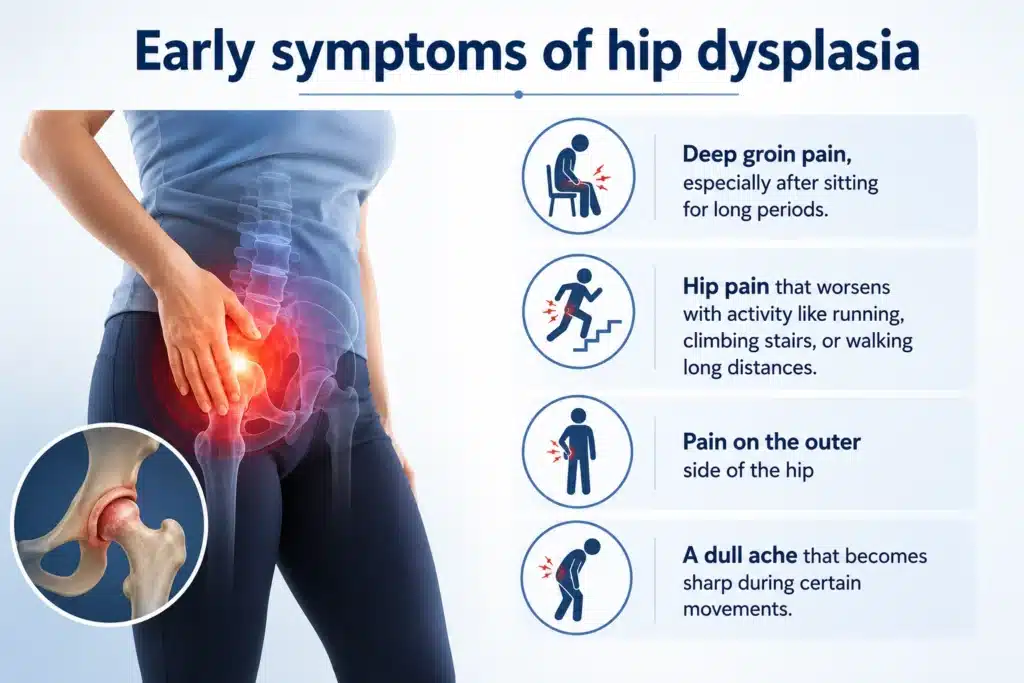
- Deep groin pain, especially after sitting for long periods.
- Hip pain that worsens with activity like running, climbing stairs, or walking long distances.
- Pain on the outer side of the hip.
- A dull ache that becomes sharp during certain movements.
Mechanical symptoms:
- Clicking, catching, or locking sensation in the hip.
- Feeling of instability, as if the hip might “give way.”
- Limping, especially after exercise.
Less obvious signs:
- One leg appears shorter than the other.
- Uneven walking pattern or gait changes.
- Hip dysplasia can cause lower back pain due to compensatory posture changes.
- Reduced range of motion, especially internal rotation.
Causes and risk factors of hip dysplasia
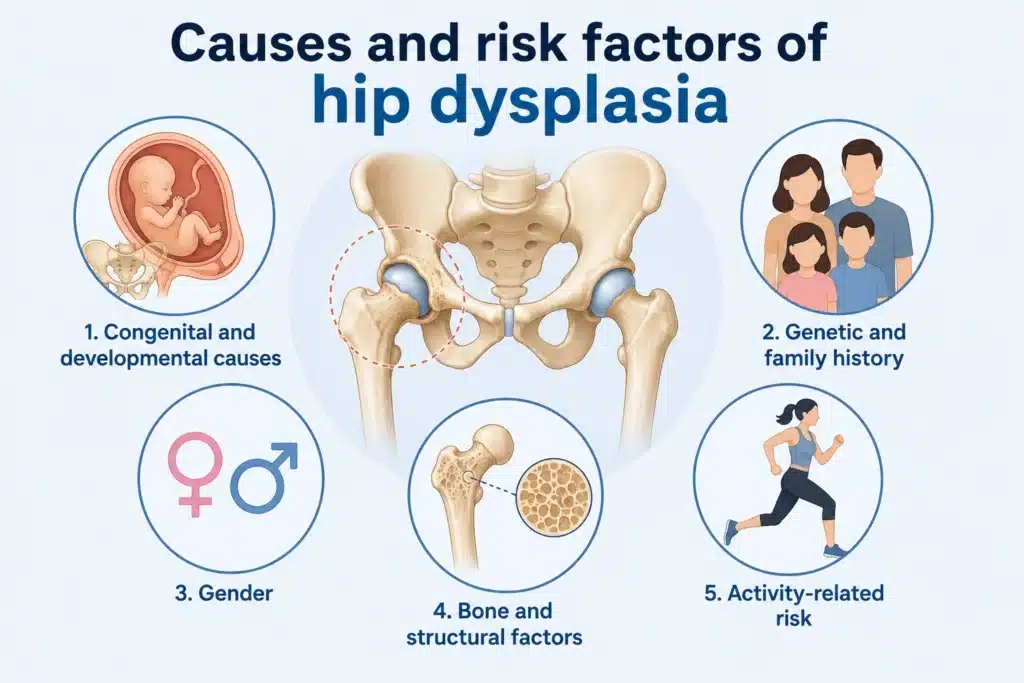
Hip dysplasia is primarily a developmental condition, but several factors increase the risk:
Congenital and developmental causes:
- Congenital hip dysplasia begins before or during birth when the hip joint does not develop correctly in the womb.
- A breech position during pregnancy puts pressure on the hip socket and increases risk.
- Tight swaddling of newborns has been linked to developmental dysplasia of the hip.
Genetic and family history:
- This runs in families.
- If a parent had hip dysplasia, the risk is significantly higher in children.
Gender:
- Women are four to eight times more likely to develop than men.
- Oestrogen may cause ligament laxity, contributing to hip socket instability.
Bone and structural factors:
- Abnormal acetabular angle (the angle of the hip socket).
- Femoral anteversion, where the femur is rotated inward.
- Associated conditions like cerebral palsy or ligamentous laxity.
Activity-related risk:
- High-impact sports and repetitive hip loading in people with undiagnosed hip dysplasia can accelerate damage.
How hip dysplasia leads to early arthritis
This is the part most patients do not expect to hear. In adults is one of the leading causes of early-onset hip arthritis, often seen in people in their 30s and 40s.
Untreated adult hip dysplasia almost always progresses. The question is not whether it will get worse; it is how quickly.
Here is why:
- In a healthy hip, body weight is distributed evenly across the joint surface.
- In hip joint dysplasia, the shallow socket concentrates stress on a smaller area.
- This abnormal loading tears the labrum (the cartilage ring around the socket) over time.
- Once the labrum is damaged, cartilage wears down faster.
- The result is hip arthritis that appears 20 to 30 years earlier than it should.
Diagnosis and imaging tests
A correct hip dysplasia diagnosis requires a specialist who understands the condition. General X-ray readings frequently miss mild to moderate.
Getting the right diagnosis for hip dysplasia requires more than a standard hip X-ray. A thorough evaluation includes:
Clinical assessment:
- Detailed history of pain, onset, and activity limitations.
- Physical examination of hip range of motion and impingement tests.
- Gait analysis to identify walking abnormalities.
Imaging:
- X-ray: The first step. Specific views like the false profile view and AP pelvis X-ray help measure the lateral center-edge angle, which indicates socket coverage. Standard X-rays alone often miss.
- MRI (Magnetic Resonance Imaging): Shows soft tissue damage, labral tears, and early cartilage changes associated with this.
- CT Scan: Provides a three-dimensional picture of the hip socket orientation, which is crucial for surgical planning.
- 3D CT Reconstruction: Used by hip preservation specialists to plan periacetabular osteotomy (PAO) surgery.
Treatment options for hip dysplasia
Hip preservation surgery in Noida is available at advanced orthopedic centers equipped with 3D imaging and joint-preserving surgical expertise.
Treatment depends on age, severity, and how much damage has already occurred.
Non-surgical management:
- Physiotherapy: Can help with pain management and muscle strengthening. However, physiotherapy alone does not correct the underlying hip socket abnormality. It is supportive, not curative.
- Pain medication and anti-inflammatories: Provide temporary relief but do not address the root cause
- Activity modification: Reducing high-impact activities to slow joint damage
- Injections: Corticosteroid or hyaluronic acid injections may offer short-term pain relief
Hip-preserving surgery (for younger patients with healthy cartilage):
- Periacetabular Osteotomy (PAO): The gold standard for treatment in adults. The surgeon cuts and repositions the hip socket to improve coverage and reduce abnormal stress. This preserves the natural hip joint and delays or prevents the need for hip replacement.
- Hip Arthroscopy: Used to repair labral tears associated with hip dysplasia. Works best when combined with corrective surgery, not as a standalone treatment.
- Femoral Osteotomy: Corrects abnormal femoral rotation in select cases of hip joint dysplasia
Newborns and infants:
- Pavlik Harness: A soft brace that holds the hips in a correct position. Most effective when developmental dysplasia of the hip is diagnosed within the first few months of life.
- Hip Spica Cast: Used for older infants when harness treatment is not sufficient.
Can hip dysplasia be prevented?
Congenital hip dysplasia cannot always be prevented. However, early detection dramatically changes outcomes.
Early treatment almost always leads to better outcomes for hip dysplasia at every stage of life.
In newborns:
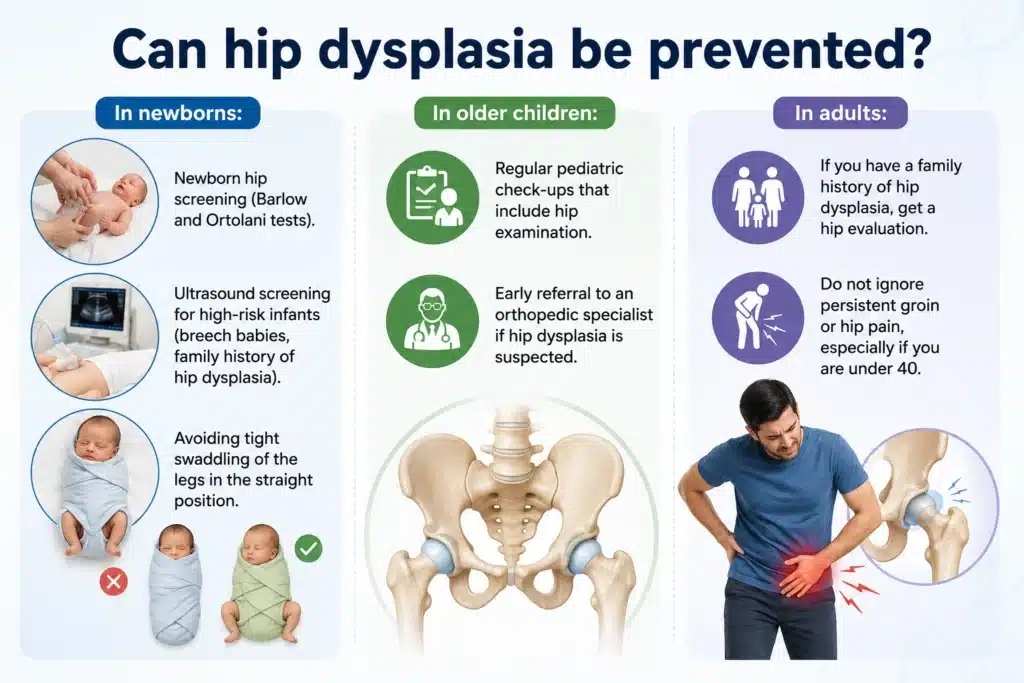
- Newborn hip screening (Barlow and Ortolani tests) should be performed at birth and follow-up checks.
- Ultrasound screening for high-risk infants (breech babies, family history of hip dysplasia).
- Avoiding tight swaddling of the legs in the straight position.
In older children:
- Regular pediatric check-ups that include hip examination.
- Early referral to an orthopedic specialist if this is suspected.
In adults:
- If you have a family history, get a hip evaluation proactively.
- Do not ignore persistent groin or hip pain, especially if you are under 40.
- See a hip specialist, not just a general practitioner, for unexplained hip symptoms.
When should you see an orthopedic specialist?
For patients in the Delhi NCR region, seeking hip dysplasia treatment in Noida from a dedicated orthopedic center means access to advanced imaging, joint-preservation expertise, and surgical options under one roof. The best hospital for hip dysplasia will offer a clear diagnosis, an honest assessment of your cartilage health, and a personalized treatment plan rather than a one-size-fits-all approach.
Do not wait for arthritis to develop. The window for hip-preserving treatment closes once the cartilage is gone.
Frequently Asked Questions (FAQs)
Is hip dysplasia common in adults?
Yes. Adult hip dysplasia is more common than most people think. Many cases go undiagnosed until patients reach their 20s, 30s, or even 40s. Studies suggest this contributes to roughly 25-40% of early hip arthritis cases in adults.
Can hip dysplasia cause lower back pain?
Yes. When this alters your walking pattern and posture, the spine and lower back compensate. This leads to chronic lower back pain that may actually have its origin in hip joint dysplasia, not a spinal problem.
How is hip dysplasia treated in adults?
Treatment depends on severity and cartilage health. Options range from physiotherapy and pain management for mild cases to periacetabular osteotomy (PAO) for younger patients with intact cartilage and hip replacement for those with advanced arthritis from hip dysplasia.
Can physiotherapy help hip dysplasia?
Physiotherapy can manage pain and improve muscle support around the hip, but it cannot correct the underlying structural abnormality of hip dysplasia.
What happens if hip dysplasia is not treated?
Untreated hip dysplasia leads to progressive labral tears, cartilage damage, and eventually severe hip arthritis.
Can hip dysplasia return after surgery?
After successful PAO or hip preservation surgery, the corrected socket position is permanent. However, patients with severe pre-existing cartilage damage may still progress to arthritis.
Conclusion
Hip dysplasia is not a rare condition. It affects far more people than most realize, and it is one of the most commonly missed causes of chronic hip pain in adults under 50.
If you or someone in your family has unexplained hip pain, do not dismiss it. A timely visit to the best hospital in Noida can mean the difference between a joint-preserving procedure and a full replacement years later.
Experiencing hip pain, groin discomfort, or difficulty walking? Get a thorough evaluation for hip dysplasia at our orthopedic center in Noida. Our team specializes in hip preservation surgery, complex hip diagnosis, and personalized treatment for every stages.