Legs and arms are meant to work in a straight, balanced way so that the body can move efficiently. When bones are bent, twisted, or uneven, the body has to compensate in ways that can cause pain, limping, early joint wear, and reduced confidence in daily activities.
Limb deformity may be present from birth, develop during growth, or appear after an injury, infection, or bone disease. Some children outgrow mild deformities on their own, but significant or worsening deformities often need medical attention. In adults, deformities may cause joint pain, arthritis, and difficulty walking over time.
Limb deformity correction is not only about appearance. It is about improving function, reducing pain, protecting joints, and helping the patient stand and walk with better alignment. A hospital-based approach ensures that surgery is planned carefully, recovery is supported properly, and long-term joint health is protected.
What Is Limb Deformity?
Limb deformity means that a bone in the arm or leg is not in a normal position or shape. It may be bent inward, bent outward, twisted, shortened, or uneven compared to the other side.
Deformities may be mild, moderate, or severe. Some cause no symptoms, while others cause pain, limping, joint strain, or difficulty with footwear and daily activities.
Common types include:
- Bow legs, where the knees stay apart when standing with feet together.
- Knock knees, where the knees touch while the ankles stay apart.
- Limb length difference, where one leg or arm is shorter.
- Angular deformities, where the bone is bent at an angle.
- Rotational deformities, where the bone is twisted.
- Deformities after fracture, infection, or bone disease.
Why Limb Deformity Correction Matters?
Limb deformities can affect more than just the bone. They can change how the joints work and how weight is carried through the body.
Correcting the deformity can help distribute weight more evenly, reduce joint stress, improve walking, and protect joints from early wear.
Problems that may develop include:
- Uneven pressure on knee, hip, or ankle joints.
- Early arthritis in the overloaded joint.
- Pain in the knee, hip, ankle, or back.
- Limping or abnormal gait.
- Difficulty with sports or long walks.
- Difficulty fitting shoes or standing evenly.
- Reduced confidence in appearance and movement.
Who Needs Limb Deformity Correction?
Not every limb deformity needs surgery. Mild cases in young children may be watched over time. Treatment is considered when the deformity is significant, worsening, or causing symptoms.
In adults, deformity correction may be needed to reduce pain, improve function, and prevent or delay joint replacement. You may need deformity correction if you or your child has:
- Noticeable bow legs or knock knees beyond the expected age.
- Limb length difference that affects walking or causes limping.
- Pain in the knee, hip, ankle, or back linked to deformity.
- Difficulty with sports, running, or long walks.
- Deformity after a fracture that healed in a poor position.
- Deformity due to infection, bone disease, or growth plate injury.
- Increasing deformity over time.
- Difficulty standing with feet together or walking straight.
Types of Limb Deformities
Limb deformities can involve different bones and different patterns of misalignment.
Angular deformities
- Bow legs, where the lower leg angles outward.
- Knock knees, where the lower leg angles inward.
- Varus or valgus deformity at the knee, ankle, or hip.
Length deformities
- One leg shorter than the other.
- Shortening after fracture or infection.
- Congenital shortening present from birth.
Rotational deformities
- Twisting of the thigh bone or shin bone.
- Inward or outward rotation of the foot or leg.
Complex deformities
- Combination of angulation, rotation, and shortening.
- Deformities after trauma, infection, or bone disease.
- Deformities involving more than one bone or joint.
Causes and Risk Factors
Limb deformities can happen for many reasons. Some are present at birth, while others develop during growth or after injury. Understanding the cause helps the surgeon decide the best time and method for correction.
Common causes
- Normal growth variation in young children.
- Congenital bone conditions.
- Rickets or vitamin D deficiency.
- Growth plate injury.
- Fracture that heals in a poor position.
- Bone infection.
- Bone tumors or cysts.
- Neuromuscular conditions.
- Metabolic bone disease.
- Genetic or developmental conditions.
Risk factors
- Family history of deformity.
- Nutritional deficiency.
- Previous bone injury.
- Chronic illness affecting bone growth.
- Repeated fractures.
- Inadequate treatment of initial injury.
Signs and Symptoms of Limb Deformity
Limb deformities may be obvious or subtle, depending on the severity. In children, parents may notice that the legs look different compared to other children of the same age. In adults, pain and joint strain may become more noticeable over time.
Common signs and symptoms include:
- Visible bowing or knock-knee appearance.
- Uneven leg length.
- Limping or abnormal walking pattern.
- Pain in the knee, hip, ankle, or back.
- Difficulty with sports or running.
- Shoes wearing out unevenly.
- Difficulty standing with feet together.
- Fatigue in the legs after walking.
- Reduced confidence due to appearance.
Diagnosis for Limb Deformity Correction
Diagnosis begins with a detailed orthopedic evaluation. The doctor looks at how the patient stands, walks, and moves, and then uses imaging to understand the exact pattern of deformity.
Accurate diagnosis helps the surgeon plan the correction precisely and choose between guided growth, osteotomy, lengthening, or external fixation.
Clinical evaluation
- Physical examination of legs and arms.
- Observation of standing and walking.
- Measurement of limb length.
- Assessment of joint movement and stability.
- Review of medical history and previous injuries.
Imaging tests
- X-rays of the affected limb in standing position.
- Full-length X-rays to assess alignment from hip to ankle.
- CT scan or 3D imaging in complex cases.
- MRI if soft tissue or joint involvement is suspected.
- Bone age assessment in children.
Additional tests
- Blood tests for vitamin D, calcium, or metabolic bone disease if needed.
- Evaluation for infection or previous fracture healing.
- Gait analysis in selected cases.
Limb Deformity Correction at a Glance
| Aspect |
What it means |
| Purpose |
Straighten, realign, or lengthen bones to improve function and reduce pain. |
| Common conditions |
Bow legs, knock knees, limb length difference, angular or rotational deformities. |
| Age groups |
Children, adolescents, and adults. |
| Methods |
Guided growth, osteotomy with plates, external fixation, lengthening devices. |
| Goal |
Improve alignment, gait, joint loading, and long-term joint health. |
Non-Surgical Treatment Options
Not all limb deformities need surgery. In young children, some mild bowing or knock-knee patterns improve naturally as they grow.
Non-surgical care is often used when the deformity is mild, expected to improve with growth, or not causing significant symptoms.
Non-surgical options may include:
- Observation and regular follow-up.
- Vitamin D and calcium supplementation if deficiency is present.
- Physiotherapy for strength and gait training.
- Shoe raises or orthotics for small limb length differences.
- Activity modification to reduce pain.
- Treatment of underlying bone or metabolic disease.
Surgical Treatment Options
When deformity is significant, worsening, or causing pain and functional problems, surgery may be recommended. The exact method depends on age, bone growth status, type of deformity, and severity.
Guided growth
- Used in children who still have growth remaining.
- Small plates or screws are placed near the growth plate.
- The growth plate is guided to grow more on one side than the other.
- Over time, the bone straightens as the child grows.
- Implants may be removed once correction is achieved.
Osteotomy with internal fixation
- The bone is cut and realigned to a better position.
- Plates, screws, or rods hold the bone in the corrected position.
- Used in older children and adults with closed growth plates.
- Can correct angulation, rotation, or combined deformities.
- Allows precise correction in a single surgery.
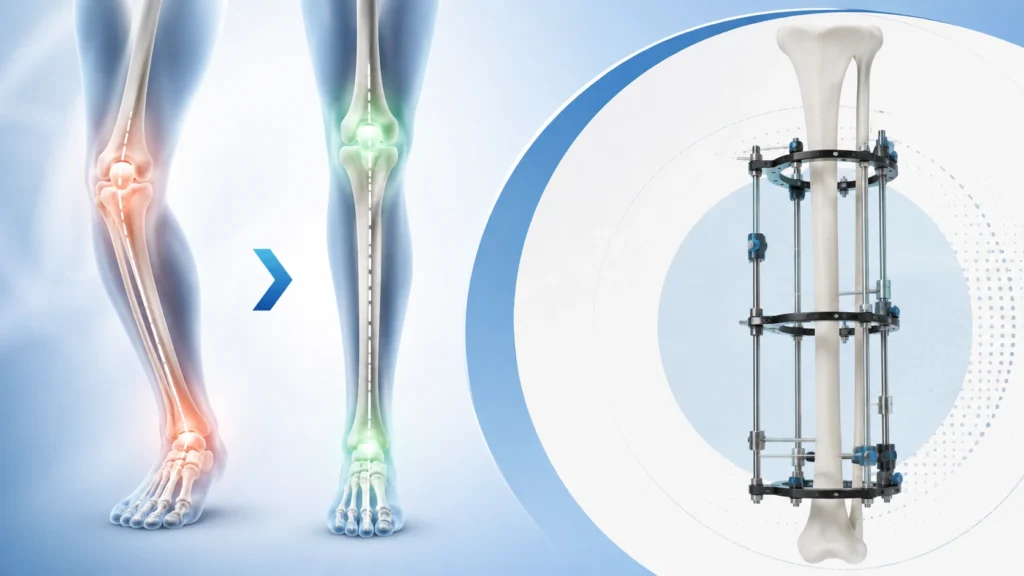
External fixation
- A frame is placed outside the limb with pins or wires in the bone.
- The frame can be adjusted gradually to correct deformity or lengthen bone.
- Useful for complex deformities or significant lengthening.
- Allows gradual correction over weeks.
- Requires careful care of pins and regular follow-up.
Limb lengthening
- Used for significant limb length difference.
- Bone is cut and slowly lengthened using an external or internal device.
- New bone forms in the gap as the bone is gradually separated.
- Used in selected cases with careful planning.
Procedure for Limb Deformity Correction
Limb deformity correction is a planned surgical process. The exact steps depend on the chosen method, but the overall flow follows a clear pattern.
Step 1: Pre-surgical evaluation and planning
- Detailed clinical examination of the limb.
- Full-length X-rays to measure deformity angles.
- Assessment of limb length and joint alignment.
- Evaluation of growth potential in children.
- Discussion of surgical options and expected outcomes.
- Planning of correction angle and method.
- Review of medical fitness and anesthesia risk.
Step 2: Pre-operative preparation
- Blood tests and basic medical checkup.
- Instructions about fasting before surgery.
- Review of current medicines and allergies.
- Counseling for patient and family about recovery and expectations.
- Arrangement of support at home for the post-operative period.
- Planning for physiotherapy and follow-up visits.
Step 3: Anesthesia
- Surgery is done under general or regional anesthesia.
- The type depends on the patient’s age, health, and procedure.
- Anesthesia ensures the patient is comfortable and pain-free.
- Vital signs are monitored throughout the operation.
- Pain control is planned for the recovery period.
Step 4: Surgical approach and exposure
- The surgeon makes an incision over the area to be corrected.
- Soft tissues are carefully moved to expose the bone.
- Nerves and blood vessels are protected during the procedure.
- The deformity is measured and confirmed during surgery.
- The surgical plan is adjusted if needed based on direct findings.
Step 5: Bone correction and realignment
- For guided growth, small plates or screws are placed near the growth plate.
- For osteotomy, the bone is cut and repositioned into the planned alignment.
- For external fixation, pins or wires are placed and connected to the frame.
- For lengthening, the bone is cut and the device is set for gradual adjustment.
- The corrected position is checked using imaging or surgical guides.
- Implants or frames are secured to maintain the new alignment.
Step 6: Stabilization and closure
- Plates, screws, rods, or external frames hold the bone in position.
- The surgeon confirms stability and alignment.
- Incisions are closed with sutures or staples.
- Sterile dressing is applied over the wound.
- A splint, cast, or brace may be used if needed.
Step 7: Immediate post-operative care
- The patient is moved to recovery and monitored closely.
- Pain, circulation, and movement of the limb are checked.
- Medicines are given for pain and infection prevention.
- Early mobilization is started as advised.
- Instructions are given for wound care and activity limits.
Step 8: Recovery and rehabilitation
- Physiotherapy is started based on the surgical method.
- Weight-bearing is increased gradually as healing progresses.
- For external fixation, frame adjustments are made as planned.
- Regular X-rays are done to monitor bone healing.
- Rehabilitation focuses on strength, movement, and gait training.
Step 9: Implant or frame removal if needed
- Guided growth plates may be removed after correction.
- External frames are removed once the bone is stable.
- Internal implants may stay in place or be removed later depending on the case.
- Final X-rays confirm alignment and healing.
- Long-term follow-up is planned to monitor joint health.
Procedure Pointers for Limb Deformity Correction
| Stage |
Key Pointers |
| Pre-op planning |
Full-length X-rays, deformity analysis, growth assessment, surgical mapping. |
| Anesthesia |
General or regional anesthesia for comfort and safety. |
| Surgical method |
Guided growth, osteotomy, external fixation, or lengthening based on age and deformity. |
| Correction |
Precise realignment of bone to planned angle and position. |
| Post-op care |
Pain control, wound care, physiotherapy, and gradual weight-bearing. |
How Methods Differ by Age and Condition
| Factor |
Children with growth remaining |
Older children and adults |
| Preferred method |
Guided growth or gradual correction. |
Osteotomy with plates or external fixation. |
| Growth potential |
Used to correct deformity over time. |
Not available; correction is done surgically. |
| Recovery |
Often faster with guided growth. |
Depends on bone healing and procedure. |
| Implants |
Small plates that may be removed later. |
Plates, screws, rods, or external frames. |
Benefits of Limb Deformity Correction
Limb deformity correction offers several important benefits for the right patient. For many patients, correction not only improves how the limb looks, but also how it functions every day.
Benefits include:
- Improved leg or arm alignment.
- Better walking pattern and gait.
- Reduced pain in joints and muscles.
- More even weight distribution across joints.
- Lower risk of early arthritis.
- Improved ability to participate in sports and daily activities.
- Better shoe fit and standing posture.
- Improved confidence and appearance.
- Protection of long-term joint health.
Risks and Complications
Like any surgery, limb deformity correction carries some risks. The actual risk depends on the method, the patient’s age, bone quality, and overall health.
The surgeon explains these risks before surgery and takes precautions to reduce them. Careful planning and follow-up are important for safe outcomes.
Possible risks include:
- Infection.
- Bleeding.
- Delayed bone healing.
- Nerve or blood vessel injury.
- Stiffness or reduced movement.
- Overcorrection or undercorrection.
- Implant-related issues.
- Need for additional surgery in some cases.
- Pain during recovery.
- Frame-related skin issues in external fixation.
Recovery After Limb Deformity Correction
Recovery depends on the type of procedure, the patient’s age, and the complexity of the deformity.
Early recovery
- Hospital stay varies by procedure.
- Pain and swelling are managed with medicines.
- Wound care instructions are provided.
- Early movement is encouraged as advised.
- Weight-bearing may be limited initially.
Home recovery
- Regular physiotherapy exercises.
- Gradual increase in walking and activity.
- Follow-up X-rays to monitor healing.
- Frame care if external fixation is used.
- Avoid high-impact activity until cleared.
Long-term recovery goals
- Return to normal daily activities.
- Improved walking and standing.
- Reduced pain and joint strain.
- Better participation in school, work, and sports.
- Ongoing monitoring for joint health.
Tips for Better Recovery
Good recovery depends on both surgery and aftercare. Helpful tips include:
- Follow all medicine and physiotherapy instructions.
- Keep the wound clean and dry.
- Attend all follow-up appointments.
- Do prescribed exercises regularly.
- Avoid putting full weight too early if restricted.
- Maintain good nutrition for bone healing.
- Report fever, increasing pain, redness, or drainage early.
- Use support devices such as crutches or walkers as advised.
- Be patient; bone healing takes time.
Why Choose Rama Hospital for Limb Deformity Correction?
Rama Hospital offers specialized orthopedic care for patients with limb deformities, focusing on accurate diagnosis, precise surgical planning, and structured recovery. Limb deformity correction is not only about straightening bones; it is about improving walking, reducing joint stress, and protecting long-term joint health. A hospital-based approach ensures that every step, from evaluation to rehabilitation, is managed by experienced professionals.
- Expert Orthopedic and Deformity Team
- Advanced Imaging and Planning
- Comprehensive Surgical Options
- Focused Recovery and Rehabilitation
- Patient and Family Education
- Safe and Structured Care
Frequently Asked Questions (FAQs)
1. What is limb deformity correction?
Limb deformity correction is a surgical treatment to straighten, realign, or lengthen bones that are bent, twisted, or uneven. It is used for bow legs, knock knees, limb length difference, and other bone alignment problems.
2. Who needs limb deformity correction?
It is needed when the deformity is significant, worsening, or causing pain, limping, or joint strain. It may be recommended for children with growth-related deformities and adults with deformities after injury or disease.
3. Is limb deformity correction only for children?
No, it is done for both children and adults. Children may benefit from guided growth, while adults usually need osteotomy or external fixation because their growth plates are closed.
4. Can limb deformity be corrected without surgery?
Mild deformities in young children may improve with growth, observation, and physiotherapy. Significant or symptomatic deformities usually need surgery for proper correction.
5. How long does recovery take after limb deformity surgery?
Recovery depends on the procedure and the patient’s age. Bone healing may take several weeks to months, and full return to sports or heavy activity may take longer.
6. Is limb deformity correction painful?
There is pain after surgery, but it is managed with medicines and supportive care. Most patients find that pain improves as healing progresses and mobility increases.
7. Will I need implants or external frames?
Some patients need plates, screws, or rods inside the bone. Others may need an external frame for gradual correction. The method depends on the type of deformity and the surgical plan.
8. Can limb deformity come back after surgery?
With proper planning and follow-up, recurrence is uncommon. Regular monitoring helps ensure that alignment remains stable as the child grows or as the patient heals.
9. Does limb deformity correction improve walking?
Yes, one of the main goals is to improve gait, reduce limping, and make walking more comfortable. Many patients notice better balance and less joint strain after correction.
10. Is limb deformity correction safe?
It is a well-established orthopedic procedure when done by experienced surgeons. Like all surgeries, it has risks, but careful planning, skilled surgery, and good aftercare help improve safety and outcomes.
Conclusion
Limb deformity correction is an important treatment for patients whose bones are bent, twisted, or uneven in a way that affects walking, causes pain, or puts extra stress on joints. It can help children and adults with bow legs, knock knees, limb length difference, and deformities after injury or disease.
At Rama Hospital, limb deformity correction is planned with detailed imaging, precise surgical techniques, and guided recovery so patients can walk more comfortably, stand more evenly, and protect their joints for the long term. The focus is not only on straightening the bone, but also on improving function, reducing pain, and supporting a confident, active life.