Most people brush off leg pain, tired feet, or a heavy-leg feeling after a long day. “It’s probably just fatigue,” they tell themselves. But if these symptoms keep coming back, especially without much physical activity, your veins may be sending you an important warning.
Varicose veins are not just a cosmetic issue. Left untreated, they can lead to skin ulcers, blood clots, and long-term complications. The good news? When caught early, they respond very well to treatment.
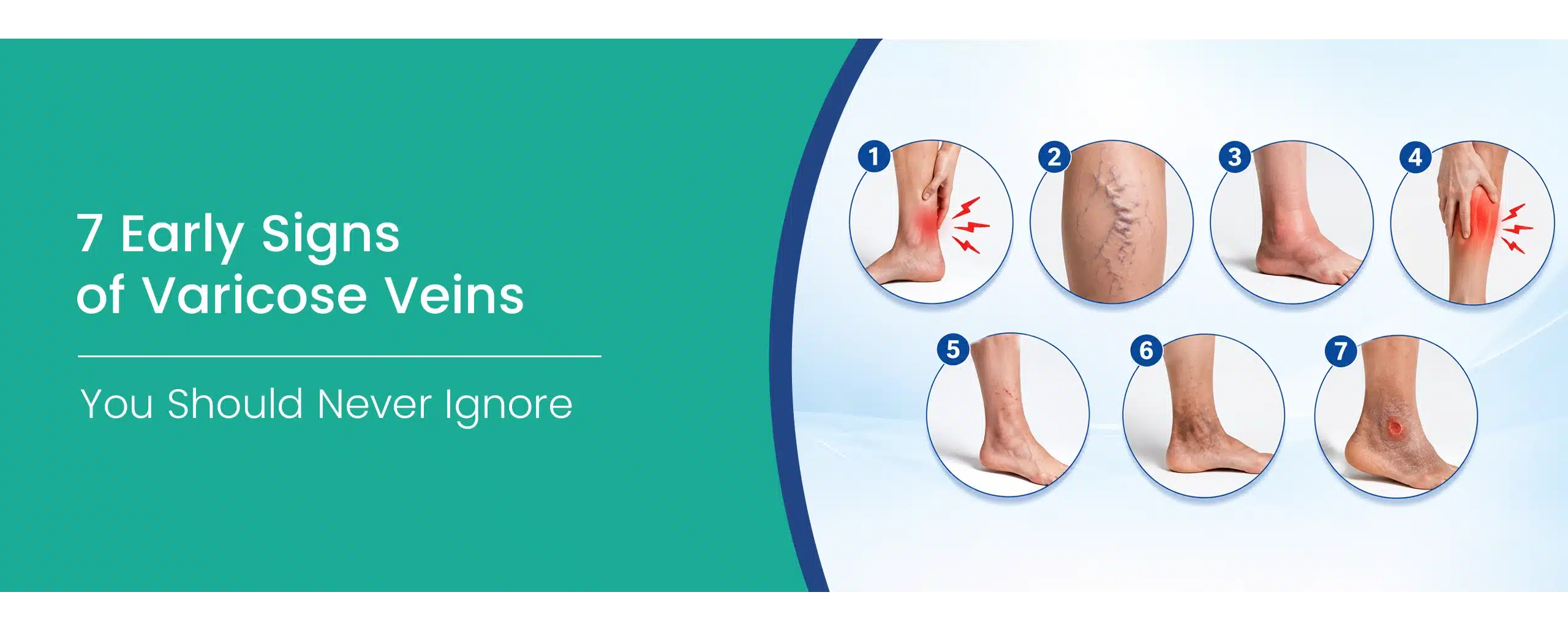
Here are 7 early signs of varicose veins you need to take seriously.
What are varicose veins, and why do they happen?
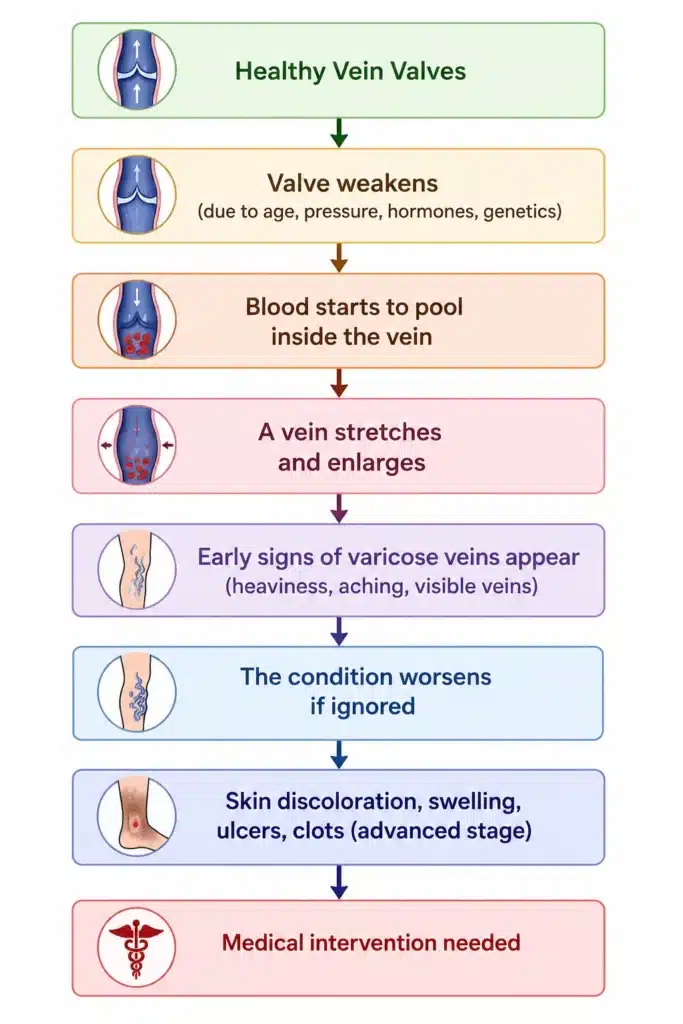
Your veins carry blood back to the heart. Inside each vein are tiny valves that open and close to keep blood moving in one direction. When these valves weaken or fail, blood pools in the vein. The vein stretches, swells, and becomes visible under the skin.
Who is most at risk?
This is a very common condition in India, especially among women, professionals who stand for long hours (teachers, nurses, and shopkeepers), and people with a sedentary, desk-bound lifestyle.
| Risk Factor | Why It Matters |
| Long hours of standing or sitting | Increases venous pressure in the legs |
| Pregnancy | Hormonal changes weaken vein walls |
| Obesity | Extra body weight adds pressure on leg veins |
| Family history | Valve weakness can be inherited |
| Age (above 40) | Vein walls and valves naturally weaken over time |
| Female gender | Hormonal fluctuations affect vein elasticity |
How varicose veins develop: A simple flowchart
The earlier you act on the early signs of varicose veins, the simpler and less invasive the treatment.
Sign 1: Visible bulging or twisted veins in the legs
This is usually the first thing patients notice.
- Bulging veins in legs that look rope-like or cord-like under the skin.
- Twisted veins in legs that may appear as a cluster or a single raised vein.
- Veins that are clearly visible, especially around the calves and thighs.
- May appear more prominent after standing for long periods.
What it looks like:
The veins often appear as raised ridges or winding lines beneath the skin. They can be quite large or start as tiny clusters.
These visible signs are among the most recognizable early signs of varicose veins. Many people in India dismiss them as “just veins showing through” and delay treatment for years. That delay can be costly.
Sign 2: Blue and purple veins under the skin
Healthy veins are not easily visible. When blue and purple veins start showing prominently through the skin, it indicates that blood is pooling inside them.
- The unusual dark coloring is due to deoxygenated blood collecting in the affected vein.
- Blue and purple veins on the legs, ankles, or feet are a classic visual marker.
- They may appear in spider web-like patterns (called spider veins) or as larger rope-like structures.
Sign 3: Aching legs and heavy-leg feeling
This is one of the most commonly reported symptoms by Indian patients and one of the most underestimated.
- Aching leg symptoms that get worse as the day progresses.
- A persistent heavy-leg feeling, like your legs are weighed down.
- Discomfort that improves when you lie down and elevate your legs.
- Leg pain due to varicose veins often worsens after long hours of standing or sitting.
- The pain is usually a dull ache, not a sharp pain.
Sign 4: Throbbing or burning sensation in the legs
Beyond general aching, many patients report specific sensations:
- Throbbing leg pain, especially in the calves.
- A burning sensation in the legs, often described as a heat feeling from inside.
- The sensations may be more intense at night or after physical activity.
- Some patients describe it as pulsating or tingling.
If you have a burning sensation in your legs combined with any other visible signs, do not wait. These are clear early signs of varicose veins that deserve professional assessment.
Sign 5: Leg swelling, especially around the ankles
Leg swelling is one of the most telling early signs of varicose veins. It happens because damaged vein walls allow fluid to leak into surrounding tissue.
- Swelling that appears by evening and improves overnight.
- Usually concentrated around the ankles and lower legs.
- Skin may feel tight or look puffy.
- Socks or footwear may leave marks on the ankles (pitting edema in some cases).
- Leg swelling may be accompanied by skin that looks slightly shiny or stretched.
Causes of leg swelling to rule out: Leg swelling tied to varicose veins is typically gradual and positional. Still, always get a proper diagnosis.
Sign 6: Itchy skin, skin discoloration, and changes near the ankles
As varicose veins progress, they begin affecting the skin. These are signs that the condition is no longer just vascular; it is impacting the tissue around the veins.
- Itchy skin around veins that worsens at night.
- Skin discoloration near ankles, appearing as brownish or reddish patches.
- Dry, flaky, or eczema-like skin over the affected vein.
- In advanced cases, small sores or ulcers may develop near the ankles.
Why does skin change?
When blood pools in veins, it leaks iron pigment (hemosiderin) into surrounding tissue. This causes the brownish skin discoloration near the ankles that many patients notice. The skin also becomes more fragile and prone to breakdown.
Sign 7: Restless legs at night and leg cramps
- Restless legs at night, an urge to constantly move the legs, especially while lying down.
- Leg cramps due to varicose veins, particularly painful cramps in the calf muscles at night.
- Cramps that wake you up from sleep.
- Discomfort that improves temporarily with stretching or walking.
If your legs feel jumpy, uncomfortable, or impossible to keep still at night, varicose veins may be the reason.
When to see a doctor immediately
These are medical emergencies. Call your hospital or go to the emergency department right away. Some situations cannot wait for a routine appointment:
- A varicose vein starts bleeding (even from a small scratch).
- Sudden severe swelling in one leg with warmth and pain (possible DVT).
- A wound near the ankle that is not healing after two weeks.
- Skin turns very dark brown or black near the ankle.
- Sudden chest pain or breathlessness combined with leg swelling.
Why Noida patients choose Rama Hospital for varicose vein treatment
If you are looking for varicose veins treatment in Noida, Rama Hospital offers a full range of advanced minimally invasive options.
If you are experiencing any of the early signs of varicose veins listed above, a timely consultation with an interventional radiologist in Noida at Rama Hospital can save you from complications down the line.
Rama Hospital is home to experienced vascular specialists, including some of the most trusted names in interventional radiology in Noida. Patients across the NCR trust Rama Hospital for:
- Advanced diagnostic tools including Doppler ultrasound for accurate vein mapping.
- Minimally invasive procedures with same-day discharge.
- An experienced team of the best varicose vein doctors in Noida.
- Dedicated patient care from consultation through recovery.
- Transparent, patient-friendly approach to treatment planning.
Frequently Asked Questions (FAQs)
Q1. My legs ache every evening. Does that mean I definitely have varicose veins?
Not necessarily. Evening leg ache can have multiple causes. But if it consistently improves when you put your feet up, and you also notice any visible veins or swelling, it’s worth getting a Doppler ultrasound done.
Q2. I can see blue veins on my legs, but they don’t hurt at all. Should I still worry?
Yes, you should at least get them evaluated. Many people have varicose veins without pain initially. The pain and discomfort can develop later as the condition progresses.
Q3. Can varicose veins go away on their own without treatment?
No. Varicose veins do not resolve on their own. The valves inside the veins are already damaged. They cannot repair themselves. The condition typically worsens over time if not treated.
Q4. I’m only 30. Can I really have varicose veins at this age?
Absolutely. While varicose veins are more common after 40, younger people can develop them due to pregnancy, prolonged standing, genetics, or obesity. Age is not a barrier for this condition.
Q5. Is the treatment painful? Do I need to stay in the hospital?
Modern varicose vein treatments like laser therapy and radiofrequency ablation are done under local anesthesia. Most patients feel minimal discomfort.
Q6. Will varicose veins come back after treatment?
Treated veins do not come back. However, new veins can develop in other areas, particularly if the underlying risk factors (prolonged standing, obesity, pregnancy) are not managed.
Q7. My mother has varicose veins. Am I at risk too?
Yes, there is a genetic component. If one parent has varicose veins, your risk is approximately 40 to 50 percent. If both parents have them, the risk rises to 90 percent. Knowing your family history is important.
Q8. Can I treat varicose veins at home with home remedies?
Home remedies cannot treat the root cause. Elevation, cold compresses, and compression stockings can offer temporary relief from symptoms, but they don’t repair damaged valves.
Conclusion
Your legs carry you through every day of your life. When they start sending signals like heaviness, aching, swelling, or visible veins, pay attention. The early signs of varicose veins are your body’s way of asking for help before things get complicated.
Early detection means simpler treatment, faster recovery, and better outcomes.
If you are in the NCR region, the team at Rama Hospital includes some of the best varicose vein doctors in Noida with deep expertise in minimally invasive vascular care. Book a consultation, get a Doppler scan done, and know exactly where you stand.
Don’t wait for the pain to become unbearable. Act on the early signs of varicose veins today.