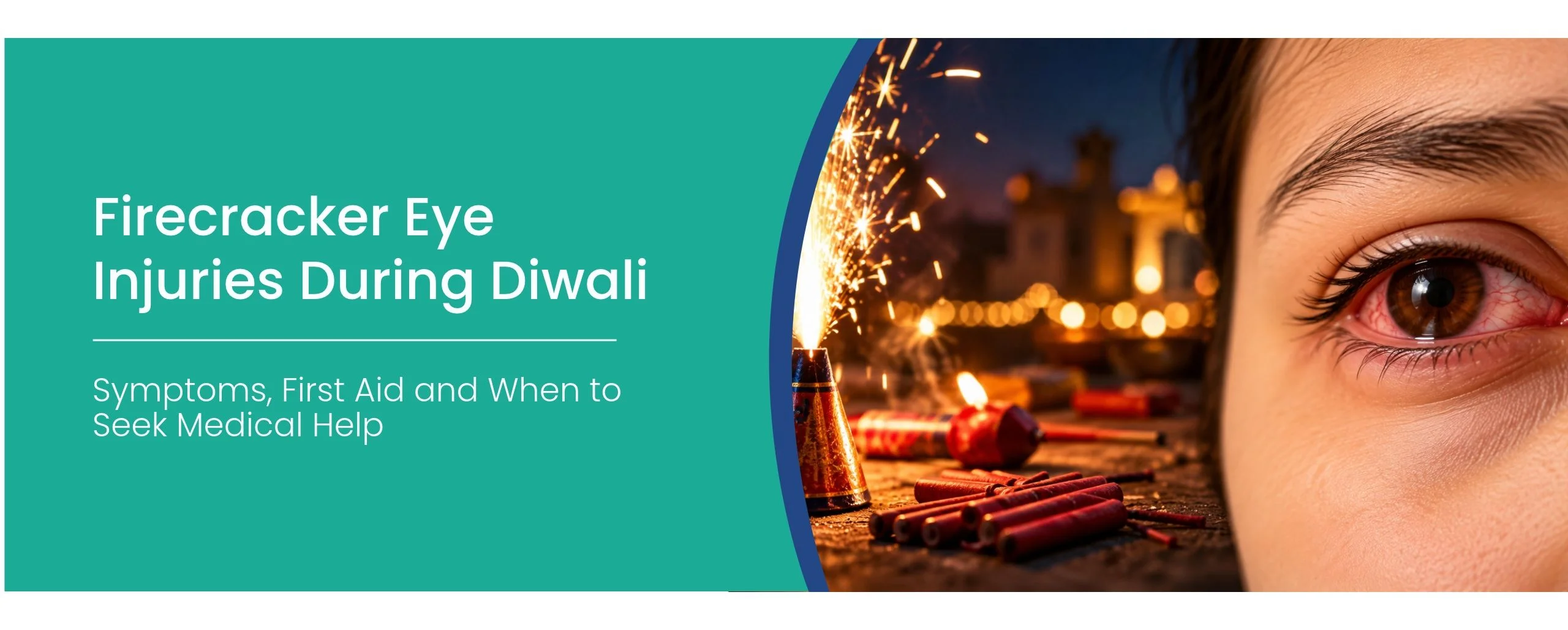
Diwali is a time for family gatherings, festive lights and celebrations. However, firecrackers can turn a joyful occasion into a medical emergency within seconds. A sudden burst, flying spark or piece of debris can injure the eye, while smoke and airborne particles can cause irritation and redness.
A firecracker eye injury can range from temporary irritation to a serious injury involving the cornea, eyelids, retina or other delicate structures of the eye. Some injuries are immediately noticeable, while others may initially appear minor despite causing significant damage. Knowing what to do in the first few minutes can make an important difference.
During Diwali, it is particularly important to recognise the difference between smoke-related irritation and an injury caused by a firecracker’s heat, impact or explosion. The appropriate first aid depends on what has happened. A suspected serious injury requires immediate medical assessment rather than home remedies.
What Is a Firecracker Eye Injury?
A firecracker eye damage refers to damage to the eye or surrounding tissues caused by a firecracker, sparkler, rocket, explosive burst or flying debris. The injury may result from direct contact with a hot spark, the force of an explosion, a chemical substance or a small fragment striking the eye.
Importantly, you do not have to be lighting a firecracker to get injured. People standing nearby, including children and other bystanders, can also be affected.
A study published in the Indian Journal of Ophthalmology in October 2026 examined 67 patients with firecracker-related eye injuries during Diwali periods in Central and Western India. Children accounted for 62.7% of the cases in this study, and some patients required surgery. Although the study was limited to three eye-care centres and should not be interpreted as a national estimate, it highlights the potential seriousness of these injuries.
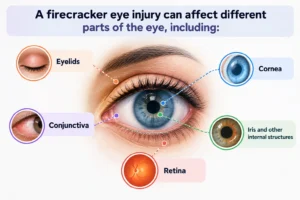
A firecracker eye injury can affect different parts of the eye, including:
- Eyelids: Burns, cuts, swelling and bruising.
- Cornea: Scratches, burns or damage to the transparent front surface of the eye.
- Conjunctiva: Irritation or injury to the thin membrane covering the white of the eye.
- Iris and other internal structures: Damage caused by impact or the force of an explosion.
- Retina: Internal injury that may affect vision, sometimes without obvious external damage.
The severity depends on the type of firecracker, the distance from the explosion, the material involved and the part of the eye affected. Therefore, a firecracker eye damage should not be judged by redness or swelling alone.
What Causes Eye Injury During Diwali?
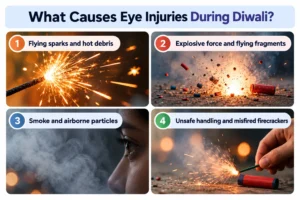
Several factors can contribute to eye injuries during festive celebrations. Understanding them helps families take appropriate precautions.
1. Flying sparks and hot debris
Firecrackers release hot particles that may strike the eyelids or the surface of the eye. Even a small spark can cause a burn or scratch, particularly when it comes into contact with the cornea.
Sparklers may appear harmless, but they can reach extremely high temperatures. Children should not be allowed to handle them unsupervised.
2. Explosive force and flying fragments
When a firecracker bursts close to the face, the force can injure the eye even if no large fragment is visible. Debris may also enter the eye or become embedded in its tissues.
This type of firecracker eye injury can be serious because damage may extend beyond the visible surface.
3. Smoke and airborne particles
Firecracker smoke contains particles and irritating substances that can affect the eyes. Exposure may lead to burning, watering, redness and discomfort, particularly when pollution levels are already high.
However, smoke irritation is not the same as a traumatic injury. Persistent symptoms, pain or blurred vision should not automatically be attributed to pollution.
4. Unsafe handling and misfired firecrackers
Leaning over a firecracker, holding it too close to the face or approaching a firecracker that has failed to ignite can expose the eyes to sudden explosions and debris.
Never attempt to relight a misfired firecracker. Move away and keep others at a safe distance.
What Are the Symptoms of a Firecracker Eye Injury?
The symptoms depend on the nature and severity of the injury. Some signs appear immediately, while others may become noticeable later.
Recognising the symptoms of a firecracker eye injury can help you decide whether emergency medical attention is necessary.
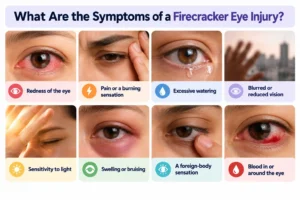
Common symptoms to watch for
- Redness of the eye: Redness may occur because of smoke exposure, irritation, inflammation or direct injury. Redness after a firecracker incident should be assessed alongside other symptoms rather than treated as proof of a minor problem.
- Pain or a burning sensation: Pain may indicate a scratch, burn or deeper injury. Severe or persistent pain requires urgent assessment.
- Excessive watering: The eye may produce more tears in response to smoke, dust or damage to its surface. Continuous watering after direct exposure to a firecracker should not be ignored.
- Blurred or reduced vision: Blurred vision, difficulty focusing or a sudden change in eyesight is a warning sign. Do not assume it will resolve on its own.
- Sensitivity to light: Bright light may become uncomfortable after an injury. This can occur with corneal damage or inflammation inside the eye.
- Swelling or bruising: The eyelids and surrounding tissues may swell following a burn or impact. Significant swelling, bruising or an injury near the eye warrants medical evaluation.
- A foreign-body sensation: You may feel as though sand or a small particle is trapped in the eye. Do not rub the eye or try to remove an embedded fragment yourself.
- Blood in or around the eye: Bleeding from a cut, blood visible inside the eye or a suspected puncture injury requires immediate medical attention.
When symptoms indicate an emergency
Seek emergency medical care immediately if a firecracker incident causes sudden vision loss, severe pain, an eye cut, a suspected penetrating injury, blood inside the eye or an object embedded in the eye.
Do not wait for all the symptoms to appear. A serious firecracker eye injury may not produce dramatic external signs.
Red Eyes Due to Smoke: Is It Always an Injury?
Not every case of eye redness during Diwali is caused by direct trauma. Smoke, dust and airborne pollutants can irritate the eye’s surface, leading to temporary discomfort.
People may experience red eyes due to smoke, watery eyes, a stinging sensation or mild irritation after spending time in an area with heavy firecracker smoke.
How does smoke affect the eyes?
The surface of the eye is protected by a tear film that helps keep it moist and comfortable. Smoke and airborne particles can disturb this protective layer, contributing to dryness, irritation and redness.
Common symptoms include:
- Mild burning or stinging.
- Watery eyes.
- Temporary redness.
- A gritty sensation.
- Discomfort that improves after leaving the smoky environment.
What about eye irritation due to pollution?
Eye irritation due to pollution may become more noticeable when firecracker smoke combines with dust and other airborne pollutants. People with dry eyes, allergies or existing eye conditions may experience greater discomfort.
If symptoms are mild and there has been no direct firecracker impact, moving away from the smoke and avoiding further exposure may help.
However, severe pain, light sensitivity, persistent redness or any change in vision requires medical evaluation. Do not assume that a red eye is simply reacting to pollution, especially after a firecracker has burst nearby.
Firecracker Eye Injury First Aid: What Should You Do Immediately?
The correct first aid depends on whether the problem is smoke irritation, loose dust, a chemical splash or a possible traumatic injury.
If an explosion, hot spark or flying fragment has struck the eye, treat it as a potential emergency.
Step 1: Move away from the source of danger
Help the injured person move to a safe location away from firecrackers, smoke and further explosions.
If the injured person is a child, keep them calm and avoid allowing them to touch or rub the affected eye.
Step 2: Do not rub or press the eye
Rubbing can worsen a scratch, push debris deeper into the tissue or increase damage to an injured eye.
Avoid pressing the eyelids or applying pressure to the eyeball, even if swelling or discomfort is present.
Step 3: Do not remove embedded objects
If a fragment appears stuck in the eye or an eye puncture is suspected, do not pull it out, use tweezers or attempt to inspect the wound closely.
Place a rigid protective shield over the injured eye if available, without allowing it to touch or press against the eye. A clean paper cup may be used as a temporary shield if it can be positioned safely.
Seek emergency medical care immediately.
Step 4: Know when rinsing is appropriate
This is an important distinction.
- Suspected blast injury, puncture, embedded debris or severe trauma: Do not rinse the eye. Protect it without pressure and seek emergency care.
- Chemical exposure or a suspected chemical splash: Immediately flush the eye with plenty of clean, lukewarm running water or sterile saline while arranging urgent medical care. Do not delay irrigation while trying to identify the substance.
- Loose dust or a small particle without signs of serious trauma: Gentle rinsing with clean water or sterile saline may help. If pain, redness or the sensation of something trapped in the eye persists, obtain medical assessment.
These situations require different responses. When the cause is uncertain and a serious injury is possible, seek urgent professional guidance rather than experimenting with home treatment.
Step 5: Avoid home remedies and unprescribed eye drops
Do not put rose water, milk, ghee, honey or other household substances into an injured eye. Avoid applying ointments or using leftover prescription eye drops unless a clinician instructs you to do so.
Some drops may be inappropriate for an injury and can delay correct treatment.
Step 6: Get medical help without delay
A suspected firecracker eye injury requires prompt evaluation, even if the person can still see or the external injury looks small.
Do not wait until the next morning to see whether symptoms improve. If the injury appears serious, go directly to an emergency department capable of assessing eye trauma.
What Should You Avoid After a Firecracker Eye Injury?
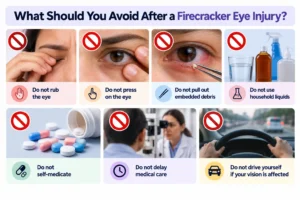
Well-intentioned actions can sometimes make an eye injury worse. Avoid these common mistakes:
- Do not rub the eye: This may increase tissue damage.
- Do not press on the eye: Pressure can worsen a serious injury.
- Do not pull out embedded debris: Removal should be handled by a medical professional.
- Do not use household liquids: These are not safe substitutes for appropriate eye irrigation or treatment.
- Do not self-medicate: Avoid unprescribed drops, ointments and home remedies.
- Do not delay medical care: An apparently minor injury may involve internal structures.
- Do not drive yourself if your vision is affected: Ask someone to assist you or use emergency transport if needed.
Following appropriate eye injury first aid can help prevent further harm while the injured person receives medical assessment.
How Do Doctors Diagnose a Firecracker Eye Injury?
The examination depends on the suspected mechanism of injury, symptoms and findings. The ophthalmologist will assess the eye carefully to identify the extent of damage and determine the treatment required.
1. Medical history and symptom assessment
The doctor may ask what type of firecracker was involved, how close the explosion occurred, when the injury happened and whether vision changed immediately afterwards.
Information about previous eye conditions, surgery, medications and allergies may also be relevant.
2. Vision assessment
The doctor may check visual acuity in each eye, provided the nature of the injury allows the examination to be performed safely.
Any reduction in vision helps guide further evaluation.
3. Examination of the eye’s surface
Depending on the injury, the ophthalmologist may use specialised lighting and magnification to examine the cornea, conjunctiva and eyelids for scratches, burns, foreign material or other damage.
4. Examination of internal eye structures
When appropriate and safe, the doctor may examine the internal structures of the eye, including the retina.
Imaging or other investigations may be needed if an internal injury or retained foreign body is suspected.
The priority is to identify potentially sight-threatening damage and begin appropriate treatment promptly.
How Is a Firecracker Eye Injury Treated?
Treatment varies according to the part of the eye affected and the severity of the injury. There is no single treatment suitable for every case.
Mild surface irritation
When an examination confirms that symptoms are due to uncomplicated irritation without a significant injury, a clinician may recommend appropriate lubricating drops or other supportive care.
Avoid self-diagnosing a firecracker eye injury as simple irritation without considering the circumstances and symptoms.
Corneal scratches or burns
Injuries involving the cornea may require prescribed medication, close monitoring or additional treatment, depending on their extent.
Chemical burns require immediate irrigation followed by urgent medical evaluation.
Eyelid cuts and facial burns
Cuts or burns around the eye may need wound care, specialist treatment or repair. The doctor will also assess whether the eye itself has been affected.
Internal eye injuries
More severe trauma may require specialised treatment or surgery. Injuries involving the retina or other internal structures can threaten sight and need urgent assessment.
Recovery depends on the injury’s location, severity and response to treatment. Early medical attention can help identify complications, but it cannot guarantee that vision will return to normal in every case.
Can a Firecracker Eye Injury Cause Permanent Vision Loss?
Yes. Severe injuries can cause permanent vision impairment, particularly when the cornea, retina or other internal structures are damaged.
Possible complications include corneal scarring, infection, bleeding inside the eye, retinal damage and other structural injuries. Some patients require surgery, while others may experience lasting changes in vision.
Not every injury leads to permanent damage. Smoke-related irritation and some minor surface injuries may resolve with appropriate care. However, it is not possible to reliably distinguish a minor problem from a serious injury based on appearance alone.
This is why prompt medical assessment is important whenever a firecracker strikes the eye or symptoms suggest significant damage.
How to Prevent Firecracker Eye Injuries During Diwali?
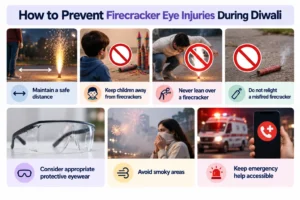
Prevention is the most effective way to reduce the risk of eye trauma during celebrations.
Follow these practical precautions
- Maintain a safe distance: Stand well away from the area where firecrackers are being lit. Follow the safety instructions provided with fireworks and any local restrictions.
- Keep children away from firecrackers: Children should never be allowed to light firecrackers without appropriate adult supervision. The safest option is to keep them away from the firing area.
- Never lean over a firecracker: Light it according to its safety instructions and move away immediately. Never hold a firecracker close to your face.
- Do not relight a misfired firecracker: A firecracker that fails to ignite may still explode unexpectedly. Do not approach or handle it.
- Consider appropriate protective eyewear: If you are in a setting where fireworks are being handled, use suitable protective eyewear and follow established safety guidance. Ordinary prescription glasses or sunglasses should not be assumed to provide adequate protection against fireworks.
- Avoid smoky areas: Move indoors or to a cleaner-air environment when smoke becomes heavy. This can reduce exposure that contributes to irritation.
- Keep emergency help accessible: Know where to seek urgent medical care before celebrations begin, especially if children, older adults or people with existing eye conditions will be present.
The safest approach is to avoid handling firecrackers and watch professional displays from a designated safe area.
When Should You Visit an Eye Hospital in Noida?
If a firecracker has struck your eye, caused a burn or left you with sudden changes in vision, seek emergency medical attention immediately.
You should not wait for a routine appointment if you experience severe pain, bleeding, a suspected puncture, sudden blurred vision, flashes, new floaters or a curtain-like shadow across your vision.
For less urgent concerns, such as persistent redness, watering, discomfort or irritation after Diwali, arrange an eye examination if symptoms do not settle or you are uncertain about their cause.
People searching for an eye hospital in Noida should prioritise access to appropriate emergency assessment and ophthalmic care. An eye specialist in Noida can evaluate ongoing symptoms and advise on suitable treatment or follow-up, depending on the injury.
It is also worth remembering that routine eye conditions and emergency eye trauma require different care pathways. Services such as cataract surgery in Noida address a different eye-health need and should not be confused with emergency treatment for firecracker injuries.
Frequently Asked Questions (FAQs)
1. What should I do if a firecracker hits my eye?
Do not rub, press or attempt to clean a potentially injured eye. Do not remove embedded debris or rinse a suspected blast or penetrating injury. Protect the eye without pressure and seek emergency medical care immediately.
2. Can firecracker smoke cause red eyes?
Yes. Smoke and airborne particles can irritate the eye’s surface, causing redness, burning and watering. However, redness after a firecracker incident can also indicate an injury, so pain, light sensitivity or blurred vision should be assessed urgently.
3. Should I wash my eyes after a firecracker injury?
It depends on the cause. Chemical exposure requires immediate irrigation with clean running water or sterile saline. A suspected blast injury, puncture or embedded object should not be rinsed; protect the eye and seek emergency care. For loose dust without signs of trauma, gentle rinsing may help.
4. Can a firecracker eye injury heal on its own?
Some mild irritation may settle after exposure ends. However, a traumatic injury should not be assumed to heal without treatment. Even if the symptoms seem manageable, an examination may be necessary to rule out damage to the eye’s surface or internal structures.
5. Can an eye injury from a sparkler be serious?
Yes. Sparklers produce intense heat, and hot particles can burn the eyelids or eye surface. Any direct contact with the eye, persistent pain or change in vision requires prompt medical assessment.
6. When should I seek emergency eye care?
Seek immediate care for sudden vision changes, severe pain, bleeding, an embedded object, a cut or suspected puncture, or signs of retinal injury such as flashes, new floaters or a curtain-like shadow.
7. Can pollution cause eye irritation during Diwali?
Yes. Smoke and airborne pollutants can cause redness, watering, burning and dryness. Move away from the polluted environment and avoid rubbing your eyes. Seek medical advice if symptoms are persistent, severe or associated with changes in vision.
8. Where can I find an eye specialist in Noida after a firecracker injury?
Look for a hospital or emergency department that can assess eye trauma promptly. For a suspected serious injury, do not delay care while comparing facilities or waiting for a routine appointment. Confirm the availability of emergency ophthalmic services where possible.
Conclusion
Diwali should be remembered for its celebrations, not an avoidable eye emergency. Firecrackers can cause burns, scratches, internal trauma and, in severe cases, permanent vision loss. Smoke can also cause irritation, but it is important not to mistake a serious injury for a minor reaction to pollution.
If a firecracker strikes the eye, avoid rubbing or pressing it, do not attempt to remove embedded debris, and seek urgent medical assessment. Chemical exposure requires immediate irrigation, while suspected blast or penetrating injuries need protection without pressure and emergency care.
Simple precautions, responsible supervision and timely treatment can make a meaningful difference. If you or someone in your family experiences eye pain, persistent redness or a change in vision during Diwali, take the symptoms seriously and seek appropriate medical help.
Celebrate safely. Protect your vision. Never delay care for a suspected eye injury.