Acne may be gone, but the evidence it left behind can stay on your skin for much longer.
You may notice a brown or red spot where a pimple used to be. Or perhaps you can feel a small depression, uneven texture, or raised area when you run your fingers over your skin. It is easy to look at both and call them “acne scars.”
But there is an important difference.
A flat dark or red spot left behind after a pimple is often a post-acne mark, not a true scar. True acne scars involve changes to the structure of the skin, usually because inflammation has damaged collagen during the healing process.
Knowing which one you have matters because the treatment is different. A mark may gradually fade with time and appropriate skincare, while an indented or raised scar usually needs a dermatologist-guided treatment plan.
What Are Post-Acne Marks?
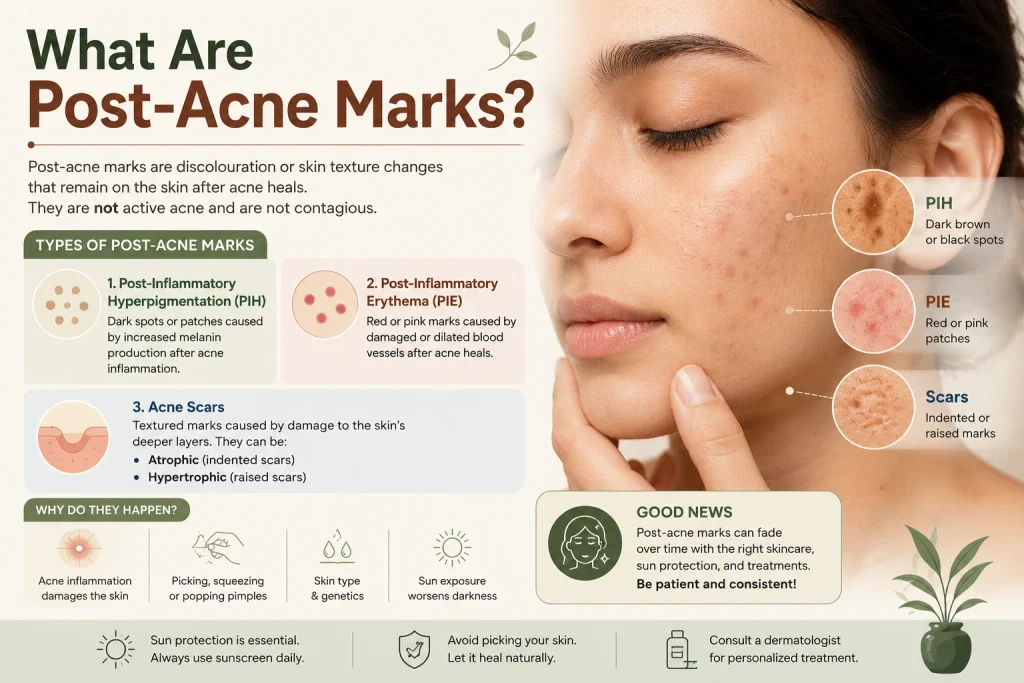
Post-acne marks are areas of discoloration that remain after an acne lesion has healed. One of the most common types is post-inflammatory hyperpigmentation (PIH).
PIH happens when inflammation from acne stimulates increased melanin production during the skin’s healing process. The result can be a flat brown, dark, purple, or sometimes bluish-gray spot, depending on your skin tone. People with medium to darker skin tones are particularly likely to notice post-inflammatory hyperpigmentation after acne.
People with lighter skin may instead notice a pink or red area after a breakout, sometimes called post-inflammatory erythema.
The important clue is texture.
If the area is completely flat and only the color has changed, it is more likely to be a post-acne mark than a true acne scar.
These marks can fade on their own, although the process may take months and, in some cases, longer. Sun exposure can also make discoloration more noticeable, which is why sun protection is an important part of managing post-acne marks.
What Are True Acne Scars?
True acne scars are different because they involve a change in the structure or texture of the skin.
When deep or inflamed acne damages the skin, the body begins a wound-healing process. Collagen plays an important role in this process. If too little collagen is produced, the skin can heal with a depression. If too much scar tissue develops, a raised scar may form.
This can leave behind:
- Depressed or pitted areas
- Uneven skin texture
- Raised areas of scar tissue
- Changes that remain even after the discoloration fades
The most common depressed acne scars include ice-pick, boxcar, and rolling scars. Raised scars, including hypertrophic scars and keloids, can also occur, particularly in certain areas and in people who are more prone to this type of scarring.
Unlike a flat post-acne mark, a true scar generally does not disappear simply because the pigmentation fades.
Post-Acne Marks vs. Acne Scars: What’s the Difference?
The easiest way to understand the difference is to look at color and texture.
The two can also occur at the same time. You may have a flat dark spot over an area that also has an indentation. In that situation, both pigmentation and textural scarring may need to be addressed.
| Feature | Post-Acne Marks | True Acne Scars |
| What you see | Flat red, pink, brown, or dark spots | Depressions, pits, uneven texture, or raised areas |
| Texture | Usually completely flat | Usually changes the skin’s texture |
| Main cause | Inflammation and changes in pigmentation | Damage to collagen and the skin’s healing process |
| Do they fade? | Often fade gradually | Usually do not completely disappear on their own |
| Treatment | Skincare, sun protection, and selected dermatological treatments | Often requires professional procedures |
| Common examples | Post-inflammatory hyperpigmentation (PIH), post-inflammatory redness | Ice-pick, boxcar, rolling, hypertrophic or keloid scars |
Why Does Acne Leave Marks or Scars?
Not every pimple leaves a lasting reminder. The risk depends on several factors, including the severity and duration of inflammation and how the acne is treated.
Deep, painful acne such as nodules and cysts is more likely to result in scarring because the inflammation can extend deeper into the skin. Picking, squeezing, or scratching pimples can also increase inflammation and the risk of discoloration and scarring.
There is also an individual component. Some people are simply more prone to developing acne scars based on their skin’s healing response and family history.
Factors that can increase the risk include:
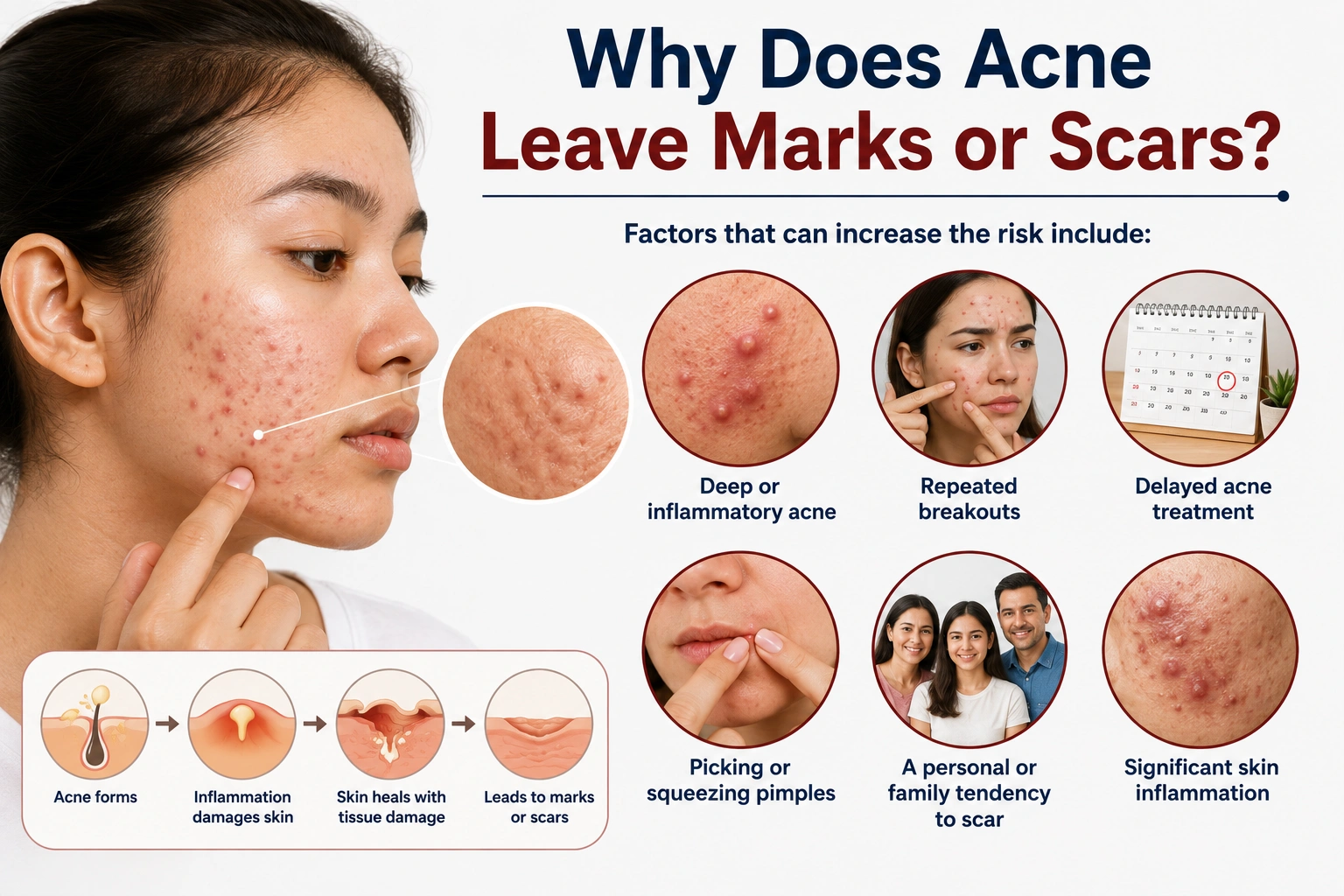
- Deep or inflammatory acne
- Repeated breakouts
- Delayed acne treatment
- Picking or squeezing pimples
- A personal or family tendency to scar
- Significant skin inflammation
How Can You Tell What You Have?
Take a close look at the area in natural light.
If it is flat: A brown, red, pink, or dark spot with no change in texture is more likely to be a post-acne mark.
If it is indented: A visible dip or small depression may indicate an atrophic acne scar.
If it is raised: A firm or elevated area may be a raised acne scar, such as a hypertrophic scar or keloid.
If you’re not sure: A dermatologist can examine the skin and determine whether you are dealing with pigmentation, redness, scarring, active acne, or a combination of these.
That distinction is important because treating pigmentation as though it were a scar, or treating a scar with products designed only for pigmentation, may not give you the results you expect.
Can Post-Acne Marks Go Away on Their Own?
Often, yes.
Post-inflammatory hyperpigmentation usually becomes lighter over time as the skin naturally clears the excess pigment. However, the process can be slow. Some dark spots can remain for many months or longer, particularly when the pigmentation is deeper or the skin continues to experience inflammation.
Daily sun protection is particularly important because ultraviolet exposure can make pigmentation more noticeable and prolong uneven skin tone.
Depending on your skin and the severity of the discoloration, a dermatologist may also recommend topical treatments or procedures to help improve pigmentation.
Potential options may include:
- Azelaic acid
- Retinoids
- Alpha hydroxy acids
- Other pigment-targeting treatments
- Chemical peels
- Selected laser or light-based treatments
Can True Acne Scars Go Away on Their Own?
True acne scars are more persistent.
The discoloration around a scar may fade with time, making the scar look less noticeable. But if the skin has developed a permanent depression or raised area, the underlying structural change generally remains.
That does not mean acne scars cannot be improved.
Dermatologists may use different procedures depending on the type and depth of the scar. Treatment can include approaches such as laser resurfacing, microneedling, chemical peels, fillers, steroid injections for selected raised scars, or other procedures. There is no single treatment that works best for every type of acne scar.
The key is matching the treatment to the scar.
For example, an ice-pick scar is structurally different from a rolling scar, so the same procedure may not be equally effective for both.
Treatment Options: Marks vs. Scars
| Skin Concern | Common Approach | Main Goal |
| Flat dark marks | Sun protection + topical treatments | Reduce excess pigmentation |
| Post-acne redness | Acne control + appropriate skincare | Allow redness to gradually settle |
| Mild uneven texture | Dermatologist-guided skincare or procedures | Improve surface texture |
| Ice-pick scars | Selected procedural treatments | Reduce the appearance of deep pits |
| Boxcar scars | Resurfacing or other scar-directed procedures | Improve depressed areas |
| Rolling scars | Procedures selected according to scar depth and tethering | Smooth uneven texture |
| Raised acne scars | Medical treatments such as steroid injections or other scar therapies | Flatten and soften raised tissue |
Why Sun Protection Matters?
Sunscreen is not just something to think about during a beach holiday.
UV exposure can make existing pigmentation more noticeable and increase the contrast between affected and unaffected skin. Regular sun protection can therefore be an important part of managing post-acne discoloration.
Choose a broad-spectrum sunscreen appropriate for your skin and use it consistently. Your dermatologist can also help you choose products that fit your skin type and acne-prone skin.
When Should You See a Dermatologist?
You do not necessarily need medical treatment for every mark left behind by a pimple. But professional advice can be helpful when you cannot tell whether you have pigmentation or scarring, or when the problem is not improving.
A dermatologist can assess both your active acne and the changes it has left behind, then build a treatment plan around your skin type and specific concern.
Consider seeing a dermatologist if:
- Dark marks are persistent or increasing.
- Acne continues to cause new marks.
- You have visible depressions or raised scars.
- Your acne is painful, deep, or recurring.
- You have tried skincare without meaningful improvement.
- Pigmentation is affecting your confidence.
- You are considering chemical peels, lasers, microneedling, or other procedures.
Conclusion
If you have a brown, red, or dark spot after acne, don’t automatically call it a scar.
If the area is completely flat and only the color has changed, it is more likely to be a post-acne mark such as post-inflammatory hyperpigmentation. These marks often fade gradually visit best hospital in Noida.
If you can see or feel a depression, pit, uneven texture, or raised area, you may be dealing with a true acne scar. These scars are more persistent and often require targeted dermatological treatment. The good news is that both concerns can be managed. The first step is simply knowing which one you’re treating.
Frequently Asked Questions
1. Are post-acne marks the same as acne scars?
No. Post-acne marks are usually flat areas of discoloration caused by inflammation and changes in pigmentation. True acne scars involve structural changes in the skin, such as depressions or raised scar tissue.
2. How long do post-acne marks take to fade?
They can gradually fade over several months, although some may take much longer. Consistent sun protection and appropriate treatment can help reduce their appearance.
3. Can acne scars disappear completely?
True acne scars usually do not disappear completely on their own. However, dermatological treatments can make many scars significantly less noticeable, depending on their type and severity.
4. Does picking pimples cause acne scars?
Picking, squeezing, or scratching acne can increase inflammation and skin damage, raising the risk of both discoloration and scarring. Leaving acne alone and treating it appropriately is generally a safer approach.
5. What is the best treatment for acne scars?
There is no single best treatment for every acne scar. Treatment depends on whether the scars are ice-pick, boxcar, rolling, raised, or mixed, as well as your skin type and severity of scarring.