Acne is easy to blame on skincare, stress, food or simply having “bad skin days.” But what if your skin is telling you something about what is happening inside your body?
For some women, persistent or difficult-to-treat acne can be linked to hormonal changes associated with polycystic ovary syndrome (PCOS). This is a hormonal and metabolic condition that can affect periods, ovulation, androgen levels, skin, hair and fertility. Acne can be one of its symptoms, particularly when it occurs alongside other signs of hormonal imbalance.
That does not mean every breakout is PCOS.
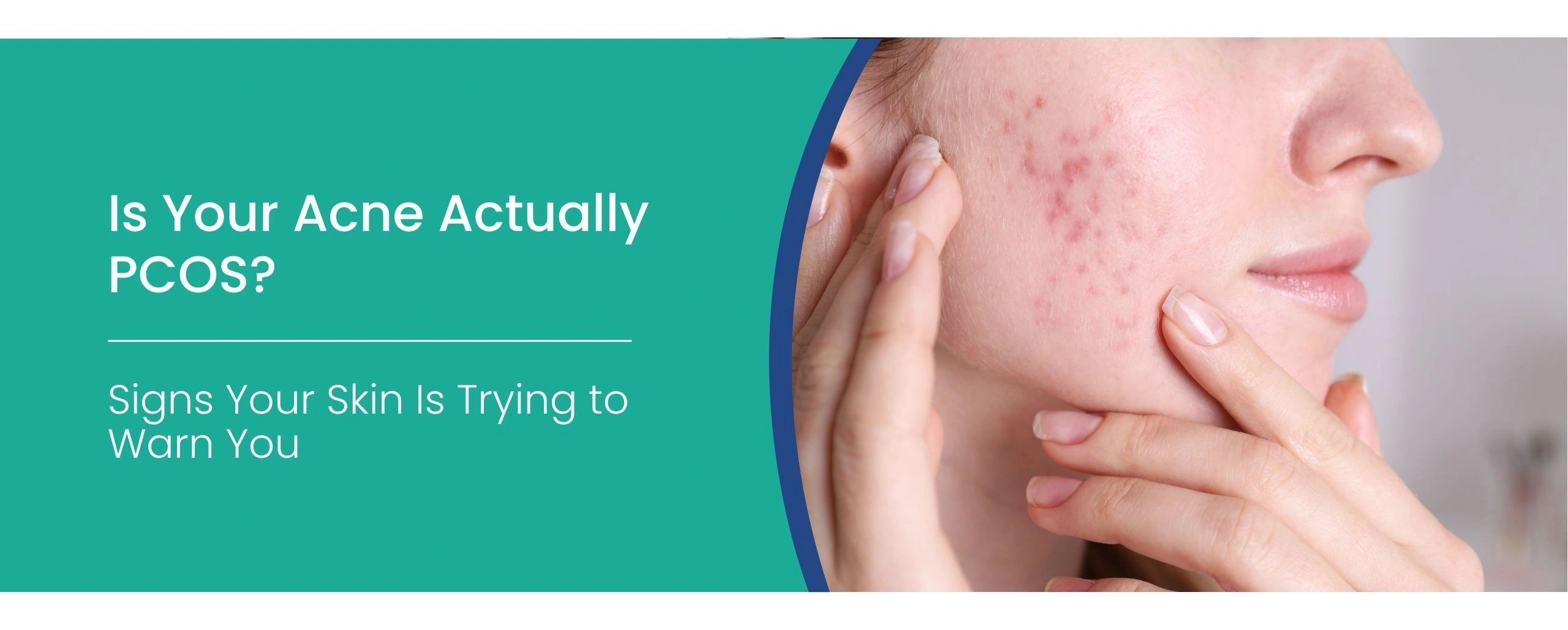
Acne is extremely common and can have many causes. But if your acne keeps returning, becomes difficult to control, or appears alongside irregular periods, unwanted facial hair, scalp hair thinning or darkened skin patches, it may be worth looking beyond your skincare routine.
What Does PCOS Have to Do With Acne?
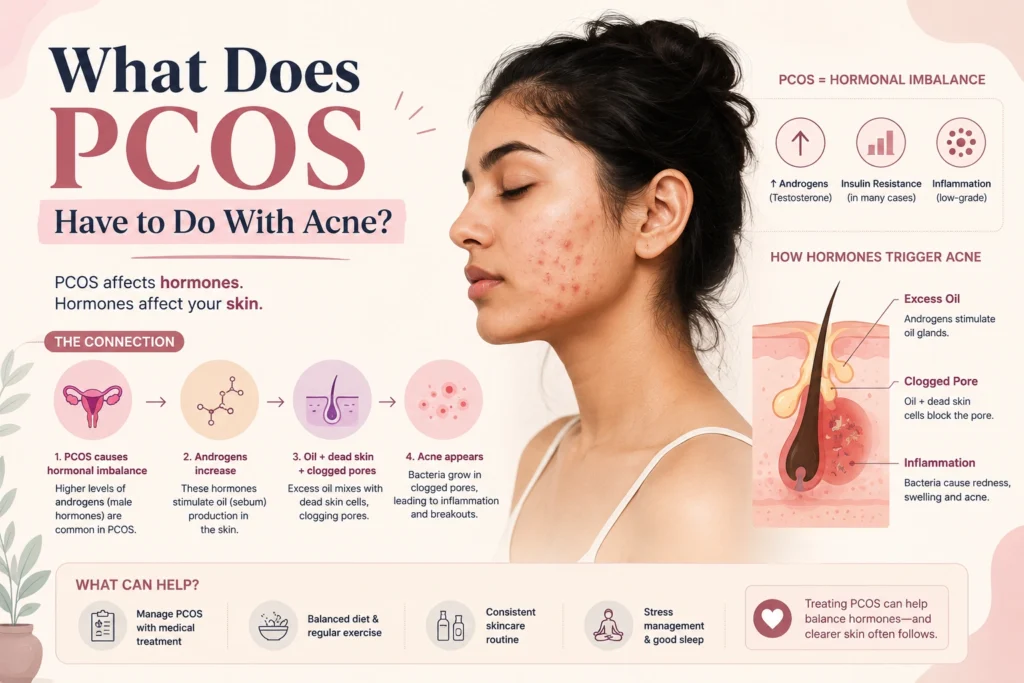
Hormones called androgens, which include testosterone, play an important role in PCOS. Higher androgen activity can stimulate the skin’s oil glands, increasing sebum production and contributing to clogged pores and inflammation. This can result in acne that is persistent or more difficult to manage.
Hormonal acne may appear on the face, chest, back or shoulders. In people with PCOS, breakouts can be particularly noticeable around the lower face, including the chin and jawline, although acne location alone cannot diagnose this condition.
The bigger clue is often what is happening alongside the acne.
Is Acne Alone a Sign of PCOS?
No. This is one of the most important things to understand.
Having acne does not automatically mean you have PCOS. Acne can be related to genetics, normal hormonal fluctuations, stress, certain medicines, skincare products and other factors.
PCOS is diagnosed based on a broader pattern of symptoms, medical history, examination and, when needed, laboratory tests or ultrasound. Depending on age and circumstances, clinicians generally look for features such as irregular ovulation or periods, signs or laboratory evidence of androgen excess, and polycystic ovarian morphology after other possible causes have been considered.
So instead of asking: “Do I have acne, therefore do I have PCOS?”
A better question is: “Do I have acne along with other signs that could point to hormonal imbalance?”
7 Signs Your Acne May Be Part of a Bigger Hormonal Picture
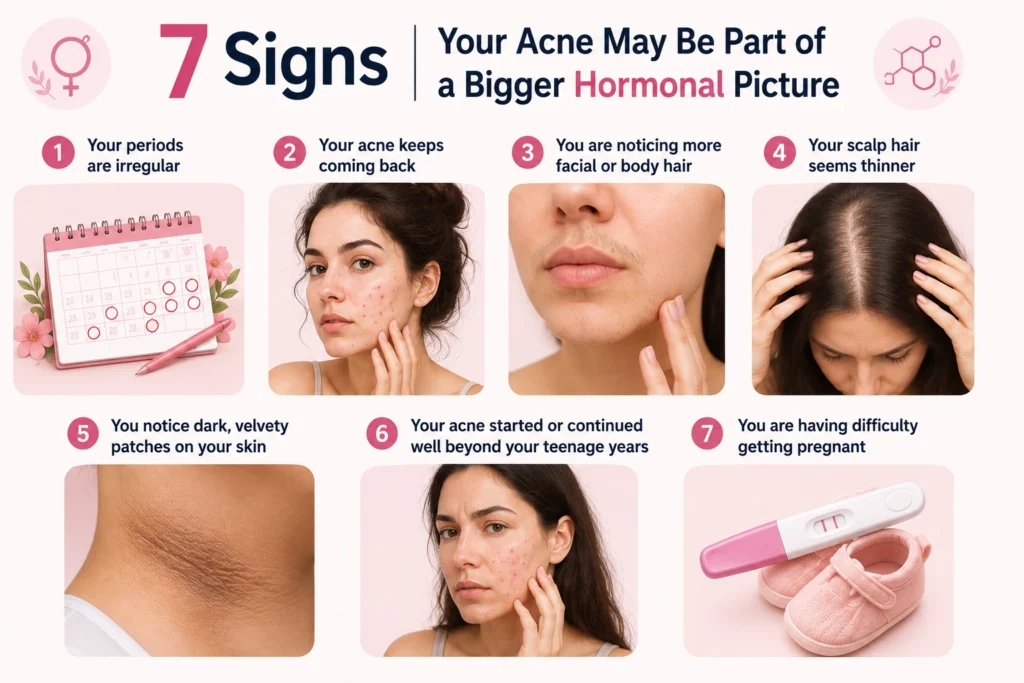
Acne becomes more worth discussing with a healthcare professional when it is accompanied by other changes in your body.
1. Your periods are irregular
One of the most noticeable signs is can be changes in the menstrual cycle.
You may notice that your periods:
- Come very late
- Are frequently missed
- Are unpredictable
- Occur much less often than expected
- Have changed significantly from your usual pattern
Irregular periods can have many causes, so they do not automatically mean PCOS. But when menstrual changes occur together with persistent acne or other signs of androgen excess, they deserve medical evaluation.
2. Your acne keeps coming back
You may have tried cleansers, spot treatments, facials or different skincare routines, yet the acne keeps returning.
Hormonal acne can be persistent because the underlying hormonal influence may continue even when the surface of the skin is being treated.
That doesn’t mean acne products are useless. It simply means that persistent acne may sometimes require looking at more than the skin itself.
3. You are noticing more facial or body hair
Another important sign of higher androgen activity is hirsutism, or increased coarse hair growth in areas such as the face, chest or abdomen.
You might notice:
- More hair on the chin
- Hair appearing around the upper lip
- Increased chest or abdominal hair
- Hair becoming thicker or darker than before
Acne and excess hair growth occurring together can be more suggestive of androgen excess than acne alone.
4. Your scalp hair seems thinner
It can also be associated with androgen-related hair changes.
If you are noticing gradual thinning on the scalp while simultaneously experiencing facial hair growth or persistent acne, tell your doctor. Looking at the combination of symptoms can be more informative than looking at any one symptom in isolation.
5. You notice dark, velvety patches on your skin
Have you noticed darker or thicker-looking skin around your neck, underarms or other skin folds?
This can sometimes be acanthosis nigricans, a skin change associated with insulin resistance. Insulin resistance can occur in people, although it is not exclusive to PCOS.
A skin change like this does not confirm this treatment. It is simply another reason to speak with a healthcare professional, especially when it appears alongside menstrual changes or other hormonal symptoms.
6. Your acne started or continued well beyond your teenage years
Adult acne is common and does not automatically indicate a hormonal disorder.
However, acne that persists into adulthood, particularly when it is severe or difficult to treat, can sometimes occur alongside hormonal conditions such as PCOS.
The important clue is not your age alone. It is the overall pattern of symptoms.
7. You are having difficulty getting pregnant
PCOS can interfere with ovulation, which can make conception more difficult for some women.
If you are experiencing fertility difficulties together with irregular periods, acne or signs of androgen excess, your doctor may consider PCOS as part of the evaluation. PCOS is one of the common causes of infertility related to ovulatory dysfunction.
Acne vs PCOS-Related Acne: What Should You Look For?
There is no single appearance of acne that can confirm PCOS. Still, certain patterns may prompt you to discuss hormonal causes with a doctor.
| Acne pattern | What it may suggest |
| Occasional pimples | Common acne; may have many possible causes |
| Acne that appears around your period | Hormonal fluctuations may be contributing |
| Persistent acne despite appropriate skincare | May need assessment for hormonal or other contributing factors |
| Deep, painful or cystic breakouts | May require medical acne treatment |
| Lower-face or jawline acne with other hormonal symptoms | Consider discussing possible hormonal causes |
| Acne plus irregular periods | Worth discussing with a healthcare professional |
| Acne plus excess facial hair | May indicate androgen excess and needs evaluation |
Remember: the appearance or location of acne cannot diagnose PCOS by itself. A healthcare professional needs to consider your complete history and other symptoms.
How Is PCOS Diagnosed?
There isn’t one single test that says, “You have PCOS.”
A physical examination may also look for signs such as acne, excess hair growth or skin changes. Depending on your symptoms, your doctor may recommend blood tests and, in some situations, an ultrasound.
Your doctor may begin by asking about your:
- Menstrual cycle
- Acne and skin changes
- Hair growth
- Scalp hair changes
- Weight and metabolic health
- Medications
- Fertility history
- Family history
What tests may be involved?
| Assessment | Why it may be considered |
| Medical and menstrual history | Helps identify irregular ovulation or periods |
| Physical examination | May help assess androgen levels and rule out other causes |
| Blood glucose/metabolic assessment | May be considered because PCOS can be associated with metabolic problems |
| Pelvic ultrasound | May be used when clinically appropriate to assess ovarian morphology or other causes |
Not everyone with PCOS has the same symptoms, and you do not need to have ovarian cysts to have PCOS. This is a common misconception. The diagnosis is based on a combination of features rather than one ultrasound finding.
What If I Have PCOS-Related Acne?
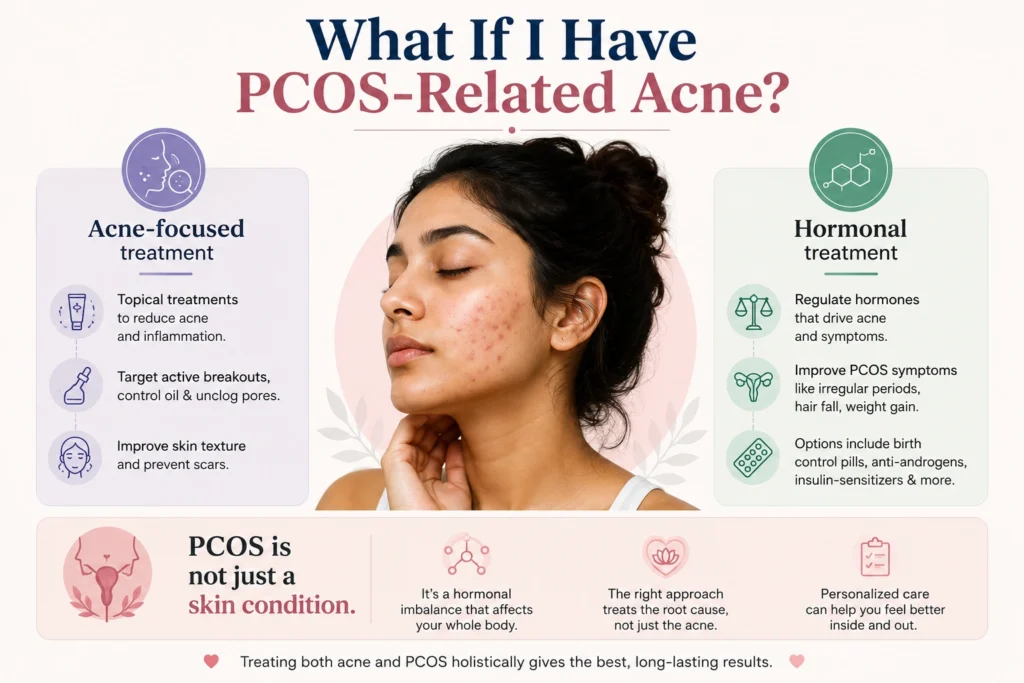
The good news is that you do not have to simply live with it.
Treatment depends on your symptoms, overall health, severity of acne and whether you are planning a pregnancy. Your doctor may recommend skincare and acne medicines, hormonal treatment, metabolic management or a combination of approaches.
Acne-focused treatment
Depending on the type and severity of acne, treatment may include topical medicines such as benzoyl peroxide or prescription retinoids. More significant acne may require additional medical treatment.
Hormonal treatment
Certain hormonal contraceptives may help regulate periods and improve acne for some people with PCOS. Anti-androgen medicines may also be considered in selected patients. These treatments are not suitable for everyone and should only be used after discussing your medical history and pregnancy plans with a healthcare professional.
Managing the bigger picture
PCOS is not just a skin condition.
For some people, it is associated with insulin resistance and an increased risk of metabolic problems. Treatment therefore focuses not only on visible symptoms such as acne, but also on menstrual health, metabolic health, fertility goals and long-term wellbeing.
Should You See a Dermatologist or a Gynaecologist?
Sometimes, you may benefit from both.
A dermatologist can assess persistent, painful or scarring acne and recommend appropriate skin treatment. A gynaecologist or other qualified healthcare professional can evaluate menstrual irregularities, androgen-related symptoms and the possibility of PCOS.
The right starting point depends on your symptoms.
If your acne is accompanied by irregular periods, increased facial hair, scalp hair thinning or other hormonal changes, don’t treat the skin in isolation. Tell your doctor about the full pattern.
Can You Have PCOS Without Acne?
Absolutely.
Acne is only one possible sign of PCOS. Some people with PCOS may have irregular periods or other signs of androgen excess without significant acne. Others may have different combinations of symptoms.
That is why PCOS should not be diagnosed, or ruled out, based on your skin alone.
Can You Have Acne Without PCOS?
Yes.
This is equally important.
Most people with acne do not automatically have PCOS. Acne can occur because of normal hormonal changes, genetics, skincare products, medications and other factors.
So if you have acne but your periods are regular and you have no other signs of hormonal imbalance, PCOS may not be the explanation.
A proper evaluation is more useful than trying to diagnose yourself from a mirror or an online symptom checklist.
Frequently Asked Questions (FAQs)
Is jawline acne always a sign of PCOS?
No. Jawline and lower-face acne can be associated with hormonal changes, but its location alone cannot diagnose PCOS. Other symptoms and medical history need to be considered.
Can PCOS cause sudden acne?
Hormonal changes associated with PCOS can contribute to acne, but sudden acne can have many possible causes. If new or persistent acne appears with irregular periods, excess facial hair or other hormonal changes, speak with a healthcare professional.
Can treating PCOS improve acne?
It can. Some treatments used to manage PCOS may also improve acne, particularly when androgen activity is contributing to breakouts. The appropriate treatment depends on your symptoms and health needs.
Do I need an ultrasound to know if I have PCOS?
Not always. PCOS diagnosis is based on a combination of clinical features and appropriate investigations. An ultrasound may be used in some situations, but having polycystic-appearing ovaries is not required for everyone to receive a PCOS diagnosis.
Can PCOS cause acne after the teenage years?
Yes. PCOS can be associated with persistent or adult acne, particularly when androgen levels or activity contribute to increased oil production.
Does having acne mean I have high testosterone?
Not necessarily. Acne has many possible causes. Your doctor may consider hormone testing when your symptoms suggest androgen excess, but acne by itself does not prove that your testosterone level is high.
Conclusion
A stubborn breakout can be frustrating, especially when you feel like you’ve tried everything.
But sometimes, the most useful question isn’t: “Which acne product should I try next?”
It is: “What else is happening in my body?”
If acne is appearing alongside irregular periods, excess facial hair, scalp hair thinning, darkened skin patches or fertility concerns, it may be worth talking with a healthcare professional about whether a hormonal condition such as PCOS could be contributing.
And if it turns out not to be PCOS, that’s useful information too. You can then focus on finding the actual cause and the right treatment for your skin.
Your skin deserves attention. So does the health behind it.
If you are experiencing persistent acne along with menstrual or other hormonal changes, consult a qualified gynaecologist or dermatologist for an appropriate evaluation rather than self-diagnosing PCOS.