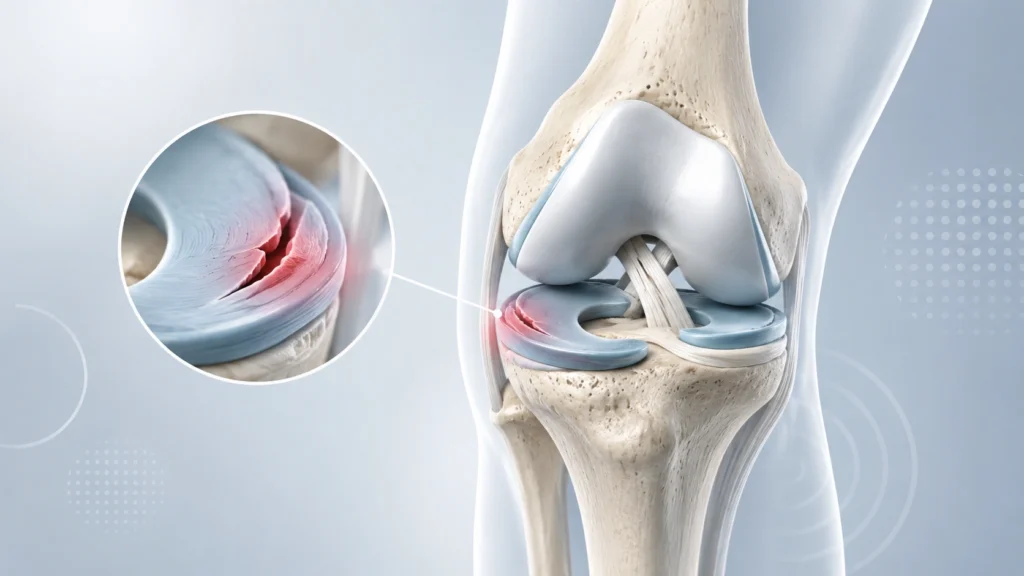
The meniscus is a C-shaped piece of tough, rubbery cartilage in the knee that acts as a shock absorber between the thigh bone and shin bone. Each knee has two menisci, one on the inner side and one on the outer side. They help stabilize the knee, distribute weight evenly, and allow smooth movement during walking, running, squatting, and twisting.
Meniscus injuries are among the most common knee problems seen in both young athletes and older adults. In younger people, the injury often happens during sports or sudden twisting movements. In older adults, the meniscus can tear more easily due to age-related wear and degeneration. A torn meniscus can cause pain, swelling, stiffness, locking, and difficulty fully straightening or bending the knee.
What is the Meniscus?
The meniscus is a wedge-shaped cartilage that sits between the femur and tibia in the knee joint. It is made of strong, flexible tissue that helps absorb shock and protect the joint surfaces.
Functions of the meniscus
- Absorbs impact during walking, running, and jumping.
- Distributes body weight evenly across the knee joint.
- Improves stability of the knee during movement.
- Reduces friction between bones.
- Helps in smooth bending and straightening of the knee.
Location in the knee
- Medial meniscus, which is on the inner side of the knee.
- Lateral meniscus, which is on the outer side of the knee.
- Both menisci work together to support knee function.
The meniscus has limited blood supply, especially in the inner portion. This affects how well different types of tears can heal on their own.
Types of Meniscus Tears
Meniscus tears can vary in size, shape, and location. The type of tear influences treatment options and recovery.
Common types of meniscus tears
- Longitudinal tear, which runs along the length of the meniscus.
- Radial tear, which goes from the inner edge toward the outer edge.
- Horizontal tear, which splits the meniscus into top and bottom layers.
- Flap tear, where a piece of meniscus becomes loose and can catch in the joint.
- Bucket-handle tear, a large tear where a fragment flips into the joint and may cause locking.
- Complex tear, which involves multiple patterns and is often seen in older adults.
- Degenerative tear, which happens due to wear and tear over time.
Location-based classification
- Tears in the outer third, which have better blood supply and may heal better.
- Tears in the middle third, with moderate healing potential.
- Tears in the inner third, which have poor blood supply and often do not heal on their own.
Understanding the type and location of the tear helps doctors decide whether repair or partial removal is more suitable.
Causes of Meniscus Injuries
Meniscus injuries can happen due to sudden trauma or gradual wear and tear.
Common causes in younger people
- Sudden twisting of the knee while the foot is planted.
- Deep squatting with rotation.
- Sports injuries during football, basketball, tennis, or cricket.
- Pivoting or changing direction quickly.
- Direct impact to the knee during contact sports.
- Landing awkwardly after a jump.
Common causes in older adults
- Degenerative changes in the meniscus due to aging.
- Minor twisting or bending during daily activities.
- Squatting to pick up objects or use the toilet.
- Getting up from a low seat with a twist.
- Walking on uneven surfaces.
- Pre-existing knee arthritis that weakens the meniscus.
Risk factors
- Age over forty increases degenerative tear risk.
- Participation in high-impact or contact sports.
- Previous knee injuries or ligament tears.
- Weak thigh muscles that reduce knee stability.
- Obesity, which increases load on the knee.
- Occupations involving frequent squatting or kneeling.
Symptoms of Meniscus Injury
Symptoms can vary depending on the size and location of the tear, as well as the patient’s age and activity level.
Common symptoms
- Pain along the inner or outer side of the knee.
- Swelling that develops over hours or days.
- Stiffness and difficulty fully bending or straightening the knee.
- A popping or clicking sensation at the time of injury.
- Feeling that the knee is catching or locking.
- Difficulty squatting or kneeling.
- Pain when twisting or rotating the knee.
- Tenderness when pressing along the joint line.
- A sense of instability or giving way.
Symptoms that suggest a significant tear
- Inability to fully straighten the knee.
- Recurrent locking or catching.
- Large or persistent swelling.
- Pain that does not improve with rest.
- Difficulty walking normally.
Symptoms in degenerative tears
- Gradual onset of pain rather than sudden injury.
- Mild to moderate swelling.
- Stiffness after sitting or resting.
- Pain with squatting, climbing stairs, or getting up from low seats.
- Symptoms that come and go over weeks or months.
Meniscus Injury in Different Age Groups
The pattern of meniscus injury often differs between younger and older patients.
In younger adults and athletes
- Often caused by sports or sudden twisting.
- More likely to have acute, traumatic tears.
- May be associated with ligament injuries such as ACL tears.
- Higher chance of repairable tears due to better tissue quality.
In middle-aged adults
- Mix of traumatic and degenerative tears.
- May occur during routine activities with a twist.
- Recovery may take longer due to early wear changes.
In older adults
- More likely to have degenerative tears.
- Often associated with knee arthritis.
- Symptoms may be mistaken for arthritis alone.
- Treatment focuses on pain relief and function rather than aggressive surgery in many cases.
How is Meniscus Injury Diagnosed?
Diagnosis is based on history, physical examination, and imaging tests.
Diagnostic steps
- Detailed history of how the injury happened.
- Description of symptoms such as pain, swelling, locking, or instability.
- Physical examination of the knee.
- Special tests to check for meniscus tear signs.
- Imaging to confirm the diagnosis and assess severity.
Physical examination findings
- Tenderness along the joint line.
- Pain with twisting or bending maneuvers.
- Swelling or fluid in the knee.
- Limited range of motion.
- Clicking or catching during movement.
Common tests that may be done
- X-ray to rule out bone problems or arthritis.
- MRI to visualize the meniscus and other soft tissues.
- Ultrasound in some cases to assess swelling or fluid.
- Clinical tests such as McMurray test or Apley grind test.
Why diagnosis matters: Accurate diagnosis helps distinguish meniscus tear from ligament injury, arthritis, or other knee problems. It also guides whether conservative treatment or surgery is more appropriate.
Treatment for Meniscus Injury
Treatment depends on the type of tear, symptoms, age, activity level, and presence of arthritis.
Initial conservative treatment
- Rest and activity modification.
- Ice application to reduce swelling.
- Compression bandage or knee support.
- Elevation of the leg when resting.
- Pain relief medicines as advised.
- Avoiding deep squatting, twisting, or high-impact activities initially.
Physiotherapy and rehabilitation
- Exercises to improve knee range of motion.
- Strengthening of thigh and hip muscles.
- Balance and proprioception training.
- Gradual return to normal activities.
- Guidance on safe movement patterns.
When conservative treatment is preferred
- Small, stable tears with mild symptoms.
- Degenerative tears in older adults without locking.
- Patients with minimal functional limitation.
- Those who improve with rest and therapy.
When surgery may be considered
- Large tears causing locking or inability to straighten the knee.
- Persistent pain and swelling despite conservative care.
- Young patients with traumatic tears.
- Tears associated with ligament injuries.
- Active individuals who need to return to sports.
Surgical Treatment Options
Surgery for meniscus injury is usually done using arthroscopy, which is a minimally invasive keyhole technique.
1. Meniscus repair
- The torn edges are stitched back together.
- Preferred for tears in the outer vascular zone.
- Common in younger patients with traumatic tears.
- Requires a period of protected weight-bearing and rehabilitation.
- Aims to preserve the meniscus and reduce long-term arthritis risk.
2. Partial meniscectomy
- The torn, unstable portion of the meniscus is trimmed away.
- The healthy remaining meniscus is preserved.
- Common for complex or inner zone tears.
- Faster recovery compared to repair in many cases.
- May increase long-term arthritis risk if too much meniscus is removed.
3. Meniscus transplant
- Considered in selected young patients with significant meniscus loss.
- Uses donor tissue to replace the damaged meniscus.
- Requires careful patient selection and rehabilitation.
- Not commonly needed for most patients.
4. Combined procedures
- Meniscus surgery may be done along with ACL reconstruction.
- Cartilage procedures may be added if there is joint surface damage.
- Arthritis management may be combined in older patients.
Recovery After Treatment
Recovery depends on the type of treatment, the extent of injury, and the patient’s overall health.
Recovery after conservative treatment
- Pain and swelling usually improve over weeks.
- Gradual return to normal activities.
- Continued strengthening and flexibility exercises.
- Avoidance of high-risk movements until fully recovered.
Recovery after meniscus repair
- Protected weight-bearing for several weeks.
- Use of brace or crutches as advised.
- Gradual increase in knee bending over time.
- Return to sports may take three to six months.
- Long-term focus on knee strength and protection.
Recovery after partial meniscectomy
- Weight-bearing as tolerated in many cases.
- Faster return to daily activities.
- Physiotherapy to restore motion and strength.
- Return to sports may take six to twelve weeks depending on progress.
Rehabilitation support
- Guided physiotherapy program.
- Home exercises for strength and flexibility.
- Advice on safe squatting, climbing, and sports techniques.
- Follow-up to monitor recovery and function.
Possible Complications
Most patients recover well, but complications can occur in some cases.
Complications without treatment
- Persistent pain and swelling.
- Recurrent locking or catching.
- Difficulty with daily activities.
- Increased risk of cartilage damage over time.
- Higher chance of developing knee arthritis.
Complications after surgery
- Infection, though rare.
- Stiffness or limited motion.
- Persistent pain in some cases.
- Re-tear or new tear in the future.
- Blood clots, though uncommon.
Long-term concerns
- Increased risk of arthritis if significant meniscus is lost.
- Need for activity modification in some patients.
- Possible need for future knee care or treatment.
When Should You See a Doctor?
Medical evaluation is important for persistent or severe knee symptoms.
- Knee pain after a twisting injury.
- Swelling that does not improve in a few days.
- Locking or catching in the knee.
- Inability to fully straighten the knee.
- Difficulty walking or bearing weight.
- Recurrent knee swelling without clear cause.
- Pain with squatting, climbing, or sports.
Prevention of Meniscus Injuries
Not all meniscus injuries can be prevented, but risk can be reduced.
- Warm up properly before sports or exercise.
- Strengthen thigh and hip muscles regularly.
- Use proper technique during sports and training.
- Avoid sudden twisting on a planted foot.
- Wear appropriate footwear for activities.
- Maintain a healthy weight to reduce knee load.
- Avoid deep squatting with heavy loads.
- Take breaks during activities involving repetitive kneeling.
For athletes
- Follow structured training programs.
- Include balance and agility drills.
- Allow adequate rest between intense sessions.
- Seek early care for knee pain rather than ignoring it.
Why Choose Rama Hospital for Meniscus Injury Treatment?
Meniscus injuries require accurate diagnosis, appropriate treatment selection, and structured rehabilitation. A hospital with experienced orthopedic surgeons, sports medicine specialists, and physiotherapy support can make a major difference in outcomes.
- Expert evaluation by orthopedic and sports medicine specialists.
- Advanced imaging for accurate diagnosis.
- Minimally invasive arthroscopic surgery when needed.
- Structured physiotherapy and rehabilitation programs.
- Long-term follow-up for knee health and function.
- Coordinated care for associated ligament or cartilage issues.
Frequently Asked Questions (FAQs)
Is surgery always needed for meniscus tear?
No, surgery is not always needed. Many patients improve with rest, medicines, and physiotherapy. Surgery is considered for large tears, locking symptoms, or when conservative treatment does not help.
How long does recovery take after meniscus surgery?
Recovery time varies based on the procedure. After partial meniscectomy, many patients return to normal activities in a few weeks. After meniscus repair, recovery may take three to six months with protected rehabilitation.
Can I walk with a meniscus tear?
Many people can walk with a meniscus tear, but it may be painful or cause limping. If the knee is locked or very painful, walking may be difficult. Medical evaluation helps determine safe activity levels.
Will a meniscus tear cause arthritis?
A significant meniscus tear, especially if a large portion is lost, can increase the risk of knee arthritis over time. Preserving the meniscus through repair when possible helps reduce this risk.
Can old meniscus injuries cause problems later?
Yes, old or untreated meniscus injuries can lead to persistent pain, swelling, or increased arthritis risk. Some people develop symptoms years after the initial injury, especially with high activity or age-related changes.
Can I play sports after meniscus treatment?
Many people return to sports after meniscus treatment, but the timeline depends on the type of injury and surgery. Physiotherapy and gradual return to activity are important to prevent re-injury.
Conclusion
Meniscus injuries are common knee problems that can affect people of all ages, from young athletes to older adults. They can cause pain, swelling, stiffness, locking, and difficulty with daily activities. The good news is that most meniscus injuries can be managed effectively with the right diagnosis and treatment.
The most important steps are proper evaluation, appropriate choice between conservative care and surgery, and structured rehabilitation. For patients with persistent knee pain, swelling, locking, or difficulty squatting, a medical evaluation can make a major difference. With timely care and consistent rehabilitation, patients can reduce pain, restore function, and protect their knee health in the long term.
Rama Hospital can help evaluate meniscus injuries, provide expert orthopedic and sports medicine care, and support patients through treatment and recovery for better knee function and quality of life.