Have you noticed that distant objects are becoming blurry again, even though you have been wearing glasses for years? Perhaps your eye power has changed, or you find yourself squinting to read road signs, recognise faces from a distance, or see clearly while driving at night.
These changes may make you wonder: Can myopia get worse with age, or should your eyesight remain stable once you become an adult?
Myopia, commonly known as short-sightedness or near-sightedness, usually develops during childhood and adolescence. For many people, it becomes more stable during adulthood. However, myopia can continue to progress in some adults, and changing vision later in life may also result from other age-related eye conditions.
Understanding the difference between progressive myopia and normal age-related changes can help you recognise when an eye examination is necessary.
In this blog, we explain whether myopia can worsen with age, what causes changes in eye power, and how regular eye care can help protect your vision.
What Is Myopia?
Myopia is a common refractive error in which nearby objects appear clear, but distant objects look blurry.
In a normally focusing eye, light entering through the cornea and lens is directed onto the retina, the light-sensitive tissue at the back of the eye. In myopia, light focuses in front of the retina rather than directly on it, causing distant images to appear blurred.
This usually happens because:
- The eyeball is longer than usual from front to back.
- The cornea is too curved.
- The focusing power of the eye is not properly matched to its length.
Common symptoms of myopia
People with myopia may experience:
- Blurry distant vision.
- Difficulty reading road signs or classroom boards.
- Squinting to see clearly.
- Eye strain.
- Headaches after visual tasks.
- Difficulty seeing clearly in dim light.
The severity of myopia is measured in dioptres (D). A negative prescription, such as -1.50 D or -5.00 D, indicates myopia. A more negative prescription generally indicates a higher degree of short-sightedness, although prescription strength alone does not describe every aspect of eye health.
Can Myopia Get Worse With Age?
Yes, myopia can get worse with age, but progression is not inevitable for everyone.
Myopia most commonly develops and progresses during childhood and adolescence. For many individuals, changes in eye power slow down or stabilise during adulthood. However, research shows that some people continue to experience myopia progression in their 20s, 30s and beyond.
A 2023 review published by the International Myopia Institute examined the onset and progression of myopia in young adults aged 18 to 40. It found that clinically meaningful progression can continue during early adulthood, although the likelihood and rate generally decline with increasing age.
This means that being an adult does not automatically guarantee that your eye power will remain unchanged.
What does myopia progression mean?
Myopia progression refers to an increase in the degree of short-sightedness over time.
These prescription values are illustrative, not a universal classification system for every patient. High myopia is commonly defined as a spherical equivalent of -6.00 D or more.
If your prescription changes from -1.50 D to -2.00 D, it means you need stronger correction for clear distance vision. However, a prescription change does not always mean the eyeball has become longer. An eye examination is needed to identify the underlying cause.
| Eye prescription | Interpretation |
| -1.00 D | Mild myopia |
| -2.00 D | Increased myopia compared with -1.00 D |
| -3.50 D | Further progression |
| -6.00 D or more | Common clinical threshold for high myopia |
Does Myopia Progress at Every Age?
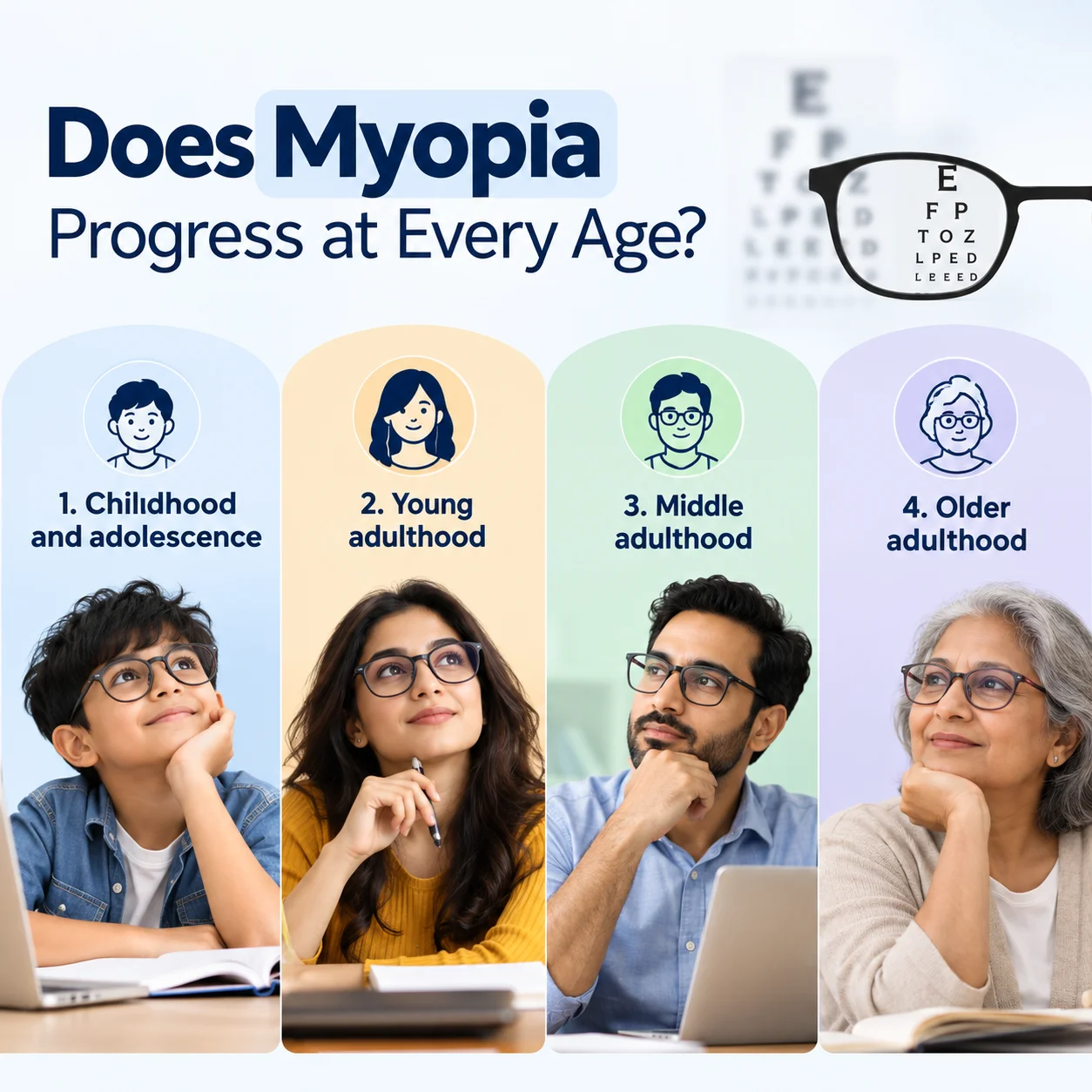
Myopia does not follow the same pattern throughout life. The age at which it begins, the degree of myopia, family history and other factors can influence how it changes.
1. Childhood and adolescence
This is the most common period for myopia development and progression.
Children may begin experiencing difficulty seeing classroom boards, recognising distant objects or watching television from a normal distance.
During these years, the eye is still developing, and changes in eyeball length can contribute to increasing myopia.
Early-onset myopia deserves attention because a longer period of progression can increase the likelihood of developing high myopia later in life.
2. Young adulthood
Many people assume that myopia stops changing after the teenage years. That is not always true.
Some young adults experience continued progression, particularly during their late teens and 20s.
A review of young adult myopia found that progression can continue during early adulthood, although it generally slows with age. Intensive near-work environments and individual eye characteristics may also be relevant.
This is particularly important for students and working professionals who spend long periods reading, studying or using digital devices.
3. Middle adulthood
For many adults, myopia is relatively stable by this stage. However, some individuals may still experience prescription changes.
If your vision becomes blurry in your 30s or 40s, it should not automatically be assumed that your myopia is progressing. Other refractive changes or eye conditions may be responsible.
A comprehensive eye examination can help distinguish between these possibilities.
4. Older adulthood
In later life, changes in vision may result from age-related changes in the lens, cataracts or other eye conditions.
For people with high myopia, ongoing eye monitoring remains important because certain retinal and other eye complications are associated with high levels of myopia.
Why Does Myopia Get Worse in Some People?
There is no single explanation for every case of increasing eye power. Several factors may contribute.
1. Genetics and family history
Myopia tends to run in families.
Children with one or both myopic parents may have a greater likelihood of developing myopia. Family history can also help eye-care professionals assess risk, particularly in children.
However, having a family history does not mean that progression is unavoidable.
2. Excessive near-work activities
Reading, studying and other prolonged close-up activities have been associated with myopia development and progression, particularly in younger people.
The exact contribution varies between individuals, and near work alone does not explain every case of myopia.
3. Limited outdoor time during childhood
Time spent outdoors during childhood has been associated with a lower risk of developing myopia.
Encouraging children to spend time outdoors is one practical component of healthy visual habits.
4. Early-onset or high myopia
People who develop myopia at a young age or already have high myopia may require closer monitoring.
Research has found that early-onset myopia is associated with a greater likelihood of high myopia in adulthood.
5. Changes in the eye or other health conditions
A change in glasses power can sometimes reflect something other than ordinary myopia progression.
Depending on the circumstances, an ophthalmologist may consider:
- Changes in the cornea.
- Changes in the eye’s lens.
- Cataract-related refractive changes.
- Other ocular conditions.
This is why repeatedly updating your glasses without evaluating unexpected vision changes may not address the underlying problem.
Can Myopia Get Worse After 30?
Yes, myopia can continue to change after age 30, although significant progression is less common than during childhood.
The idea that myopia always stops progressing by age 20 or 30 is too absolute.
Research on adult myopia indicates that progression can occur beyond adolescence, but rates generally decrease with age. The likelihood of progression varies between individuals and may depend on factors such as age of onset and the degree of myopia.
If you notice increasing eye power after 30, consider an eye examination, particularly if:
- Your prescription has changed repeatedly.
- You experience new or persistent blurry vision.
- You have high myopia.
- You notice difficulty seeing in low-light conditions.
- You experience new visual symptoms.
A changing prescription does not automatically indicate a serious condition, but it deserves appropriate evaluation.
Myopia vs Presbyopia: Are They the Same?
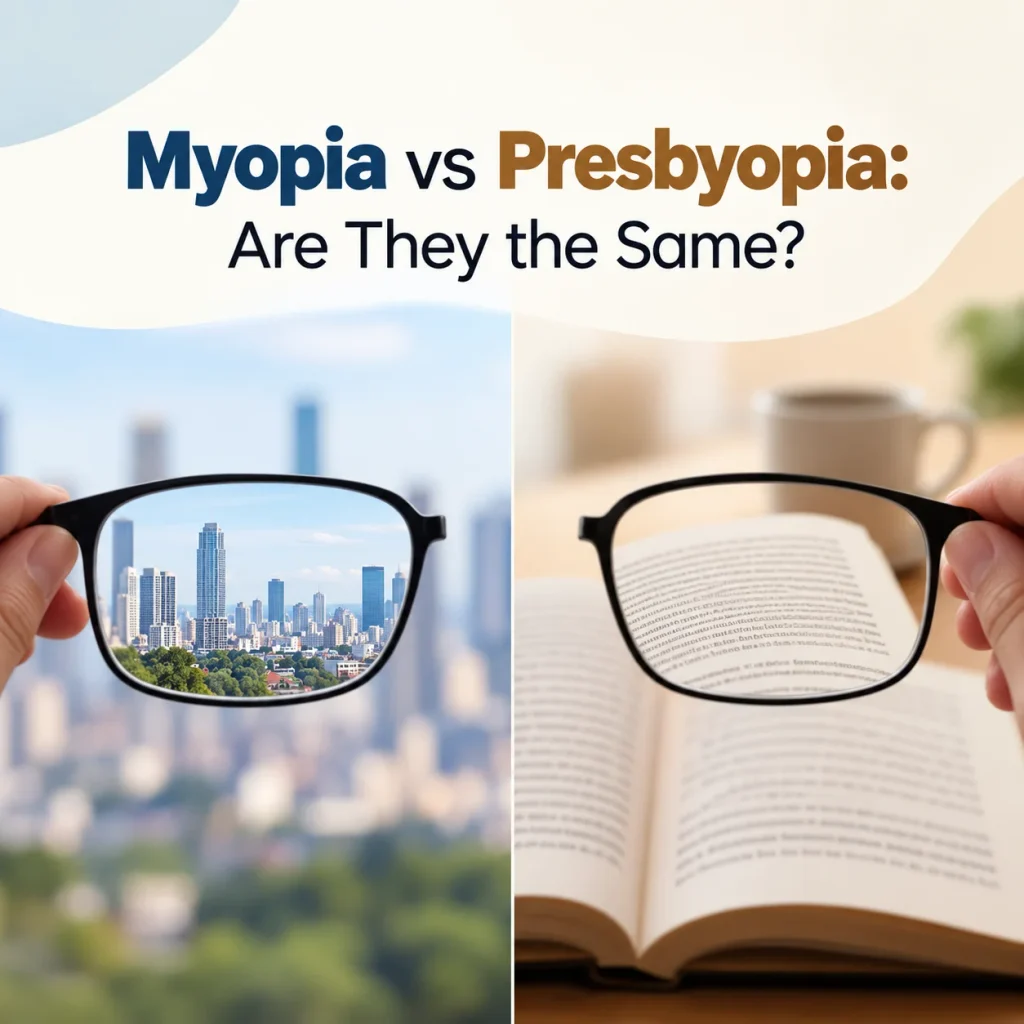
This is one of the most common sources of confusion about ageing and eyesight.
You may have worn minus-power glasses for years and then begin experiencing difficulty reading small text in your 40s. You might assume your myopia is getting worse.
But the problem could instead be presbyopia, a normal age-related change in the eye’s ability to focus on nearby objects.
What is presbyopia?
Presbyopia occurs when the eye’s natural lens gradually loses flexibility, making it harder to focus on close objects.
It commonly becomes noticeable after age 40–45 and affects nearly everyone as they age.
Myopia vs presbyopia
| Feature | Myopia | Presbyopia |
| Common description | Short-sightedness | Age-related difficulty focusing up close |
| Main difficulty | Seeing distant objects clearly | Reading or focusing on nearby objects |
| Common onset | Often childhood or adolescence | Usually noticeable in middle age |
| Main mechanism | Light focuses in front of the retina | Reduced ability of the lens to focus near |
| Common correction | Minus-power glasses or contact lenses | Reading glasses, multifocal lenses or other suitable correction |
A person can have both myopia and presbyopia at the same time.
For example, someone who has worn minus-power glasses since childhood may later need additional near-vision correction.
The key takeaway: Not every change in eyesight with age means that myopia is progressing.
Can Myopia Get Better With Age?
In most cases, established structural myopia does not simply disappear because a person gets older.
However, some people may notice changes in their prescription over time, and certain lens-related changes can alter refractive power.
For example, age-related changes in the eye’s lens can sometimes shift vision toward farsightedness, while cataract-related changes may produce a myopic shift in some individuals.
This is different from the eye returning to its original shape or reversing established axial myopia.
If your vision appears to improve unexpectedly, it is still worth discussing the change with an ophthalmologist rather than assuming that the underlying myopia has resolved.
What Are the Risks of High Myopia?
Many people manage myopia successfully with glasses or contact lenses. However, high myopia deserves additional attention because it is associated with an increased risk of certain eye complications.
When the eyeball is excessively elongated, the tissues at the back of the eye may be placed under greater structural stress.
Potential complications associated with high myopia include:
Retinal detachment
High myopia is associated with an increased risk of retinal detachment, a condition in which the retina separates from its normal position.
Myopic retinal changes
Severe or pathological myopia may be associated with progressive retinal degeneration and other vision-threatening changes.
Glaucoma and cataracts
Myopia management also includes monitoring for eye conditions such as glaucoma and cataracts, which may occur alongside myopia.
This does not mean that everyone with myopia will develop these complications.
However, people with high myopia should discuss an appropriate eye examination schedule with their ophthalmologist.
How Do Doctors Check Whether Myopia Is Getting Worse?
If you notice a change in your glasses prescription, an ophthalmologist may perform a comprehensive eye examination to determine whether your myopia has progressed or whether another condition is affecting your vision.
1. Visual acuity testing
This checks how clearly you can see at different distances.
You may be asked to read letters or symbols on an eye chart, first without correction and then with appropriate lenses.
2. Refraction assessment
Refraction helps determine the prescription required to correct your vision.
It can identify changes in your spherical power, cylinder power or other refractive measurements.
3. Dilated eye examination
In selected cases, the doctor may use dilating drops to examine the retina and optic nerve more closely.
This is particularly relevant when assessing patients with high myopia or symptoms that may suggest retinal problems.
4. Additional tests when needed
Depending on your age, symptoms, examination findings and risk factors, the ophthalmologist may recommend further tests.
These may include retinal imaging or measurements of the eye’s structure, such as axial length, when clinically appropriate.
The purpose is not just to prescribe stronger glasses—it is to understand why your vision is changing and whether your eyes remain healthy.
Can You Prevent Myopia From Getting Worse?
There is no guaranteed way to prevent progression in every person who already has myopia. However, healthy visual habits and appropriate professional monitoring can support eye health.
1. Encourage outdoor time for children
Regular outdoor activity during childhood is associated with a lower risk of developing myopia.
Parents can encourage children to spend time outdoors as part of their daily routine.
2. Take regular breaks during close-up work
If you spend long hours reading or using a computer, take periodic breaks and look at distant objects.
This may help reduce visual fatigue, although breaks should not be presented as a guaranteed method of stopping myopia progression.
3. Maintain appropriate reading distance and lighting
Avoid holding reading material unnecessarily close to your face.
Use comfortable lighting and maintain a practical working distance during study or screen-based activities.
4. Follow your prescribed eye-care plan
If your child or teenager has progressive myopia, an ophthalmologist may discuss evidence-based myopia-management options.
Depending on age and clinical suitability, these may include:
- Low-dose atropine.
- Specialised myopia-control contact lenses.
- Orthokeratology.
- Other prescribed myopia-control strategies.
These approaches are primarily studied and used for slowing progression in children and adolescents. Their suitability and effectiveness in adults may differ.
5. Get regular eye examinations
Do not wait until your glasses become unusable before checking your vision.
Regular examinations can help identify prescription changes and detect eye conditions that may not produce obvious symptoms in their early stages.
When Should You See an Ophthalmologist?
A routine eye examination is appropriate if you notice gradual changes in your vision or repeated changes in your glasses prescription.
However, some symptoms require urgent medical attention.
Seek immediate ophthalmic evaluation if you experience:
- A sudden increase in floaters.
- Flashes of light.
- A curtain-like shadow over part of your vision.
- Sudden loss of vision.
- A new blind spot or significant change in peripheral vision.
These may be warning signs of retinal detachment or another urgent eye problem. Significant myopia is associated with an increased risk of retinal detachment. Do not wait for your next routine appointment if these symptoms occur.
Frequently Asked Questions (FAQs)
1. Can myopia get worse after age 40?
Yes, it is possible, although myopia progression generally becomes less common with age. Changes in vision after 40 may also result from presbyopia, cataracts or other eye conditions. An eye examination can help identify the cause.
2. Does wearing glasses make myopia worse?
No. Corrective glasses improve the way light focuses on the retina; wearing the appropriate prescription does not cause the eyeball to become longer. If your power changes, it is important to assess the reason rather than blame the glasses.
3. Why is my eye power increasing every year?
Possible explanations include ongoing myopia progression, particularly in younger individuals, or other changes affecting the eye’s refractive system. Repeated prescription changes should be evaluated by an ophthalmologist.
4. Can myopia turn into presbyopia?
Myopia does not turn into presbyopia. They are different refractive conditions, but one person can have both. Presbyopia is a normal age-related reduction in near-focusing ability.
5. Can eye exercises reduce myopia?
Eye exercises should not be promoted as a proven way to reverse established axial myopia. If you are concerned about increasing eye power, consult an ophthalmologist for appropriate assessment and management.
6. Is high myopia dangerous?
High myopia is associated with a greater risk of certain eye complications, including retinal detachment and progressive retinal changes. It does not mean that complications are inevitable, but regular monitoring is important.
7. How often should I get my eyes checked if I have myopia?
The appropriate examination frequency depends on your age, prescription, symptoms, eye health and risk factors. Your ophthalmologist can recommend a schedule suited to your needs. People with high myopia or new visual symptoms may require closer monitoring.
Conclusion
So, can myopia get worse with age? Yes. Although myopia often stabilises during adulthood, some people experience continued progression, especially during young adulthood. In later life, changes in eyesight may also be caused by presbyopia, cataracts or other eye conditions.
The important thing is not to assume that every change in vision is simply a normal part of ageing.
If your glasses prescription keeps changing, distant objects are becoming harder to see, or you notice new visual symptoms, a comprehensive eye examination can help determine what is happening.
At Rama Hospital, patients seeking an eye specialist in Noida can consult an ophthalmologist for evaluation of changing vision, refractive errors and other eye-health concerns in best hospital in Noida.