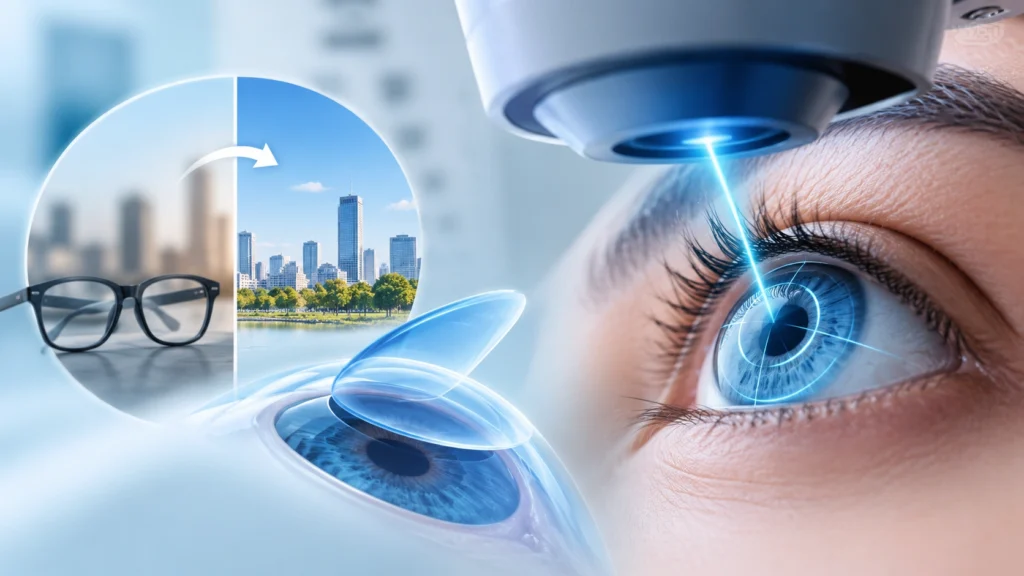
LASIK, which stands for Laser-Assisted In Situ Keratomileusis, is one of the most common and advanced laser procedures used to correct vision problems. It is designed for people who want to reduce or eliminate their dependence on glasses and contact lenses. LASIK reshapes the cornea, which is the clear front surface of the eye, so that light focuses properly on the retina. This improves vision for conditions such as myopia, hypermetropia, and astigmatism.
Many people consider LASIK because it offers quick recovery, minimal discomfort, and long-lasting results for suitable candidates. However, not everyone is a good candidate for LASIK. A detailed eye evaluation is essential to determine whether the procedure is safe and appropriate. Understanding the benefits, risks, and realistic expectations is important before making a decision.
What is LASIK?
LASIK is a type of refractive surgery that uses a laser to reshape the cornea and correct vision problems. The cornea acts like a lens at the front of the eye. If its shape is not ideal, light does not focus correctly on the retina, leading to blurred vision. LASIK changes the curvature of the cornea so that light focuses more accurately.
The procedure is usually done on both eyes on the same day. It is performed under local anesthesia in the form of eye drops, so the patient remains awake but feels no pain. The actual laser treatment time is very short, often less than a minute per eye, although the entire process in the operating room takes longer.
LASIK is suitable for many adults with stable vision and healthy eyes. It is not recommended for children, people with unstable vision, certain eye diseases, or specific medical conditions. A thorough pre-operative evaluation is essential to ensure safety and good outcomes.
How LASIK Works?
LASIK works by precisely removing a thin layer of corneal tissue using an excimer laser. This changes the focusing power of the cornea.
Basic steps of how LASIK works
- A thin flap is created on the surface of the cornea using a laser or a microkeratome blade.
- The flap is gently lifted to expose the underlying corneal tissue.
- The excimer laser reshapes the cornea based on the patient’s prescription.
- The flap is repositioned, where it heals naturally without stitches.
- Vision improves as the cornea heals over the next few days to weeks.
Vision problems corrected by LASIK
The goal is to reduce dependence on glasses or contact lenses, although some patients may still need glasses for specific tasks such as night driving or reading after a certain age.
- Myopia or nearsightedness, where distant objects appear blurred.
- Hypermetropia or farsightedness, where near objects appear blurred.
- Astigmatism, where vision is distorted or blurred at all distances due to irregular corneal shape.
- Mixed refractive errors in selected cases.
Who is Eligible for LASIK?
Not everyone is a suitable candidate for LASIK. Eligibility depends on age, vision stability, corneal thickness, eye health, and general medical condition.
Ideal candidates for LASIK
- Adults aged eighteen years or older.
- People with stable vision for at least one year.
- Individuals with mild to moderate myopia, hypermetropia, or astigmatism.
- Patients with adequate corneal thickness.
- People with healthy eyes and no active eye disease.
- Individuals who understand the benefits, risks, and realistic expectations.
People who may not be suitable
- Children and teenagers whose vision is still changing.
- Pregnant or breastfeeding women due to hormonal changes affecting vision.
- People with very high refractive errors beyond the safe treatment range.
- Patients with thin corneas or abnormal corneal shape.
- Individuals with dry eye syndrome that is severe or uncontrolled.
- People with certain eye diseases such as keratoconus, glaucoma, or cataract.
- Patients with uncontrolled diabetes or autoimmune diseases.
- Individuals with unrealistic expectations about perfect vision.
Why eligibility matters: Proper selection reduces the risk of complications and improves satisfaction. A detailed pre-operative assessment helps identify suitable candidates and those who may benefit more from alternative procedures.
Pre-Operative Evaluation for LASIK
A thorough eye examination is essential before LASIK to ensure safety and plan the procedure.
Evaluation steps
- Detailed medical and eye history.
- Measurement of current glasses or contact lens prescription.
- Assessment of vision stability over time.
- Corneal thickness measurement using pachymetry.
- Corneal topography to map the shape of the cornea.
- Dry eye evaluation and tear film assessment.
- Pupil size measurement in dim light.
- Retinal examination to check for any underlying issues.
- Discussion of expectations, benefits, and risks.
Preparation before surgery
- Discontinuation of contact lenses for a specified period before evaluation and surgery.
- Treatment of dry eye or other minor eye issues before proceeding.
- Avoidance of eye makeup, creams, or perfumes on the day of surgery.
- Arrangement for someone to accompany the patient on the day of procedure.
- Understanding post-operative care instructions in advance.
LASIK Procedure Steps
The LASIK procedure is quick and usually performed on both eyes in one session.
Step-by-step overview
- The patient is positioned under the laser system.
- Numbing eye drops are applied to ensure comfort.
- An eyelid speculum is used to keep the eye open.
- A corneal flap is created using a femtosecond laser or microkeratome.
- The flap is gently lifted.
- The excimer laser reshapes the corneal tissue based on the prescription.
- The flap is repositioned and smoothed into place.
- The eye is examined to ensure proper flap alignment.
- Protective shields or goggles may be placed after the procedure.
Duration and comfort
- The actual laser time is usually less than a minute per eye.
- The entire procedure in the operating room takes about ten to fifteen minutes per eye.
- Most patients feel pressure but no pain during the procedure.
- Vision may be hazy or blurry immediately after surgery.
Benefits of LASIK
LASIK offers several benefits for suitable candidates.
Common benefits
- Significant reduction in dependence on glasses and contact lenses.
- Quick visual recovery, often within a day or two.
- Minimal discomfort during and after the procedure.
- Long-lasting results for most patients.
- Improved convenience for sports, travel, and daily activities.
- High patient satisfaction when expectations are realistic.
- Ability to perform many daily tasks without visual aids.
Lifestyle advantages
- Easier participation in physical activities and sports.
- No need to manage contact lenses or solutions.
- Better peripheral vision without frames.
- Improved confidence and convenience for many patients.
Risks and Side Effects of LASIK
Like any surgical procedure, LASIK carries some risks and potential side effects.
Common temporary side effects
- Dry eyes for weeks to months after surgery.
- Glare, halos, or starbursts around lights, especially at night.
- Fluctuating vision during the healing period.
- Mild discomfort, itching, or watering in the first few days.
- Light sensitivity for a short period.
Less common risks
- Under-correction or over-correction requiring enhancement.
- Regression of effect over time in some patients.
- Infection or inflammation, which is rare but serious.
- Flap-related complications such as wrinkles or displacement.
- Corneal ectasia, a rare condition where the cornea weakens and bulges.
- Persistent dry eye in a small number of patients.
- Night vision problems that may affect driving.
Why risks occur: Risks are influenced by pre-existing eye conditions, corneal characteristics, surgical technique, and post-operative care. Proper screening and experienced surgeons reduce the likelihood of complications.
Recovery After LASIK
Recovery is usually quick, but proper care is essential for optimal results.
Immediate post-operative period
- Rest for the first few hours after surgery.
- Use prescribed eye drops regularly.
- Avoid rubbing the eyes.
- Wear protective shields or goggles as advised.
- Expect some blurriness, watering, and light sensitivity.
First week after surgery
- Vision typically improves significantly within a few days.
- Continue using antibiotic and steroid eye drops as prescribed.
- Use lubricating eye drops frequently for dryness.
- Avoid swimming, hot tubs, and dusty environments.
- Avoid eye makeup for at least a week.
- Attend follow-up visits as scheduled.
Long-term care
- Continue lubricating drops if dryness persists.
- Protect eyes from dust, wind, and excessive sun.
- Attend regular eye check-ups.
- Report any sudden vision changes, pain, or redness immediately.
- Understand that reading glasses may still be needed after a certain age due to natural aging of the eye.
Alternatives to LASIK
Not everyone is a candidate for LASIK. Other refractive procedures may be more suitable.
- PRK or Photorefractive Keratectomy, which reshapes the cornea without creating a flap.
- SMILE or Small Incision Lenticule Extraction, a minimally invasive laser procedure.
- ICL or Implantable Collamer Lens, which places a lens inside the eye for high refractive errors.
- RLE or Refractive Lens Exchange, which replaces the natural lens in selected cases.
- Continued use of glasses or contact lenses for those who prefer non-surgical options.
Why alternatives may be recommended
- Thin corneas or abnormal corneal shape.
- Very high refractive errors.
- Dry eye or other risk factors.
- Patient preference or lifestyle considerations.
- Surgeon’s assessment of safety and outcomes.
Long-Term Outcomes of LASIK
Most patients enjoy stable vision for many years after LASIK.
Expected long-term results
- Stable vision for distance in most suitable candidates.
- Reduced dependence on glasses for daily activities.
- High satisfaction rates when expectations are realistic.
- Possible need for reading glasses after the age of forty due to presbyopia.
- Occasional need for enhancement in a small percentage of patients.
Factors affecting long-term outcomes
- Initial refractive error and corneal characteristics.
- Age and natural changes in vision over time.
- Eye health and presence of other conditions.
- Adherence to post-operative care and follow-up.
- Lifestyle and occupational visual demands.
Why Choose Rama Hospital for LASIK Treatment?
LASIK is a precise procedure that requires advanced technology, experienced surgeons, and comprehensive pre- and post-operative care. A hospital setting provides safety, expertise, and support throughout the journey.
- Detailed pre-operative evaluation with advanced diagnostics.
- Experienced refractive surgeons with specialized training.
- Modern laser platforms for precision and safety.
- Strict infection control and sterile operating environment.
- Structured post-operative follow-up and support.
- Access to alternative procedures if LASIK is not suitable.
Frequently Asked Questions (FAQs)
Is LASIK painful?
Most patients feel little to no pain during LASIK due to numbing eye drops. Some pressure, mild discomfort, or watering may be experienced during and after the procedure.
How long does the LASIK procedure take?
The actual laser treatment time is usually less than a minute per eye. The entire process in the operating room typically takes about ten to fifteen minutes per eye.
How soon can I return to work after LASIK?
Many patients can return to work within one to two days, depending on their job and visual demands. Desk jobs are usually easier to resume than jobs involving dust, heavy physical activity, or prolonged screen time.
Can LASIK correct all vision problems?
LASIK can correct most cases of myopia, hypermetropia, and astigmatism within a safe range. Very high prescriptions or certain eye conditions may require alternative procedures.
Will I still need glasses after LASIK?
Many patients do not need glasses for distance after LASIK. However, reading glasses may still be needed after the age of forty due to natural aging of the eye. Some patients may need glasses for specific tasks such as night driving.
Is LASIK permanent?
LASIK provides long-lasting vision correction for most patients. However, natural changes in vision can occur over time due to aging or other eye conditions. A small number of patients may need enhancement surgery.
What are the risks of LASIK?
Common risks include dry eyes, glare, halos, and fluctuating vision in the early period. Rare risks include infection, flap complications, under-correction, over-correction, or corneal ectasia. Proper screening reduces these risks.
Conclusion
LASIK laser vision correction is a safe and effective option for many people who want to reduce their dependence on glasses and contact lenses. It offers quick recovery, minimal discomfort, and long-lasting results for suitable candidates. However, it is not appropriate for everyone, and a detailed eye evaluation is essential to determine eligibility.
The most important steps are proper screening, realistic expectations, experienced surgical care, and diligent post-operative follow-up. For patients with stable vision, healthy eyes, and appropriate corneal parameters, LASIK can significantly improve convenience and quality of life. For those who are not suitable candidates, alternative refractive procedures may be considered.
Rama Hospital can provide comprehensive LASIK evaluation, advanced laser treatment, and structured post-operative care to support safe and effective vision correction.