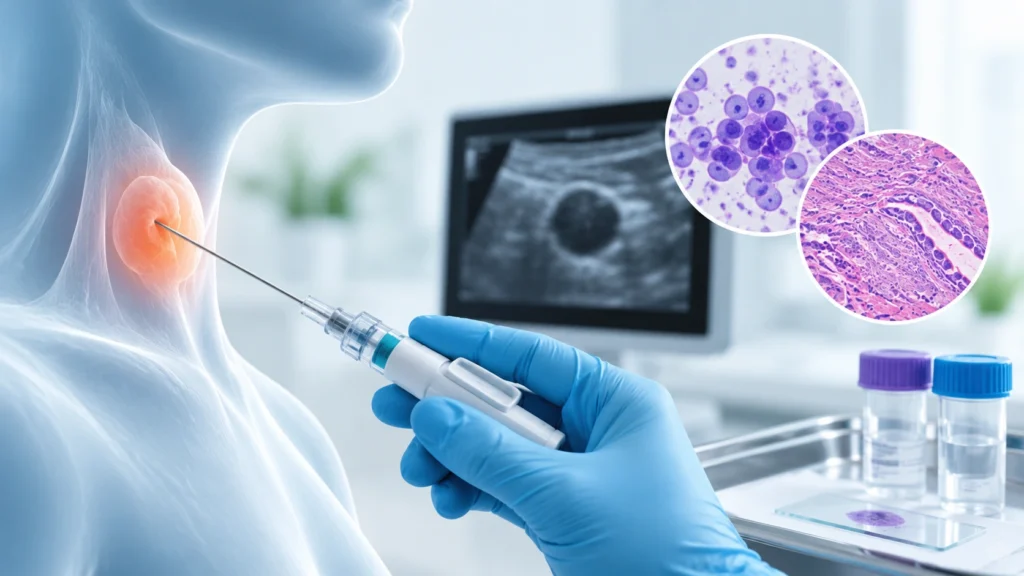
FNAC and core needle biopsy are two of the most common and important tests used to find the cause of a lump, swelling, or abnormal area in the body. FNAC stands for Fine Needle Aspiration Cytology. It uses a very thin needle to collect cells from a suspicious area. Core needle biopsy uses a slightly thicker needle to collect a small piece of tissue. Both tests help doctors decide whether a lump is benign, inflammatory, or malignant.
These procedures are used for lumps in the breast, thyroid, lymph nodes, salivary glands, soft tissue, and other organs. They are usually quick, minimally invasive, and done with local anesthesia. In many cases, they are guided by ultrasound or other imaging to improve accuracy. The results help guide further treatment, including whether surgery, medicines, or observation is needed.
What is FNAC?
FNAC stands for Fine Needle Aspiration Cytology. It is a simple and minimally invasive test that uses a very thin needle to collect cells from a lump or abnormal area. The collected cells are then examined under a microscope by a pathologist to look for signs of infection, inflammation, benign growth, or cancer.
FNAC is commonly used for superficial lumps that can be felt by hand, such as in the breast, thyroid, lymph nodes, and salivary glands. It can also be used for deeper areas when guided by ultrasound or other imaging. The procedure is quick, usually takes only a few minutes, and does not require a large incision.
Because FNAC uses a thin needle, it causes minimal discomfort and leaves little to no scar. It is often the first test done when a new lump is found. The results help decide whether further tests, such as core biopsy or surgery, are needed.
What is Core Needle Biopsy?
Core needle biopsy is a test that uses a slightly thicker needle to collect a small core or piece of tissue from a suspicious area. This tissue sample is then processed and examined under a microscope by a pathologist. Core biopsy provides more tissue than FNAC, which can help in making a more detailed diagnosis.
Core needle biopsy is often used when FNAC results are inconclusive or when more tissue is needed to confirm a diagnosis. It is commonly used for breast lumps, thyroid nodules, lymph nodes, liver lesions, kidney masses, and other deep or complex areas. It is usually done with local anesthesia and may be guided by ultrasound, CT, or other imaging.
Because core biopsy provides a larger sample, it can give more information about the type and grade of a lesion. This can be especially important when planning treatment for cancer or other serious conditions.
When are FNAC and Core Biopsy Advised?
These tests are advised when a lump, nodule, or abnormal area is found and the cause is not clear from examination or imaging alone.
Common situations where FNAC is advised
- New lump in the breast that needs evaluation.
- Thyroid nodule seen on ultrasound.
- Enlarged lymph node in the neck, armpit, or groin.
- Salivary gland swelling.
- Soft tissue lump under the skin.
- Cystic lesion that needs fluid analysis.
- Follow-up of a known lesion that has changed.
Common situations where core biopsy is advised
- Breast lump with suspicious features on imaging.
- Thyroid nodule with indeterminate FNAC result.
- Lymph node enlargement with concern for malignancy.
- Liver, kidney, or lung lesion needing tissue diagnosis.
- Soft tissue mass where tumor type needs confirmation.
- Cases where architecture of tissue is important for diagnosis.
- When hormone receptor or other special tests are needed.
Why these tests are important
- They help distinguish benign from malignant lesions.
- They guide whether surgery is needed or not.
- They reduce unnecessary operations for benign conditions.
- They provide information for cancer staging and treatment planning.
- They help avoid delay in diagnosis and treatment.
How is FNAC Done?
FNAC is a simple procedure that is usually done in an outpatient setting.
Steps of the FNAC procedure
- The area is cleaned with an antiseptic solution.
- The doctor may use ultrasound to locate the exact target.
- A very thin needle is inserted into the lump or nodule.
- Gentle suction is applied to collect cells.
- The needle is moved slightly to sample different areas.
- The collected material is spread on slides for pathology.
- Pressure is applied to the site to prevent bleeding.
- A small bandage is placed if needed.
What the patient feels
- A brief pinprick when the needle enters.
- Mild pressure or pulling sensation during sampling.
- Minimal discomfort that resolves quickly.
- Most patients tolerate the procedure well without anesthesia.
Duration and setting
- The actual needle procedure usually takes a few minutes.
- Total time including preparation and dressing may be ten to fifteen minutes.
- Done in a procedure room or radiology suite.
- Patient can usually go home immediately after.
How is Core Needle Biopsy Done?
Core needle biopsy is also done as an outpatient procedure, but it may take slightly longer than FNAC.
Steps of the core biopsy procedure
- The area is cleaned and draped in a sterile manner.
- Local anesthesia is injected to numb the skin and deeper tissues.
- Imaging guidance such as ultrasound or CT is used to plan the path.
- A small skin nick may be made to help the needle pass.
- A core needle is advanced into the target area.
- Multiple cores of tissue are collected using a spring-loaded device.
- Samples are placed in preservative solution for pathology.
- Pressure is applied to the site to prevent bleeding.
- A small bandage or dressing is applied.
What the patient feels
- A brief sting from the local anesthetic injection.
- Pressure or pushing sensation during needle placement.
- Mild discomfort that is usually well tolerated.
- Some soreness at the site for a day or two.
Duration and setting
- The procedure may take fifteen to thirty minutes depending on the site.
- Done in a procedure room, radiology suite, or operating room if needed.
- Patient is observed for a short time after the procedure.
- Most patients can go home the same day.
Preparation for FNAC and Core Biopsy
Proper preparation helps ensure the procedure is safe and accurate.
- Inform the doctor about all medicines, especially blood thinners.
- Share any history of bleeding disorders or allergies.
- Mention any previous surgeries or biopsies in the same area.
- Wear comfortable clothing that allows easy access to the area.
- Avoid applying creams, powders, or lotions on the area before the test.
- Eat normally unless advised otherwise for specific organ biopsies.
- Arrange for someone to accompany you if you feel anxious.
Medicine-related preparation
- Blood thinners may need to be paused or adjusted before core biopsy.
- Diabetes medicines may need timing adjustment if fasting is required.
- Pain medicines should be taken only as advised.
- Do not stop any medicine without discussing with your doctor.
Anxiety and comfort
- Many patients feel nervous before a biopsy.
- The team will explain each step to reduce anxiety.
- Breathing slowly and staying relaxed can help.
- Ask questions if any step is unclear.
What to Expect After the Procedure
Most patients recover quickly after FNAC or core biopsy.
Immediate post-procedure period
- Mild tenderness or soreness at the site.
- Small bruise or swelling in some cases.
- Minor bleeding that stops with pressure.
- Ability to resume light activity the same day.
Care at home
- Keep the dressing clean and dry for the advised period.
- Avoid heavy lifting or strenuous activity for a day or two.
- Use a cold pack if there is mild swelling or discomfort.
- Take pain relief medicine only if advised.
- Watch for signs of infection or excessive bleeding.
When to contact the hospital
- Increasing pain not relieved by simple measures.
- Excessive bleeding or soaking of the dressing.
- Fever, chills, or feeling unwell.
- Redness, warmth, or pus at the site.
- Any new lump or rapid swelling.
Understanding the Biopsy Report
The biopsy report is a key part of diagnosis and treatment planning.
What the report includes
- Patient details and sample site.
- Type of procedure performed.
- Description of cells or tissue seen.
- Diagnosis or impression by the pathologist.
- Comments on whether the lesion is benign, suspicious, or malignant.
- Additional tests if done, such as special stains or markers.
Common report categories
- Benign, meaning non-cancerous and often not serious.
- Inflammatory or infectious, suggesting infection or inflammation.
- Indeterminate or equivocal, meaning more information may be needed.
- Suspicious, meaning features are concerning but not definitive.
- Malignant, meaning cancer cells are identified.
Why report interpretation matters
- It guides whether further tests or surgery are needed.
- It helps plan treatment for cancer if present.
- It reduces uncertainty about the nature of the lump.
- It provides a baseline for future comparison.
Benefits of FNAC and Core Biopsy
These tests offer several advantages over open surgical biopsy in many cases.
Benefits of FNAC
- Minimally invasive with a very thin needle.
- Quick procedure with minimal discomfort.
- Little to no scarring.
- Can be repeated if needed.
- Useful for initial evaluation of many lumps.
- Lower risk of complications compared to surgery.
Benefits of core needle biopsy
- Provides more tissue for detailed diagnosis.
- Allows assessment of tissue architecture.
- Helps in grading and subtyping of tumors.
- Enables special tests such as hormone receptors.
- Often avoids the need for open surgical biopsy.
- High accuracy when done with imaging guidance.
Overall benefits
- Faster diagnosis and treatment planning.
- Reduced need for diagnostic surgery.
- Better patient comfort and quicker recovery.
- Cost-effective compared to open procedures.
- Supports personalized treatment decisions.
Risks and Complications
FNAC and core biopsy are generally safe, but like any procedure, they have some risks.
Common minor risks
- Mild pain or tenderness at the site.
- Small bruise or hematoma.
- Minor bleeding that stops with pressure.
- Temporary swelling or discomfort.
Less common risks
- Infection at the biopsy site.
- Larger hematoma requiring observation.
- Injury to nearby structures in deep biopsies.
- Allergic reaction to local anesthetic or antiseptic.
- Need for repeat biopsy if sample is inadequate.
Rare risks
- Significant bleeding requiring intervention.
- Damage to important vessels or organs in deep biopsies.
- Spread of tumor cells along the needle track, which is very rare.
- Need for surgical management of a complication.
Why risks are usually low
- Procedures are done by trained specialists.
- Imaging guidance improves accuracy and safety.
- Sterile technique reduces infection risk.
- Careful patient selection and preparation minimize complications.
FNAC and Core Biopsy in Specific Areas
These tests are used in many parts of the body, with slight variations in technique.
Breast lumps
- FNAC is often the first test for a palpable breast lump.
- Core biopsy is preferred when imaging is suspicious or FNAC is inconclusive.
- Helps distinguish cysts, fibroadenoma, and cancer.
- Guides need for surgery or further imaging.
Thyroid nodules
- FNAC is the main test for thyroid nodule evaluation.
- Core biopsy may be used in selected indeterminate cases.
- Helps decide between observation, surgery, or other treatment.
- Reduces unnecessary thyroid operations.
Lymph nodes
- FNAC helps identify infection, inflammation, or malignancy.
- Core biopsy may be needed for lymphoma evaluation.
- Guides treatment for tuberculosis, metastasis, or blood disorders.
- Important for staging in cancer patients.
Liver, kidney, and other organs
- Core biopsy is more common for deep organ lesions.
- Imaging guidance is essential for safety.
- Helps diagnose tumors, infections, or inflammatory conditions.
- Supports treatment planning for complex cases.
Why Choose Rama Hospital for FNAC and Core Biopsy?
FNAC and core biopsy require skilled operators, good imaging support, and experienced pathology. A hospital setup ensures safety, accuracy, and coordinated care.
- Expert radiologists and surgeons performing biopsies.
- Advanced ultrasound and imaging guidance.
- Experienced pathology team for accurate reporting.
- Availability of additional tests and markers when needed.
- Support for complications, though rare, if they occur.
Frequently Asked Questions (FAQs)
What is the difference between FNAC and core biopsy?
FNAC uses a thin needle to collect cells, while core biopsy uses a thicker needle to collect a small piece of tissue. FNAC is quicker and less invasive, while core biopsy provides more tissue for detailed diagnosis. The choice depends on the lump and clinical question.
Is FNAC or core biopsy painful?
Most patients feel only mild discomfort. FNAC causes a brief pinprick sensation. Core biopsy involves local anesthesia, so pain is minimal. Some soreness at the site for a day or two is common and manageable.
How long does it take to get the report?
FNAC reports are often available within one to two days. Core biopsy reports may take a few days longer, especially if special tests are needed. The hospital will inform you when and how to collect the report.
Do I need to fast before FNAC or core biopsy?
Fasting is usually not required for superficial FNAC or core biopsy. For some deep organ biopsies, fasting may be advised. Follow the specific instructions given by your doctor for your procedure.
Can FNAC or core biopsy confirm cancer?
Yes, these tests can often confirm whether a lump is cancerous. FNAC can suggest malignancy, while core biopsy can provide more detailed information. In some cases, additional tests or surgery may still be needed.
Are there any serious side effects?
Serious side effects are rare. Most patients have only mild pain, bruising, or swelling. Infection or significant bleeding is uncommon. The team will give clear instructions to minimize risks.
Can the biopsy spread cancer?
The risk of cancer spreading along the needle track is extremely low. Modern techniques and careful planning make this complication very rare. The benefit of accurate diagnosis far outweighs this theoretical risk.
What if the report is inconclusive?
Sometimes the sample may not be enough for a clear diagnosis. In such cases, a repeat FNAC or core biopsy may be advised. Your doctor will explain the next steps based on your specific situation.
Conclusion
FNAC and core needle biopsy are essential tests for evaluating lumps, nodules, and abnormal areas in the body. They help distinguish benign from malignant conditions, guide treatment decisions, and reduce the need for unnecessary surgery. Both procedures are minimally invasive, generally safe, and well tolerated by most patients.
For anyone with a new lump, thyroid nodule, enlarged lymph node, or suspicious imaging finding, these tests can provide clarity and direction. With proper preparation, expert technique, and accurate pathology, patients can get reliable answers and move forward with confidence.
Rama Hospital can provide expert FNAC and core needle biopsy services with imaging guidance, experienced pathology support, and clear counseling to help patients understand their results and next steps.