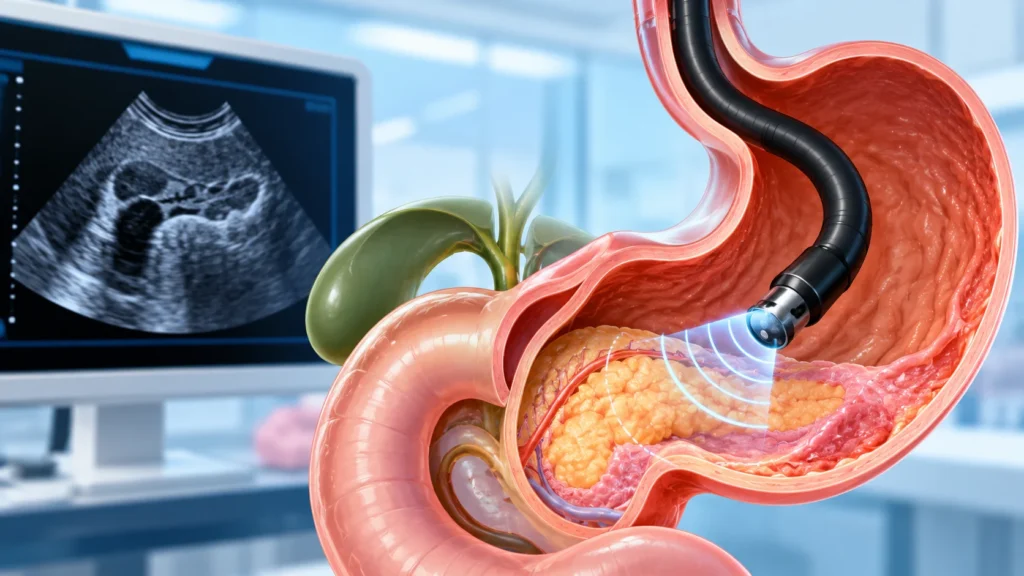
Endoscopic Ultrasound, commonly called EUS, is an advanced diagnostic and treatment procedure that combines two technologies: endoscopy and ultrasound. It allows doctors to see inside the digestive tract and also examine the organs and structures around it, such as the pancreas, liver, gallbladder, bile ducts, and nearby lymph nodes.
Unlike a regular endoscopy, which only shows the inner lining of the food pipe, stomach, or intestines, Endoscopic Ultrasound can see deeper layers of the wall and the organs just outside it. This makes it very useful for detecting small tumors, assessing pancreatic disease, evaluating bile duct problems, and guiding biopsies with high precision.
What is Endoscopic Ultrasound (EUS)?
Endoscopic Ultrasound is a minimally invasive procedure that uses a thin, flexible tube called an endoscope with a small ultrasound probe at its tip. The endoscope is passed through the mouth or rectum, depending on the area being examined. The ultrasound probe uses sound waves to create detailed images of the organs and tissues around the digestive tract.
Because the ultrasound probe is placed very close to the organs being studied, the images are much clearer and more detailed than those from a regular ultrasound done from outside the body. This allows doctors to see small lesions, assess the depth of tumors, and guide needles for biopsy when needed.
Endoscopic Ultrasound is used both for diagnosis and, in some cases, for treatment. It can help detect cancer at an early stage, evaluate chronic pancreatitis, assess cysts in the pancreas, and guide drainage procedures for fluid collections.
Why is EUS Done?
Endoscopic Ultrasound is recommended when doctors need detailed information about the digestive tract and nearby organs that cannot be obtained from regular scans or endoscopy alone.
Common reasons for EUS
- Evaluation of abnormal findings on CT scan, MRI, or regular ultrasound.
- Assessment of pancreatic tumors, cysts, or inflammation.
- Evaluation of bile duct stones or blockages.
- Staging of cancers in the food pipe, stomach, pancreas, or rectum.
- Detection of small tumors or lesions not visible on regular endoscopy.
- Evaluation of unexplained abdominal pain or weight loss.
- Assessment of lymph nodes near the digestive organs.
- Guidance for biopsy of suspicious lesions.
- Drainage of fluid collections or cysts in selected cases.
Why EUS is preferred in some cases
- Provides clearer images than external ultrasound.
- Can see through the wall of the digestive tract.
- Allows biopsy of deep or hard-to-reach areas.
- Helps avoid more invasive surgery in some cases.
- Gives real-time information during the procedure.
Conditions Evaluated with EUS
Endoscopic Ultrasound is used to assess many conditions affecting the digestive system and nearby organs.
Pancreatic conditions
- Pancreatic cancer.
- Chronic pancreatitis.
- Pancreatic cysts.
- Pancreatic pseudocysts.
- Neuroendocrine tumors of the pancreas.
- Unexplained pancreatic duct dilation.
Bile duct and gallbladder conditions
- Bile duct stones.
- Bile duct strictures or narrowing.
- Gallbladder polyps.
- Cholangiocarcinoma or bile duct cancer.
- Unexplained jaundice.
Esophageal and stomach conditions
- Esophageal cancer staging.
- Gastric cancer staging.
- Submucosal tumors in the food pipe or stomach.
- Assessment of thickened stomach wall.
- Evaluation of Barrett’s esophagus in selected cases.
Rectal and colon conditions
- Rectal cancer staging.
- Rectal polyps and submucosal lesions.
- Anal canal tumors in selected cases.
- Assessment of perianal abscess or fistula in some cases.
Other uses
- Evaluation of mediastinal lymph nodes.
- Assessment of lung or chest masses near the food pipe.
- Drainage of pancreatic fluid collections.
- Celiac plexus block for pain relief in pancreatic cancer.
How is the EUS Performed?
Endoscopic Ultrasound is usually done as an outpatient procedure, meaning most patients go home the same day. It is performed under sedation to keep the patient comfortable.
Before the procedure
- The patient is asked to fast for 6 to 8 hours.
- Medicines may be adjusted as advised by the doctor.
- Blood thinners may need to be paused temporarily.
- A brief medical history and consent are taken.
- An IV line may be placed for fluids and medicines.
During the procedure
- The patient lies on the left side.
- Sedation is given through the IV line.
- The endoscope is gently passed through the mouth into the stomach and duodenum, or through the rectum for lower GI evaluation.
- The ultrasound probe at the tip creates detailed images.
- If a biopsy is needed, a thin needle is passed through the scope to take a small tissue sample.
- The procedure usually takes 30 to 60 minutes.
After the procedure
- The patient is monitored until sedation wears off.
- Mild throat discomfort or bloating may occur.
- Most patients can go home the same day.
- Biopsy results may take a few days.
Types of EUS Procedures
Endoscopic Ultrasound can be used in different ways depending on the purpose.
Diagnostic EUS
- Used to visualize organs and structures.
- Helps assess size, location, and depth of lesions.
- Guides decision on whether biopsy or treatment is needed.
EUS-guided biopsy
- Also called EUS-guided fine needle aspiration or biopsy.
- Uses a thin needle to take tissue or fluid samples.
- Helps confirm diagnosis of tumors, cysts, or infections.
- Very accurate because the needle is guided by real-time ultrasound.
EUS-guided drainage
- Used to drain pancreatic pseudocysts or fluid collections.
- Creates a small connection between the cyst and the stomach or intestine.
- Helps avoid open surgery in many cases.
EUS-guided celiac plexus block
- Used to relieve pain in pancreatic cancer.
- Inject medicine near the nerves that carry pain signals.
- Can improve quality of life in selected patients.
EUS-guided biliary drainage
- Used when bile duct blockage cannot be treated with regular endoscopy.
- Creates a new pathway for bile to drain.
- Helps relieve jaundice and infection.
Benefits of EUS
Endoscopic Ultrasound offers several advantages over other diagnostic and treatment methods.
Key benefits
- Minimally invasive with no large incisions.
- Very detailed images of deep organs.
- Can detect small lesions missed by other scans.
- Allows biopsy of hard-to-reach areas.
- Helps avoid exploratory surgery in some cases.
- Can be used for both diagnosis and treatment.
- Short recovery time in most cases.
- Performed as a day-care procedure in many patients.
Why EUS is valuable
- Combines visualization and tissue sampling in one procedure.
- Reduces need for multiple tests.
- Helps plan surgery or treatment more accurately.
- Improves early detection of cancers.
- Supports better patient outcomes through precise information.
Preparation for EUS
Proper preparation helps ensure the procedure is safe and effective.
Preparation pointers
- Do not eat or drink for 6 to 8 hours before the procedure.
- Inform the doctor about all medicines, especially blood thinners and diabetes medicines.
- Arrange for someone to accompany you and take you home.
- Wear loose, comfortable clothing.
- Remove jewelry or dentures before the procedure.
- Follow any specific instructions given by the hospital.
Medicines to discuss with the doctor
- Blood thinners such as aspirin, clopidogrel, or warfarin.
- Diabetes medicines, especially insulin.
- Medicines for seizures or heart conditions.
- Any herbal or over-the-counter supplements.
Risks and Complications
Endoscopic Ultrasound is generally safe, but like any medical procedure, it carries some risks.
Common minor side effects
- Mild throat discomfort or soreness.
- Bloating or gas.
- Mild abdominal cramping.
- Temporary drowsiness from sedation.
Rare but serious complications
- Bleeding, especially after biopsy.
- Infection.
- Pancreatitis after pancreatic procedures.
- Perforation or tear in the digestive tract wall.
- Reaction to sedation or anesthesia.
- Aspiration or breathing problems in rare cases.
When to seek help after the procedure
- Severe or worsening abdominal pain.
- Fever or chills.
- Vomiting blood or black stools.
- Difficulty breathing.
- Persistent dizziness or fainting.
- Swelling or redness at the IV site.
Recovery After EUS
Most patients recover quickly and can return to normal activities within a day or two.
Recovery pointers
- Rest for the remainder of the day.
- Avoid driving or operating machinery for 24 hours due to sedation.
- Start with light, soft food if advised.
- Avoid alcohol for at least 24 hours.
- Follow any specific diet or medicine instructions.
- Attend follow-up for biopsy results and further planning.
When to resume normal activities
- Most people return to work the next day.
- Strenuous activity may need to be avoided for a day or two.
- Follow the doctor’s advice based on the procedure and biopsy.
EUS vs Other Diagnostic Tests
Endoscopic Ultrasound is often compared with other tests used to evaluate digestive and pancreatic conditions.
EUS vs regular ultrasound
- Regular ultrasound is done from outside the body and may be limited by gas or body habitus.
- EUS places the probe very close to the organs, giving much clearer images.
- EUS can also guide biopsy, which regular ultrasound cannot do as precisely.
EUS vs CT or MRI
- CT and MRI give good overall images but may miss small lesions.
- EUS provides very detailed, close-up views.
- EUS can take tissue samples during the same procedure.
EUS vs regular endoscopy
- Regular endoscopy shows only the inner lining.
- EUS can see through the wall and into surrounding organs.
- EUS is more useful for staging cancers and evaluating deep lesions.
When is EUS Recommended?
Doctors may recommend EUS in specific situations where detailed information is needed.
Common indications
- Abnormal finding on CT, MRI, or regular ultrasound.
- Suspicion of pancreatic or bile duct disease.
- Staging of known cancer before surgery or treatment.
- Unexplained weight loss or abdominal pain.
- Need for biopsy of a deep lesion.
- Evaluation of cysts or fluid collections.
- Assessment before planned surgery.
When EUS may not be suitable
- Severe breathing or heart problems.
- Active infection or unstable condition.
- Inability to tolerate sedation.
- Certain anatomical or medical contraindications.
Why Choose Rama Hospital for EUS?
Endoscopic Ultrasound is an advanced procedure that requires skilled gastroenterologists, modern equipment, and safe sedation support. A hospital with experienced teams and advanced technology can make the procedure safer and more effective.
- Experienced gastroenterologists trained in the EUS.
- Modern endoscopy and ultrasound equipment.
- Safe sedation and monitoring.
- On-site pathology for biopsy analysis.
- Coordination with surgery, oncology, and radiology when needed.
- Comprehensive care from diagnosis to treatment planning.
Frequently Asked Questions (FAQs)
Is EUS painful?
No, Endoscopic Ultrasound is not painful. It is done under sedation, so the patient is comfortable and may not remember the procedure. Mild throat discomfort may occur afterward.
How long does an EUS procedure take?
The procedure usually takes 30 to 60 minutes. If a biopsy or drainage is done, it may take a little longer. Most patients go home the same day.
Is EUS safe?
Yes, Endoscopic Ultrasound is generally safe when performed by experienced doctors. Serious complications are rare. Minor side effects like sore throat or bloating may occur.
Do I need to stay in the hospital after EUS?
Most patients go home the same day after recovery from sedation. If a biopsy or drainage was done, the doctor may advise a short observation period.
When will I get my EUS results?
Preliminary findings may be shared soon after the procedure. Biopsy results usually take a few days, depending on the laboratory.
Can EUS detect cancer?
Yes, Endoscopic Ultrasound is very useful for detecting and staging cancers of the pancreas, esophagus, stomach, and rectum. It can also guide biopsy to confirm the diagnosis.
Is EUS better than CT scan?
Endoscopic Ultrasound and CT scan give different types of information. Endoscopic Ultrasound provides more detailed, close-up images and can take biopsies, while CT gives a broader view. Doctors may use both depending on the case.
Conclusion
Endoscopic Ultrasound is an advanced, minimally invasive procedure that plays a key role in diagnosing and treating conditions of the digestive tract and nearby organs. It provides detailed images that other tests may miss and can guide biopsies and treatments with high precision.
The most important steps are proper preparation, skilled performance, and clear follow-up. For patients with unexplained abdominal symptoms, abnormal scans, or suspected pancreatic or bile duct disease, EUS can provide the answers needed to plan the right treatment. With experienced care, most patients recover quickly and benefit from accurate diagnosis and effective management.
Rama Hospital can provide expert Endoscopic Ultrasound services with modern equipment, skilled gastroenterologists, and safe sedation support, along with clear guidance on preparation, recovery, and follow-up care.