You passed the stone. You went through the pain, the treatment, maybe even a procedure. You told yourself, never again.
But here is the uncomfortable truth: kidney stone recurrence is not rare. It is expected.
Studies show that nearly 50% of patients who have had one kidney stone will develop another within 5 to 10 years if they make no changes to their diet, hydration, or lifestyle. That number goes up further if there are underlying medical conditions involved.
So yes, kidney stones can absolutely come back. But the good news? Most recurrences are preventable if you understand what causes them and take the right steps after treatment.
This guide breaks down everything patients in Noida and across India want to know about kidney stone recurrence, why it happens, who is at risk, and how to stop it.
How common is kidney stone recurrence?
Kidney stone recurrence is one of the most underestimated problems in urology. Most patients finish treatment and assume the problem is solved. It rarely is.
Here is what the data says:
| Time After First Stone | Risk of Recurrence |
| Within 1 year | 10–15% |
| Within 5 years | 35–50% |
| Within 10 years | 50–70% |
| Lifetime risk (untreated) | Up to 80% |
Source: https://www.mdpi.com/2077-0383/14/12/4037
The risk is not equal for everyone. Some people get one stone and never see another. Others develop chronic kidney stone disease, a pattern of recurring stones that needs long-term medical management.
Understanding which category you fall into starts with understanding why stones came back in the first place.
Why do kidney stones come back? The real causes
Kidney stone recurrence does not happen randomly. It happens for specific, identifiable reasons. Most of them are either lifestyle-related or medically driven, and in many cases, both.
Dehydration: The leading cause of recurrent kidney stones
This one tops the list because it is both the most common cause and the most preventable.
- Dehydration and kidney stone recurrence are directly connected.
- When you don’t drink enough water, your urine becomes highly concentrated.
- Minerals and salts in concentrated urine have nowhere to go; they crystallize and form stones.
- In Delhi-NCR and Noida’s climate, especially in summer, dehydration risk is extremely high.
- Many patients don’t realize they are chronically under-hydrated until a second stone shows up.
The target: At least 2.5 to 3 liters of water daily. More if you sweat a lot or work outdoors.
Poor diet and kidney stones: What you eat comes back to haunt you
Poor diet and kidney stones go hand in hand. India’s food culture, high in oxalates, salt, and protein, contributes heavily to recurrence.
High salt diet and kidney stones:
- Excess sodium increases calcium in the urine.
- More calcium in urine means a higher chance of calcium oxalate stone formation.
- Processed foods, pickles, papads, and packaged snacks all contribute to high salt intake.
- Salt is arguably the most overlooked dietary risk for stone recurrence in Indian patients.
Excess protein and kidney stones:
- A high-protein diet, especially animal protein, raises uric acid levels.
- This directly triggers uric acid stone recurrence.
- Gym culture, high-protein diets, and excessive meat consumption are rising risk factors.
Sugar intake and kidney stone recurrence:
- Fructose from sugar and sugary drinks increases uric acid and oxalate excretion.
- Packaged juices, cold drinks, and sweets eaten regularly raise recurrence risk significantly.
- This is a major but poorly discussed cause of kidney stone recurrence in younger patients.
Low water intake and stones:
- Even a “decent” water intake may not be enough.
- If your diet is high in salt, protein, or sugar, you need even more water to flush out the excess load.
- Low water intake and stones work together as a compounding risk.
Lifestyle-related causes: What your daily routine is doing to your kidneys
Lifestyle-related kidney stone recurrence is rising sharply in urban India, driven by desk jobs, poor eating habits, and chronic inactivity.
- Sedentary lifestyle and kidney stones: Physical inactivity slows metabolism and reduces fluid intake. People who sit for long hours without moving drink less water and have poorer kidney clearance.
- Obesity and kidney stone risk: Obesity changes how the body processes calcium and uric acid. It also increases insulin resistance, which raises urinary calcium excretion, a direct contributor to calcium oxalate stones.
- Together, obesity and a sedentary lifestyle create a metabolic environment where kidney stones thrive.
The medical risk factors behind recurrent stones
Not all kidney stone recurrence is lifestyle-driven. For many patients, the body itself is creating conditions that cause stones to form again and again.
Metabolic causes of recurrent stones
Metabolic causes of recurrent stones are often missed because they require specific blood and urine tests to diagnose.
| Condition | What It Does | Stone Type |
| Hypercalciuria | Too much calcium excreted in urine | Calcium oxalate |
| Hyperuricosuria | Too much uric acid in urine | Uric acid stones |
| Hyperoxaluria | Too much oxalate excreted | Calcium oxalate |
| Renal tubular acidosis | Keeps urine too alkaline | Calcium phosphate |
| Gout | Elevated uric acid in blood | Uric acid stones |
If you have had multiple stones and your doctor hasn’t tested for these metabolic causes, it is time to ask.
Calcium oxalate stone recurrence
Calcium oxalate stone recurrence is the most common type in India. More than 70–80% of all kidney stones are made of calcium oxalate.
Recurrence risk is high if you:
- Eat a diet rich in spinach, tomatoes, nuts, tea, and chocolate (all high in oxalates).
- Have low calcium intake (counterintuitively, low dietary calcium increases oxalate absorption).
- Are chronically dehydrated.
- Have had intestinal surgery or inflammatory bowel disease.
Uric acid stone recurrence
Uric acid stone recurrence is the second most common type, and it is rising fast, especially among patients with diabetes, gout, or high-protein diets.
Unlike calcium oxalate stones, uric acid stones can actually be dissolved with medications that raise urine pH, but only if diagnosed correctly.
Key triggers:
- High intake of red meat, organ meats, and seafood.
- Low urine pH (acidic urine).
- Poorly controlled diabetes.
- Gout or elevated uric acid levels.
Family history and kidney stones
Family history and kidney stones are significant risk factors most patients overlook:
- If your parents or siblings have had kidney stones, your risk is 2 to 3 times higher.
- Genetic factors influence how the kidneys process calcium, oxalate, and uric acid.
- Some rare genetic conditions (like cystinuria) cause almost inevitable stone recurrence.
- Family history is not destiny, but it means you need to be more vigilant, not less.
How to recognize kidney stone recurrence symptoms early
Kidney stone recurrence symptoms are often identical to your first episode, but some patients have smaller stones that cause subtle signs before the full-blown pain arrives.
Important: Not all recurring stones cause pain. Some are discovered incidentally on scans. Regular follow-up ultrasounds every 12–18 months after a stone episode are recommended.
Watch for:
- Flank pain: pain on the side of your lower back, often coming in waves.
- Burning or pain during urination: a sign the stone is moving toward the bladder.
- Blood in urine: even trace amounts (pinkish or brownish urine).
- Frequent urge to urinate, especially without infection.
- Nausea and vomiting often accompany severe renal colic.
- Cloudy or foul-smelling urine: may indicate infection alongside a stone.
- Fever and chills: this is a red flag requiring emergency care; it suggests an infected obstruction.
Can diet prevent kidney stone recurrence?
Yes. Significantly. Diet and kidney stone prevention after treatment is one of the most evidence-based interventions in urology.
Can diet prevent kidney stone recurrence? The short answer is yes, the right diet can cut recurrence risk by 30 to 50%.
Dietary Recommendations Based on Stone Type
| Stone Type | Reduce | Increase |
| Calcium Oxalate | Spinach, nuts, tea, salt, sugar | Water, dietary calcium, citrus |
| Uric Acid | Red meat, organ meat, sugary drinks | Water, vegetables, citrate-rich foods |
| Calcium Phosphate | Sodium, animal protein | Water, potassium |
| Struvite | N/A (infection-related) | Treat the infection and increase water |
Key dietary principles for everyone:
- Drink water throughout the day, not just in the morning.
- Eat normal amounts of dietary calcium (do not restrict dairy unless advised).
- Reduce salt intake drastically; this is the single most impactful dietary change.
- Limit animal protein to moderate amounts.
- Eat more citrus, lemon water, mosambi juice, and oranges; citrate inhibits stone formation.
- Avoid extreme high-protein diets (a common mistake in patients trying to lose weight).
Prevention plan after treatment: A step-by-step approach
Kidney stone prevention after treatment is not complicated. It just requires consistency.
Step 1: Hydration first; set a daily water goal. 2.5 to 3 liters minimum. In summers or on active days, go higher. Your urine should be pale yellow; that is your hydration check.
Step 2: Get a 24-hour urine test done; this is the most important test for understanding your personal recurrence risk. It measures calcium, oxalate, uric acid, citrate, sodium, and pH. Without this, prevention advice is generic.
Step 3: Adjust your diet based on stone type; generic advice helps, but personalized dietary guidance based on your stone composition gives far better results. Ask your urologist or a dietitian familiar with stone disease.
Step 4: Medications if needed; some patients need long-term medications, such as diuretics for calcium stones, allopurinol for uric acid stones, and potassium citrate for multiple types. These are safe and effective but require medical supervision.
Step 5: Follow-up imaging; annual or biannual ultrasound scans to catch small stones before they become big problems. Early detection means simpler treatment.
Step 6 — Treat underlying conditions: control diabetes, manage gout, and treat recurrent UTIs. These conditions directly fuel kidney stone recurrence if left unmanaged.
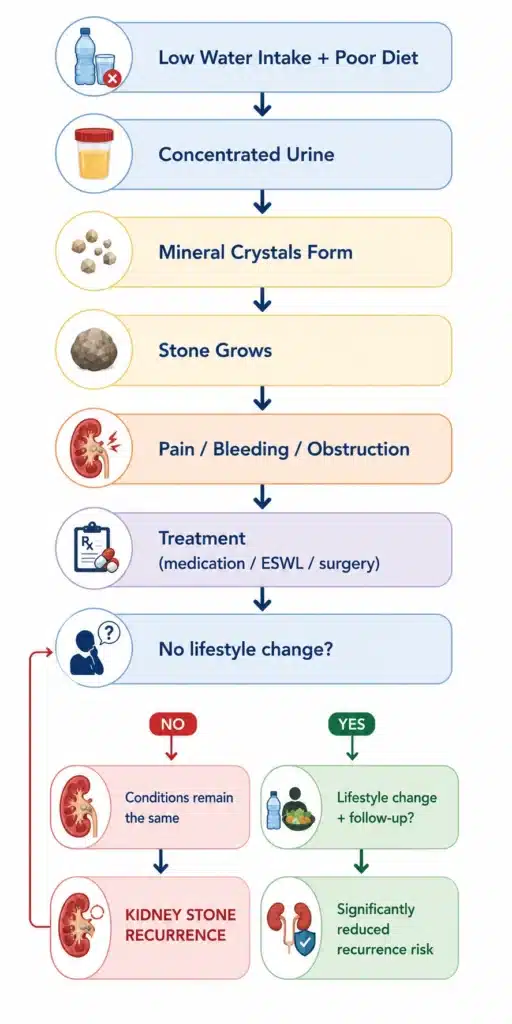
Kidney stone recurrence: A visual flow
This cycle is exactly why treatment without prevention planning leads to chronic kidney stone disease.
Who is at highest risk for chronic kidney stone disease?
Some patients are at significantly elevated risk of developing chronic kidney stone disease, meaning repeated stones over years or decades. If you fall into this group, you need ongoing urological care, not just reactive treatment when pain strikes.
High-risk profile:
- First stone before age 25.
- Strong family history of stones.
- Stones in both kidneys.
- Already had two or more stone episodes.
- Underlying conditions: gout, diabetes, Crohn’s disease, hyperparathyroidism.
- Recurrent urinary tract infections.
- Anatomical kidney abnormalities (horseshoe kidney, medullary sponge kidney).
- Taking medications that raise stone risk (topiramate, vitamin C megadoses, and calcium supplements without adequate water).
Kidney Stone Treatment in Noida: When to See a Urologist
If you have had a kidney stone before, or if you are experiencing kidney stone recurrence symptoms, do not wait for the pain to become unbearable.
Seeing the best urologist in Noida early means the following:
- Stone composition can be analyzed to guide prevention.
- Metabolic causes can be identified before more stones form.
- Medical therapy can be started to reduce future risk.
- Complex or large stones can be treated with minimal recovery time.
Rama Hospital in Noida offers comprehensive care for patients with kidney stone recurrence, from initial diagnosis to stone removal to long-term prevention planning. Their urology team focuses on understanding the root cause of each patient’s stone disease, not just removing the stone that brought them in.
If you are based in Noida or the NCR region and dealing with recurrent stones, an early consultation at Rama Hospital with the best urologist in Noida can genuinely change the pattern you have been stuck in.
Frequently Asked Questions (FAQs)
Q: I already had one stone removed. Does that mean I am cured?
No. Treatment removes the stone but does not fix the conditions that created it. Without dietary changes, hydration improvement, and sometimes medication, kidney stone recurrence is very likely, especially within 5 years.
Q: How will I know if my stone has come back? Will it always hurt?
Not always. Some stones are silent until they grow large or move. That is why regular ultrasound follow-ups matter. When symptoms do appear, they typically include flank pain, blood in urine, burning urination, or a frequent urge to urinate. These are your early warning signs.
Q: My doctor said it was a calcium stone. Should I stop drinking milk?
This is one of the most common misconceptions about calcium oxalate stone recurrence. Cutting out dairy is usually not recommended. In fact, dietary calcium from food helps bind oxalate in the gut before it reaches the kidneys. The problem is usually high-oxalate foods and low water intake, not calcium from dairy.
Q: I drink “enough” water. Why did my stone come back?
“Enough” is relative. If your urine is dark yellow, you need more. If your diet is high in salt or protein, your kidneys need even more water to flush the extra load. In hot climates like Delhi-NCR, most people need more water than they think.
Q: Can the same type of stone come back, or will the next one be different?
In most cases, kidney stone recurrence tends to follow the same type. If you had a calcium oxalate stone, your next one is likely to be calcium oxalate too. This is actually useful; it allows your doctor to give you very targeted dietary and medication advice.
Q: Is surgery the only option if my stone keeps coming back?
Not at all. Most stones under 6mm pass on their own with medications and hydration. Larger stones may need ESWL (shockwave lithotripsy), ureteroscopy, or PCNL depending on size and location. Long-term prevention is about medical management and lifestyle; surgery is only for when stones are already causing problems.
Q: My father had kidney stones. Am I automatically going to get them too?
Not automatically, but family history and kidney stones do increase your risk significantly, 2 to 3 times higher than average. The good news is that knowing your family history lets you be proactive. Staying well-hydrated, limiting salt and animal protein, and getting periodic urine tests can help you stay stone-free even with a genetic predisposition.
Q: What is the single most important thing I can do to prevent kidney stone recurrence?
Drink more water. This single habit, consistently keeping urine dilute throughout the day, is the most evidence-backed way to reduce kidney stone recurrence. Everything else (diet, medication, follow-ups) builds on top of this foundation.