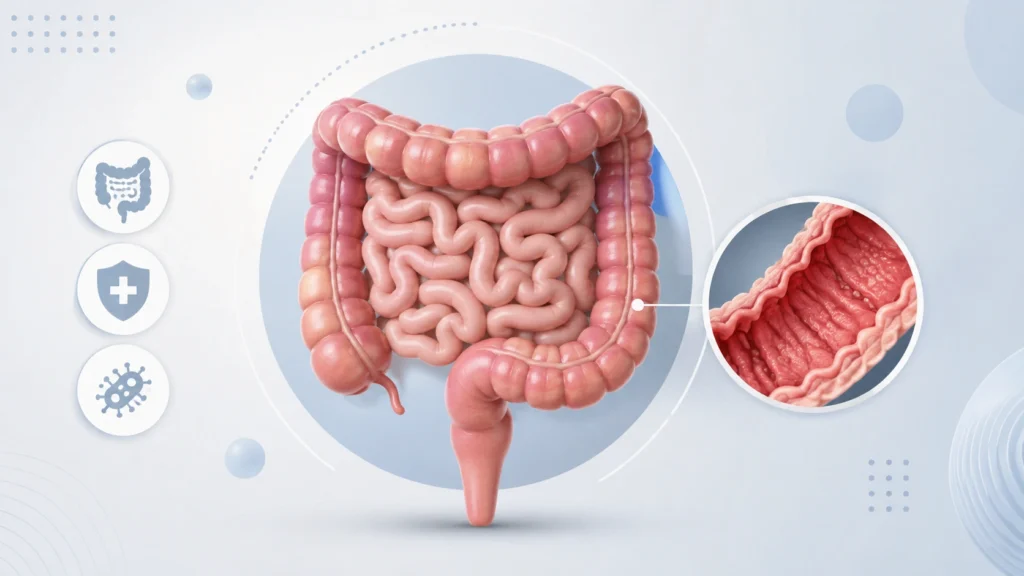
Most people think of the gut as just a place where food is digested. But when inflammation becomes chronic, the digestive system can turn into the source of ongoing pain, fatigue, urgency, weight loss, and stress that affects almost every part of life.
That is what happens in Inflammatory Bowel Disease, commonly called IBD. It is not the same as a simple stomach infection, food poisoning, acidity, or temporary upset stomach. IBD is a long-term condition in which the immune system causes persistent inflammation in the digestive tract. The two main forms are Crohn’s disease and ulcerative colitis.
Crohn’s disease can affect any part of the digestive tract, from the mouth to the anus, and it may involve deep layers of the bowel wall. Ulcerative colitis mainly affects the large intestine, especially the colon and rectum, and typically involves the inner lining of the bowel. Both conditions can be mild, moderate, or severe, and both may come and go in flares.
For many patients, the first signs are easy to dismiss. Loose motions, abdominal discomfort, blood in stool, urgent need to pass stool, low appetite, or tiredness may not seem serious at first. But when these symptoms continue for weeks or keep returning, they may point to IBD. Early diagnosis matters because treatment can reduce inflammation, control symptoms, and prevent complications.
Inflammatory Bowel Disease is a chronic condition in which the immune system attacks parts of the digestive tract, leading to long-term inflammation. This inflammation can damage the bowel lining, cause ulcers, affect absorption of food, and lead to repeated symptoms that may flare up and settle down over time.
IBD is an umbrella term for two main diseases:
Although both are inflammatory bowel disorders, they are not the same. They differ in where they affect the gut, how deep the inflammation goes, and what complications they may cause. Some patients may have symptoms that overlap or make diagnosis harder at the beginning.
IBD should not be confused with irritable bowel syndrome (IBS). IBS is a functional disorder and does not cause visible inflammation or ulcers in the bowel. IBD, on the other hand, is an inflammatory disease that can be confirmed through blood tests, stool tests, imaging, and endoscopy.
Understanding the difference between Crohn’s disease and ulcerative colitis is important because the treatment plan may vary depending on which type of IBD a patient has.
Crohn’s disease can affect any part of the gastrointestinal tract, from the mouth to the anus. It often affects the end of the small intestine and the beginning of the large intestine, but it may appear anywhere in a patchy pattern. The inflammation can go deep into the bowel wall, which increases the risk of strictures, fistulas, and abscesses.
Common features of Crohn’s disease include:
Ulcerative colitis affects the colon and rectum. The inflammation usually starts in the rectum and spreads upward in a continuous pattern. It mainly affects the inner lining of the bowel.
Common features of ulcerative colitis include:
Main differences
IBD can occur in both men and women. It is commonly diagnosed in adolescents and young adults, though older adults can also develop it. Not everyone with a risk factor will develop IBD. But if symptoms continue or repeatedly return, medical evaluation is important.
The exact cause of IBD is not fully known. It is believed to happen because of a combination of genetics, immune dysfunction, gut bacteria imbalance, and environmental triggers.
IBD is not caused by eating something wrong once. It is not just a food allergy or infection. It is a complex immune-mediated disease that requires specialist treatment.
Symptoms vary depending on whether the patient has Crohn’s disease or ulcerative colitis, how severe the inflammation is, and which part of the bowel is affected.
IBD may also affect other organs and systems.
IBD is more than just a bowel condition. It can affect school, work, travel, social activities, sleep, nutrition, and mental health.
A person with IBD may avoid eating outside, travelling long distances, or attending events because of bowel urgency or fear of flare-ups. Repeated abdominal pain and diarrhoea can also affect concentration and confidence. For some patients, the emotional burden becomes as difficult as the physical symptoms.
That is why treatment should not only focus on stopping diarrhoea. It should also aim to reduce flares, improve nutrition, restore energy, and help the patient live normally again.
Diagnosis of IBD usually requires multiple tests. Doctors do not rely on symptoms alone, because many digestive problems can look similar.
Early and accurate diagnosis helps guide the right treatment plan and prevents complications from being missed.
A colonoscopy allows the doctor to look directly at the bowel lining and take tissue samples. This is one of the most important ways to confirm IBD and distinguish Crohn’s disease from ulcerative colitis.
IBD treatment depends on the type of disease, the severity of inflammation, symptoms, and whether the patient has complications. The main goals are to reduce inflammation, control symptoms, heal the bowel, maintain remission, and improve long-term health.
Medicines are usually the first line of treatment for both Crohn’s disease and ulcerative colitis.
Aminosalicylates
These are often used especially in mild to moderate ulcerative colitis.
Corticosteroids
Steroids may be used during flare-ups to quickly reduce inflammation.
Immunomodulators
These medicines help control the immune system over a longer period.
Biologic therapy
Biologics are advanced medicines used in moderate to severe IBD or when other medicines do not work well.
Supportive care is also important because IBD can affect nutrition, energy, hydration, and overall strength.
Surgery is sometimes needed, especially in complicated disease. Surgery is not the first choice for most patients, but it can be life-saving in severe cases.
In Crohn’s disease surgery may be needed for:
In ulcerative colitis surgery may be needed for:
IBD care is usually not one single medicine. It works best when treatment is combined with diet guidance, follow-up, and lifestyle support.
Many patients with IBD struggle with food intake because they fear symptoms. But nutrition is important for healing and energy.
Helpful strategies may include:
Stress does not directly cause IBD, but it can worsen symptoms and affect quality of life. Some patients may benefit from sleep support, counselling, relaxation techniques, or structured psychological care.
If IBD is not well controlled, it may lead to complications. Complications do not happen in every patient, but the risk is higher when inflammation continues unchecked for long periods.
A person should seek medical care if they have:
IBD is a chronic condition that often needs long-term specialist care. A hospital setting is important because the diagnosis may require endoscopy, imaging, lab testing, medication monitoring, and coordinated specialist support.
No. IBS is a functional bowel disorder and does not cause inflammation or ulcers in the bowel. IBD is a true inflammatory disease that can damage the digestive tract and needs medical treatment.
IBD is usually a long-term condition, so it may not be “cured” in the usual sense. But it can often be controlled well with the right treatment, and many patients live active, normal lives.
Crohn’s disease can affect any part of the digestive tract and may involve deeper layers of the bowel wall. Ulcerative colitis mainly affects the colon and rectum and usually involves the inner lining.
Not always. Blood in stool is more common in ulcerative colitis, but Crohn’s disease may also cause it in some cases. Some patients mainly have diarrhoea, pain, and weight loss without visible bleeding.
No. Many people manage IBD with medicines and follow-up alone. Surgery is usually reserved for complications, severe disease, or when medicines do not work well enough.
Diet is important, but it usually cannot replace medical treatment. Food changes may help symptoms and support nutrition, but inflammation often needs proper medicines.
Yes. IBD can affect the eyes, skin, joints, liver, and overall energy levels. That is why a full-body approach to care is important.
Inflammatory Bowel Disease is a serious but manageable long-term condition. Crohn’s disease and ulcerative colitis can both affect digestion, energy levels, nutrition, and daily life, but with timely diagnosis and proper treatment, symptoms can often be controlled and complications reduced.
The key is not to ignore repeated bowel symptoms or assume they are just acidity, infection, or stress. When diarrhoea, blood in stool, abdominal pain, fatigue, or weight loss keep happening, proper medical evaluation is important. With specialist care, the right medicines, nutrition support, and ongoing monitoring, many patients with IBD can maintain remission and live well.
Rama Hospital can provide expert evaluation and treatment for IBD, including Crohn’s disease and ulcerative colitis, with a focus on accurate diagnosis, medical management, and long-term support.
Inflammatory bowel disease (IBD) includes Crohn’s disease and ulcerative colitis. IBD causes symptoms like belly pain and cramps, diarrhea and blood in your poop (stool).
No rows found.