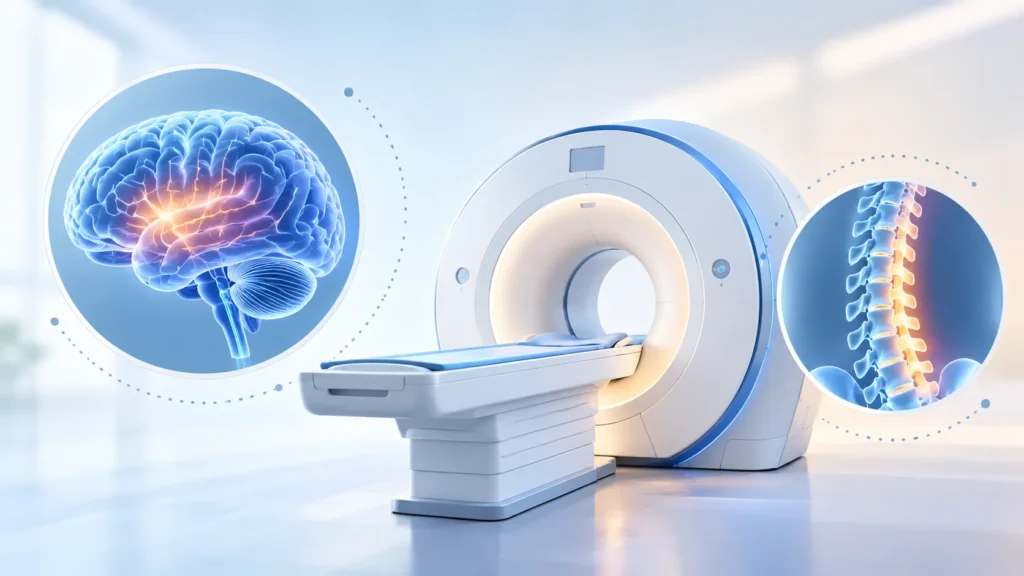
MRI Brain & Spine scans are advanced imaging tests that help doctors see detailed pictures of the brain, spinal cord, and surrounding structures. MRI stands for Magnetic Resonance Imaging. It uses a strong magnetic field and radio waves to create clear, detailed images without using X-rays or radiation. This makes MRI a safe and highly useful test for diagnosing many neurological and spinal conditions.
Many people are asked to get an MRI Brain & Spine scan when they have symptoms such as persistent headache, dizziness, back pain, numbness, weakness, seizures, or unexplained neurological problems. The scan helps doctors find the cause of symptoms, check for injury or disease, and plan the right treatment. Because MRI gives very detailed images, it can detect problems that may not show up on X-rays or CT scans.
What is MRI Brain & Spine?
MRI Brain & Spine is a type of imaging test that uses magnetic fields and radio waves to create detailed pictures of the brain and spinal cord. Unlike X-rays or CT scans, MRI does not use radiation. Instead, it uses a strong magnet and radio signals to produce high-resolution images.
The scan can show the brain, spinal cord, nerves, discs, bones, and surrounding tissues in great detail. This helps doctors identify problems such as tumors, inflammation, infections, injuries, disc issues, nerve compression, and other neurological or spinal conditions.
MRI Brain & Spine can be done as a single combined scan or as separate scans for the brain and spine depending on the patient’s symptoms and medical need. The test is painless and usually takes between thirty minutes to an hour depending on the area being scanned.
Why is MRI Brain & Spine Done?
MRI Brain & Spine is done to diagnose, monitor, or plan treatment for many conditions affecting the brain, spinal cord, and surrounding structures.
Common reasons for MRI Brain
- Persistent or severe headache.
- Dizziness or balance problems.
- Seizures or epilepsy.
- Stroke or suspected stroke.
- Memory problems or confusion.
- Tumors or abnormal growths.
- Infections such as meningitis or encephalitis.
- Multiple sclerosis or other demyelinating diseases.
- Head injury or trauma.
- Vision or hearing problems.
- Unexplained neurological symptoms.
Common reasons for MRI Spine
- Chronic back or neck pain.
- Numbness or tingling in arms or legs.
- Weakness in limbs.
- Disc problems or herniation.
- Spinal cord compression.
- Spinal tumors or infections.
- Spinal injury or trauma.
- Nerve compression or radiculopathy.
- Evaluation before spine surgery.
- Monitoring after spine surgery.
Why doctors may recommend MRI
- To find the cause of symptoms.
- To check for injury or disease.
- To plan surgery or other treatment.
- To monitor known conditions over time.
- To guide procedures such as biopsy or injection.
Types of MRI Brain & Spine
MRI Brain & Spine can be done in different ways depending on the area and purpose of the scan.
Based on area scanned
- MRI Brain, which focuses on the brain and surrounding structures.
- MRI Spine, which focuses on the spinal cord, discs, and vertebrae.
- MRI Brain & Spine combined, which scans both areas in one session.
Based on use of contrast
- Non-contrast MRI, which uses only magnetic fields and radio waves.
- Contrast MRI, which uses a special dye injected through a vein to highlight certain tissues or blood vessels.
Based on purpose
- Diagnostic MRI, done to find the cause of symptoms.
- Follow-up MRI, done to monitor known conditions.
- Pre-surgical MRI, done to plan surgery.
- Post-treatment MRI, done to check recovery or recurrence.
How to Prepare for MRI Brain & Spine
Preparation for MRI is usually simple, but some steps are important for safety and image quality.
Before the scan
- Inform the staff about any implants, pacemakers, or metal in the body.
- Remove all metal items such as jewelry, watches, and hearing aids.
- Tell the staff if you are pregnant or may be pregnant.
- Inform the staff about any allergies, especially to contrast dye.
- Follow instructions about eating or drinking if contrast is being used.
- Wear comfortable clothing without metal parts.
- Arrive a little early to complete paperwork and safety checks.
For patients with implants or devices
- Some implants such as pacemakers or certain aneurysm clips may not be safe for MRI.
- Always inform the staff about any surgical implants or devices.
- The radiology team will check safety before proceeding.
For children or anxious patients
- Parents may be allowed to stay nearby in some cases.
- Sedation may be considered for young children or patients who cannot stay still.
- The staff will explain the procedure and answer questions before starting.
What Happens During the MRI Scan?
The MRI scan is painless and usually takes between thirty minutes to an hour depending on the area being scanned.
During the scan
- You will lie on a movable table that slides into the MRI machine.
- The machine is a large, tube-shaped scanner.
- You must stay very still during the scan to get clear images.
- The machine makes loud knocking or tapping sounds during the scan.
- Earplugs or headphones are usually provided to reduce noise.
- The staff can communicate with you through an intercom.
- If contrast is used, it is injected through a vein before or during the scan.
How long does it take
- MRI Brain usually takes about thirty to forty-five minutes.
- MRI Spine may take about thirty to forty-five minutes depending on the area.
- Combined MRI Brain & Spine may take about an hour or more.
What you may feel
- The scan itself is painless.
- You may feel slight warmth in the area being scanned.
- The machine may feel noisy or enclosed.
- Some people feel anxious in tight spaces, so inform the staff if this happens.
Benefits of MRI Brain & Spine
MRI is one of the most detailed and useful imaging tests for neurological and spinal conditions.
Key benefits
- Very detailed images of brain, spinal cord, and surrounding tissues.
- No radiation exposure, unlike X-rays or CT scans.
- Helps detect problems early.
- Useful for planning surgery or treatment.
- Can monitor conditions over time.
- Safe for most patients, including children and pregnant women in certain cases.
Why MRI is preferred
- Better soft tissue detail than CT or X-ray.
- Can detect small lesions, inflammation, or nerve compression.
- Useful for a wide range of neurological and spinal conditions.
- Non-invasive and painless.
Risks and Safety of MRI
MRI is generally very safe, but there are some important safety considerations.
Safety points
- No radiation is used.
- Safe for most patients including children and pregnant women in many cases.
- Some implants or devices may not be safe, so always inform the staff.
- Contrast dye may cause allergic reactions in rare cases.
- Patients with kidney problems may need special care if contrast is used.
- Claustrophobia or anxiety can be managed with support or sedation if needed.
Who should inform the staff before MRI
- Patients with pacemakers or defibrillators.
- Patients with aneurysm clips or metal implants.
- Patients with cochlear implants.
- Patients with metal fragments in the body.
- Pregnant women.
- Patients with kidney disease or allergies.
- Patients with claustrophobia or anxiety.
Recovery After MRI Brain & Spine
Recovery after MRI is usually immediate, and most patients can return to normal activities right away.
After the scan
- You can usually go home the same day.
- If contrast was used, drink plenty of water to help flush it out.
- Mild headache or dizziness can happen in some cases but usually passes quickly.
- If sedation was used, arrange for someone to accompany you home.
- Follow any specific instructions given by the radiology team.
When results are ready
- A radiologist will review the images and prepare a report.
- The report is usually shared with your doctor within a day or two.
- Your doctor will explain the findings and plan the next steps.
When is MRI Brain & Spine Needed?
MRI Brain & Spine may be needed in many situations depending on symptoms and medical history.
Common situations
- Persistent headache or dizziness.
- Seizures or unexplained neurological symptoms.
- Back or neck pain with numbness or weakness.
- Suspected disc problems or nerve compression.
- Stroke or suspected stroke.
- Tumors or abnormal growths.
- Infections or inflammation.
- Spinal injury or trauma.
- Evaluation before or after surgery.
- Monitoring of known conditions.
Why Choose Rama Hospital for MRI Brain & Spine?
MRI Brain & Spine requires advanced technology, experienced radiologists, and a comfortable patient experience. A hospital with modern imaging facilities and expert staff can make a major difference in diagnosis and care.
Why hospital care matters
- Advanced MRI machines for detailed imaging.
- Experienced radiologists for accurate reporting.
- Safe and comfortable scanning environment.
- Support for anxious or claustrophobic patients.
- Fast and reliable reporting.
- Coordinated care with neurology, neurosurgery, and other departments.
Trust and authority points
- Modern imaging technology.
- Experienced radiology and technical staff.
- Patient safety and comfort as priority.
- Clear communication of results and next steps.
- Comprehensive care from diagnosis to treatment planning.
Frequently Asked Questions (FAQs)
1. What is MRI Brain & Spine?
MRI Brain & Spine is an imaging test that uses magnetic fields and radio waves to create detailed pictures of the brain and spinal cord. It helps doctors diagnose many neurological and spinal conditions without using radiation.
2. Is MRI Brain & Spine painful?
No, the scan itself is painless. Some people may feel slight warmth or discomfort from lying still, but the procedure is generally comfortable.
3. How long does an MRI Brain & Spine take?
The scan usually takes between thirty minutes to an hour depending on the area being scanned. Combined scans may take longer.
4. Do I need to prepare for MRI Brain & Spine?
Yes, you should remove metal items, inform staff about implants or allergies, and follow any instructions about eating or drinking if contrast is used.
5. Is MRI safe during pregnancy?
MRI is generally safe during pregnancy, especially after the first trimester. However, always inform the staff if you are pregnant or may be pregnant.
6. Can I eat before MRI Brain & Spine?
If contrast is not used, you can usually eat and drink normally. If contrast is used, follow the specific instructions given by the radiology team.
7. What if I am claustrophobic?
Inform the staff before the scan. They can provide support, headphones, or sedation if needed to help you stay comfortable.
8. When will I get my MRI report?
A radiologist will review the images and prepare a report, usually within a day or two. Your doctor will explain the findings and plan the next steps.
Conclusion
MRI Brain & Spine is a safe, detailed, and highly useful imaging test for diagnosing and monitoring many neurological and spinal conditions. It helps doctors find the cause of symptoms, plan treatment, and monitor recovery without using radiation.
The most important steps are proper preparation, clear communication with the radiology team, and follow-up with your doctor after the scan. For patients with persistent headache, back pain, numbness, or other neurological symptoms, MRI Brain & Spine can provide valuable answers and guide the right treatment.
Rama Hospital can provide advanced MRI Brain & Spine scans with expert radiology care, a comfortable scanning environment, and clear reporting to support accurate diagnosis and effective treatment.