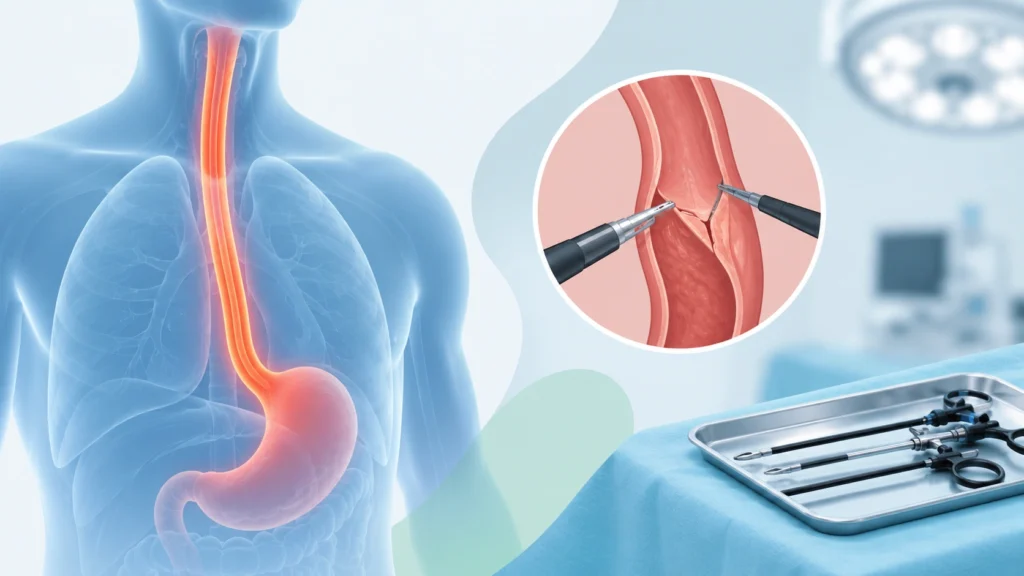
Esophageal surgery refers to surgical procedures performed on the esophagus, the muscular tube that connects the throat to the stomach. These surgeries are done to treat conditions such as severe acid reflux, swallowing difficulties, esophageal cancer, benign tumors, strictures, perforations, and other structural problems. When medicines and less invasive treatments are not enough, surgery may be needed to restore normal function and improve quality of life.
The esophagus plays a critical role in digestion. It moves food from the mouth to the stomach through coordinated muscle contractions. When the esophagus is damaged, narrowed, or affected by disease, a person may experience difficulty swallowing, chest pain, regurgitation, weight loss, or chronic cough. In some cases, these problems can lead to serious complications such as malnutrition, aspiration, or progression of cancer.
What is Esophageal Surgery?
Esophageal surgery involves operative treatment of diseases affecting the esophagus. The goal may be to remove diseased tissue, repair structural problems, improve swallowing, control severe reflux, or treat cancer.
The esophagus is located in the chest and passes through the diaphragm to join the stomach. Because of its location, esophageal surgery may be performed by gastrointestinal surgeons, thoracic surgeons, or a combined team. Some procedures are done through small incisions using minimally invasive techniques, while others require larger incisions depending on the condition.
Esophageal surgery is not a single operation. It includes a range of procedures tailored to the specific problem. The type of surgery depends on the diagnosis, severity of disease, overall health, and surgeon expertise.
Why is Esophageal Surgery Done?
Esophageal surgery is recommended when non-surgical treatments are not sufficient or when the condition is serious enough to require operative intervention.
Common reasons for esophageal surgery
- Severe gastroesophageal reflux disease that does not respond to medicines.
- Large hiatal hernia causing reflux, pain, or breathing problems.
- Difficulty swallowing due to narrowing or stricture.
- Benign tumors or growths in the esophagus.
- Esophageal cancer requiring removal of part or all of the esophagus.
- Perforation or tear in the esophagus.
- Achalasia, a condition where the lower esophageal sphincter does not relax properly.
- Complications of long-standing reflux such as Barrett’s esophagus with high-grade changes.
- Recurrent aspiration due to structural problems.
Goals of surgery
- To relieve symptoms such as reflux, pain, or swallowing difficulty.
- To remove diseased or cancerous tissue.
- To restore normal anatomy and function.
- To prevent complications such as bleeding, perforation, or cancer progression.
- To improve nutrition and quality of life.
Types of Esophageal Surgery
Different procedures are used depending on the underlying condition.
Anti-reflux surgery
- Often done for severe acid reflux or hiatal hernia.
- Common procedure is laparoscopic fundoplication, where the top part of the stomach is wrapped around the lower esophagus to strengthen the valve.
- Helps prevent acid from flowing back into the esophagus.
- Usually done through small incisions using a camera.
Hiatal hernia repair
- Done when part of the stomach pushes up into the chest through the diaphragm.
- The stomach is moved back into the abdomen and the opening in the diaphragm is tightened.
- Often combined with anti-reflux surgery.
- Can be done laparoscopically in many cases.
Esophagectomy
- Involves removal of part or all of the esophagus.
- Often done for esophageal cancer or severe benign disease.
- The remaining esophagus or stomach is connected to restore the passage for food.
- May be done through open or minimally invasive approach depending on the case.
Myotomy for achalasia
- Done for achalasia, where the lower esophageal sphincter does not relax.
- The muscle fibers are cut to allow food to pass more easily.
- Can be done laparoscopically or through an endoscopic approach.
- Helps improve swallowing and reduce regurgitation.
Stricture dilation or stenting
- Done for narrowing of the esophagus.
- A balloon or instrument is used to widen the narrowed area.
- In some cases, a stent is placed to keep the esophagus open.
- May be repeated if narrowing returns.
Removal of benign tumors
- Small growths or cysts in the esophagus may be removed surgically.
- Approach depends on size and location.
- Goal is to relieve symptoms and prevent complications.
Repair of perforation
- Done when there is a tear or hole in the esophagus.
- May happen due to injury, severe vomiting, or medical procedures.
- Requires urgent surgical repair to prevent infection and other complications.
Preparation for Esophageal Surgery
Proper preparation helps reduce risks and improves recovery.
Pre-surgery evaluation
- Detailed medical history and physical examination.
- Review of symptoms such as swallowing difficulty, reflux, weight loss, or pain.
- Blood tests to check overall health and fitness for surgery.
- Imaging tests such as CT scan, MRI, or PET scan if cancer is suspected.
- Endoscopy to visualize the inside of the esophagus.
- Barium swallow study to assess swallowing and structure.
- Esophageal manometry to measure muscle function in selected cases.
- Heart and lung evaluation to ensure safety during anesthesia.
Medication review
- Some medicines may need to be stopped or adjusted before surgery.
- Blood thinners, diabetes medicines, and certain supplements may require special attention.
- The surgical team will provide clear instructions on what to continue or stop.
Lifestyle preparation
- Stop smoking well before surgery to improve healing.
- Limit or avoid alcohol as advised.
- Maintain good nutrition to support recovery.
- Practice breathing exercises if advised.
- Arrange for help at home during the initial recovery period.
Fasting instructions
- Patients are usually asked to avoid food and drink for several hours before surgery.
- Clear instructions are given about when to stop eating and drinking.
- This reduces the risk of aspiration during anesthesia.
What Happens During Surgery?
The exact steps depend on the type of procedure, but there are common elements.
Anesthesia
- Esophageal surgery is done under general anesthesia.
- The patient is fully asleep and does not feel pain during the procedure.
- Breathing is supported through a tube connected to a ventilator.
Surgical approach
- Minimally invasive surgery uses small incisions and a camera.
- Open surgery uses a larger incision in the chest, abdomen, or both.
- The choice depends on the condition, complexity, and surgeon expertise.
Key steps in common procedures
- In anti-reflux surgery, the stomach is wrapped around the lower esophagus to strengthen the valve.
- In hiatal hernia repair, the stomach is repositioned and the diaphragm opening is tightened.
- In esophagectomy, the diseased part of the esophagus is removed and the stomach or intestine is connected to restore continuity.
- In myotomy, the tight muscle at the lower end of the esophagus is cut to improve relaxation.
- In tumor removal, the growth is carefully excised while preserving normal tissue.
Duration of surgery
- Simple procedures may take one to two hours.
- Complex surgeries such as esophagectomy may take several hours.
- The surgical team keeps the family informed about progress.
Recovery After Esophageal Surgery
Recovery varies depending on the type of surgery and the patient’s overall health.
Hospital stay
- Minimally invasive procedures may require a shorter stay.
- Major surgeries such as esophagectomy may need several days in the hospital.
- Some patients may need intensive care monitoring initially.
Pain management
- Pain is expected after surgery but is managed with medicines.
- Pain control helps with breathing, walking, and recovery.
- The team adjusts pain medicines based on comfort and side effects.
Breathing and movement
- Early walking is encouraged to prevent clots and improve lung function.
- Breathing exercises help prevent chest infections.
- Physiotherapy may be advised for major surgeries.
Drain and tube care
- Some patients may have drains or tubes temporarily.
- These help remove fluid or air from the surgical area.
- They are removed when no longer needed.
Diet progression
- Initially, patients may be on liquids only.
- Diet is gradually advanced to soft foods and then regular food.
- Specific instructions are given based on the type of surgery.
- Eating small, frequent meals is often recommended.
Activity restrictions
- Heavy lifting and strenuous activity are restricted for several weeks.
- Walking and light activity are encouraged.
- Driving is resumed only when cleared by the surgeon.
Diet After Esophageal Surgery
Diet plays a major role in recovery and long-term comfort.
Early diet
- Clear liquids such as water, broth, or diluted juices.
- Thick liquids such as soups, yogurt, or smoothies.
- Small sips and slow intake to avoid discomfort.
Soft diet phase
- Soft, easy-to-swallow foods such as mashed potatoes, khichdi, soft rice, boiled vegetables.
- Avoid dry, hard, or sticky foods initially.
- Chew food well and eat slowly.
Long-term diet advice
- Eat small, frequent meals rather than large meals.
- Avoid lying down immediately after eating.
- Limit very spicy, oily, or acidic foods if reflux is a concern.
- Stay well hydrated throughout the day.
- Follow specific advice if there is narrowing or swallowing difficulty.
Foods to be careful with
- Very dry bread or tough meats.
- Large chunks of food.
- Carbonated drinks if they cause bloating.
- Alcohol and smoking, which can irritate the esophagus.
Possible Complications
Like any major surgery, esophageal surgery carries some risks.
General surgical risks
- Bleeding.
- Infection.
- Blood clots.
- Reaction to anesthesia.
- Pneumonia or chest infection.
Esophagus-specific risks
- Leakage at the surgical connection site.
- Narrowing or stricture at the connection.
- Difficulty swallowing that persists or returns.
- Reflux symptoms that may continue or change.
- Injury to nearby structures such as nerves, lungs, or blood vessels.
- Hoarseness or voice changes due to nerve involvement.
- Need for additional procedures or revision surgery.
Long-term considerations
- Some patients may need long-term dietary adjustments.
- Regular follow-up is important to monitor healing and function.
- Additional treatment may be needed if cancer was the reason for surgery.
Follow-Up Care
Regular follow-up helps ensure proper healing and early detection of any problems.
Follow-up schedule
- First visit is usually within one to two weeks after discharge.
- Further visits depend on the type of surgery and recovery.
- Additional tests may be done if symptoms persist.
Monitoring
- Assessment of swallowing and reflux symptoms.
- Review of diet tolerance and weight.
- Evaluation of wound healing.
- Adjustment of medicines as needed.
Long-term follow-up
- For cancer patients, regular imaging and endoscopy may be advised.
- For reflux surgery, follow-up ensures symptoms remain controlled.
- For achalasia or stricture, monitoring helps detect recurrence early.
When to Seek Medical Help?
Certain symptoms after surgery need prompt medical attention.
- Fever or chills.
- Increasing pain not relieved by medicines.
- Redness, swelling, or discharge from the wound.
- Difficulty swallowing that worsens.
- Persistent vomiting.
- Chest pain or shortness of breath.
- Unexplained weight loss.
- New or worsening reflux symptoms.
Why Choose Rama Hospital for Esophageal Surgery?
Esophageal surgery is complex and requires specialized skills, advanced technology, and coordinated care. A hospital with experienced gastrointestinal and thoracic surgeons can make a major difference in outcomes.
- Expert evaluation by specialized surgeons.
- Advanced minimally invasive and open surgical options.
- Comprehensive pre-operative assessment.
- Dedicated post-operative care and monitoring.
- Nutrition and diet support during recovery.
- Long-term follow-up for function and disease control.
Frequently Asked Questions (FAQs)
Is esophageal surgery painful?
Some pain is expected after surgery, but it is managed with medicines. Most patients find that pain improves significantly within the first few days to weeks. Pain control is an important part of recovery.
How long is the hospital stay?
Hospital stay depends on the type of surgery. Minimally invasive procedures may need a shorter stay, while major surgeries such as esophagectomy may require several days in the hospital.
Will I be able to eat normally after surgery?
Most patients can return to a near-normal diet over time. Initially, the diet is restricted to liquids and soft foods. Long-term, small frequent meals and careful chewing are often recommended.
Can reflux come back after anti-reflux surgery?
Reflux can return in some patients, especially if lifestyle measures are not followed. Most patients experience significant improvement. Follow-up helps manage any persistent or recurrent symptoms.
Is esophageal surgery safe?
Esophageal surgery is generally safe when performed by experienced surgeons in a well-equipped hospital. Like any major surgery, it carries some risks, which are explained before the procedure.
Will I need follow-up after surgery?
Yes, regular follow-up is important to monitor healing, diet tolerance, and symptom control. For cancer patients, long-term surveillance is essential to detect any recurrence early.
Conclusion
Esophageal surgery is an important treatment option for patients with severe reflux, swallowing problems, tumors, cancer, or structural issues of the esophagus. While it is a major surgery, modern techniques and expert care have improved safety and outcomes significantly.
The most important steps are proper evaluation, choosing the right procedure, careful preparation, and dedicated post-operative care. For patients with persistent symptoms, difficulty swallowing, or diagnosed esophageal disease, surgical evaluation can make a major difference. With the right support, most patients recover well and regain comfortable eating and digestion.
Rama Hospital can provide comprehensive evaluation, advanced surgical options, and structured post-operative care for patients requiring esophageal surgery, with a focus on safety, recovery, and long-term quality of life.