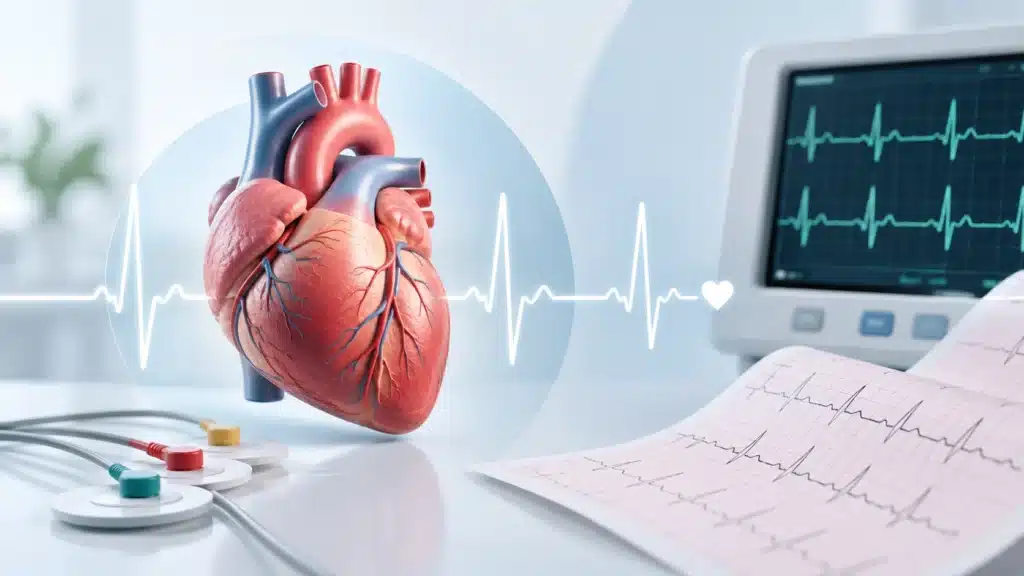
An electrocardiogram, commonly known as ECG or EKG, is one of the most basic and important tests used to evaluate heart health. It is a simple, painless, and non-invasive test that records the electrical activity of the heart. Every heartbeat is triggered by an electrical signal that travels through the heart muscle. The ECG captures these signals and displays them as waves on a graph, which doctors can analyze to understand how well the heart is functioning.
ECG is used in many situations, from routine health check-ups to emergency evaluation of chest pain, palpitations, breathlessness, fainting, or suspected heart attack. It helps detect abnormal heart rhythms, previous heart damage, thickening of heart muscle, electrolyte imbalances, and effects of certain medicines. Despite being a quick test, it provides valuable information that guides further diagnosis and treatment.
What is an Electrocardiogram (ECG)?
An electrocardiogram is a test that measures and records the electrical activity of the heart over a short period of time. Small sticky patches called electrodes are placed on the skin of the chest, arms, and legs. These electrodes are connected to a machine that detects the electrical signals produced by the heart with each beat.
The heart has its own electrical system that controls the timing and coordination of each heartbeat. When this system works normally, the heart beats in a regular rhythm at an appropriate rate. When there is a problem, the electrical signals may become irregular, too fast, too slow, or abnormal in pattern. The helps identify these changes.
The test is safe, painless, and does not send any electricity into the body. It simply records what the heart is doing electrically. The entire process usually takes only a few minutes, and results are often available quickly for the doctor to review.
Why is ECG Done?
ECG is one of the first tests ordered when heart-related symptoms are present. It is also used for routine screening in certain patients.
Common reasons for doing an ECG
- Evaluation of chest pain or discomfort.
- Assessment of palpitations or irregular heartbeat.
- Investigation of breathlessness or reduced exercise tolerance.
- Evaluation of fainting or dizziness.
- Detection of previous heart attack or heart damage.
- Monitoring of known heart disease.
- Pre-operative assessment before surgery.
- Routine check-up in patients with high blood pressure, diabetes, or high cholesterol.
- Monitoring effects of certain medicines on the heart.
- Screening in patients with family history of heart disease.
Situations where ECG is especially important
- Emergency evaluation of suspected heart attack.
- Assessment of abnormal heart rhythms such as atrial fibrillation.
- Evaluation of patients with pacemakers or other heart devices.
- Monitoring during hospital admission for heart or lung conditions.
- Assessment before starting certain medications that can affect heart rhythm.
How is ECG Performed?
The procedure is simple and straightforward. It is usually done in a clinic, hospital room, or emergency department by a trained technician or nurse.
Step-by-step procedure
- The patient is asked to lie down on a bed or examination table.
- The chest, arms, and legs are exposed slightly to place electrodes.
- The skin may be cleaned to ensure good contact.
- Small sticky electrodes are placed on specific positions on the chest, wrists, and ankles.
- Wires connect the electrodes to the ECG machine.
- The patient is asked to lie still, breathe normally, and avoid talking during the recording.
- The machine records the heart’s electrical activity for a few seconds.
- The electrodes are removed after the recording is complete.
- The ECG strip or digital report is generated for the doctor to interpret.
What the patient may feel
- No pain or discomfort during the test.
- Slight coolness from the electrodes or gel.
- Need to lie still for a short time.
- Possible mild skin irritation from adhesive in sensitive individuals.
Duration of the test
- The actual recording takes only a few seconds.
- The entire process including preparation usually takes 5 to 10 minutes.
- Results are often available within minutes for urgent cases.
Types of ECG
There are different types of tests depending on the clinical need.
Resting ECG
- This is the standard ECG done while the patient is lying down at rest.
- It is the most common type used in clinics and hospitals.
- It provides a snapshot of heart activity at that moment.
Stress ECG or Exercise ECG
- This is done while the patient walks on a treadmill or cycles.
- It helps evaluate how the heart responds to exercise.
- It is useful for detecting reduced blood flow to the heart that may not be visible at rest.
Holter Monitor
- This is a portable ECG device worn for 24 to 48 hours or longer.
- It continuously records heart rhythm during daily activities.
- It is useful for detecting intermittent arrhythmias that may not appear on a resting ECG.
Event Monitor
- This is worn for weeks to months and records only when symptoms occur.
- The patient activates the device when they feel symptoms.
- It is useful for infrequent palpitations or fainting episodes.
Echocardiogram is different from ECG
- This records electrical activity.
- Echocardiogram uses ultrasound to create images of heart structure and function.
- Both tests are often used together for complete cardiac evaluation.
Preparation for ECG
This requires minimal preparation, but a few simple steps can help ensure a good quality recording.
Before the test
- Wear comfortable clothing that allows easy access to the chest, arms, and legs.
- Avoid applying oily creams, lotions, or powders on the chest on the day of the test.
- Inform the doctor about all medicines being taken.
- Inform about any known skin allergies to adhesives.
- Continue regular medicines unless advised otherwise by the doctor.
On the day of the test
- Arrive a few minutes early to complete any paperwork.
- Remove jewelry or metal objects from the chest area.
- Inform the technician if you feel anxious or have difficulty lying flat.
- Follow any specific instructions given by the hospital or clinic.
Special considerations
- No fasting is required for a standard resting ECG.
- For stress, specific instructions about food, medicines, and exercise may be given.
- For Holter or event monitors, bathing instructions will be provided since the device must stay dry.
Understanding ECG Results
This results are interpreted by a doctor, usually a cardiologist or physician trained in reading ECGs. The report shows waves and intervals that represent different parts of the heart’s electrical cycle.
What the doctor looks for
- Heart rate, whether it is normal, too fast, or too slow.
- Heart rhythm, whether it is regular or irregular.
- Signs of previous heart attack or reduced blood flow.
- Evidence of thickened heart muscle or enlarged chambers.
- Abnormal conduction patterns or blocks.
- Effects of electrolyte imbalances or medications.
- Signs of inflammation of the heart lining or sac.
Common findings that may be reported
- Normal sinus rhythm, which means normal heart rhythm.
- Sinus tachycardia, which means fast but regular rhythm.
- Sinus bradycardia, which means slow but regular rhythm.
- Atrial fibrillation, which is an irregular and often fast rhythm.
- Extra beats such as premature atrial or ventricular contractions.
- ST segment changes that may suggest reduced blood flow or heart attack.
- Bundle branch blocks that indicate delayed conduction in certain parts of the heart.
- QT interval prolongation that may increase risk of certain arrhythmias.
What happens after the test
- The doctor reviews the ECG in the context of symptoms and medical history.
- If the ECG is normal but symptoms persist, further tests may be advised.
- If the ECG is abnormal, additional evaluation such as echocardiogram, stress test, or blood tests may be needed.
- Treatment is planned based on the overall clinical picture, not just the alone.
Limitations of ECG
While this is a very useful test, it has some limitations that patients should understand.
Important limitations
- A normal ECG does not always rule out heart disease.
- Some heart problems may not show up on a single resting ECG.
- This cannot show the structure of the heart or blockages in arteries directly.
- Some abnormalities may be temporary and not captured during the short recording.
- Interpretation depends on the quality of the recording and the experience of the reader.
Why additional tests may be needed
- Echocardiogram may be needed to assess heart structure and function.
- Stress test may be needed to evaluate blood flow during exercise.
- Coronary angiography may be needed to visualize artery blockages.
- Blood tests may be needed to check for heart damage or electrolyte issues.
- Holter or event monitor may be needed for intermittent symptoms.
Role of ECG in Heart Care
This plays a central role in cardiac evaluation and ongoing heart care.
In emergency care
- First test done for chest pain to rule out heart attack.
- Helps identify dangerous arrhythmias that need immediate treatment.
- Guides urgent decisions about medications, admission, or procedures.
In outpatient care
- Part of routine evaluation for palpitations, breathlessness, or fainting.
- Baseline test for patients with high blood pressure, diabetes, or high cholesterol.
- Monitoring tool for patients on certain heart or psychiatric medications.
In pre-operative assessment
- Done before major surgeries to assess cardiac risk.
- Helps identify patients who may need further cardiac evaluation before surgery.
- Provides baseline information for anesthesia and surgical teams.
In long-term follow-up
- Used to monitor known heart conditions over time.
- Helps assess response to treatment for arrhythmias or heart failure.
- Part of regular check-ups for patients with pacemakers or heart devices.
Safety and Risks
This is a very safe test with minimal risks.
Safety features
- Non-invasive and painless.
- No radiation involved.
- No electricity sent into the body.
- Can be repeated as often as needed.
- Safe for children, adults, and elderly patients.
Possible minor issues
- Mild skin irritation or redness where electrodes are placed.
- Discomfort from shaving small areas of chest hair if needed for good contact.
- Anxiety in some patients due to medical setting or worry about results.
Special situations
- Safe during pregnancy as it does not involve radiation.
- Safe for patients with pacemakers or defibrillators.
- Can be done in bedridden or critically ill patients.
When is ECG Recommended?
This is recommended in many clinical scenarios where heart evaluation is needed.
Common recommendations
- Chest pain, pressure, or tightness.
- Palpitations or feeling of irregular heartbeat.
- Unexplained breathlessness or reduced exercise capacity.
- Fainting, near-fainting, or unexplained dizziness.
- Known heart disease requiring monitoring.
- High-risk patients with multiple cardiac risk factors.
- Pre-operative clearance for moderate to high-risk surgeries.
- Routine screening in patients with diabetes, hypertension, or high cholesterol.
- Evaluation before starting certain medications that can affect heart rhythm.
- Family history of sudden cardiac death or inherited heart conditions.
When ECG may not be needed
- Routine screening in very low-risk young individuals without symptoms.
- Minor illnesses where heart involvement is not suspected.
- When recent normal ECG is available and clinical status has not changed.
Why Choose Rama Hospital for ECG and Cardiac Care?
This is just one part of comprehensive heart care. A hospital with experienced cardiologists, modern equipment, and integrated cardiac services can provide better evaluation and follow-up.
- Accurate ECG recording by trained technicians.
- Immediate interpretation by experienced doctors.
- Access to advanced cardiac tests if further evaluation is needed.
- Integrated care with cardiology, emergency, and critical care teams.
- Follow-up for abnormal results and long-term heart health.
Frequently Asked Questions (FAQs)
Is ECG painful or risky?
No, ECG is not painful and has minimal risks. It does not send electricity into the body and only records the heart’s natural electrical signals. Some people may have mild skin irritation from the electrodes.
Do I need to fast before ECG?
No, fasting is not required for a standard resting ECG. You can eat and drink normally before the test. For stress ECG, specific instructions about food and medicines may be given.
How long does an ECG take?
The actual recording takes only a few seconds. The entire process including preparation usually takes 5 to 10 minutes. Results are often available quickly for the doctor to review.
Can ECG detect all heart problems?
No, this cannot detect all heart problems. Some conditions may not show up on a single resting ECG. Additional tests such as echocardiogram, stress test, or angiography may be needed for complete evaluation.
What if my ECG is abnormal?
An abnormal ECG does not always mean serious heart disease. The doctor will interpret it in the context of your symptoms, history, and other tests. Further evaluation may be advised if needed.
Can ECG be done during pregnancy?
Yes, This is safe during pregnancy as it does not involve radiation. It is often done to evaluate palpitations, chest pain, or breathlessness in pregnant women when heart issues are suspected.
How often should I get an ECG?
The frequency depends on your age, risk factors, and symptoms. People with heart disease or high risk may need regular ECGs. Low-risk individuals without symptoms may not need routine ECGs.
Conclusion
Electrocardiogram (ECG) is a simple, safe, and highly informative test that plays a central role in heart care. It helps evaluate heart rhythm, detect previous heart damage, assess chest pain, and guide treatment decisions. While it has some limitations, it remains one of the first and most important tests in cardiac evaluation.
For patients with chest pain, palpitations, breathlessness, fainting, or known heart disease, ECG provides valuable information that helps doctors plan the right care. When combined with clinical evaluation and other tests, it forms the foundation of modern cardiac diagnosis and treatment.
Rama Hospital can provide accurate ECG testing, expert interpretation, and comprehensive cardiac care including further evaluation, treatment, and long-term follow-up for heart health.