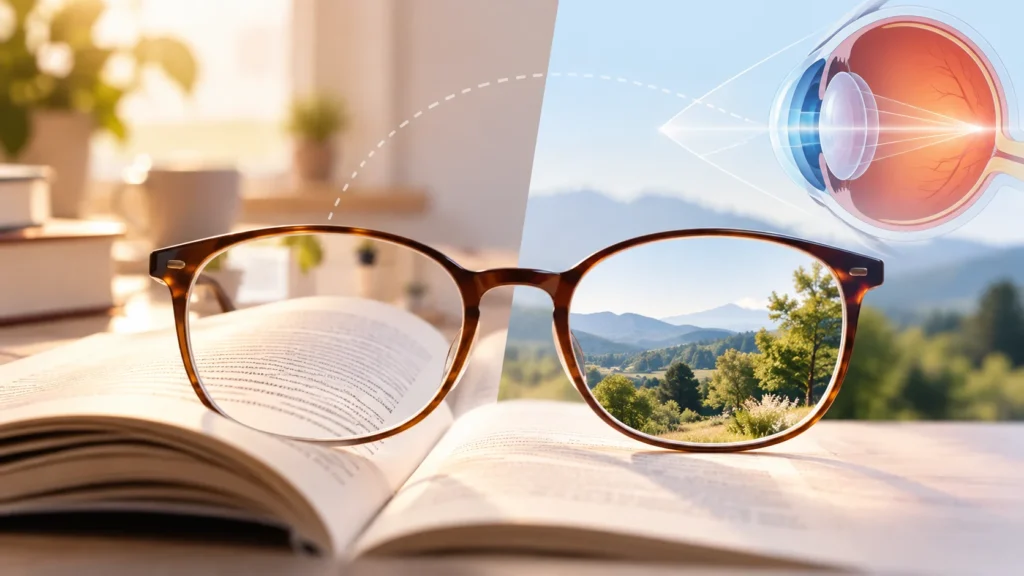
Presbyopia is a common age-related vision condition that makes it difficult to focus on close objects. Most people begin to notice it in their early to mid-forties, when they find themselves holding books, phones, or menus farther away to see clearly. Words may look blurred at normal reading distance, and eyes may feel tired or strained after reading or working on a computer.
This condition is a normal part of aging and happens to almost everyone over time. It is not a disease, but rather a natural change in the way the eye’s lens works. As the lens becomes less flexible with age, it loses its ability to change shape and focus on near objects. This makes tasks like reading, sewing, using a phone, or working on a computer more difficult without help.
Presbyopia is an age-related condition where the eye gradually loses its ability to focus on nearby objects. The word comes from Greek, meaning “old eye.” It typically becomes noticeable around age forty to forty-five and continues to progress slowly until about age sixty to sixty-five, when it tends to stabilize.
The main reason for presbyopia is the natural aging of the eye’s lens. In younger people, the lens is soft and flexible. It can easily change shape to focus on objects at different distances. This process is called accommodation. With age, the lens becomes harder and less flexible. The muscles around the lens also become less effective. As a result, the eye cannot focus clearly on close objects.
Presbyopia affects everyone eventually, regardless of whether they had perfect vision, were nearsighted, or were farsighted earlier in life. Even people who never needed glasses before may find they need reading glasses as they get older.
Presbyopia is caused by natural changes in the eye that occur with aging.
The lens inside the eye is made of layers of protein fibers. Over time, these fibers become more compact and less elastic. At the same time, the muscle that controls the lens does not work as efficiently. Together, these changes reduce the eye’s ability to focus up close, leading to presbyopia.
Symptoms usually develop gradually and become more noticeable over time.
In the early stage, a person may only notice difficulty in dim light or when tired. Over time, they may need to increase the distance for reading. Eventually, reading glasses or other correction become necessary for most near tasks. Without correction, near vision remains blurred, but distance vision may stay clear if there is no other eye problem.
Presbyopia follows a fairly predictable pattern with age.
Diagnosis is based on symptoms, age, and a detailed eye examination.
Presbyopia can coexist with other vision problems such as nearsightedness, farsightedness, or astigmatism. A proper eye exam ensures that the correct type of correction is given and that no other eye disease is missed. Regular eye checks are important, especially after age forty.
Presbyopia cannot be reversed, but it can be corrected effectively. Treatment aims to restore clear near vision and reduce eye strain.
Reading glasses are the simplest and most common solution.
Bifocal lenses have two powers in one lens.
Trifocal lenses have three zones in one lens.
Progressive lenses are multifocal lenses without visible lines.
Contact lenses can also correct presbyopia.
Surgery may be considered for selected patients who want to reduce dependence on glasses.
Some people use a combination of methods.
Simple daily habits can make near vision more comfortable.
Good visual habits reduce strain and fatigue. They do not stop presbyopia, but they make daily tasks more comfortable and help prevent additional stress on the eyes.
Presbyopia itself does not damage the eyes, but uncorrected presbyopia can affect quality of life.
Regular eye examinations ensure that presbyopia is properly corrected and that other age-related eye conditions are detected early. Conditions such as cataract, glaucoma, diabetic retinopathy, and macular degeneration can coexist with presbyopia and need separate management.
Medical evaluation is important for anyone noticing changes in near vision.
Presbyopia itself cannot be prevented, as it is a natural part of aging. However, overall eye health can be supported.
Presbyopia may seem like a simple need for reading glasses, but proper evaluation is important to rule out other eye problems and to choose the right correction. A hospital-based eye care team can provide comprehensive assessment and personalized solutions.
Presbyopia typically begins in the early to mid-forties. Symptoms may start mildly and progress slowly until around age sixty to sixty-five, when they tend to stabilize. The exact age can vary from person to person.
Presbyopia cannot be cured or reversed, as it is a natural part of aging. However, it can be corrected effectively with reading glasses, bifocals, progressive lenses, contact lenses, or selected surgical options. Proper correction restores clear near vision and reduces eye strain.
Most people need some form of near vision correction for the rest of their lives. The power may change over time and then stabilize. Glasses or lenses do not weaken the eyes; they simply help the eyes focus comfortably at near distances.
Yes, multifocal contact lenses and monovision contact lenses can help correct presbyopia. They provide different focusing powers for near and distance. Proper fitting and regular follow-up are important, especially for people with dry eye or other eye conditions.
No, presbyopia is not the same as farsightedness, although both can cause difficulty with near vision. Farsightedness is a refractive error due to the shape of the eye, while presbyopia is an age-related loss of focusing ability. A person can have one, the other, or both.
Surgery can reduce dependence on glasses in selected patients, but it does not stop the aging process of the eye. Options include laser vision correction with monovision or lens-based surgery with multifocal lenses. Suitability depends on eye health, lifestyle, and expectations.
Adults over forty should have a comprehensive eye exam every one to two years, or as advised by their eye specialist. Regular checks ensure that presbyopia is properly corrected and that other age-related eye conditions are detected early.
Presbyopia is a normal, age-related change in vision that affects almost everyone as they grow older. It makes near tasks such as reading, using a phone, or working on a computer more difficult without correction. While it cannot be prevented or reversed, it can be managed very effectively with the right glasses, lenses, or selected surgical options.
The most important steps are timely diagnosis, proper correction, and regular eye examinations. For people noticing increasing difficulty with near vision, eye strain, or headaches after reading, an evaluation by an eye specialist can make daily tasks much more comfortable. With appropriate care, patients can maintain clear vision, reduce strain, and enjoy good quality of life as they age.
Rama Hospital can help evaluate presbyopia, rule out other eye conditions, and provide personalized solutions such as reading glasses, multifocal lenses, contact lenses, or surgical options where appropriate, along with long-term follow-up for healthy aging of the eyes.
Presbyopia is the loss of clear close-up vision that happens when your eye’s lens becomes less flexible.
No rows found.