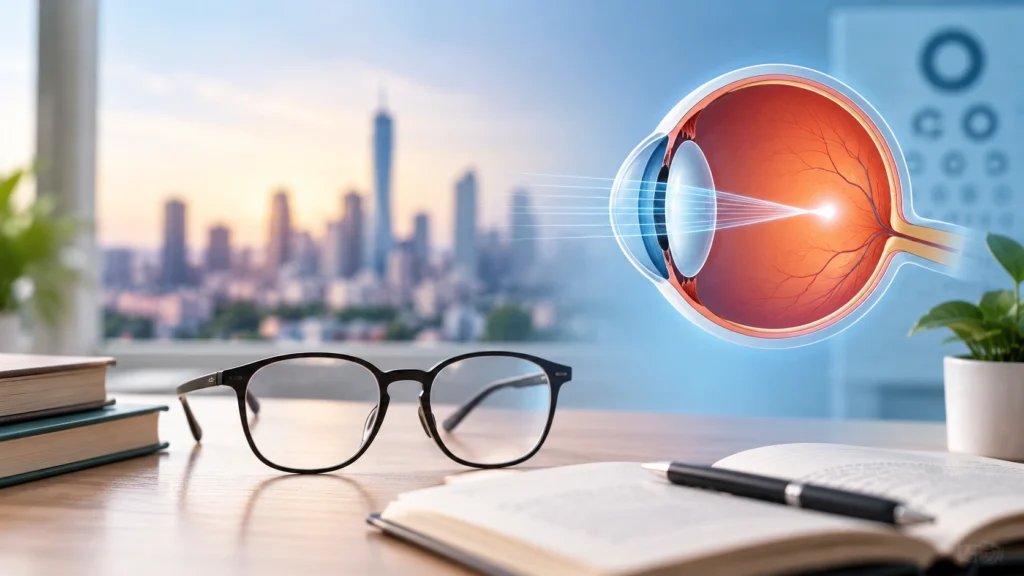
Myopia, commonly known as nearsightedness, is one of the most common vision problems worldwide. A person with myopia can see nearby objects clearly, but distant objects appear blurred. This happens because the eye focuses light in front of the retina instead of directly on it. Myopia can range from mild to severe, and in some cases, it can increase the risk of serious eye problems later in life.
Myopia often begins in childhood or teenage years and may progress as the eye continues to grow. Many parents notice that their child squints, sits too close to the television, or has difficulty reading the board in school. In adults, myopia may remain stable or continue to increase slowly. Without proper correction, it can affect learning, work performance, driving safety, and overall quality of life.
What is Myopia?
Myopia is a refractive error of the eye where distant objects appear blurred while near objects are seen clearly. In a normal eye, light rays focus precisely on the retina at the back of the eye. In myopia, the eye is usually too long from front to back, or the focusing power of the eye is too strong. This causes light to focus in front of the retina instead of on it.
Myopia is measured in diopters, with negative values indicating nearsightedness. Mild myopia may be around minus 0.50 to minus 3.00 diopters. Moderate myopia may range from minus 3.00 to minus 6.00 diopters. High or severe myopia is usually above minus 6.00 diopters and carries a higher risk of eye complications.
Myopia can affect one eye or both eyes. It may remain stable for years or progress over time, especially in children and teenagers. Early detection and proper management are important to ensure good vision and reduce long-term risks.
Types of Myopia
Myopia can be classified in different ways based on age of onset, progression, severity, and underlying cause.
Based on age of onset
- Congenital myopia, which is present at birth or detected in early infancy.
- Childhood or juvenile myopia, which starts during school-age years and may progress as the child grows.
- Adult-onset myopia, which develops later in life, sometimes due to visual stress, health conditions, or lens changes.
Based on progression
- Stable myopia, where the eye power does not change significantly over time.
- Progressive myopia, where the power keeps increasing, especially in growing children.
- High or pathological myopia, which is severe and may be associated with structural changes in the eye.
Based on severity
- Mild myopia, which causes slight difficulty with distance vision.
- Moderate myopia, which requires regular use of glasses or contact lenses for daily activities.
- High myopia, which significantly affects distance vision and may increase the risk of retinal problems, glaucoma, or cataract in the future.
Based on underlying cause
- Axial myopia, where the eyeball is too long.
- Refractive myopia, where the cornea or lens has too much focusing power.
- Secondary myopia, which occurs due to other eye conditions, diabetes, certain medicines, or lens changes.
Causes of Myopia
Myopia is caused by a combination of genetic and environmental factors. The exact reason why the eye grows too long or focuses too strongly is not fully understood, but several contributing factors have been identified.
Common causes and contributing factors
- Genetic predisposition, especially when one or both parents are myopic.
- Excessive near work such as reading, writing, or using digital devices for long periods.
- Limited outdoor time and reduced exposure to natural light during childhood.
- Rapid eye growth during school-age years.
- Urban lifestyle with more indoor activities and less open-space play.
- Poor visual habits such as reading in dim light or holding books very close.
- Certain health conditions that affect the eye or metabolism.
- Early onset of myopia, which increases the chance of higher power later.
Why myopia develops in children: During childhood, the eye grows rapidly. If this growth is not well regulated, the eyeball can become too long. This leads to light focusing in front of the retina. Environmental factors such as too much near work and too little outdoor time appear to influence this growth pattern.
Risk Factors for Myopia
Some people are more likely to develop myopia than others.
Higher-risk groups
- Children with one or both parents who have myopia.
- Children who spend most of their time indoors.
- Students with heavy academic workloads and prolonged near tasks.
- People living in urban areas with limited outdoor space.
- Children who start showing signs of myopia at a very young age.
- Individuals with certain genetic or connective tissue disorders.
- People with uncorrected or under-corrected vision problems.
Why risk increases in these groups
- Genetics can influence eye shape and growth patterns.
- Less outdoor time reduces natural light exposure, which may affect eye development.
- Prolonged near work increases focusing stress on the eye.
- Early onset gives more time for myopia to progress before adulthood.
- Urban environments often encourage more screen time and indoor activities.
Symptoms of Myopia
Symptoms of myopia can vary depending on the severity and age of the person.
Common symptoms
- Blurred vision when looking at distant objects.
- Clear vision for near tasks such as reading or using a phone.
- Squinting to see clearly.
- Sitting too close to the television or board in class.
- Difficulty recognizing faces from a distance.
- Eye strain or tired eyes after visual tasks.
- Headaches after prolonged reading or screen use.
- Frequent rubbing of eyes.
- Difficulty driving at night or in low light.
- Needing to move closer to see signs, screens, or presentations.
Symptoms in children
- Complaints of not being able to see the board.
- Decline in school performance due to vision issues.
- Avoiding outdoor games that require distance vision.
- Holding books or devices very close to the face.
- Covering one eye or tilting the head to see better.
- Short attention span during visual tasks.
When symptoms need attention
- Sudden increase in blurriness.
- Frequent headaches with visual tasks.
- Difficulty with daily activities such as watching television or recognizing people.
- Any change in vision that affects learning, work, or safety.
Myopia in Children
Myopia in children is a major concern because it often progresses as the child grows. Early detection and myopia control strategies can help slow down the progression and reduce the final adult eye power.
Signs parents should watch for
- Child sitting very close to screens.
- Squinting while watching television.
- Complaints of blurred board or difficulty in class.
- Avoiding sports that require distance vision.
- Frequent eye rubbing or headaches.
- Decline in academic performance.
Why childhood myopia matters
- Early onset increases the chance of high myopia in adulthood.
- High myopia increases the risk of retinal detachment, glaucoma, and myopic macular degeneration later in life.
- Progressive myopia can affect self-confidence, sports participation, and learning.
- Proper management in childhood can reduce long-term eye risks.
How is Myopia Diagnosed?
Diagnosis of myopia is done through a comprehensive eye examination by an eye specialist.
Diagnostic steps
- Detailed history of vision problems and symptoms.
- Family history of myopia or other eye conditions.
- Visual acuity testing using a chart for distance and near vision.
- Refraction test to determine the exact lens power needed.
- Eye health examination using a slit lamp microscope.
- Retinal examination to check the health of the back of the eye.
- Measurement of eye length in selected cases.
- Corneal curvature measurement in some patients.
Special tests for children
- Cycloplegic refraction, where drops are used to relax focusing muscles for accurate measurement.
- Axial length measurement to monitor eye growth over time.
- Regular follow-up to track changes in power and eye health.
Why diagnosis matters: Accurate diagnosis ensures the correct glasses or contact lens prescription. It also helps identify children who may benefit from myopia control treatments. Regular monitoring is important to detect any increase in power or early signs of eye complications.
Treatment for Myopia
Treatment aims to provide clear vision, reduce eye strain, and in children, slow down the progression of myopia.
1. Corrective lenses
Glasses are the most common and safest way to correct myopia.
- Single vision lenses for clear distance vision.
- Progressive or bifocal lenses in selected cases.
- Anti-reflective coating to reduce glare.
- Regular updates in prescription as needed.
Contact lenses are another option for suitable candidates.
- Soft contact lenses for daily or extended wear.
- Rigid gas permeable lenses for specific visual needs.
- Proper hygiene and care to prevent infection.
- Regular follow-up to ensure eye health.
2. Myopia control in children
Myopia control aims to slow down the progression of nearsightedness in growing children.
- Special myopia control glasses designed to reduce peripheral blur.
- Multifocal or dual-focus soft contact lenses.
- Orthokeratology, which uses special rigid lenses worn at night to temporarily reshape the cornea.
- Low-dose atropine eye drops used under medical supervision.
- Increased outdoor time and reduced continuous near work.
- Regular monitoring of eye power and axial length.
3. Lifestyle and visual habits
Healthy visual habits support better eye health and may help reduce progression.
- Encourage at least two hours of outdoor time daily for children.
- Follow the 20-20-20 rule: every 20 minutes, look at something 20 feet away for 20 seconds.
- Maintain a proper reading distance of about 30 to 40 centimeters.
- Ensure good lighting while reading or studying.
- Limit prolonged screen time without breaks.
- Avoid reading while lying down or in moving vehicles.
4. Surgical options for adults
Refractive surgery can reduce or eliminate the need for glasses or contact lenses in suitable adult candidates.
- LASIK, which reshapes the cornea using a laser.
- PRK, a surface laser procedure for selected cases.
- SMILE, a minimally invasive laser procedure.
- Implantable collamer lens or phakic IOL for high myopia.
- Clear lens exchange in selected older patients.
Surgery is generally considered only after the age of 18 to 21 when the eye power has stabilized. A detailed pre-operative evaluation is essential to ensure safety and suitability.
Recovery and Follow-up After Treatment
Recovery and follow-up depend on the type of treatment chosen.
For glasses and contact lenses
- Immediate improvement in vision once the correct prescription is used.
- Regular eye check-ups every six to twelve months for children.
- Annual check-ups for adults with stable myopia.
- Prompt review if there is any sudden change in vision.
For myopia control treatments
- Regular monitoring every three to six months.
- Adjustment of treatment based on progression.
- Continued emphasis on outdoor time and visual habits.
- Long-term follow-up until eye growth stabilizes.
For refractive surgery
- Short recovery period of a few days to a few weeks depending on the procedure.
- Use of prescribed eye drops for healing and comfort.
- Avoidance of rubbing eyes, swimming, or dusty environments initially.
- Follow-up visits to monitor healing and visual outcome.
- Long-term eye health monitoring as advised.
Possible Complications of Myopia
While mild myopia mainly affects vision clarity, moderate to high myopia can increase the risk of certain eye conditions.
Complications associated with myopia
- Retinal detachment, where the retina pulls away from the back of the eye.
- Myopic macular degeneration, which affects the central part of the retina.
- Glaucoma, which damages the optic nerve and affects vision.
- Cataract, which causes clouding of the natural lens.
- Posterior vitreous detachment, which can cause floaters and flashes.
- Increased risk of retinal tears or holes.
- Higher chance of visual impairment in high or pathological myopia.
Why complications happen: In high myopia, the eyeball is longer and the retina is stretched thinner. This makes it more vulnerable to tears, degeneration, and other structural problems. That is why regular retinal check-ups are important for people with moderate to high myopia.
When Should You See an Eye Specialist?
Regular eye examinations are important for everyone, but especially for those with myopia or risk factors.
- Blurred distance vision.
- Frequent headaches with visual tasks.
- Difficulty seeing the board, screen, or road signs.
- A child who squints or sits too close to screens.
- Family history of high myopia or retinal problems.
- Need for regular vision correction.
Prevention of Myopia and Progression
Not all myopia can be prevented, but the risk and progression can be reduced with healthy habits and early intervention.
- Encourage outdoor play and natural light exposure for children.
- Limit continuous near work and screen time.
- Follow the 20-20-20 rule during study or work.
- Maintain proper reading distance and posture.
- Ensure good lighting in study and work areas.
- Get regular eye check-ups, especially for children.
- Use prescribed glasses or contact lenses consistently.
- Consider myopia control options for progressing childhood myopia.
- Avoid self-medication or unverified eye drops.
- Seek early evaluation if vision changes are noticed.
For children at high risk
- Start eye examinations early, even before school age if there is family history.
- Discuss myopia control options with an eye specialist.
- Monitor vision and eye health regularly during growth years.
- Encourage a balanced routine of study, play, and outdoor activities.
Why Choose Rama Hospital for Myopia Care?
Myopia is more than just needing glasses. It requires accurate diagnosis, appropriate correction, and in children, proactive management to reduce long-term risks. A hospital with experienced eye specialists, advanced diagnostic tools, and myopia control options can provide comprehensive care.
- Accurate refraction and eye health assessment.
- Access to myopia control treatments for children.
- Evaluation for refractive surgery in suitable adults.
- Regular monitoring of eye power and retinal health.
- Coordinated care for high myopia and associated risks.
- Patient education on visual habits and long-term eye care.
Frequently Asked Questions (FAQs)
Can myopia be cured completely?
Myopia cannot be reversed naturally, but it can be corrected effectively with glasses, contact lenses, or refractive surgery. In children, myopia control treatments can slow down progression but do not eliminate existing myopia.
At what age does myopia usually start?
Myopia often starts in childhood, typically between 6 and 14 years of age. It may progress during school years and usually stabilizes in late teens or early adulthood. Early onset increases the chance of higher myopia later.
Does reading in dim light cause myopia?
Reading in dim light does not directly cause myopia, but it can cause eye strain and discomfort. Prolonged near work, limited outdoor time, and genetic factors play a larger role in the development and progression of myopia.
Can myopia lead to blindness?
Mild to moderate myopia usually does not lead to blindness. However, high or pathological myopia increases the risk of retinal problems, glaucoma, and macular degeneration, which can affect vision if not monitored and managed properly.
Is LASIK safe for myopia?
LASIK is safe and effective for suitable candidates with stable myopia. A detailed pre-operative evaluation is essential to ensure corneal thickness, eye health, and realistic expectations. Not everyone is a candidate for laser surgery.
Can myopia get worse after surgery?
In most cases, vision remains stable after surgery if the myopia was stable before the procedure. However, natural eye changes with age can still occur. Regular follow-up is important to monitor long-term eye health.
How can parents help control myopia in children?
Parents can encourage outdoor time, limit continuous screen use, ensure proper reading distance and lighting, and follow the 20-20-20 rule. Early eye examinations and myopia control treatments prescribed by a specialist can also help slow progression.
Conclusion
Myopia is a common vision condition that affects people of all ages, especially children and young adults. While it can be corrected with glasses, contact lenses, or surgery, uncontrolled or high myopia can increase the risk of serious eye problems in the future. Early detection, proper correction, and myopia control in children are essential for long-term eye health.
The most important steps are regular eye examinations, appropriate vision correction, healthy visual habits, and timely intervention for progressing myopia. For patients with blurred distance vision, frequent headaches, or children showing signs of nearsightedness, a professional eye evaluation can make a major difference. With the right care, people with myopia can enjoy clear vision and reduce long-term risks.
Rama Hospital can help evaluate myopia, provide accurate prescriptions, offer myopia control options for children, and guide suitable adults toward safe vision correction procedures. Comprehensive eye care and long-term follow-up ensure better vision and healthier eyes for the future.