Local flap reconstruction is a surgical technique used to repair and rebuild areas of skin or tissue that have been damaged, removed, or lost due to injury, surgery, infection, burns, or other conditions. Instead of using skin from a distant part of the body, a local flap uses nearby healthy skin and tissue that is moved or rotated to cover the defect. This allows the wound to heal with tissue that closely matches the surrounding area in color, texture, and thickness.
This type of reconstruction is commonly used after the removal of skin cancers, traumatic injuries, chronic wounds, burns, or certain congenital conditions. It is also used in some cosmetic and functional surgeries where skin coverage is needed. The main goal is to restore both the appearance and the function of the affected area while ensuring proper healing.
Local flap reconstruction is a well-established procedure in plastic and reconstructive surgery. It requires careful planning, precise surgical technique, and proper aftercare to achieve the best results. Recovery time varies depending on the size and location of the flap, the patient’s overall health, and the reason for reconstruction.
What is Local Flap Reconstruction?
Local flap reconstruction is a surgical method where a section of healthy skin, fat, or muscle near the wound is moved to cover a defect. Unlike a skin graft, which is completely detached from its blood supply, a flap keeps its own blood supply intact. This makes flaps more reliable for healing, especially in areas with poor blood flow or where thicker tissue is needed.
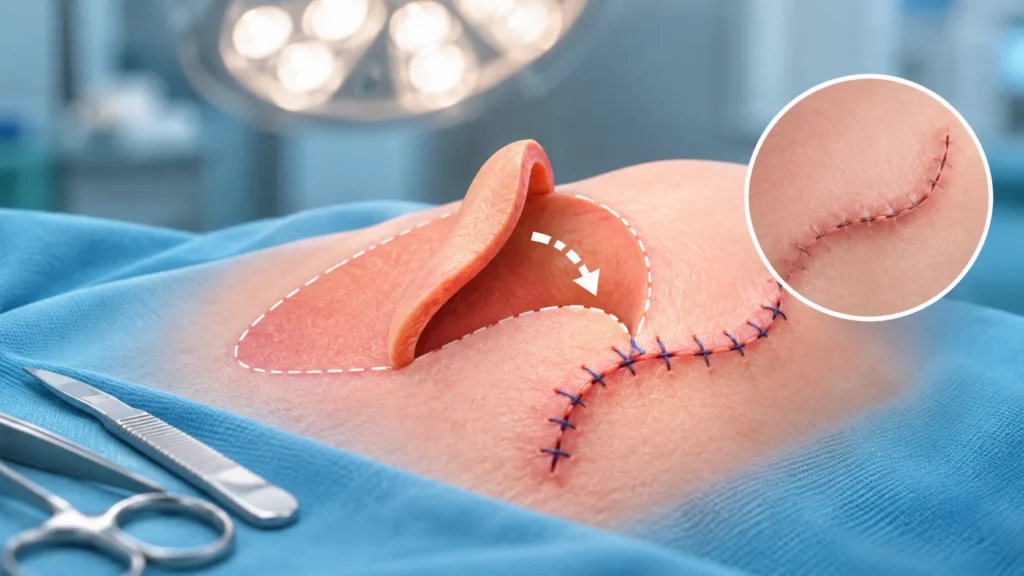
The flap can be moved in different ways depending on the location and size of the wound. It may be rotated, advanced, or transposed to cover the defect. Once in place, the flap is stitched into position and allowed to heal. Over time, the tissue adapts and blends with the surrounding area.
Local flaps are commonly used on the face, scalp, hands, and other visible or functionally important areas. They are preferred when a simple skin graft would not provide enough thickness, durability, or cosmetic match.
Types of Local Flaps
There are several types of local flaps, each suited to different wound locations and needs.
Based on movement
- Advancement flap, where the skin is stretched and moved forward to cover the defect.
- Rotation flap, where the skin is rotated around a pivot point to cover the wound.
- Transposition flap, where the skin is lifted and moved sideways to cover the defect.
- Interpolation flap, where the flap is passed over or under intact skin to reach the defect.
Based on tissue included
- Skin flap, which includes only skin and subcutaneous tissue.
- Fasciocutaneous flap, which includes skin, fat, and the underlying fascia.
- Muscle flap, which includes muscle tissue along with skin.
- Myocutaneous flap, which includes muscle, fat, and skin together.
Based on blood supply
- Random pattern flap, which relies on small blood vessels in the skin.
- Axial pattern flap, which follows a known artery and vein.
- Free flap, which is completely detached and reconnected to blood vessels at the new site, though this is not always considered a local flap.
When is Local Flap Reconstruction Needed?
Local flap reconstruction is used in many situations where skin or tissue coverage is needed.
Common indications
- After removal of skin cancer such as basal cell or squamous cell carcinoma.
- After traumatic injuries such as cuts, crush injuries, or avulsions.
- After burns that have destroyed skin layers.
- For chronic wounds that have not healed with other treatments.
- After surgical removal of tumors or lesions.
- For congenital defects or birthmarks.
- After infection that has damaged skin and tissue.
- For pressure sores or ulcers in certain cases.
- After previous surgery where skin coverage is inadequate.
Why a flap may be chosen over a graft
- The wound is in a visible area where cosmetic match is important.
- The wound is deep and needs thicker tissue.
- The area has poor blood supply, making grafts less likely to take.
- The wound is over a joint or moving area where flexibility is needed.
- The defect is too large for a simple graft to cover.
How is Local Flap Reconstruction Done?
The procedure is usually done under local or general anesthesia depending on the size and location of the flap.
Steps of the procedure
- The area is cleaned and prepared.
- The size and shape of the defect are measured.
- The flap design is planned based on nearby skin availability.
- The flap is carefully lifted, keeping its blood supply intact.
- The flap is moved or rotated to cover the defect.
- The flap is stitched into place.
- The donor site, where the flap was taken from, is closed directly or with a graft if needed.
- Dressings are applied to protect the area.
Anesthesia options
- Local anesthesia for small flaps.
- Regional anesthesia for larger areas.
- General anesthesia for complex or extensive reconstruction.
Duration of surgery
- Small flaps may take one to two hours.
- Larger or more complex flaps may take several hours.
- The exact time depends on the location, size, and technique used.
Recovery After Local Flap Reconstruction
Recovery depends on the size and location of the flap, the patient’s health, and the reason for reconstruction.
Immediate recovery
- The area may be swollen and bruised for the first few days.
- Pain is usually managed with prescribed medicines.
- Dressings are kept in place as advised.
- The flap is monitored for color, warmth, and blood flow.
First few weeks
- Stitches may be removed after one to two weeks.
- Swelling gradually reduces.
- The flap begins to settle and blend with surrounding skin.
- Normal activities can be resumed gradually.
- Strenuous activity may be restricted for a few weeks.
Long-term recovery
- Full healing may take several weeks to months.
- Scars fade over time but may not disappear completely.
- Follow-up visits are needed to monitor healing.
- In some cases, minor revision surgery may be needed for best cosmetic result.
Benefits of Local Flap Reconstruction
Local flap reconstruction offers several advantages over other methods.
Key benefits
- Better cosmetic match since the tissue comes from nearby skin.
- More reliable healing due to preserved blood supply.
- Thicker, more durable coverage for deep wounds.
- Better function in areas that move, such as joints or the face.
- Less need for skin from distant parts of the body.
- Faster healing in many cases compared to grafts.
- Improved quality of life and confidence.
Why these benefits matter
For patients with wounds on the face, hands, or other visible areas, appearance matters. A flap that matches the surrounding skin can make a big difference in confidence and daily life. For wounds over joints or moving areas, durable and flexible coverage is essential for normal function.
Risks and Complications
Like any surgery, local flap reconstruction carries some risks.
Possible complications
- Infection.
- Bleeding or hematoma.
- Partial or complete flap failure due to poor blood flow.
- Scarring.
- Delayed healing.
- Numbness or changed sensation in the area.
- Asymmetry or contour irregularity.
- Need for revision surgery in some cases.
How risks are reduced
- Careful surgical planning and technique.
- Proper patient selection.
- Good blood sugar and nutrition control.
- Avoiding smoking before and after surgery.
- Proper wound care and follow-up.
Aftercare and Follow-up
Proper aftercare is essential for good healing and best results.
Aftercare pointers
- Keep the area clean and dry as advised.
- Avoid touching or picking at the flap.
- Take medicines exactly as prescribed.
- Avoid smoking, which can reduce blood flow to the flap.
- Avoid strenuous activity until cleared by the surgeon.
- Attend all follow-up visits.
- Report any signs of infection such as redness, warmth, or discharge.
Signs that need urgent attention
- Sudden change in flap color, such as darkening or paleness.
- Severe pain not controlled by medicines.
- Fever or chills.
- Pus or foul-smelling discharge.
- Bleeding that does not stop.
Why Choose Rama Hospital for Local Flap Reconstruction?
Local flap reconstruction requires skill, experience, and careful planning. A hospital with experienced plastic and reconstructive surgeons, modern operating facilities, and good post-operative care can make a major difference in outcomes.
Why hospital care matters
- Expert evaluation by plastic and reconstructive surgery specialists.
- Careful planning of flap design and technique.
- Modern operating facilities and anesthesia support.
- Post-operative monitoring for flap health.
- Rehabilitation and scar management if needed.
- Coordinated care for complex cases.
Trust and authority points
- Experienced reconstructive surgery team.
- Advanced surgical techniques and technology.
- Personalized treatment plans for each patient.
- Patient education and support.
- Comprehensive care from surgery to full recovery.
Frequently Asked Questions (FAQs)
1. What is local flap reconstruction?
Local flap reconstruction is a surgical technique where nearby healthy skin and tissue are moved to cover a wound or defect. Unlike a graft, the flap keeps its own blood supply, which helps it heal better.
2. When is a flap needed instead of a skin graft?
A flap is preferred when the wound is deep, in a visible area, over a joint, or has poor blood supply. Flaps provide thicker, more durable, and better-matching coverage than grafts in many cases.
3. How long does recovery take?
Recovery varies but most small flaps heal within a few weeks. Larger or more complex flaps may take several weeks to months for full healing. Follow-up visits are important to monitor progress.
4. Will there be a scar?
Some scarring is expected, but scars usually fade over time. The surgeon plans the flap carefully to place scars in less visible areas where possible. Scar management may help improve the final appearance.
5. Is local flap reconstruction painful?
Some pain and discomfort are normal after surgery, but this is usually managed with prescribed medicines. Pain decreases as healing progresses. Severe or worsening pain should be reported to the doctor.
6. Can the flap fail?
In some cases, the flap may not survive due to poor blood flow, infection, or other issues. This is more common in smokers or patients with poor circulation. Careful planning and aftercare reduce this risk.
7. Can I move the area after surgery?
Movement may be restricted for a few days or weeks depending on the location of the flap. The surgeon will give specific instructions on when and how much movement is safe.
8. When can I return to normal activities?
Light activities can usually be resumed within a few days to a week. Strenuous activity, heavy lifting, or exercise may need to wait for a few weeks. The surgeon will advise based on the specific case.
Conclusion
Local flap reconstruction is a valuable surgical technique for repairing skin and tissue defects caused by injury, cancer removal, burns, or other conditions. By using nearby healthy tissue with its own blood supply, flaps provide reliable healing, good cosmetic match, and durable coverage.
The success of the procedure depends on careful planning, skilled surgical technique, and proper aftercare. For patients with wounds that need more than a simple graft, local flap reconstruction can restore both appearance and function, improving quality of life.
Rama Hospital can help evaluate whether local flap reconstruction is the right option, plan the procedure carefully, and provide full support through surgery and recovery.