Laparoscopic nephrectomy is a minimally invasive surgical procedure used to remove all or part of a kidney through small incisions instead of one large cut. It is commonly performed for kidney cancer, non-functioning kidneys, severe kidney damage, recurrent infections, or certain structural problems. The goal is to remove the diseased part while preserving as much healthy kidney tissue as possible.
The word “nephrectomy” means removal of a kidney. When the entire kidney is removed, it is called radical nephrectomy. When only the tumor or diseased part is removed and the rest of the kidney is preserved, it is called partial nephrectomy. Laparoscopic nephrectomy uses small keyhole incisions, a camera, and special instruments to perform the surgery with less pain, less blood loss, and faster recovery compared to open surgery.
What is Laparoscopic Nephrectomy?
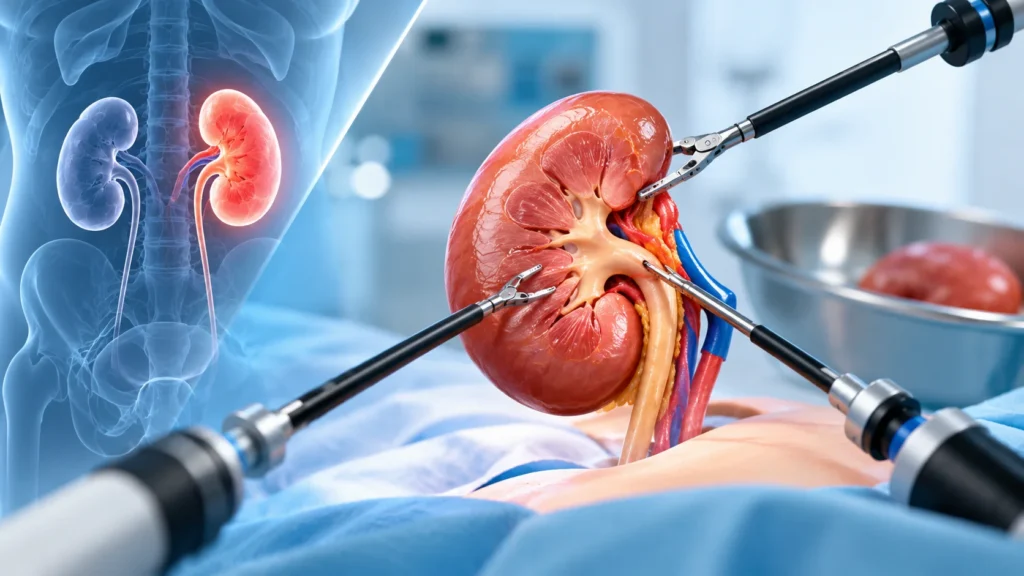
Laparoscopic nephrectomy is a surgical procedure to remove a kidney or part of a kidney using small incisions and a camera-guided technique. Instead of making a large cut in the side or abdomen, the surgeon makes three to four small incisions. A thin tube with a camera, called a laparoscope, is inserted through one incision to give a clear view of the kidney and surrounding structures. Special instruments are passed through the other incisions to perform the surgery.
This approach is less invasive than traditional open surgery. It causes less tissue damage, less pain, less blood loss, and faster recovery. Most patients can go home within a few days and return to normal activities sooner than after open surgery.
Laparoscopic nephrectomy can be done for both benign and malignant conditions. In cancer cases, the goal is to remove the tumor completely while preserving kidney function. In non-cancer cases, the goal is to remove a kidney that is no longer working properly and may be causing pain, infection, or other problems.
Types of Laparoscopic Nephrectomy
There are different types of nephrectomy depending on how much of the kidney is removed and the reason for surgery.
Based on extent of removal
- Radical nephrectomy, where the entire kidney is removed along with surrounding tissue if needed.
- Partial nephrectomy, where only the tumor or diseased part is removed and the rest of the kidney is preserved.
- Simple nephrectomy, where the kidney is removed without surrounding tissue, usually for non-cancer conditions.
- Radical nephroureterectomy, where the kidney and part of the ureter are removed, usually for tumors in the upper urinary tract.
Based on surgical approach
- Laparoscopic nephrectomy, which uses small incisions and a camera.
- Robotic-assisted nephrectomy, which uses robotic arms controlled by the surgeon for more precision.
- Open nephrectomy, which uses a larger incision and is reserved for complex cases.
Based on urgency
- Elective nephrectomy, which is planned in advance for conditions such as tumor or non-functioning kidney.
- Emergency nephrectomy, which may be needed in cases of severe trauma, uncontrolled bleeding, or life-threatening infection.
Why is Laparoscopic Nephrectomy Done?
Laparoscopic nephrectomy is done to treat conditions where the kidney is diseased, damaged, or cancerous and cannot be preserved.
Common indications include:
- Kidney cancer or renal tumor.
- Large or complex kidney cysts causing symptoms.
- Non-functioning kidney due to chronic blockage.
- Severe kidney damage from stones or infection.
- Recurrent kidney infections not responding to treatment.
- Kidney trauma with uncontrolled bleeding.
- Congenital abnormalities causing recurrent problems.
- Donor nephrectomy in living kidney donation.
- Severe hydronephrosis with loss of function.
- Certain benign tumors that cannot be managed conservatively.
Why removal may be needed
When a kidney is severely damaged or has a tumor, keeping it may cause pain, infection, bleeding, or spread of disease. Removing the affected kidney or part of it can improve quality of life, prevent complications, and in cancer cases, improve survival.
Who is a Candidate for Laparoscopic Nephrectomy?
Not every patient with kidney disease needs nephrectomy. The decision depends on the condition, kidney function, overall health, and imaging findings.
Good candidates include:
- Patients with kidney tumor confined to the kidney.
- Patients with non-functioning kidney causing symptoms.
- Patients with recurrent infections in a damaged kidney.
- Patients with large cysts or benign tumors not suitable for other treatment.
- Patients with kidney trauma needing urgent removal.
- Patients suitable for minimally invasive surgery.
- Patients with adequate overall health to undergo anesthesia.
Who may need alternative treatment
- Patients with small tumors that can be managed with partial nephrectomy or ablation.
- Patients with poor overall health who may not tolerate surgery.
- Patients with advanced cancer needing systemic therapy first.
- Patients with bilateral kidney disease where preserving function is critical.
- Patients with severe heart or lung disease needing careful evaluation.
Preparation Before Surgery
Proper preparation helps ensure safe surgery and smooth recovery.
Pre-operative evaluation
- Detailed medical history and physical examination.
- Blood tests to check kidney function, blood count, and clotting.
- Urine tests to check for infection.
- Imaging such as CT scan or MRI to assess the kidney and tumor.
- Heart and lung evaluation if needed.
- Anesthesia assessment.
- Review of current medicines and supplements.
Instructions before surgery
- Stop certain medicines as advised, especially blood thinners.
- Fast for a specified period before surgery.
- Arrange for someone to accompany and assist after discharge.
- Stop smoking well before surgery to improve healing.
- Follow all pre-operative instructions given by the surgical team.
Mental preparation
Understanding the procedure, recovery, and possible outcomes helps reduce anxiety. Patients should ask questions about the type of nephrectomy, expected hospital stay, pain management, and follow-up plan.
How is Laparoscopic Nephrectomy Performed?
The procedure is done under general anesthesia in an operating room with specialized laparoscopic equipment.
Steps of the procedure
- Patient is positioned on the side to give access to the kidney.
- Small incisions are made in the abdomen or flank.
- Carbon dioxide gas is used to create space for better visibility.
- Laparoscope is inserted to view the kidney and surrounding structures.
- Blood vessels supplying the kidney are identified and controlled.
- Kidney or part of kidney is carefully dissected and removed.
- Removed tissue is placed in a bag and taken out through a slightly larger incision.
- Incisions are closed with sutures or staples.
Duration of surgery
- Simple nephrectomy may take two to three hours.
- Radical or partial nephrectomy may take longer depending on complexity.
- Robotic-assisted surgery may take similar or slightly longer time but offers more precision.
Anesthesia and hospital stay
- General anesthesia is used.
- Most patients stay in hospital for two to four days.
- Some may need longer stay if there are complications or other health issues.
Benefits of Laparoscopic Nephrectomy
Laparoscopic nephrectomy offers several advantages over open surgery.
Key benefits
- Smaller incisions and less scarring.
- Less pain after surgery.
- Less blood loss.
- Lower risk of infection.
- Shorter hospital stay.
- Faster return to normal activities.
- Better cosmetic outcome.
- Reduced risk of hernia at incision site.
- Quicker recovery of bowel function.
Why minimally invasive matters
Less tissue damage means less pain and faster healing. Patients can move, breathe, and recover more comfortably. This is especially important for older patients or those with other health conditions.
Risks and Complications
Like any surgery, laparoscopic nephrectomy carries some risks.
Common risks
- Pain at incision sites.
- Bleeding.
- Infection.
- Reaction to anesthesia.
- Blood clots.
- Injury to nearby organs such as bowel, spleen, or liver.
- Leakage of urine if ureter is involved.
- Conversion to open surgery if difficulty arises.
Rare but serious risks
- Major bleeding requiring transfusion.
- Injury to major blood vessels.
- Kidney failure in remaining kidney.
- Long-term kidney function decline.
- Cancer recurrence in case of malignant tumor.
- Need for further treatment such as chemotherapy or targeted therapy.
How risks are managed
- Careful pre-operative evaluation.
- Experienced surgical team.
- Intra-operative monitoring.
- Early mobilization after surgery.
- Proper pain and infection control.
- Regular follow-up to detect complications early.
Recovery After Laparoscopic Nephrectomy
Recovery is usually faster than open surgery but still requires care and patience.
Immediate recovery
- Patient is monitored in recovery room after anesthesia.
- Pain medicines are given as needed.
- Early walking is encouraged to prevent clots.
- Catheter may be placed temporarily to drain urine.
- Diet is started slowly, first with liquids then solid food.
Hospital stay
- Most patients go home within two to four days.
- Some may need longer stay if complications occur.
- Discharge depends on pain control, mobility, and overall condition.
At home
- Rest for the first few days.
- Avoid heavy lifting for several weeks.
- Walk regularly to improve circulation.
- Keep incisions clean and dry.
- Follow medicine schedule as prescribed.
- Watch for signs of infection or complications.
Return to normal activities
- Light activities within one to two weeks.
- Office work may be resumed in two to three weeks.
- Heavy lifting and strenuous exercise avoided for four to six weeks.
- Driving resumed when pain is controlled and mobility is good.
- Sexual activity can be resumed when comfortable.
Diet After Laparoscopic Nephrectomy
Diet plays an important role in recovery and protecting the remaining kidney.
Early recovery diet
- Start with clear liquids.
- Progress to soft foods.
- Avoid heavy, oily, or spicy food initially.
- Eat small frequent meals.
Long-term diet advice
- Stay well hydrated.
- Limit salt intake to protect kidney function.
- Include fruits, vegetables, and whole grains.
- Adequate protein but not excessive.
- Avoid excessive painkillers that can harm kidney.
- Limit alcohol and avoid smoking.
Foods to include
- Water and healthy fluids.
- Fresh fruits and vegetables.
- Whole grains.
- Lean protein sources.
- Low-salt options.
Foods to limit
- Processed and packaged foods high in salt.
- Excess red meat.
- Sugary drinks.
- Alcohol.
- Excessive caffeine.
Follow-Up Care After Surgery
Regular follow-up is important to monitor recovery and kidney function.
Follow-up schedule
- First visit within one to two weeks after discharge.
- Repeat blood tests to check kidney function.
- Imaging follow-up if cancer was the reason for surgery.
- Long-term monitoring depending on diagnosis.
What is monitored
- Kidney function tests.
- Blood pressure.
- Signs of infection or complications.
- Cancer surveillance if applicable.
- Overall recovery and quality of life.
Life After Kidney Removal
Most people can live a normal, healthy life with one kidney if the remaining kidney is functioning well.
Important points
- Remaining kidney usually takes over the function of the removed kidney.
- Regular check-ups are important to monitor kidney health.
- Blood pressure control is crucial.
- Avoid medicines that can harm kidney.
- Maintain healthy lifestyle and diet.
- Stay hydrated but avoid overhydration.
Long-term outlook
- Many patients return to full normal activity.
- Kidney function usually remains stable if remaining kidney is healthy.
- Regular monitoring helps detect any decline early.
- Quality of life is generally good after recovery.
When to Seek Medical Care After Surgery
Some symptoms after surgery need prompt attention.
- Fever or chills.
- Increasing pain not controlled by medicines.
- Redness, swelling, or discharge from incisions.
- Difficulty passing urine.
- Blood in urine.
- Severe nausea or vomiting.
- Shortness of breath or chest pain.
- Leg swelling or pain.
- Signs of dehydration.
Why Choose Rama Hospital for Laparoscopic Nephrectomy?
Laparoscopic nephrectomy requires skilled surgeons, advanced equipment, and comprehensive perioperative care. A hospital with experienced urologists and minimally invasive surgery teams can make a major difference in outcomes.
- Expert urology and laparoscopic surgery team.
- Advanced imaging and diagnostic support.
- Minimally invasive and robotic surgery options.
- Intensive care support if needed.
- Structured recovery and rehabilitation.
- Long-term follow-up for kidney health and cancer surveillance.
Frequently Asked Questions (FAQs)
Why is nephrectomy done?
It is done for kidney cancer, non-functioning kidney, severe damage, recurrent infections, or trauma. The goal is to remove diseased tissue while preserving overall kidney function.
Is laparoscopic nephrectomy safe?
Yes, it is generally safe when performed by experienced surgeons. Like any surgery, it carries some risks such as bleeding, infection, or injury to nearby organs, but these are uncommon.
How long is the hospital stay?
Most patients stay in hospital for two to four days. Some may need longer if there are complications or other health issues.
Can I live a normal life with one kidney?
Yes, most people live a normal, healthy life with one kidney if it is functioning well. Regular check-ups and healthy lifestyle are important to protect the remaining kidney.
What is the difference between radical and partial nephrectomy?
Radical nephrectomy removes the entire kidney. Partial nephrectomy removes only the tumor or diseased part and preserves the rest of the kidney.
When can I return to work after surgery?
Most patients return to office work within two to three weeks. Heavy physical work or strenuous activity may need four to six weeks depending on recovery.
Will I need dialysis after nephrectomy?
Not usually, if the remaining kidney is healthy. Dialysis may be needed only if both kidneys are affected or if the remaining kidney function declines.
Conclusion
Laparoscopic nephrectomy is a safe and effective minimally invasive surgery for removing a diseased or cancerous kidney. It offers less pain, less blood loss, shorter hospital stay, and faster recovery compared to open surgery. It is used for a wide range of conditions including kidney cancer, non-functioning kidney, severe damage, and trauma.
The most important steps are proper diagnosis, careful surgical planning, expert execution, and structured follow-up. For patients with kidney tumors or severe kidney disease, laparoscopic nephrectomy can improve quality of life and long-term outcomes. With the right care, most patients recover well and return to normal life with good kidney function.
Rama Hospital can help evaluate kidney conditions, provide advanced laparoscopic and robotic surgery options, and guide patients through recovery to protect long-term kidney health.