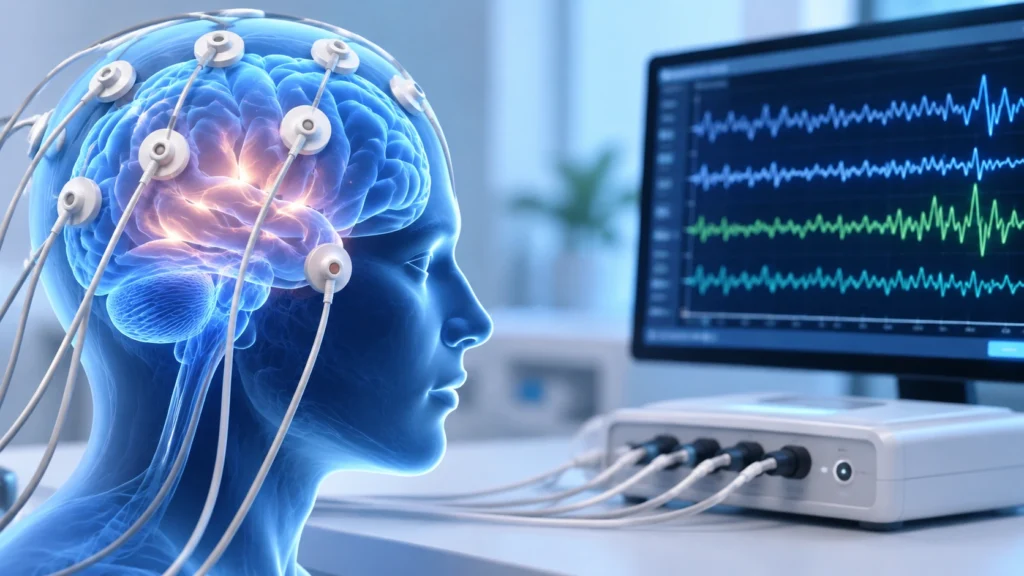
An Electroencephalogram, commonly known as an EEG, is a safe and non-invasive test that records the electrical activity of the brain. It is one of the most important tools used by neurologists to evaluate brain function in patients with seizures, epilepsy, sleep disorders, head injuries, infections, and other neurological conditions. The test uses small sensors placed on the scalp to detect tiny electrical signals produced by brain cells.
Many people feel anxious when they hear the word brain test, but this does not involve any pain, radiation, or electric shock. It simply records the natural activity of the brain. The results help doctors understand whether there are abnormal patterns that may explain symptoms such as fits, blackouts, confusion, or unusual behavior.
What is an Electroencephalogram (EEG)?
An EEG is a diagnostic test that measures and records the electrical activity of the brain using small electrodes placed on the scalp. The brain works through electrical signals. Nerve cells communicate with each other using tiny electrical impulses. These impulses create patterns that can be detected and recorded by an machine.
The test produces a graph-like recording called an electroencephalogram. This recording shows different types of brain waves that correspond to different states such as wakefulness, sleep, relaxation, or active thinking. Neurologists analyze these patterns to identify abnormalities that may indicate epilepsy, seizures, sleep disorders, brain injury, infection, or other conditions.
This is painless, safe, and usually takes between thirty minutes to one hour for a routine test. Some specialized tests may take longer or be done over several hours or days depending on the clinical need.
Why is EEG Done?
This is one of the most commonly used tests in neurology. It helps doctors evaluate brain function when symptoms suggest a neurological problem.
Common reasons for EEG
- Evaluation of seizures or epilepsy.
- Investigation of unexplained blackouts or loss of consciousness.
- Assessment of unusual spells, staring episodes, or behavioral changes.
- Diagnosis of sleep disorders such as narcolepsy or certain parasomnias.
- Evaluation of head injury or brain trauma.
- Assessment of brain function after cardiac arrest or severe illness.
- Investigation of encephalitis or brain infection.
- Monitoring of brain activity in intensive care units.
- Evaluation of dementia or confusion in selected cases.
- Pre-surgical evaluation for epilepsy surgery.
What EEG can detect
- Abnormal electrical discharges associated with seizures.
- Patterns suggestive of epilepsy syndromes.
- Generalized or focal slowing of brain activity.
- Effects of medications or metabolic problems on brain function.
- Sleep-related abnormalities.
- Brain dysfunction after injury or illness.
Types of EEG Tests
There are different types of tests depending on the clinical question and the patient’s condition.
Routine EEG
- Usually lasts thirty to sixty minutes.
- Done in a clinic or hospital setting.
- Records brain activity during wakefulness and sometimes during sleep.
- May include activation procedures such as hyperventilation or flashing lights.
Sleep-deprived EEG
- Patient is asked to sleep less the night before the test.
- Increases the chance of detecting abnormal activity.
- Useful when routine procedure is normal but seizures are still suspected.
Prolonged EEG
- Records brain activity for several hours.
- May be done in the hospital or at home with portable equipment.
- Useful for capturing infrequent events.
Video EEG monitoring
- Combines procedure recording with video monitoring.
- Allows correlation of physical events with brain activity.
- Often used in epilepsy evaluation before surgery.
Ambulatory EEG
- Patient wears a portable device at home.
- Records brain activity over twenty-four hours or longer.
- Useful for capturing events that do not occur during a short clinic test.
Inpatient EEG monitoring
- Done in a hospital setting over several days.
- Used for complex epilepsy cases or pre-surgical evaluation.
- Allows continuous monitoring and medication adjustment.
How is EEG Performed?
This procedure is simple, painless, and safe. It is performed by a trained technologist under the supervision of a neurologist.
Step-by-step procedure
- The patient is asked to sit or lie down comfortably.
- The scalp is cleaned and marked for electrode placement.
- Small electrodes are attached to the scalp using a special paste or adhesive.
- The electrodes are connected to wires that lead to the machine.
- The patient is asked to relax, close eyes, and follow simple instructions.
- Brain activity is recorded for the duration of the test.
- Activation procedures such as hyperventilation or flashing lights may be done if needed.
- The electrodes are removed at the end of the test.
- The scalp is cleaned and the patient can resume normal activities.
What the patient may experience
- A feeling of electrodes on the scalp.
- Mild discomfort during electrode placement or removal.
- No pain or electric shock during the test.
- Possible dizziness during hyperventilation.
- Sensitivity to flashing lights in photosensitive individuals.
Preparation for EEG Test
Proper preparation helps ensure good quality recording and accurate results.
General preparation
- Wash hair the night before or morning of the test.
- Do not apply oil, gel, cream, or hair products on the scalp.
- Avoid hair spray or styling products.
- Eat normally before the test unless instructed otherwise.
- Take regular medicines unless the doctor advises otherwise.
- Inform the doctor about all medications being taken.
Special instructions for sleep-deprived EEG
- Sleep only four to five hours the night before.
- Avoid caffeine on the day of the test.
- Arrange transport if feeling very sleepy.
Special instructions for children
- Explain the procedure in simple terms.
- Bring comfort items such as a toy or blanket.
- Feed the child before the test to encourage sleep if needed.
- Parents may stay with the child during the test.
What to bring
- Doctor’s referral or prescription.
- Previous reports if available.
- List of current medications.
- Comfortable clothing.
Safety and Comfort of EEG
This is a very safe test with minimal risks.
Safety points
- No radiation is involved.
- No electric shock is given to the patient.
- Electrodes only record activity, they do not stimulate the brain.
- Safe for children, adults, and elderly patients.
- Can be repeated as needed without harm.
Comfort measures
- The room is kept quiet and comfortable.
- The patient can lie down or sit as preferred.
- Breaks can be given if needed.
- Parents can stay with children during the test.
- The technologist explains each step to reduce anxiety.
Possible minor side effects
- Mild skin irritation from electrodes or adhesive.
- Temporary redness on the scalp.
- Fatigue if sleep-deprived for the test.
- Dizziness during hyperventilation.
What Happens During the Test?
During the procedure, the patient is asked to follow certain instructions to help record different brain states.
Typical instructions
- Close eyes and relax.
- Open eyes when asked.
- Take deep breaths for a few minutes during hyperventilation.
- Look at a flashing light if photosensitivity testing is done.
- Try to sleep if sleep recording is part of the test.
What the technologist monitors
- Quality of the recording.
- Patient comfort and safety.
- Any events such as seizures or unusual movements.
- Artifacts from muscle movement or eye blinking.
Duration of the test
- Routine procedure usually takes thirty to sixty minutes.
- Sleep-deprived or prolonged procedure may take longer.
- Video EEG or ambulatory EEG may last several hours or days.
Understanding EEG Results
This results are interpreted by a neurologist or a specialist in clinical neurophysiology.
Normal EEG findings
- Regular brain wave patterns appropriate for age and state.
- No abnormal discharges or spikes.
- Symmetrical activity on both sides of the brain.
- Normal response to activation procedures.
Abnormal EEG findings
- Epileptiform discharges such as spikes or sharp waves.
- Focal slowing suggesting localized brain dysfunction.
- Generalized slowing suggesting diffuse brain dysfunction.
- Patterns suggestive of specific epilepsy syndromes.
- Abnormalities during sleep or activation procedures.
Limitations of EEG
- A normal procedure does not always rule out epilepsy.
- Some abnormalities may be seen in people without seizures.
- Results must be interpreted in the context of clinical symptoms.
- Sometimes repeat or prolonged procedure is needed.
When is EEG Recommended?
This is recommended when symptoms suggest a neurological problem that may involve abnormal brain activity.
Common indications
- First-time seizure or fit.
- Recurrent seizures or diagnosed epilepsy.
- Unexplained blackouts or loss of consciousness.
- Episodes of staring, confusion, or unusual behavior.
- Sleep disorders with suspected neurological cause.
- Head injury with altered consciousness.
- Brain infection or inflammation.
- Unexplained confusion or cognitive decline.
- Pre-surgical evaluation for epilepsy.
- Monitoring in intensive care for brain function.
When EEG may not be needed
- Simple fainting with clear cause.
- Typical migraine without neurological deficits.
- Psychiatric symptoms without neurological signs.
- Routine screening in healthy individuals without symptoms.
After the EEG Test
After the test, patients can usually resume normal activities immediately.
Post-test instructions
- Wash hair to remove any remaining paste or adhesive.
- Resume normal diet and medications.
- Rest if sleep-deprived for the test.
- Follow up with the referring doctor for results.
When to expect results
- Preliminary observations may be shared immediately.
- Formal report is usually available within one to three days.
- Complex cases may take longer for detailed analysis.
Follow-up care
- Review results with the neurologist.
- Discuss diagnosis and treatment plan.
- Plan further tests if needed.
- Adjust medications based on findings.
Why Choose Rama Hospital for EEG Test?
This requires skilled technologists, modern equipment, and expert neurologist interpretation. A hospital with a dedicated neurophysiology lab can provide high-quality testing and accurate diagnosis.
Why hospital care matters
- Experienced technologists and neurologists.
- Modern digital equipment with high sensitivity.
- Facility for routine, sleep-deprived, prolonged, and video EEG.
- Safe and comfortable environment for patients.
- Integrated care with neurology, epilepsy, and sleep clinics.
Trust and authority points
- Accurate and timely procedure reporting.
- Correlation of procedure findings with clinical symptoms.
- Comprehensive epilepsy evaluation and management.
- Patient education and counseling.
- Support for children, adults, and elderly patients.
Frequently Asked Questions (FAQs)
Is EEG test painful?
No, this is not painful. The electrodes only record brain activity and do not give any electric shock. Some patients may feel mild discomfort during electrode placement or removal.
How long does an EEG take?
A routine procedure usually takes thirty to sixty minutes. Sleep-deprived, prolonged, or video EEG may take several hours or even days depending on the clinical need.
Do I need to prepare for EEG?
Yes, you should wash your hair and avoid oil, gel, or hair products. Eat normally and take regular medicines unless advised otherwise. For sleep-deprived EEG, you may need to sleep less the night before.
Can children have an EEG?
Yes, this is safe for children of all ages. Parents can stay with the child during the test. Special techniques are used to make the child comfortable and obtain good quality recording.
What if my EEG is normal?
A normal EEG does not always rule out epilepsy or other conditions. Sometimes repeat or prolonged EEG is needed. Results must be interpreted along with clinical symptoms and history.
Can EEG detect all brain problems?
No, this mainly detects abnormalities in electrical activity. It is most useful for seizures, epilepsy, and certain sleep or brain dysfunction conditions. Other tests like MRI may be needed for structural problems.
When will I get my EEG results?
Preliminary observations may be shared immediately. A formal report is usually available within one to three days. Your doctor will discuss the results and next steps during follow-up.
Conclusion
An Electroencephalogram or EEG is a safe, painless, and highly useful test for evaluating brain function. It plays a key role in diagnosing and managing seizures, epilepsy, sleep disorders, and other neurological conditions. Although the test may seem intimidating, it is simple and well-tolerated by patients of all ages.
The most important steps are proper preparation, following instructions during the test, and discussing results with a qualified neurologist. For patients with seizures, blackouts, unusual spells, or sleep-related symptoms, an EEG can provide valuable information that guides treatment and improves outcomes. With expert care and modern technology, procedure testing can be done accurately and comfortably.
Rama Hospital can provide comprehensive services including routine, sleep-deprived, prolonged, and video EEG, along with expert interpretation and integrated neurology care for accurate diagnosis and effective treatment.