
Your knees carry your entire body weight with every step you take. When the alignment of this joint goes wrong, life changes, slowly at first, then all at once. Knee joint deformities are more common than most people realize, and ignoring them rarely ends well.
A knee deformity occurs when the knee joint is not aligned properly, causing the legs to angle inward, outward, or become structurally unstable. Some people are born with these conditions, while others develop them over time due to arthritis, injuries, infections, nutritional deficiencies, or age-related wear and tear. In the early stages, the changes may appear subtle, but they can gradually affect the way a person stands, walks, and moves.
As the alignment worsens, the pressure on the knee joint becomes uneven. Certain parts of the joint experience excessive stress, leading to faster cartilage wear, chronic pain, stiffness, swelling, and reduced mobility. Many patients notice difficulty climbing stairs, walking long distances, squatting, or standing for extended periods. Over time, untreated knee joint deformities can significantly impact independence and quality of life.
The good news is that early diagnosis and proper treatment can help prevent further joint damage. Depending on the severity and underlying cause, treatment may include physiotherapy, weight management, supportive braces, medications, or corrective surgery. Recognizing the symptoms early and seeking timely orthopedic evaluation can make a significant difference in preserving joint function and maintaining an active lifestyle.
What is a knee joint deformity?
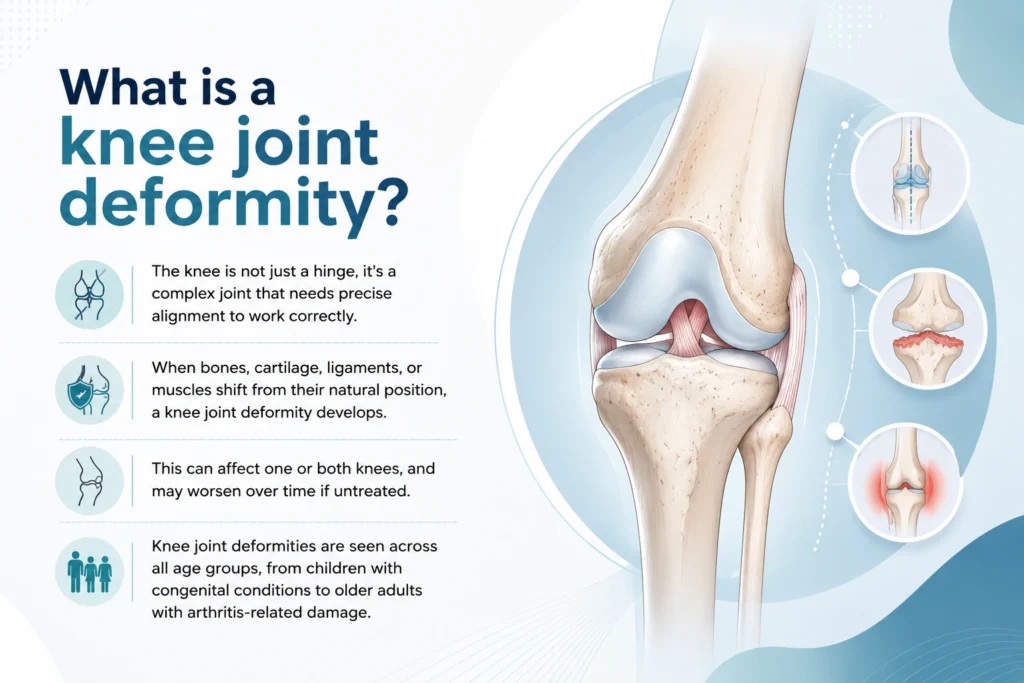
A knee joint deformity is any structural or alignment abnormality in the knee that causes it to function outside its normal range.
- The knee is not just a hinge, it’s a complex joint that needs precise alignment to work correctly.
- When bones, cartilage, ligaments, or muscles shift from their natural position, a knee joint deformity develops.
- This can affect one or both knees, and may worsen over time if untreated.
- Knee joint deformities are seen across all age groups, from children with congenital conditions to older adults with arthritis-related damage.
The key point: a knee joint deformity is not just a cosmetic concern. It affects how you walk, how you feel, and how independent your life remains.
How does a healthy knee maintain proper alignment?
Understanding normal knee function helps explain why knee joint deformities are so disruptive.
Even a small shift in alignment increases pressure on specific areas of the knee, wearing down cartilage faster and leading to pain, stiffness, and eventually knee joint deformity.
- A healthy knee maintains a straight mechanical axis, the weight line should pass through the center of the knee.
- Cartilage cushions the joint and absorbs shock.
- Ligaments hold bones in place during movement.
- Muscles around the knee support and stabilize it during walking and activity.
- When any part of this system fails, knee alignment problems develop.
Common types of knee joint deformities
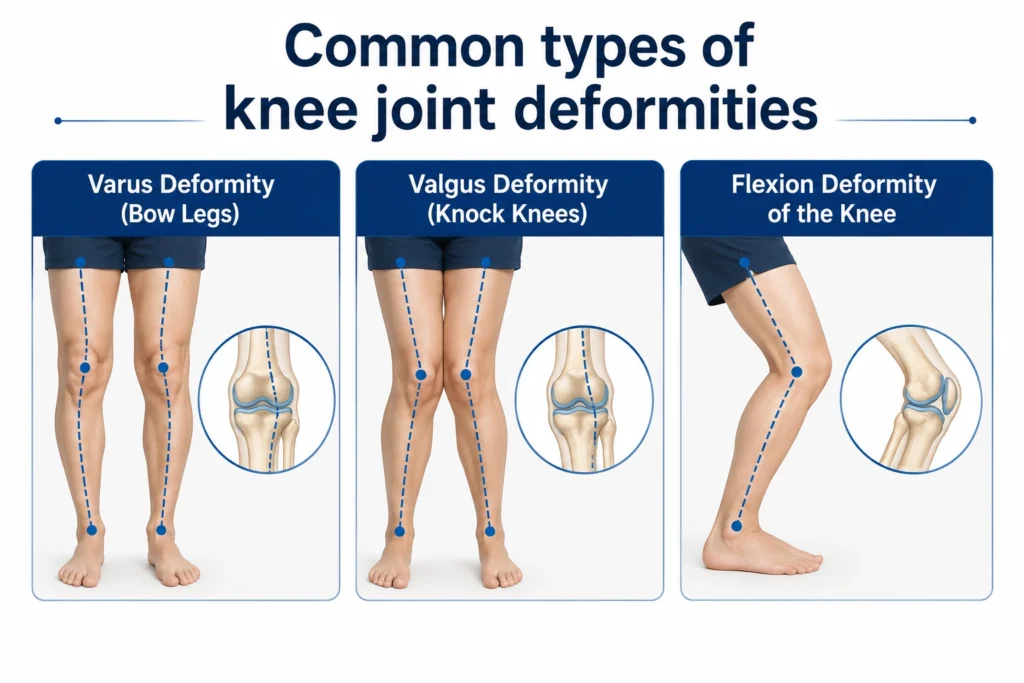
Varus Deformity (Bow Legs)
This is one of the most common knee joint deformities seen in adults over 50 in India.
- In a varus deformity, the knees bow outward.
- Bow legs place excessive stress on the inner (medial) side of the knee.
- Common causes include osteoarthritis, rickets, Blount’s disease, and old fractures.
- Walking with bow legs gradually destroys the inner cartilage and leads to severe knee joint misalignment.
- The condition often worsens with age and weight gain.
Valgus Deformity (Knock Knees)
- In a valgus deformity, the knees tilt inward and touch even when the feet are apart.
- Knock knees stress the outer (lateral) part of the knee.
- Common in children, but can persist into adulthood or develop due to arthritis and obesity.
- Knock knees cause abnormal gait, ankle pain, and increased risk of falls.
- Severe knock knee deformity is a leading reason for corrective surgery.
Flexion Deformity of the Knee
- A flexion deformity means the knee cannot fully straighten.
- The patient walks with a permanent bend at the knee.
- Caused by prolonged inflammation, muscle contracture, or advanced arthritis.
- Even a 10–15 degree flexion deformity significantly impacts walking ability.
- This type of knee joint deformity often goes unnoticed until it severely limits movement.
What causes knee joint deformities?
Knee joint deformities rarely appear overnight. Several conditions contribute:
- Osteoarthritis: Most common cause; destroys cartilage unevenly and shifts the joint axis.
- Rheumatoid arthritis: Causes joint inflammation and structural damage.
- Nutritional deficiencies: Vitamin D and calcium deficiency cause rickets, leading to bow legs and knock knees in children.
- Old fractures: Poorly healed bone fractures can permanently alter knee alignment.
- Obesity: Excess body weight accelerates cartilage wear and worsens knee joint misalignment.
- Ligament injuries: Untreated ACL or MCL tears destabilize the knee.
- Congenital conditions: Some children are born with knee joint deformities.
- Infections and tumors: Can damage bone structure and cause secondary knee deformity.
Can osteoarthritis lead to knee deformities?
Yes, and this is a very important connection that patients often miss. This is why early intervention matters. If you have a knee arthritis specialist in Noida evaluate you in the early stages, the progression can often be slowed significantly.
- Osteoarthritis starts with cartilage loss. At first, it feels like mild knee pain or stiffness.
- As cartilage wears away unevenly, the knee begins to shift, creating a knee joint deformity.
- Most cases of bow legs in older adults are directly caused by medial compartment osteoarthritis.
- Similarly, knock knees in adults often indicate lateral compartment arthritis.
- Once a knee joint deformity develops from arthritis, conservative treatment alone becomes less effective.
- The deformity and arthritis feed each other, more misalignment creates more pressure, which destroys more cartilage.
Early warning signs of knee joint deformities
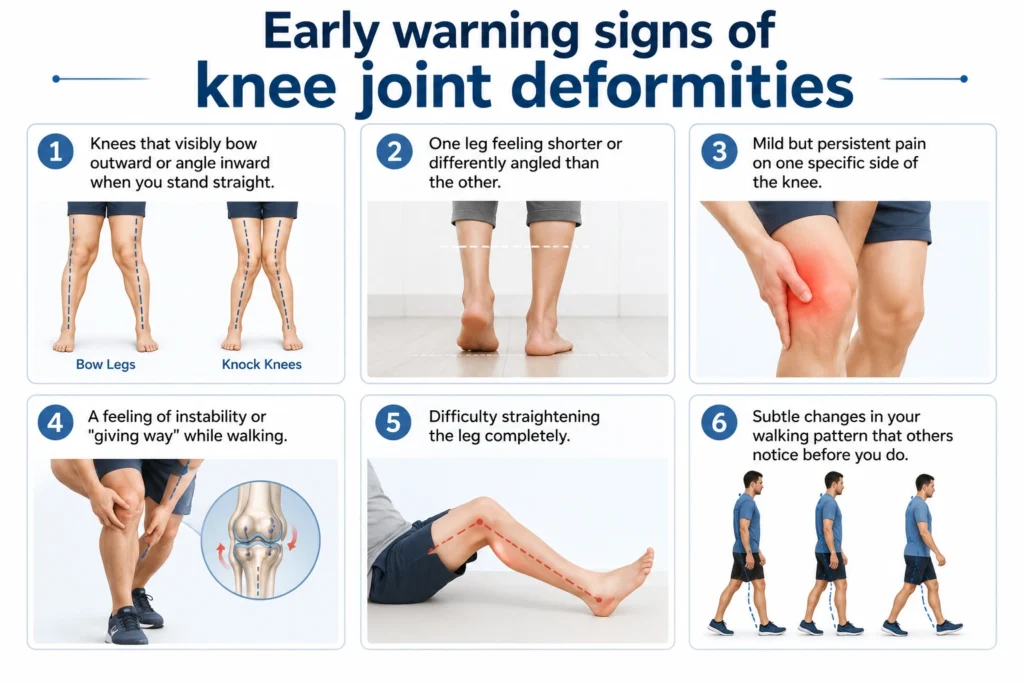
Catching knee joint deformities early gives patients far more treatment options. Most people wait too long before seeking help. Watch for these early signs:
- Knees that visibly bow outward or angle inward when you stand straight.
- One leg feeling shorter or differently angled than the other.
- Mild but persistent pain on one specific side of the knee.
- A feeling of instability or “giving way” while walking.
- Difficulty straightening the leg completely.
- Subtle changes in your walking pattern that others notice before you do.
Symptoms patients should never ignore
If any of the following are present, schedule a consultation immediately:
- Severe pain on the inner or outer side of the knee during walking.
- Visible deformity, legs that look noticeably bent or misaligned.
- Inability to straighten the knee fully.
- Significant swelling that does not go down with rest.
- Locked knee, sudden inability to bend or straighten.
- Worsening limp that has been progressing over months.
- Knee pain at rest or at night, a serious sign of advanced joint damage.
These knee deformity symptoms indicate that the joint is under significant stress and needs medical evaluation not just pain medication.
How knee deformities affect walking and daily activities?
Many patients with untreated knee joint deformities develop depression and social isolation, a dimension that is often overlooked.
Knee joint deformities do not just cause pain. They change life in ways patients describe as slowly losing independence:
- Walking speed decreases significantly.
- Climbing stairs becomes difficult and eventually impossible without support.
- Squatting and sitting cross-legged (common in Indian daily life) becomes painful or impossible.
- The altered gait puts stress on the hips, lower back, and ankles, creating pain in multiple areas.
- The fear of falling increases, reducing outdoor activity and social life.
- Sleep is disrupted by night pain in advanced knee joint deformities.
Can knee replacement correct severe deformities?
Yes, and this is a critical point many patients do not know.
- Modern knee replacement surgery in Noida and across India routinely corrects severe knee joint deformities including significant bow legs, knock knees, and flexion contractures.
- A skilled joint replacement surgeon in Noida can restore near-normal alignment during the replacement procedure.
- Advanced implant systems and navigation tools allow surgeons to precisely correct the mechanical axis.
- Even patients with 20–30 degree deformities can achieve excellent outcomes with knee replacement surgery.
- The correction happens during the surgery itself, patients often wake up with straight legs for the first time in years.
If you are looking for the best orthopedic surgeon in Noida to evaluate severe knee joint deformity, choose one with specific experience in complex deformity correction surgeries.
Recovery after knee deformity correction surgery
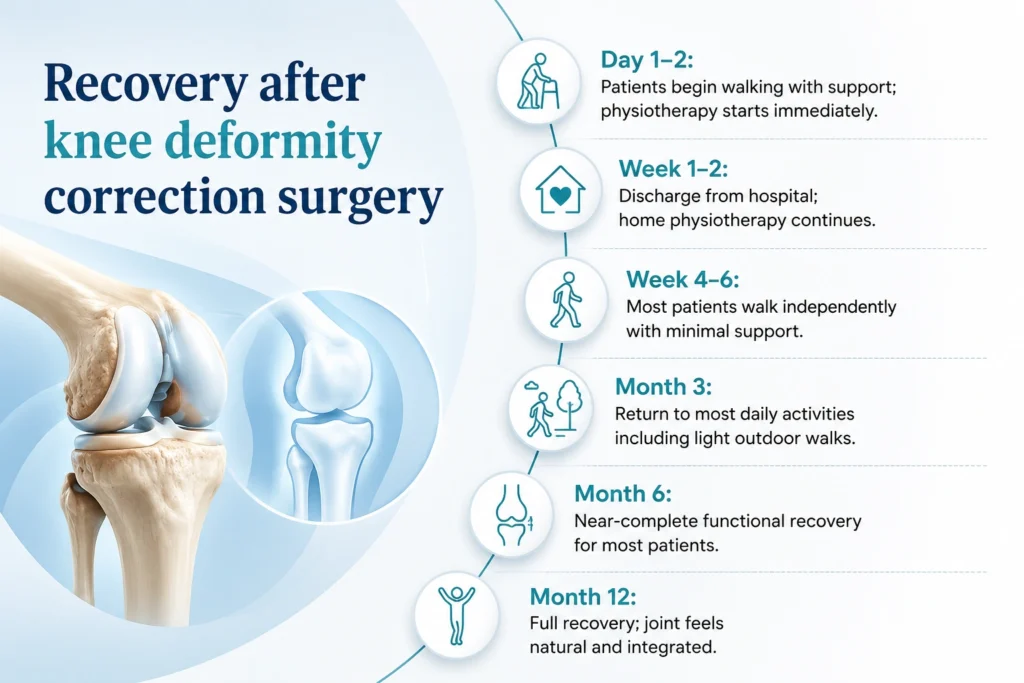
Recovery is a process, not an overnight result. Compliance with physiotherapy is the single most important factor in recovery after knee deformity treatment surgery. Here is what to expect:
- Day 1–2: Patients begin walking with support; physiotherapy starts immediately.
- Week 1–2: Discharge from hospital; home physiotherapy continues.
- Week 4–6: Most patients walk independently with minimal support.
- Month 3: Return to most daily activities including light outdoor walks.
- Month 6: Near-complete functional recovery for most patients.
- Month 12: Full recovery; joint feels natural and integrated.
Tips to prevent progression of knee deformities
If you already have mild knee joint deformities, these steps help slow progression:
- Maintain a healthy body weight, it is the most impactful thing you can do.
- Do low-impact exercises daily, swimming, cycling, and walking on flat surfaces.
- Avoid squatting on floors and sitting cross-legged for extended periods.
- Wear supportive footwear, avoid flat chappals and worn-out shoes.
- Get a Vitamin D test and correct any deficiency.
- Do not ignore knee pain, early evaluation saves the joint.
- Follow up with a knee arthritis specialist in Noida at least once a year if you have early deformity.
When should you consult an orthopedic specialist?
The best hospital in Noida for orthopedic care will offer a thorough assessment, physical examination, X-rays, and a detailed consultation, before recommending any course of treatment. Consult a specialist if:
- Your knees look visibly bent or angled inward/outward.
- You have had knee pain for more than 3 months.
- You notice a change in how you walk.
- Climbing stairs has become difficult or painful.
- Medications no longer control your knee pain.
- You want to understand whether surgery is actually needed, or avoidable.
Frequently Asked Question (FAQs)
Can knee deformities be corrected without surgery?
Yes, in mild to moderate cases. Physiotherapy, weight management, bracing, and injections can manage symptoms and slow progression. However, severe knee joint deformities with significant cartilage damage typically require surgical correction for lasting results.
Are bow legs and knock knees serious?
They can be. Mild bow legs and knock knees in children often self-correct with age. In adults, persistent misalignment accelerates cartilage damage and leads to arthritis. Severe cases need treatment to prevent permanent joint damage.
Can osteoarthritis cause knee misalignment?
Absolutely. Osteoarthritis is actually one of the leading causes of knee joint deformity in adults. As cartilage wears away unevenly, the joint axis shifts, creating bow legs or knock knees over time.
Is knee replacement necessary for severe deformity?
In most adults over 55–60 with severe knee joint deformity and significant arthritis, knee replacement surgery is the most reliable option. It corrects the deformity, relieves pain, and restores function, often dramatically.
Can physiotherapy improve knee alignment?
Physiotherapy improves muscle strength and function around a knee joint deformity but cannot reverse established bone or cartilage changes. It is most effective in early-stage deformities and as a post-surgical recovery tool.
Conclusion
Knee joint deformities are progressive conditions. Left untreated, they get worse, not better.
The good news is that excellent treatment options exist, from physiotherapy and bracing to advanced knee replacement surgery for knee joint deformity that can correct even severe deformities.
The most important thing you can do is not wait. Get evaluated early. Understand your options. And make an informed decision with a qualified orthopedic surgeon in Noida before the damage becomes irreversible.
If you or a family member is experiencing knee pain, visible leg deformity, or walking difficulty, do not delay. Consult with an experienced orthopedic specialist at a trusted orthopedic hospital in Noida today.