You feel a small bulge near your stomach. It doesn’t hurt much. You tell yourself it can wait.
That’s exactly what most hernia patients do. And it’s one of the most common and potentially dangerous mistakes in general surgery.
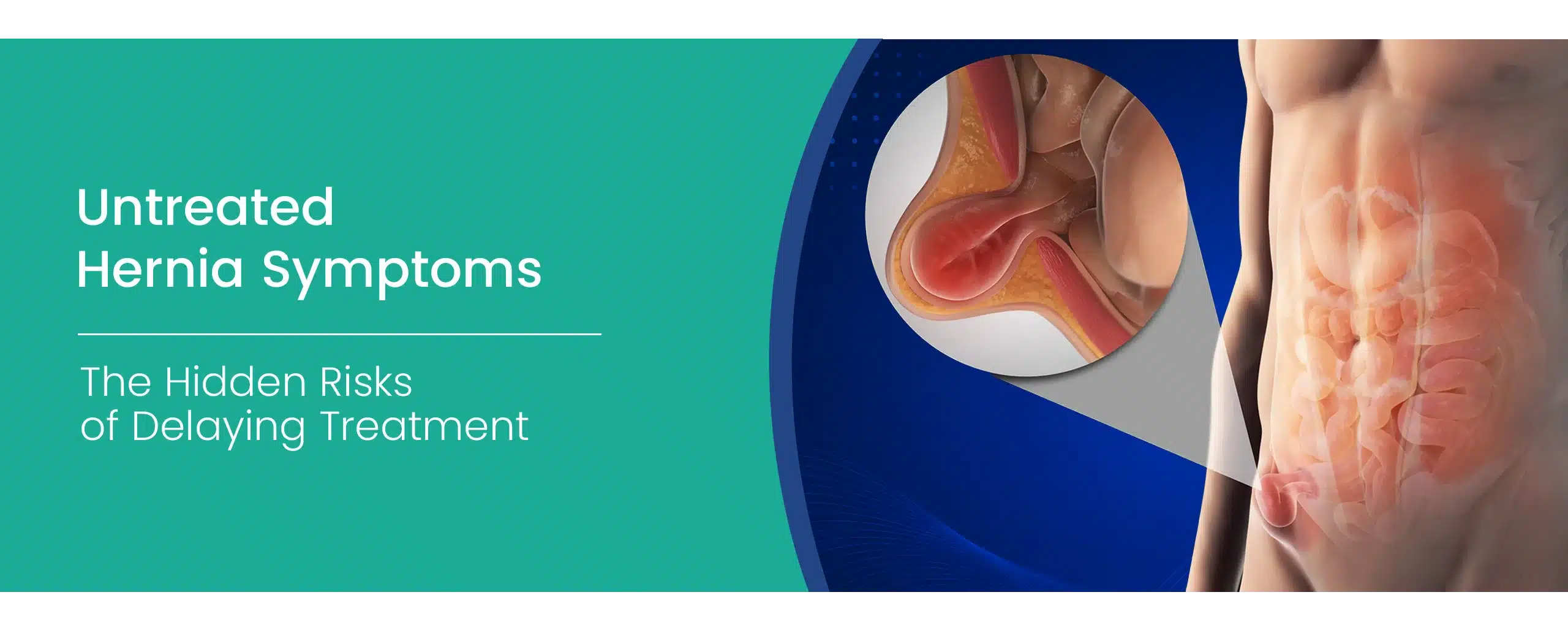
Untreated hernia symptoms don’t disappear on their own. They quietly progress. And the longer you wait, the fewer options you have.
What is a hernia and why it doesn’t heal itself
A hernia happens when an internal organ or tissue pushes through a weak spot in the surrounding muscle or connective tissue wall. It’s like a hole in a tire. The hole won’t seal on its own. It only gets bigger with pressure.
Common types include:
- Inguinal hernia (groin): most common, especially in men.
- Umbilical hernia (belly button): common in infants and overweight adults.
- Hiatal hernia (upper stomach/diaphragm): affects digestion and breathing.
- Incisional hernia: appears at a previous surgical scar.
- Femoral hernia (upper thigh): more common in women.
In every case, the biology is the same. There is a structural defect. Without surgery, it cannot repair itself. This is why untreated hernia conditions always carry risk and why understanding untreated hernia symptoms is so important.
Early warning signs: What untreated hernia symptoms look like
Most patients first notice mild, easy-to-ignore signs. This is the stage where treatment is safest and recovery is fastest.
Early untreated hernia symptoms typically include the following:
- A visible bulge or lump near the abdomen, groin, or navel
- Mild aching or pressure, especially when standing, bending, or coughing
- Discomfort that worsens by end of day and eases when lying down
- A dragging sensation in the affected area
- Occasional nausea, particularly after heavy meals (in hiatal hernias)
These untreated hernia symptoms are manageable at this stage. Many people mistake them for muscle strain or gas. But this is precisely when a hernia diagnosis should happen.
What happens when you ignore untreated hernia symptoms
This is where things become serious.
When untreated hernia conditions are left without medical attention, the defect in the muscle wall grows. More tissue pushes through. The risk of complications rises sharply.
Stage-by-Stage Progression of Untreated Hernia
| Stage | What’s Happening | Symptoms | Risk Level |
| Stage 1: Early | Small defect, reducible hernia | Mild bulge, dull ache | Low |
| Stage 2: Expanding | The defect widens, and the hernia grows | Increased pain, bigger lump | Moderate |
| Stage 3: Incarceration | Tissue trapped, can’t push back | Severe pain, hard lump, nausea | High |
| Stage 4: Strangulation | Blood supply cut off, tissue dying | Extreme pain, vomiting, fever | Critical / Emergency |
Once a hernia reaches Stage 3 or 4, you are no longer looking at a routine procedure. You are looking at emergency surgery, with higher risks, longer recovery, and sometimes permanent complications.
The real dangers of ignoring a hernia
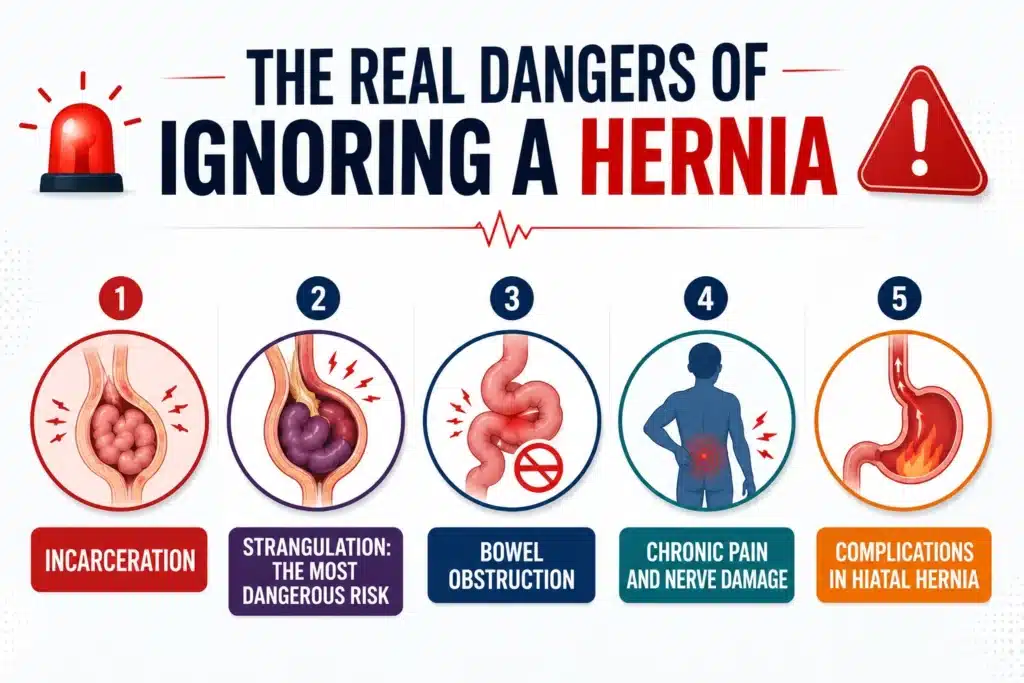
Let’s go beyond symptoms and talk about what risks of untreated hernia actually mean for your body.
1. Incarceration
This is when the herniated tissue gets stuck outside the abdominal wall and cannot be pushed back in.
- The bulge becomes hard and painful.
- No amount of position change relieves the discomfort.
- Vomiting and nausea often accompany it.
- Untreated hernia symptoms at this stage feel urgent and relentless.
An incarcerated hernia is a medical emergency. It cannot wait until morning.
2. Strangulation: The most dangerous risk
Strangulation happens when the blood supply to the trapped tissue is completely cut off.
- Tissue begins to die within hours.
- Severe, constant, worsening pain.
- High fever and rapid heartbeat.
- Vomiting, inability to pass gas or stool.
- The area may turn red or purple.
A strangulated hernia can cause gangrene, sepsis, and death if not treated within hours. This is the most extreme danger of ignoring a hernia.
3. Bowel obstruction
When a portion of the intestine gets trapped in the hernia, it can block the passage of stool and gas entirely.
- Severe bloating and abdominal cramping.
- No bowel movements despite the urge.
- Nausea and repeated vomiting.
- Risk of bowel rupture if untreated.
This is one of the most serious risks of untreated hernia that patients rarely anticipate.
4. Chronic pain and nerve damage
Even without acute emergencies, long-term untreated hernia causes persistent nerve compression.
- Shooting or burning pain in the groin, thigh, or abdomen.
- Numbness or tingling in surrounding areas.
- Chronic discomfort that limits daily activities.
- Difficulty walking, standing, or exercising.
This kind of nerve damage can sometimes become permanent.
5. Complications in hiatal hernia
Untreated hernia symptoms in hiatal hernias are often confused with acid reflux or GERD.
- Chronic heartburn and regurgitation.
- Difficulty swallowing solid foods.
- Shortness of breath after meals.
- Barrett’s esophagus (a pre-cancerous condition) in long-term cases.
- Increased risk of aspiration pneumonia.
Many patients take antacids for years without realizing they actually have an untreated hernia pressing against their stomach.
Why patients delay hernia diagnosis (and why that’s risky)
Understanding patient behavior is as important as understanding the disease. Here’s why hernia diagnosis gets delayed and what the cost of that delay really is.
Common reasons for delayed hernia diagnosis
| Reason | Reality Check |
| “The pain is bearable.” | Pain tolerance doesn’t reduce internal tissue damage |
| “I’ll wait and see if it goes away.” | Hernias never resolve on their own |
| “I’m scared of surgery.” | Elective hernia repair is far safer than emergency repair |
| “I’m too busy right now.” | A strangulation emergency will cost more time, money, and risk |
| “It’s just a muscle pull.” | Many inguinal hernias are misdiagnosed this way for months |
| “It doesn’t look that bad.” | The internal damage often exceeds what’s visible externally |
The uncomfortable truth: Elective hernia surgery when symptoms are mild is a low-risk, outpatient procedure. Emergency surgery for strangulation carries significantly higher complication rates.
How hernia diagnosis works
A proper hernia diagnosis doesn’t require extensive tests in most cases. But it does require a trained eye and the right tools.
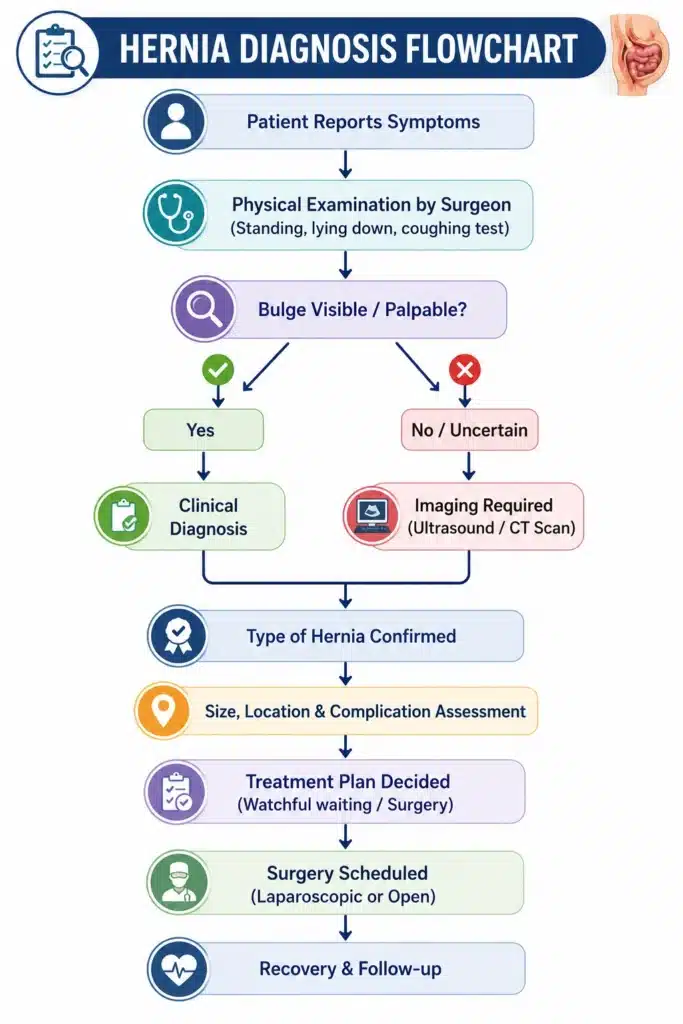
Diagnosis commonly done:
Early hernia diagnosis at the right facility makes a significant difference in treatment outcomes.
- Physical examination: The most reliable first step.
- Ultrasound: Ideal for groin and abdominal hernias.
- CT scan: Used for complex, recurrent, or internal hernias.
- Endoscopy: Used specifically for hiatal hernia evaluation.
When is surgery necessary?
Not every hernia requires immediate surgery. But most hernias eventually do.
Surgery is recommended when:
- The hernia is growing or becoming more symptomatic.
- It is irreducible (cannot be pushed back).
- The patient is young and active.
- There is risk of future incarceration based on hernia type.
- Symptoms are affecting quality of life.
Surgery is urgent when:
- The hernia cannot be reduced manually.
- The patient has severe pain, fever, or vomiting.
- Signs of strangulation are present.
- Bowel obstruction is suspected.
The best hernia surgeon in Noida will evaluate your specific case and recommend the right approach, whether laparoscopic (minimally invasive) or open surgery.
Laparoscopic vs open hernia surgery: A quick comparison
Most patients with untreated hernia symptoms who come in early are candidates for laparoscopic repair, faster recovery, less pain, and smaller scars.
| Factor | Laparoscopic Surgery | Open Surgery |
| Incision | 2–3 small cuts | One larger cut |
| Hospital Stay | 1 day (day care possible) | 2–3 days |
| Recovery Time | 1–2 weeks | 3–4 weeks |
| Pain Level | Low | Moderate |
| Return to Work | Faster | Takes longer |
| Best For | Most hernias, bilateral repair | Complex/recurrent hernias |
Frequently Asked Questions (FAQs)
Q1. Can a hernia go away on its own without surgery?
No. Hernias are structural defects in the muscle wall. Once that defect forms, no medication, diet, or exercise can close it. Untreated hernia conditions always carry long-term risk. Surgery is the only permanent solution.
Q2. I have a hernia but no pain. Do I still need treatment?
A painless hernia is still a hernia. Pain is not the only indicator of severity. Some hernias that feel mild externally can still undergo strangulation suddenly. A proper hernia diagnosis will tell you whether watchful waiting is safe for your specific case.
Q3. I’m nervous about surgery. Is hernia surgery safe?
Elective hernia surgery is one of the most commonly performed general surgeries in India. With laparoscopic techniques, most patients go home the same day or the next morning. The risks of untreated hernia, including strangulation and emergency surgery, are far greater than the risks of a planned, elective repair.
Q4. What happens if a hernia becomes strangulated?
A strangulated hernia cuts off blood supply to the trapped tissue. The tissue begins to die within hours. This is a life-threatening emergency requiring immediate surgery. Dangers of ignoring a hernia are most severe at this stage. Do not delay if you experience sudden, severe pain, fever, and a hard lump that won’t reduce.
Q5. How do I know if my bulge is a hernia or something else?
Only a doctor can confirm this. A physical examination combined with an ultrasound can usually identify a hernia quickly. If you notice a new or growing bulge in your groin, abdomen, or navel, get a hernia diagnosis done as soon as possible.
Q6. Can I exercise with an untreated hernia?
Light activity may be okay for small, reducible hernias, but intense exercise, heavy lifting, and straining can worsen untreated hernia symptoms and increase the risk of incarceration. Your surgeon’s advice matters here. Don’t push through pain.
Q7. Where can I get hernia treatment in Noida?
Rama Hospital in Noida is a trusted center for comprehensive hernia care. From hernia diagnosis to advanced laparoscopic repair, the team provides end-to-end surgical support. Consult the best hernia surgeon in Noida before your condition progresses.
Q8. Is hernia more common in men or women?
Inguinal hernias (groin hernias) are far more common in men. However, femoral hernias are more common in women. Hiatal and umbilical hernias affect both genders. Regardless of gender, untreated hernia symptoms need prompt attention.
Conclusion
A hernia won’t fix itself. Waiting makes it worse.
The difference between a simple, planned surgery and a life-threatening emergency often comes down to how quickly you respond to untreated hernia symptoms. The earlier you act, the safer your treatment, and the faster your recovery.
If you or someone in your family has been living with a bulge, recurring pain, or digestive discomfort that hasn’t been properly evaluated, today is the right time to get a hernia diagnosis.
Don’t wait for a crisis to make the call.
Reach out to Rama Hospital, the best hospital in Noida for hernia care, and consult a qualified hernia specialist who can give you a clear, honest picture of your condition and your options.
Book your consultation at Rama Hospital, Noida. Expert hernia surgeons. Advanced laparoscopic facilities. Compassionate care from diagnosis to recovery.